
Fang–Howard wave function modelling of electron mobility in AlInGaN/AlN/InGaN/GaN double heterostructures?
2021-09-28 02:18:20YaoLi李姚andHongBinPu蒲紅斌
Chinese Physics B 2021年9期
Yao Li(李姚)and Hong-Bin Pu(蒲紅斌)
1Department of Electronic Engineering,Xi’an University of Technology,Xi’an 710048,China
2Key Laboratory of Wide Bandgap Semiconductor Materials,Ministry of Education,Xi’an 710071,China
3Xi’an Key Laboratory of Power Electronic Devices and High Efficiency Power Conversion,Xi’an 710048,China
Keywords:scattering mechanism,double heterostructures,electron mobility,InGaN channel
1.Introduction
InGaN material has proved its potential for the realization of blue-green light-emitting diodes and laser diodes.[1]Owing to the large carrier sheet density attainable and relatively high saturation velocity,the heterojunction field effect transistors(HFETs)using InGaN alloys as channels layer promise in high-frequency and large-power fields.Furthermore,the relatively small bandgap of InGaN materials conduces to enlarging the discontinuity of conduction band and leads to better carrier confinement in the quantum well.However,the growth of InGaN layer is still a challenge due to the solid phase immiscibility of InN and GaN and the interdiffusion of In and Ga in InGaN/GaN system.[2]The randomly distributed In and Ga atoms at the periodic lattice sites also cause ADO scattering,which is proved to be one of the main issues limiting the carrier mobility of InGaN channel heterostructures.[3,4]Therefore,further optimizations of the heterostructure and process are necessary to fully realize the potential of InGaN channel HFETs.

2.Results and discussion

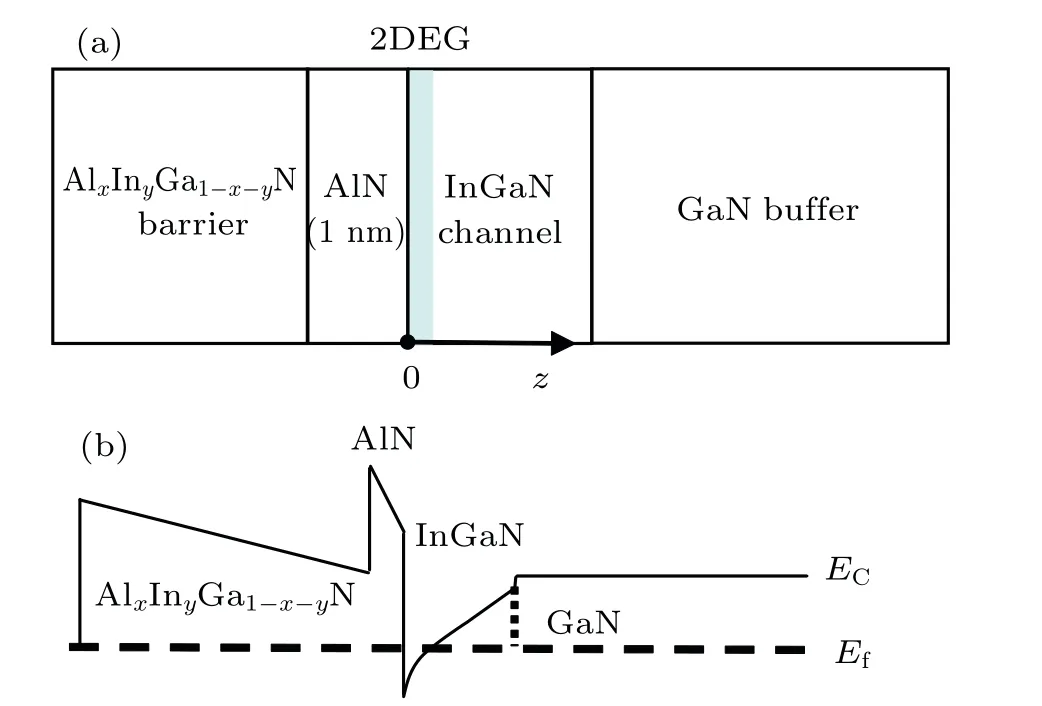
Fig.1.Schematic diagram of calculated AlInGaN/AlN/InGaN/GaN DH,showing(a)epitaxy structure and(b)conduction band profile.

Fig.2.Electronic transport properties in AlInGaN/AlN/In0.04GaN/GaN DH at room temperature,with red balls denoting LM DH.
We first compare the electronic transport properties in AlInGaN/AlN/In0.04GaN with and without GaN back barrier layer,whose variations with barrier alloy composition are displayed in Figs.2 and 3.Thereinto,the lattice-matched(LM)heterostructures are indicated in red balls with indium mole fraction y relating to aluminum mole fraction x in AlInGaN barrier as y=0.224x+0.04.As shown,both electron mobility and 2DEG density surface in AlInGaN/AlN/In0.04GaN/GaN DH and AlInGaN/AlN/In0.04GaN SH are similar,the former presents parabolic curves along the directions of increasing aluminum content and indium content,while 2DEG density is apparently proportional to aluminum composition and inversely proportional to indium composition of AlIn-GaN barrier.The scope of barrier alloy composition in AlInGaN/AlN/In0.04GaN/GaN DH is narrowed due to the superimposed electric field caused by the polarization charges at the bottom InGaN/GaN interface.[12]For clarity,we extract the theoretical data for LM heterojunction from Figs.2 and 3,and contrast the effects of detailed scattering mechanisms in Fig.4.As indicated in Fig.4,the 2DEG density increases with increasing aluminum mole fraction in AlInGaN barrier due to the enlarged conduction band offset and polarization charges at AlInGaN/AlN/In0.04GaN heterointerface,whose value is lower in InGaN channel-based DH than that in SH caused by the effect of GaN back barrier.For the InGaN channel-based SH in Fig.4(a),the effects of ADO scattering and PO scattering are almost equally important in the whole range of alloy composition,while the effect of DIS scattering fades away due to the strengthened screening effect by relatively large two-dimensional electron gas density.For InGaN channel-based DH in Fig.4(b),the mobility curve is mainly determined by DIS scattering for lower two-dimensional electron gas density and ADO scattering for relatively high electron density.

Fig.3.Electronic transport properties in AlInGaN/AlN/In0.04GaN SH at room temperature,with red balls denoting LM SH.
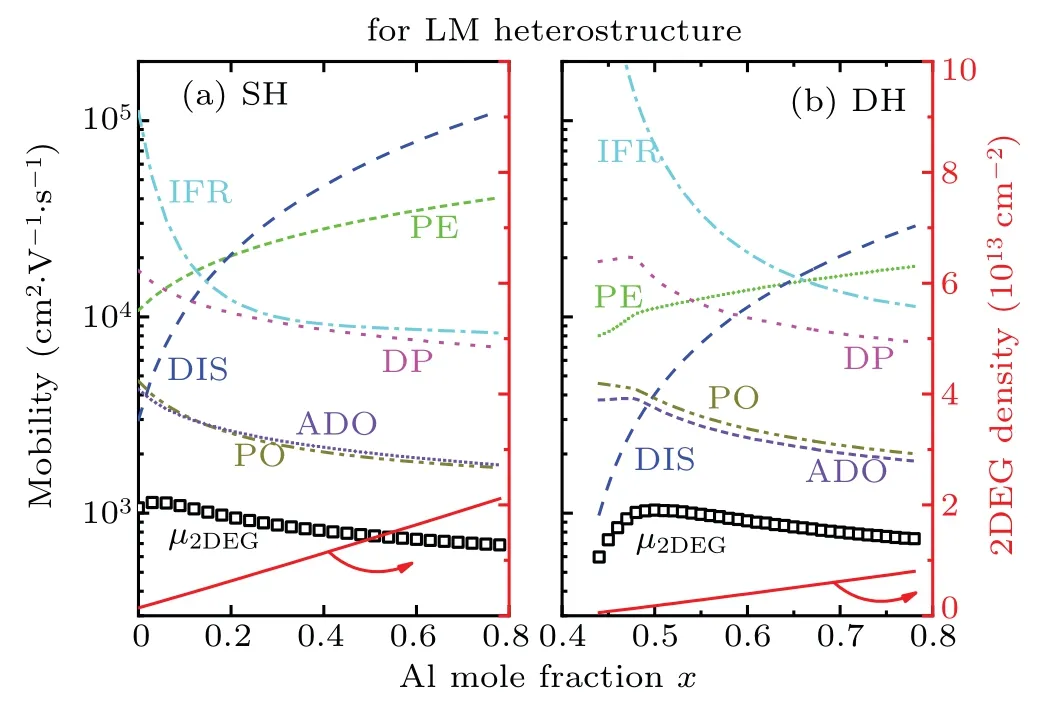
Fig.4.The mobility limited by various scattering mechanisms in LM AlInGaN/AlN/In0.04GaN SH and AlInGaN/AlN/In0.04GaN/GaN DH at room temperature.
Then the electronic transport property in AlIn-GaN/AlN/InGaN/GaN DH is analyzed as a function of indium mole fraction in InGaN channel layer.Since the technologically important AlInGaN barrier layers are either indium-doped AlGaN or gallium-doped AlInN,the comparisons in 2DEG mobility and density among InGaN channel heterostructures with Al0.4In0.07Ga0.53N,Al0.4Ga0.6N,Al0.83In0.13Ga0.04N,and Al0.83In0.17N barriers are conducted.The results are shown in Fig.5.As shown in the figure,with the increase of indium mole fraction in InGaN channel,the mobility in AlInGaN/AlN/InGaN/GaN DH with Al0.4In0.07Ga0.53N barrier first increases for indium content less than 0.04 and then gradually decreases,while the curves for DH with other barriers decline uniformly.The detailed mechanisms are discussed below.In contrast with the mobility value in InGaN channel-based DH with Al0.4Ga0.6N barrier,replacing few gallium by indium in barrier layer reduces the mobility for InGaN channel with relatively small indium content(less than 0.35),but increases the mobility hereafter.While for AlInN-like barrier layer,the substitution of indium for gallium brings a minor effect on electron mobility.As shown in Fig.5(b),2DEG density increases after indium has been substituted for gallium with aluminum mole fraction fixed in Al(In)GaN barriers,which is due to the enhancing polarization strength at Al(In)GaN/InGaN heterointerface.
To illustrate the effects of different barrier layers,the variations of mobility limitedby various scattering mechanisms in AlInGaN/AlN/InGaN/GaN DH are computed and the results are shown in Fig.6.Here,Al0.4In0.07Ga0.53N and Al0.83In0.13Ga0.04N barriers are taken for example.As shown in Fig.6(a),when indium content in InGaN channel is small,the 2DEG mobility in Al0.4In0.07Ga0.53N/AlN/InGaN/GaN DH is determined mainly by DIS scattering.With indium composition increasing further,ADO scattering becomes strong and dominates the 2DEG mobility.Therefore,the calculated 2DEG mobility first increases to a maximum value at indium mole fraction of 0.04 in InGaN channel and then descends with indium content increasing.Since the increased 2DEG density in InGaN channel-based DH with Al0.4Ga0.6N depresses DIS scattering and highlights the effect of ADO scattering,the final 2DEG mobility decreases directly and turns lower than that for the case with Al0.4In0.07Ga0.53N barrier.For DH with Al0.83In0.13Ga0.04N barrier,as displayed in Fig.6(b),the 2DEG mobility is mainly determined by POP and ADO scatterings and decreases monotonically with the increase of indium composition in InGaN channel.For this case,electron mobility is immune to the substitution of little gallium for indium in barrier.
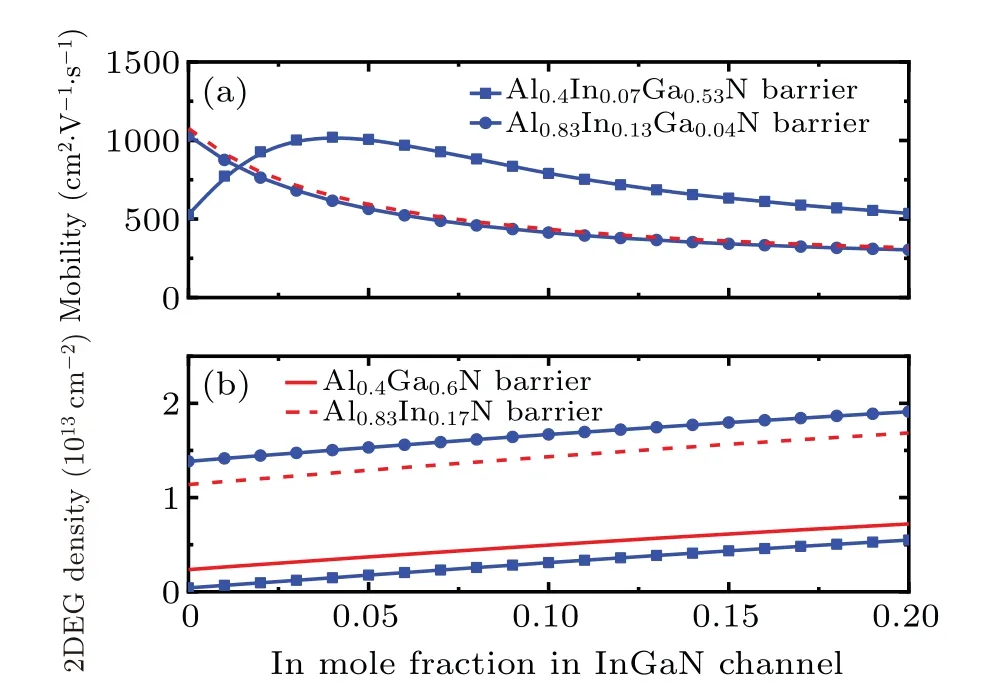
Fig.5.Plots of electron mobility in Al(In)GaN/AlN/InGaN/GaN DH versus indium mole fraction in InGaN channel layer at room temperature.

Fig.6.Plots of electron mobility and 2DEG density versus indium mole fraction limited by various scattering mechanisms in InGaN channel layer at room temperature for(a)Al0.4In0.07Ga0.53N/AlN/InGaN/GaN DH and(b)Al0.83In0.13Ga0.04N/AlN/InGaN/GaN DH.
Finally,we investigate the temperature dependence of electron mobility in AlInGaN/AlN/In0.04Ga0.96N/GaN DHs with Al0.4In0.07Ga0.53N and Al0.83In0.13Ga0.04N barriers in Fig.7,where 2DEG density is combined with the temperaturedependent band gaps.Although 2DEG density value is higher in In0.04Ga0.96N channel-based DH with Al0.83In0.13Ga0.04N barrier than the case with Al0.4In0.07Ga0.53N barrier(on the order of 1013cm?2versus 1012cm?2),the increment of electron density in a temperature range from 10 K to 1000 K is relatively small in Al0.83In0.13Ga0.04N/AlN/In0.04Ga0.96N/GaN DHs(9.6%),in contrast to the case with Al0.4In0.07Ga0.53N barrier(120.3%).Therefore,the temperature-independent scattering mechanisms,DIS,IFR,and ADO scatterings are changed by the noticeable variation of 2DEG density with temperature for the case with Al0.4In0.07Ga0.53N barrier but remain almost unchanged for the case with Al0.83In0.13Ga0.04N barrier.With the increase of temperature,the effects of several scattering processes related to lattice vibration,including PE scattering,DP scattering,and POP scattering are remarkably strengthened.Theoretically,mobility limited by DP or PE scattering is proportional to the reciprocal of temperature(μDP,μPE∝T?1),while the influence of POP scattering increases exponentially as temperature rises(μPO∝exp(ˉhωLO/kBT),whereˉhωLOis the POP energy of InGaN channel,kBis the Boltzmann constant),making POP scattering the main limiting scattering mechanism at temperature over 300 K in both cases.As shown in Fig.7(a),2DEG mobility is limited mainly by the DIS scattering for temperature below 320 K and then POP scattering for higher temperature in Al0.4In0.07Ga0.53N/AlN/In0.04Ga0.96N/GaN DH,while for the case with Al0.83In0.13Ga0.04N barrier as shown in Fig.7(b),the dominating scattering mechanism is ADO scattering for temperature below 310 K and POP scattering hereafter.Since the intensity of ADO scattering and POP scattering are both directly proportional to 2DEG density as shown in Fig.4,higher density in InGaN channel-based DH with Al0.83In0.13Ga0.04N barrier results in lower mobility.As a result,the reduction of 2DEG mobility in a temperature range from 10 K to 1000 K is relatively small for the case with Al0.4In0.07Ga0.53N barrier(88.5%)compared to that for the case with Al0.83In0.13Ga0.04N barrier(92.2%).

Fig.7.The temperature-dependent electron mobility and the 2DEG density in(a)Al0.4In0.07Ga0.53N/AlN/In0.04Ga0.96N/GaN DH,and(b)Al0.83In0.13Ga0.04N/AlN/In0.04Ga0.96N/GaN DH.
3.Conclusions
In this paper,the electronic transport properties in AlIn-GaN/AlN/InGaN/GaN DH are analyzed based on a modified FH wave function and the effects of alloy composition from both barrier and channel layers are considered.The mobility in InGaN channel-based SH and InGaN channel-based DH behave as parabolic curves along the directions of increasing aluminum content and indium content of AlInGaN barrier,while their corresponding 2DEG densities are apparently proportional to aluminum composition and inversely proportional to indium composition.For InGaN channel-based heterostructures with Al0.4Ga0.6N-like barrier layer,replacing few gallium with indium in barrier layer will reduce the mobility for InGaN channel with relatively small indium content(less than 0.35),but increases the mobility hereafter.While for the case with Al0.83In0.17N-like barrier layer,the substitution of indium for gallium brings minor effect on electron mobility.To achieve higher mobility,the optimal indium mole fraction in InGaN channel is 0.04 for the case with Al0.4In0.07Ga0.53N barrier,while for the Al0.83In0.13Ga0.04N barrier layer,the incorporation of indium depresses the mobility.Comparing with the case with Al0.83In0.13Ga0.04N barrier,the high temperature tolerance of mobility is slightly improved for In0.04Ga0.96N channel-based DH with Al0.4In0.07Ga0.53N barrier layer.
- Chinese Physics B的其它文章
- Origin of anomalous enhancement of the absorption coefficient in a PN junction?
- Protection of isolated and active regions in AlGaN/GaN HEMTs using selective laser annealing?
- First-principles study of plasmons in doped graphene nanostructures?
- Probing thermal properties of vanadium dioxide thin films by time-domain thermoreflectance without metal film?
- An improved model of damage depth of shock-melted metal in microspall under triangular wave loading?
- Signal-to-noise ratio of Raman signal measured by multichannel detectors?