
Recent results of fusion triple product on EAST tokamak
2021-09-10 09:26:06XiangGAO高翔TaoZHANG張濤MuquanWU吳木泉GuoqiangLI李國強LongZENG曾龍andtheEASTTeam
Plasma Science and Technology 2021年9期
Xiang GAO (高翔),Tao ZHANG (張濤),Muquan WU (吳木泉),Guoqiang LI (李國強),Long ZENG (曾龍) and the EAST Team
1 Institute of Plasma Physics,Chinese Academy of Sciences,Hefei 230031,People’s Republic of China
2 Advanced Energy Research Center,Shenzhen University,Shenzhen 518060,People’s Republic of China
Abstract High fusion triple product has been obtained in the advanced scenarios with high normalized beta(βN)on the Experimental Advanced Superconducting Tokamak(EAST).A record value of ni0Ti0τE~1.0×10¹⁹ m?3 keV s for EAST deuterium plasma has been achieved,which is due to the formation of strong and broad internal transport barriers (ITBs) in ne, Te and Ti profiles.Analysis shows that the strong ITB formation could be attributed to the reduction of transport from ITG modes.Based on the analysis,the physical mechanisms and methods to further improve the plasma performance are discussed.
Keywords: fusion triple product,advanced scenario,internal transport barriers
1.Introduction
The achievement of long pulse operation with high performance plasma is one of the major challenges for present day tokamaks and future fusion devices,like ITER [1] and CFETR[2].The ITER baseline scenario[3],i.e.the standard H-mode operation,does not allow complete non-inductively driven plasma current.In order to maximize the bootstrap current and lengthen the plasma operation time,advanced scenarios with improved confinement and stability have been developed in present devices and are hopefully applied in future devices.Two main types of advanced scenarios,i.e.the hybrid and steady-state scenario,are being developed in present tokamak devices [4,5].
The Experimental Advanced Superconducting Tokamak(EAST)[6–8]is an ITER-like fully superconducting tokamak facility and the major radiusR=1.85 m,minor radiusa=0.45 m,plasma currentIp≤1 MA and toroidal fieldBT≤3.5 T.EAST started operation in 2006[6]and achieved the first H-mode plasma in 2010 by using a lower hybrid wave(LHW)after lithium-wall coating[9].After that,one of the major missions of EAST is to demonstrate the long pulse steady-state H-mode operation [10] with RF heating (mainly LHW and ECRH).By means of a simultaneous integration of engineering technology and physics issues,such as external current drive,heat flux to the first wall and divertor,and active plasma control,an H-mode plasma with pulse length
>100 s and good confinement (H98y2~1.1) has been recently achieved [11].A typical characteristic of these long pulse H-mode plasmas on EAST is that the electron temperature is much larger than the ion temperature,i.e.Te?Ti,since the auxiliary power mainly heated the electrons[12].In these plasmas,the electrons and ions are decoupled and thus they are very suitable for the study of electron heat transport.However,a key concept in the pursuit of fusion energy is the so-called fusion triple product,i.e.niTiτE,which is related to the temperature of main ions.The ignition condition requires that it exceeds a specific value.Therefore,one of the major tasks of fusion experiment is to increase the fusion triple product up to the ignition condition.On EAST,another mission,except the long pulse H-mode mentioned above,is to explore the regimes with high density,highTiand goodconfinement,corresponding to high fusion triple product.Up to now,the highest value of fusion triple product (expressed byni0Ti0τE)for deuterium plasma achieved on EAST is about 1.0×10¹⁹m?3keV s,which is realized in plasmas for the exploration of advanced scenarios.In this paper,we mainly review the efforts in exploring the regimes with high fusion triple product on EAST and lastly give an outlook for the future study.

Table 1.The parameters ne0, Ti0 and τE for the shots in figure 1.
2.Efforts in exploration of high fusion triple product on EAST
After the first H-mode plasma in 2010,the value of fusion triple productni0Ti0τEin deuterium plasma on EAST has been gradually increased in the past ten years,as shown in figure 1.In the calculation,an approximationni0=ne0is assumed since only the electron density is measured in the experiment.The parametersne0,Ti0and τEfor the shots in figure 1 are presented in table 1.In the early years,EAST is only equipped with <2 MW 2.45 GHz LHW and a 32 s H-mode(#41195)is realized in a plasma with relatively low plasma current and density (Ip=280 kA,BT=1.9 T,q95=6.8,〈ne〉=2.2×10¹⁹m?3)[10].This kind of plasma has a very low value ofni0Ti0τE~1.0×10¹⁸m?3keV s,as shown in figure 1.In order to increase the plasma heating power,particularly the ion heating,the first NBI(NBI-1)was installed and became operational in 2014 [13].With the NBI power heating,the value ofni0Ti0τEis increased (#48068 as an example shown in figure 1).Later,the second NBI(NBI-2)is also installed.In EAST normal operation,the plasma current is anti-clockwise and the NBI-1 is co-current injection while the NBI-2 is counter-current injection.Each injector is composed of two ion sources.In experiment,the injection time of the four ion sources can be set flexibly so that a stepwise increase of beam power can be realized.In the campaign of 2015,we began to explore the plasmas with higher βN[17] which are usually operated with lower toroidal magnetic fieldBT~1.6 T (Ip=400–500 kA andq95=4–5).In these discharges,high confinement plasmas associated with internal transport barriers in both density and temperature are observed when full NBI powers were injected[14].One typical plasma is#56933,which achieves βN~2,H98y2~1.1 andni0Ti0τE~1.0×10¹⁹m?3keV s,the largest value of triple product for EAST up to now (as shown in figure 1).More details on this plasma will be presented later.By analyzing these plasmas,it is found that the centralqprofile could be important for the realization of internal transport barriers (ITBs).In the following experiments,H-mode plasmas with different centralqprofiles are produced[16],including monotonicqprofile,central flatqprofile [15]and reverse shearedqprofile [18].However,the plasma performance cannot arrive at the state of #56933,as exampled by #71320 and #78723 in figure 1.Several reasons could be attributed to it.Firstly,the counter-NBI usually produces more fast ion losses which could bring metallic impurities into plasmas by interacting with the first wall.This makes it difficult for the plasma to be stably operated in full beam power.Secondly,the available heating power is presently critical for the formation of strong ITBs as #56933 while weak ITBs in density and temperature are usually observed in plasma with central flat q profiles[15,16].Lastly,the ITB formation in plasma with reverse shearedqprofile is usually terminated by MHD events [19].
As shown in figure 1,the highest value of fusion triple productni0Ti0τEfor deuterium plasma on EAST is realized in#56933,where strong ITBs in both density and temperature are formed [14].The plasma parameters for #56933 are shown in figure 2.The plasma is withIp=430 kA,BT=1.6 T andq95~4.2 and heated by 4.6 GHz LHW and NBI.The NBI power is applied at 2.4 s and then increases stepwise by presetting the injection time sequence of the four ion sources.The plasma entered H-mode at aboutt=2.45 s and the first edge localized mode (ELM) appeared 0.1 s later.The ITB starts at about 3.59 s.With the ITBs formation,both the plasma core density and stored energy increase gradually up to 3.75 s,after which the ITBs are gradually degraded.Figure 3 shows a comparison ofne,TeandTiprofiles before ITB and the fully developed ITBs.It is seen that strong and broad ITBs are formed inne,TeandTiprofiles with ITB foot at about ρ=0.5.For the fully developed ITBs,the central densityne0is about 8.5×10¹⁹m?3(ne0/nG~1.25 withnGthe Greenwald density limit),the central ion temperatureTi0~2.1 keV and energy confinement time τE~54 ms,corresponding to fusion triple productni0Ti0τE~1.0×10¹⁹m?3keV s.

Figure 1.Evolution of the fusion triple product,expressed by ni0Ti0τE,on EAST.It is noted that an approximation ni0=ne0 is assumed since only electron density is measured in experiment.
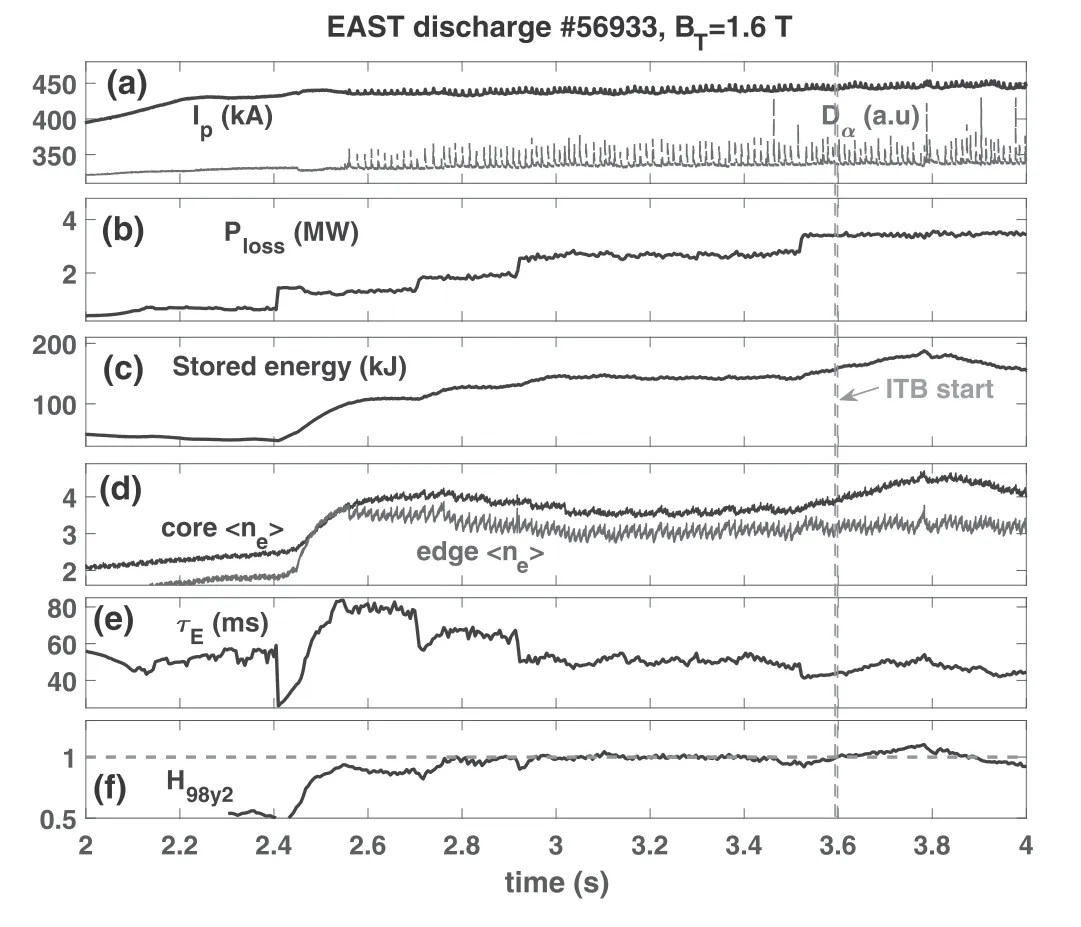
Figure 2.Typical discharge #56933 with strong ITB formation.(a) Plasma current (Ip) and Dα signal,(b) Ploss=Pabs+Pohm?dW/dt,(c)stored energy,(d)the core line averaged density and edge line averaged density,(e) confinement time τE,(f) confinement quality H98y2.
The two discharges #71320 and #78723 in figure 1 are two typical plasmas with weak ITB formations.These plasmas are usually accompanied by fishbone activities and flatqprofiles in the core.Figure 4 shows the plasma parameters for#71320,where 4.6 GHz LHW works as preheating,and NBI powers injected in the plasma at about 2.5 s and then increases stepwise.The plasma accesses the H-mode at about 2.55 s.The ITB formation is observed att=3.53 s.Figure 5 shows the profiles ofne,TeandTiatt=6.0 s.It is observed that weak ITBs are formed inne,TeandTiprofiles with ITB foot at about ρ=0.3.The central densityne0is about 5.5×10¹⁹m?3,central ion temperatureTi0~1.8 keV and energy confinement time τE~36 ms,corresponding to fusion triple productni0Ti0τE~0.36×10¹⁹m?3keV s.For#78723,the plasma parameters and profiles are shown in figures 6 and 7,respectively.It is observed that weak ITBs are formed inne,TeandTiprofiles with ITB foot at about ρ=0.3.The central densityne0is about 5.58×10¹⁹m?3,central ion temperatureTi0~1.94 keV and energy confinement time τE~45 ms,corresponding to fusion triple productni0Ti0τE~0.49×10¹⁹m?3keV s.
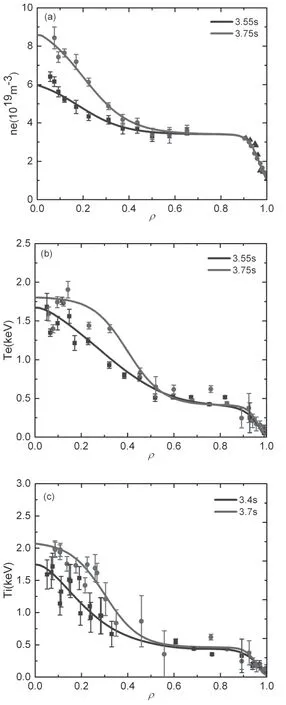
Figure 3.(a) ne profiles,(b) Te profiles and (c) Ti profiles of EAST discharge #56933.
3.Outlook for future study
In section 2,we have presented the efforts to increase the fusion triple product on EAST.With the installation of NBI heating power,the ion can be effectively heated and plasma performance is improved,leading to the increase of fusion triple product.By tailoring theqprofiles,this value can be further increased.In a 2015 experiment,strong and broad ITBs are formed inne,TeandTi,such as#56933,resulting in a record value ofni0Ti0τE~1.0×10¹⁹m?3keV s on EAST.Due to the three reasons as discussed in section 2,this value has not yet been exceeded in later experiments.In order to guide the future experiment to increase the triple product,a further analysis on #56933 has been done.Figure 8 shows thekspectra of the linear growth rate and frequency of the most unstable modes at the core gradient region (ρ=0.36)before (t=3.55 s) and after the ITB formation (t=3.75 s)for #56933.These spectra are calculated by TGLF [20–22],which uses the fluid moments of the gyro-kinetic equation to compute a spectrum of linearly unstable eigenmodes.The normalized growth rate,frequency,and poloidal wave number are γ′=γ(a/cs),ω′=ω(a/cs),ky=kθρs.The length scaleais the circular equivalent minor radius of the last closed flux surface.In figure 8(b),the positive (negative)value of real frequency(ω′)represents that the mode rotates in electron (ion) diamagnetic direction.It is observed that the dominant unstable modes for both cases are with normalized poloidal wave numberky<1,rotating in ion diamagnetic direction,which should be the ion temperature gradient(ITG)mode.This is very different from the plasma heated by LHW and ECRH,where the core instability is dominated by the trapped electron mode [23].

Figure 4.Discharge #71320.(a) Plasma current (Ip) and Dα signal,(b) Ploss=Pabs+Pohm?dW/dt,(c) stored energy,(d) the core line averaged density and edge line averaged density,(e) confinement time τE,(f) core XUV spectrogram.

Figure 5.(a) ne profile,(b) Te profile and (c) Ti profile of EAST discharge #71320.
For the present case (#56933),the NBI power distributions to electron and ions are nearly equal,leading toTe~Tiwhile the plasma with LHW and ECRH is mainly electron heating,leading toTe?Ti.Figure 8(a) shows that the growth rate of the ITG mode is reduced after ITB formation.This implies that the ITB formation and confinement improvement are due to the reduction of transport from ITG mode.In order to further increase the triple product,it is important to further increase the ion temperature which requires more ion heating.In particular,previous studies have shown that ITG can be more stable and ion heat transport can be reduced with the increase of the ratio betweenTiandTe(Ti/Te) [24–26].A large number of experiments actually showed that the plasma performance is significantly improved in plasma withTi>Te,such as the ‘hot-ion’ mode in JET[27],‘super-shot’ in TFTR [28] and advanced scenarios in AUG[29].In addition,it is observed in experiments that high toroidal rotation is efficient to reduce the ITG heat transport at low magnetic shear [30,31].Therefore,it is expected that more ion heating power and higher rotation could further improve the plasma performance and increase the triple product.In order to support this study,the NBI-2 injected direction has been changed from counter-Ipto co-Ip(for usually anti-clockwiseIp).With this change,it is expected that the NBI heating will be more efficient and can drive higher toroidal rotation.On the other hand,one ICRF antenna has been modified and can produce wave with lower wave number,which is more efficient for plasma-wave coupling in EAST plasma [32].All these new equipments will be commissioned in a 2021 campaign and expected to provide more power on ion heating and to drive higher toroidal rotation in future experiments.

Figure 6.Discharge #78723.(a) Plasma current (Ip) and Dα signal,(b) Ploss=Pabs+Pohm?dW/dt,(c) stored energy,(d) the core line averaged density,(e) confinement time τE,and (f) core XUV spectrogram.
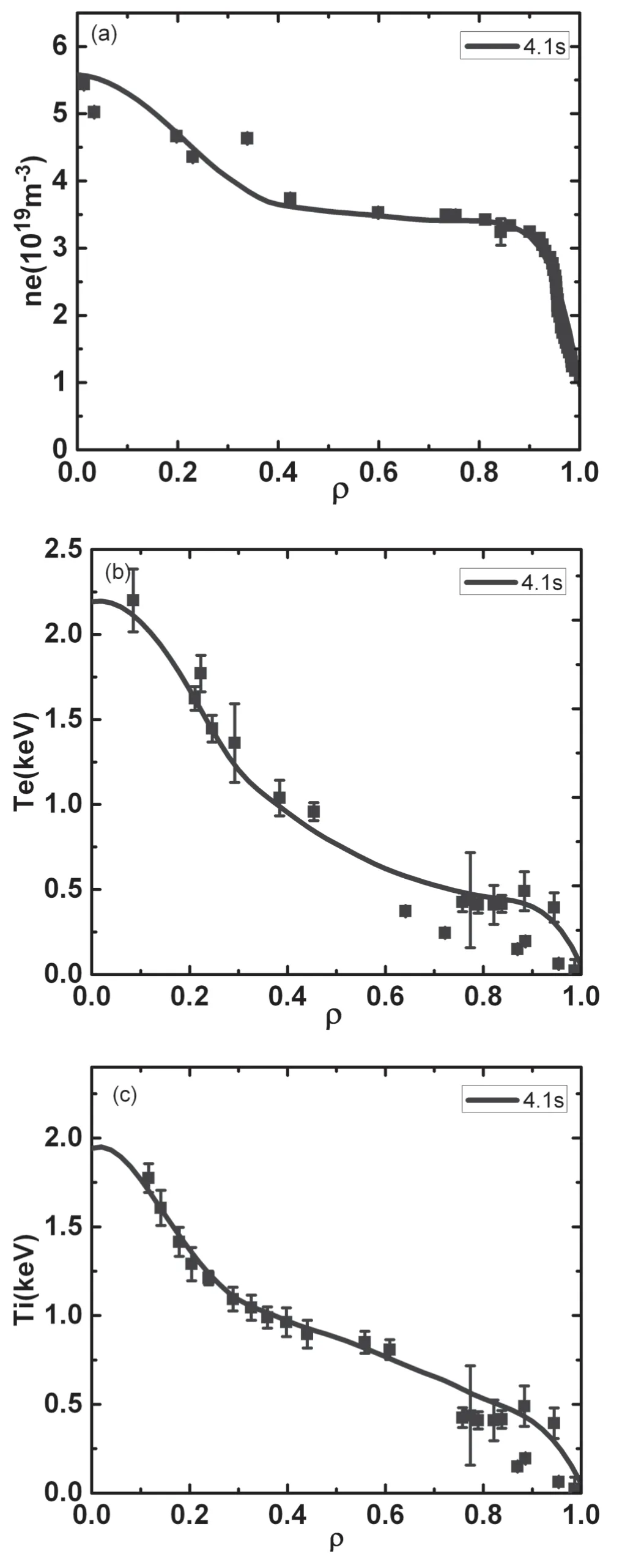
Figure 7.(a) ne profile,(b) Te profile and (c) Ti profile of EAST discharge #78723.

Figure 8.Comparison of the growth rate and frequency spectrum at ρ=0.36 before(t=3.55 s)and after ITB formation(t=3.75 s)for#56933.
Acknowledgments
The authors wish to acknowledge Professor G Y Fu for fruitful discussions.This work was supported by the National Key R&D Program of China (Nos.2017YFE0301205 and 2019YFE03040002),and National Natural Science Foundation of China (Nos.11875289,11975271,11805136 and 12075284).
 Plasma Science and Technology2021年9期
- Plasma Science and Technology的其它文章
- Conceptual design and heat transfer performance of a flat-tile water-cooled divertor target
- Study of selective hydrogenation of biodiesel in a DBD plasma reactor
- Temporal and spatial study of differently charged ions emitted by ns-laser-produced tungsten plasmas using time-of-flight mass spectroscopy
- Analysis of the microstructure and elemental occurrence state of residual ash-PM following DPF regeneration by injecting oxygen into non-thermal plasma
- The low temperature growth of stable p-type ZnO films in HiPIMS
- Improving the surface insulation of epoxy resin by plasma etching