
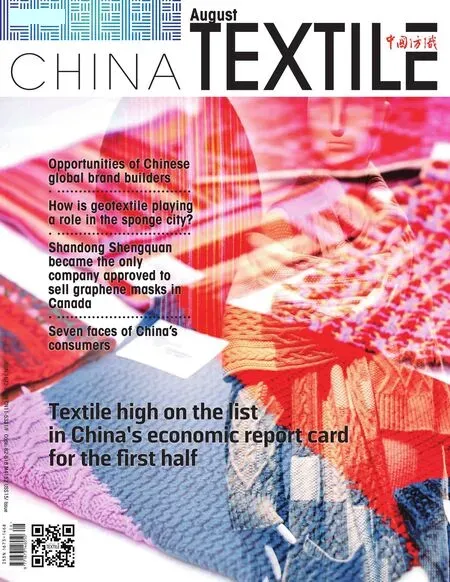
Seven faces of China’s consumers
2021-08-26 07:16:42
China Textile 2021年4期
As China enters a new stage of development, con—sumption means more than a balancing of demand. In—stead, it focuses on improving the quality of consumption and social welfare by building a digital economy, and sup—ports economic development based on sustainable growth,with domestic demand leading the shift from high—speed growth to high—quality development.
The rising of China’s middle class size and the persis—tence of high household savings rates, suggest that huge potential remains untapped. Reform of the social security system is accelerating and the birth policy has been re—laxed, while improving people's lives has been a policy pri—ority.
Expanding domestic demand and improving people's living standards are priorities of the 14th Five—Year Plan period, and fully releasing the potential of the consumer market is also an important part of the long—term goal of 2035. Favorable policies, demographics and geography are conducive to the rise of a new army of urban, silver and small—city consumers who will dominate China's consumer market.
In general, China’s retail sector is already the world’s second largest and looks set to surpass that of the U.S.soon. In 2010, most urban Chinese households had enough money to cover basic needs like food, clothes,and housing, with median disposable income per capita at around RMB21,000 per year. In 2020, the median ur—ban disposable income has more than doubled to around RMB44,000 per year, and a lot of well—todo households are now having ample funds for leisure like regularly eating out, beauty products, flat—screen TVs, and holiday travel.By 2024, the Development Research Center (DRC) of the State Council expects that the nation will have at least 560 million middle—income consumers. Now it is time to enjoy for Chinese people.
However, there is still significant potential in China’s consumers that has yet to be unlocked. As a share of GDP,China’s private consumption expenditure is uniquely low by international standards. It reflects a persistent trend in China’s household savings rate that has been well—studied by academic researches with social precaution (insufficient social security protection) and birth control policy often at—tributed as some of its main drivers.
As a result, the Ernst & Young China created the Fu—ture Consumer Index to try to understand and track the emerging behaviors and moods of consumers around the world. Using the index, the team found that Chinese con—sumers have much higher expectations for service, quality assurance and product customization than other countries,and are equally enthusiastic about digital upgrading in the consumer sector. Recently, Ernst & Young has divided Chi—nese consumers into seven categories, so that enterprises can take targeted measures and reshape themselves to meet the different needs of different consumers. In this issue, we have summarized seven types of Chinese con—sumers to readers.
The new urbanites
Defined as rural workers who move to urban areas in pursuit of non—farm job opportunities for more than six months a year, there are 285.6m migrant workers ac—counting for over 35% of China’s labor force in 2020. In the past, the ample supply of surplus rural worker finding casual employment in factories and construction sites kept China’s labor cost low. Due to the transient nature of migrant workers and their lack of residential registration(hukou), their access to public service such as low—rent housing and public education for their children was limited for a long time. Together with the uncertain prospect of work, this has led to strong propensity for them to save compared to local workers at similar income level.
The Central Committee for Economic Affairs an—nounced in August 2019 that major city clusters will be the focus of urbanization strategy, and rural residents may settle to benefit from the better social welfare and modern infrastructure.Their children, for example, can be part of the urban education system with access to modern vocational training, as they reunite with their families.That can structurally reduce their need for extra savings. Cai Fang, vice president of the Chinese Academy of Social Sciences, noted that if migrant workers were transformed into urban residents, their consumption could increase by as much as 27%.

In addition, with the 14FYP pledging to allow further marketization of rural land, migrants may also be able to cash in their land wealth as they relocate. It could be a substantial boost of their wealth that will further in—crease their propensity to consume as they resettle. All in, the new lifestyle in the city clusters will attract not only new supply of workers but also a leap in consuming power on a national level.
The silver generation
China is not only the country with the largest population on earth,it is also one of the countries with the fastest aging population. This is mainly due to decades of falling birth rates on the one hand and steeply rising life expectancy on the other hand. The number of citizens aged 60—65 and above 65 stood at 78m and 176m respectively at end—2019, ac—counting for 5.6% and 12.6% of the population respectively. Tackling the problem of aging population has become one of the key focuses in the 14 Five—Year Plan.
The senior market in China’s consumer sector re—mains underexploited. To some extent the silver genera—tion continues to be viewed as being more inclined to save than to spend on discretionary items, and more reliant on traditional word—of—mouth than modern technology. The fact, however, is quite the opposite. A comprehensive sur—vey found that senior consumers are not only willing and ready to spend, but they also have vast profiles of interest in service and product spending. In addition to spending on health care, they like eating out, going to karaoke, cinema,and spending on gyms and exercise. Many of them also feel that are marginalized by the market which primarily focuses on the younger generation.
Small city big spenders
Housing burdens and the cost of living have squeezed the disposable income of people living in big cities, while in smaller cities where housing prices are lower, they have stronger spending power as disposable income grows rapidly, and their rapidly rising disposable income in recent years also affords them considerable spending power.
As growth driver in the consumer sector moves away from the traditional supercities, successful businesses should expect customer expectations to become more heterogeneous. The marketplace will reflect the vast topo—graphical and cultural differences that go beyond the tra—ditional categorization of cities by size and population. As such, the strategies that brands have built up in first—tier cities over the past decades may be inadequate for driving performances. Businesses have to reinvent themselves and adopt a new marketing strategy in the face of unique consumer demands.
The health conscious
Even though Chinese consumers have been able to return to“normal life” quickly after the COVID—driven lockdown, the pandemic has already changed the way consumers think about what they buy and how they spend their time. The EY FCI found that health benefit and prod—uct quality, respectively, are expected to be top priority long after the outbreak has ended. In particular, 85% of respon—dents considered that in the longer term, they will be more aware and cautious about physical health, and 82% said they are willing to make healthier product choice.
The respondents are willing to take awareness into action, as 65% of responding consumers are willing to pay a premium for high—quality products that promote health and wellness compared to products that emphasize luxury(10%) or technology (10%) alone. As intangible factors, the authenticity of health and wellness will rely on established brands and products that are made domestically, by large corporations, and recognized through previous purchases.
The planet first
Rectified together with the 14FYP in the 2021 NPC,“Vision 2035” is a midterm economic strategy that paves the way for China to fully become a modernized socialist nation and a greater power in the world by 2050. High—lights of the strategy include China’s commitment on“fundamental improvement in ecological environment”and “reduction in carbon footprint”, following President Xi’s pledge for China to reach peak carbon emissions by 2030 before reaching carbon neutrality by 2060.
The planet first consumers prioritize their desire to make a difference by actively working for a higher pur—pose: greater individual, environmental and global well—being. Environmental impact will become an important parameter in the consumers’ decision to spend. With the objective of the policymakers and the market in align—ment, government regulations will be welcomed as ways to incentivize further actions. We expect consumers, investors, and cor—porate interest in environment preservation will shape China’s consump—tion habits together.

Experience everything
With more incentive to spend, China’s tech—savvy consumers will be hungry for more enjoyable and personalized experiences from their pre—ferred brands. In this world, consumers expect immersive shopping to be—come one of the most exciting and rewarding experiences in everyday life,while mundane buying transactions are taken care of by AI swiftly, silently and conveniently.
Insatiable demand for novelty and value drives companies to innovate relentlessly. Words such as “convenience”, “experience” and “retail” are redefined. “Good enough” products are no longer good enough to maintain consumer loyalty. They don’t just ditch brands that fail to give them what they want; they exercise their responsibility to give negative feedback.
The ascendant consumers
With the growth of the middle class and expansion of the consumer market, Chinese consumers have the kind of buying power they have never experienced before. Consumers will be kings — or queens — and newly crowned at that. In the world of the ascendant consumers, they are proud in expressing who they are, and happy to use their growing economic and social power to dictate terms to the brands.
We are in an era of rising consumers who are confident in themselves and their place in the global economy and whose needs and preferences must be recognized, understood and met. Therefore, companies must adapt to the rapidly changing needs of consumers and respect their values;brands also need to take their flexible response to a new level, adapting to consumers' immediate needs as well as subtle ones.
Conclusion
Data show, China has 855 million digital consumers, and 24.9 percent of retail transactions were completed online in 2020, making China the world's largest market for online goods sales.
China is a huge, high—growth consumer market, leading the world in terms of digital adoption rate. China is a huge incubator for new behaviors,new trends and new business models that are redefining retail. China's new retail era is just beginning. As we have seen, Chinese consumers’ in—novative behaviors and its explosive consumption growth will inspire global consumer market. Whether or not the 'China experience' can be replicated,no brand can afford to ignore the Chinese market.
- China Textile的其它文章
- Textile high on the list in China’s economic report card for the first half
- Dear readers:
- China’s cotton textile industry climate index report in June
- Texworld Evolution Paris - Le Showroom A new kind of sourcing
- Updates
- U.S. apparel and textile makers expect economic and job growth in 2021