
Editorial: Special Topic on
2021-08-19 07:54:07
ZTE Communications 2021年4期

YUAN Jinhong received the B. E. and Ph. D. degrees inelectronicsengineeringfromtheBeijingInstituteof Technology, China in 1991 and 1997, respectively. From 1997 to 1999, he was a research fellow with the School of ElectricalEngineering,Universityof Sydney,Australia. In 2000, he joined the School of Electrical Engineering andTelecommunications,UniversityofNewSouth Wales, Australia, where he is currently a professor and theHead of TelecommunicationGroup with theschool. He has published two books, five book chapters, over 300papers in telecommunications journals and conference proceedings, and 50 in? dustrial reports. He is a co-inventor of one patent on MIMO systems and four patents on low-density-parity-check codes. He has co-authored four Best Paper Awards and one Best Poster Award, including the Best Paper Award from the IEEE International Conference on Communications, USA in 2018, the Best Pa? per Award from IEEE Wireless Communications and Networking Conference in 2011, and the Best Paper Award from the IEEE International Symposium on Wireless Communications Systems in 2007. He is an IEEE Fellow and current? ly serving as an Associate Editor for the IEEE Transactions on Wireless Com ? munications and IEEE Transactions on Communications. His current research interests include error control coding and information theory, communication theory, and wireless communications.
BAIBaomingreceivedtheB. S.degreefromthe NorthwestTelecommunicationsEngineeringInstitute, China in 1987, and the M. S. and Ph. D. degrees in com? municationengineeringfromXidianUniversity,China in 1990 and 2000, respectively. From 2000 to 2003, he wasaseniorresearchassistantattheDepartmentof Electronic Engineering,City University of HongKong, China. Since April 2003, he has been with the State KeyLaboratoryofIntegratedServicesNetworks(ISN), School of Telecommunication Engineering, Xidian University, China, where he is currently a professor. In 2005, he was with the Uni? versity of California, USA, as a visiting scholar. In 2018, he spent one month as a Senior Visiting Fellow at McMaster University, Canada. Dr. BAI co-authored the book Channel Codingfor 5G (in Chinese, 2020). His research inter? ests include information theory and channel coding, wireless communication, andquantumcommunication.HereceivedtheBestPaperAward fromthe CIC/IEEE China Communications, in 2018. He is a senior member of IEEE.
FAN Pingzhi received the M. Sc. degree in computer sciencefromSouthwestJiaotongUniversity,Chinain 1987, and the Ph.D. degree in electronic engineering from Hull University, U. K. in 1994. He is currently the direc ? tor and distinguished professor of the Institute of Mobile Communications,SouthwestJiaotongUniversity,China, and a visiting professor of Leeds University, UK ( 1997- ), a guest professor of Shanghai Jiaotong University ( 1999-). He served as an EXCOM member for the IEEE Region 10, IET (IEE) Council and the IET Asia Pacific Region.He was a recipient of the UK ORS Award (1992), the National Science Fund for Distinguished Young Scholars ( 1998, NSFC), IEEE VT Society Jack Neubauer Memorial Award (2018), IEEE SP Society SPL Best Paper Award (2018), IEEE WCSP10-Year Anniversary Excellent Paper Award(2009-2019), and IEEE/ CIC ICCC Best Paper Award (2020). He served as a chief scientist of the Na? tional 973 Plan Project between 2012. 1 – 2016. 12. His research interests in? cludehighmobilitywirelesscommunications,massiverandom-accesstech? niques, signal design & coding, etc. He is an IEEE VTS Distinguished Speaker (2019-2022), a fellow of IEEE, IET, CIE and CIC.
AI Bo is a professor and doctoral supervisor of Bei ? jingJiaotong University. He is also the deputy director of the State Key Laboratory of Rail Traffic Control and Safety. Prof. AI has been awarded the National Science Fund for Distinguished Young Scholars, the Outstanding Youth Science Fund, the Newton Advanced Fellowship, the National Central Organization Departments 10 000- Person PlanLeading Talents, theChinese Academy of Engineering Distinguished Young Investigator of China Frontiers of Engineering. Prof. AI has published 6 Chinese academic books, 3 English books,150 IEEE jour? nalarticles.Hehasobtained13internationalpaperawardsincludeIEEE VTSNeilShepherdMemorialBestPropagationAwardandIEEEGLOBE ? COM 2018 Best Paper Award, 32 invention patents; 21 proposals adopted by the ITU, 3GPP, etc., and 9 provincial and ministerial-level science and tech? nology awards. His research results have been involved in 4 national stan? dards. He is mainly engaged in the research and application of the theory and core technology of broadband mobile communication and rail transit dedicat ? ed mobile communication systems (GSM-R, LTE-R, 5G-R, LTE-M). He is the president of IEEE BTS Xian Branch, vice president of IEEE VTS Beijing Branch, and IEEE VTS distinguished lecturer. He is a fellow of IEEE.
Future wireless networks are expected to provide high speed and ultra-reliable communications for a wide range of emerging mobile applications, including real- time online gaming, vehicle-to-everything (V2X), unmannedaerialvehicle(UAV)communications,andhigh- speed railway systems. Communications in high mobility sce ? narios suffer from severe channel Doppler spreads as well as delay spread, which deteriorates the performance of the widely adoptedorthogonalfrequencydivisionmultiplexing(OFDM) modulation in the current 4G and 5G networks.
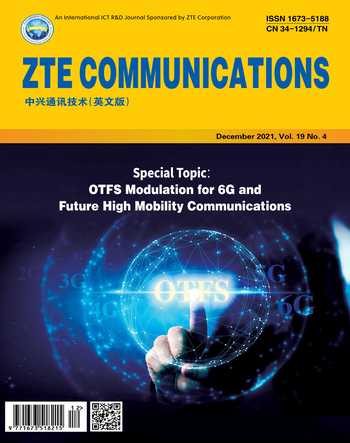
Recently, a new two-dimensional (2D) modulation scheme referred to as orthogonal time frequency space (OTFS) modu? lation was proposed, where the information symbols are mul? tiplexedin thedelay-Doppler(DD)domain rather than thetime-frequency (TF) domain as in the traditional modulation techniques. The DD domain multiplexing provides the possi ? bility to embrace the channel impairments and to provide the benefits of delay- andDoppler-resilience.OTFS enjoys the full time-frequency diversity of the channel, a key to provide reliablecommunications. Sinceitwasintroducedin2017, OTFS has been recognized globally for its great potential to achievehigh-speedandhigh-reliablecommunicationsina high-mobility environment. While some initial works on the concepts and the implementations of OTFS have been inves ? tigated, there are still several challenges and open problems to be addressed.
Inthisspecialissue,wehaveinvitedsevenactiveand leading research groups who have been working on this topic in the last few years to provide tutorials, surveys or technical papers on various important issues facing OTFS system de ? signs, including efficient DD domain channel estimation , low complexity OTFS signal detection, coded OTFS systems per? formance evaluations, iterative receiver designs, multiple-an? tennaOTFSsystemsdesigns,OTFSbasedmultipleaccess forsatellitecommunications,etc.Thesepapersprovidean overview of the latest OTFS research and innovations as well as their applications. Thereby, it is expected that these pa? pers will motivate and inspire further work amongst research ? ers, engineers, and Ph. D students working on OTFS and re ? lated areas.
One of the challenges facing OTFS system design is how to detect the transmitted symbols with a low complexity receiver. In this special issue, three papers investigate OTFS receiver designs, particularly on the signal detection and channel esti ? mations for OTFS systems. ZHANG Zhengquan et al. in the paper entitled“A Survey on Low Complexity Detectors for OT? FS Systems”provide a survey on low complexity OTFS detec ? tors and their related insights on future researches. OTFS de? tectorstructuresandclassificationsarecomparedanddis ? cussed. Motivated by the principles of OTFS detection algo ? rithms, theauthorsproposethedesignof hybridOTFSand OFDM detector in single user and multi-user systems.
The paper entitled “Signal Detection and Channel Estima? tion in OTFS”by CHOCKALINGAM et al. presents an over? view of the state-of-the-art approaches in the OTFS signal de ? tection and DD domain channel estimation. Three signal de? tectionmethods(lineardetection,approximatemaximuma posteriori detection, and deep neural network based detection) and three DD channel estimations (separate pilot, embedded pilot, and superimposed pilot) are discussed. The main chal? lenges and future research directions are identified.
Considering that an efficient detector is paramount to harvesting the time and frequency diversities promised by OTFS,GUO Qinghua et al. in their paper “Message Passing BasedDetection for Orthogonal Time Frequency Space Modulation” offer an overview of some recent message passing based OTFSdetectors, which can exploit the features of the OTFS channelmatrices, compare their performance, and shed some light onpotential research on the design of OTFS receivers.
While most of the existing OTFS work deals with uncoded systems, this special issue has two papers contributing to the design of coded OTFS systems. In the paper entitled “Perfor? manceofLDPCCodedOTFSSystemsoverHighMobility Channels”by ZHANG Chong et al., the performance of coded OTFSsystemswith5GLDPCcodesand5GOFDMframe structure over high mobility channels is evaluated. Various it? erative detection and decoding algorithms are proposed. The effect of channel estimation error on the LDPC coded OTFS system performance is discussed.
The work “Coded Orthogonal Time Frequency Space Modu? lation”by LIU Mengmeng et al. analyses the performance of theuncoded/codedOTFSsystemandcomparethemwith OFDMsystemswithdifferentrelativespeeds,modulation schemes and iterations. They show that the OTFS system has the potential of full diversity gain and better robustness under high mobility scenarios.
The paper “OTFS Enabled NOMA for MMTC Systems over LEO Satellite”by MA Yiyan et al. suggests one potential ap ? plication of OTFS for the massive machine type communica? tions (mMTC) in low earth orbit (LEO) satellite networks with notable Doppler shifts. OTFS-NOMAschemes are described for the systems. The challenges of applying OTFS and NOMA into the LEO satellite mMTC systems and the potential tech ? nologies for the system are investigated.
Finally,inthework“OrthogonalTimeFrequencySpace Modulation in Multiple-Antenna Systems”by WANG Dong et al., the application of OTFS modulation in multiple-antenna systems is investigated. Two classes of OTFS-based multiple- antennaapproachesforboththeopen-loopandtheclosed- loop (with Tomlinson-Harashima precoding) systems are pro? posed. Key challenges and opportunities for applying OTFS to multiple-antenna systems are presented.
Insummary,thisspecialissuecoversthestate-of-the-art OTFS technologies for channel estimation, detection, code de? sign, iterative receiver development, and its applications for LEO satellite and multiple-antenna systems. We thank all au? thors, reviewers, editorial staff who have contributed to this is ? sue. It is our expectation that these papers will inspire further research and development for future6G and emerging wire? less communications.
- ZTE Communications的其它文章
- OTFS Enabled NOMA for MMTC Systems over LEO Satellite
- A Survey on Low Complexity Detectors for OTFS Systems
- Coded Orthogonal Time Frequency Space Modulation
- Truly Grant-Free Technologies and Protocols for 6G
- Performance of LDPC Coded OTFS Systems over High Mobility Channels
- Message Passing Based Detection for Orthogonal Time Frequency Space Modulation