
Agapetes nana, A Newly Recorded Species of Ericaceae from China
2021-08-09 12:39:28WANGLiyanTANYunhongYANGBin
熱帶亞熱帶植物學報 2021年4期
WANG Li-yan, TAN Yun-hong, YANG Bin*
, A Newly Recorded Species of Ericaceae from China
WANG Li-yan1, TAN Yun-hong2,3,4, YANG Bin2,3,4*
(1. Management and Conservation Bureau of Yunnan Tongbiguan Provincial Nature Reserve,Dehong 678400, Yunnan, China; 2. Southeast Asia Biodiversity Research Institute, Chinese Academy of Sciences,Yezin 05282, Nay Pyi Taw, Myanmar; 3. Center for Integrative Conservation, Xishuangbanna Tropical Botanical Garden, Chinese Academy of Sciences,Mengla 666303, Yunnan, China; 4. Center of Conservation Biology, Core Botanical Gardens, Chinese Academy of Sciences,Mengla 666303, Yunnan, China)
(Griff.) Hook. f. is reported as a newly recorded species of Ericaceae from China for the first time, which is previously known only from northeast India and north Myanmar. It is special and differs from its congeners by its distinct palisade of gland-tipped hairs which forms a sort of epicalyx at the base of calyx tube and corolla tube lobed to 2/3 with conspicuous reflexed lobes. A detailed description, a colour plate and taxonomic notes on the species were provided. Additionally, the morphology of its mature flowers is described for the first time. The voucher specimen is kept in the herbarium of Xishuangbanna Tropical Botanical Garden, Chinese Academy of Sciences (HITBC).
Ericaceae;;; New record
D. Don ex G. Don comprises appro- ximately 100 currently recognized species[1], most of which are distributed in the Asian subtropical mon- soon region. It belongs to the tribe Vaccinieae Rchb.[2], but the generic delimitation has not been solved satisfactorily due to the very closely related polyphy- letic genusL.[1–4]. This genus not only contains ornamentally important taxa, with enlarged and swollen rootstocks and, in most species, beautiful and delicate flowers, but also forms an important component of the evergreen broad-leaved forest, mainly as epiphytes but occasionally terrestrial trees[1].
During a field investigation to Yingjiang County, one specimen of an unusualwas collected. Detailed studies revealed that it did not match with any of the species so far reported from China[1,5–7]. After examining allspecies from neigh- boring countries, we found out that this species is identical to(Griff.) Hook. f., which was previously recorded onlyfrom Northeast India and North Myanmar[8–11]. Therefore, a new distributionalrecord offor the flora of China is presented in this study.
(Griff.) Hook. f. in Benth. & Hook. f. Gen. Pl. 2(2): 571, 1876. (Fig.1)
≡Griff., Not. Pl. Asiat. 4: 303, 1854 & Ic. Pl. Asiat.: t.505, 1854. Type: India: Assam, Naga hills, 16 Mar. 1837, W. Griffith 26 (holotype: K000729410!).
=(Griff.) Hook. f. var.Airy Shaw, Kew Bull. 13(3): 474, 1958. Type: Myanmar. Sumpra Bum, 5 Mar. 1953, F. Kingdon Ward 22017 (holotype: BM000752865!).
Epiphytic shrubs, up to ca. 0.8 m tall. Twigs terete, with inconspicuous pale grey lenticels, 0.3– 0.7 cm in diam., glabrous, young branches with ovate- lanceolate leaf-shaped bud scales, 0.4–0.7 cm×0.2– 0.3 cm. Leaves spirally aggregated, pseudo-verticillate; petioles short, 3–4 mm long, glabrous; leaf blades coriaceous, ovate-elliptic to elliptic-oblong, 6.5– 12.8 cm×3.0–4.5 cm, apex acute, base attenuate to obtuse, glabrous, margins entire, with unconspicuous nodulose thickening, slightly revolute when dry, midvein raised abaxially, slightly impressed adaxially, secondary veins 8–14 pairs, inconspicuous abaxially, lateral and reticulate veins forming a conspicuous intra-marginal vein. Raceme corymb-like, 12–18- flowered, 4–6 cm long, axillary or on leafless branches; peduncle stout, sub-fleshy, with sparse short glandular hairs, 1.5–2.2 cm long, bracts small, brown, triangular, ca. 0.7 mm×1.5 mm; pedicels stout, sub-fleshy, green, 1.2–1.6 cm long, ca. 1.5 mm in diam., with sparse short glandular hairs, with an epicalyx consisting of 12–18 conspicuous linear glandular ancillae (ca. 2 mm long) at the apex; bracteoles 2, brown, inserted at the base of pedicles, small, scale-like, triangular, ca. 1 mm long. Calyx narrowly campanulate, 3–3.5 mm long, glabrous; calyx tube cylindrical, slightly pale green, ca.1.5 mm long, 1.5–2 mm in diam., calyx divided to middle; lobes lanceolate, 1.5–2 mm×0.8 mm. Corolla cylindrical-conical, 1.0–1.1 cm long, glabrous, maroon (dark red); corolla tube lobed to 2/3, lobes narrowly lanceolate to linear, 7–8 mm×3–3.5 mm, strongly reflexed at anthesis. Stamens 10, ca. 1.0 cm long; filaments flat, curved at upper part, ca. 3 mm long, pubescent upper part to middle; anthers 7.5–8 mm long, thecae reddish brown, ca. 3.5 mm long, papillate, tubules brownish yellow, 4.0–4.5 mm long; with 2 spurs abaxially, spurs ca. 2 mm long, downward; Style ca. 1.1 cm long. Berry sub-globose to depressed glo- bose, 6–7 mm in diam., pinkish white when mature.
Distribution: China (Yunnan) (new record), India[10], Myanmar[11].
Habitat and ecology: It is an epiphytic shrub which grows on the trees in montane broad-leaved forests.
Phenology:Flowering from April to May; fruiting from May to June.
Chinese name: xiàn bāo shù luó bo (腺苞樹蘿卜) (新擬)
Notes:is special amongbecause of its distinct palisade of gland-tipped hairs which forms a sort of epicalyx (Fig.1: F, leftmost)[9]. AlthoughAiry Shaw also has similar epicalyx[12–13], it is very different fromby the whole habit. As there are very few collections of this species, the previous descriptions of its flower were based on materials with young or late flowers[9,11]. Airy Shaw indicated that the anthers ofare devoid of dorsal appendages (spurs)[9]. The most likely reason is that the dorsal appendages are not well developed when the flowers are young. Our collection possibly represents the first material with mature flowers of, so the characters of its mature flower can be described precisely, especially for the size and color of the corolla and the spurs on the back of anthers[11]. Fortunately, we also collected the specimens with mature fruits, and the description of fruit was based on our collections from Myanmar[Yun-Hong Tan et al. M4611 (HITBC), collected on 17 June 2018].
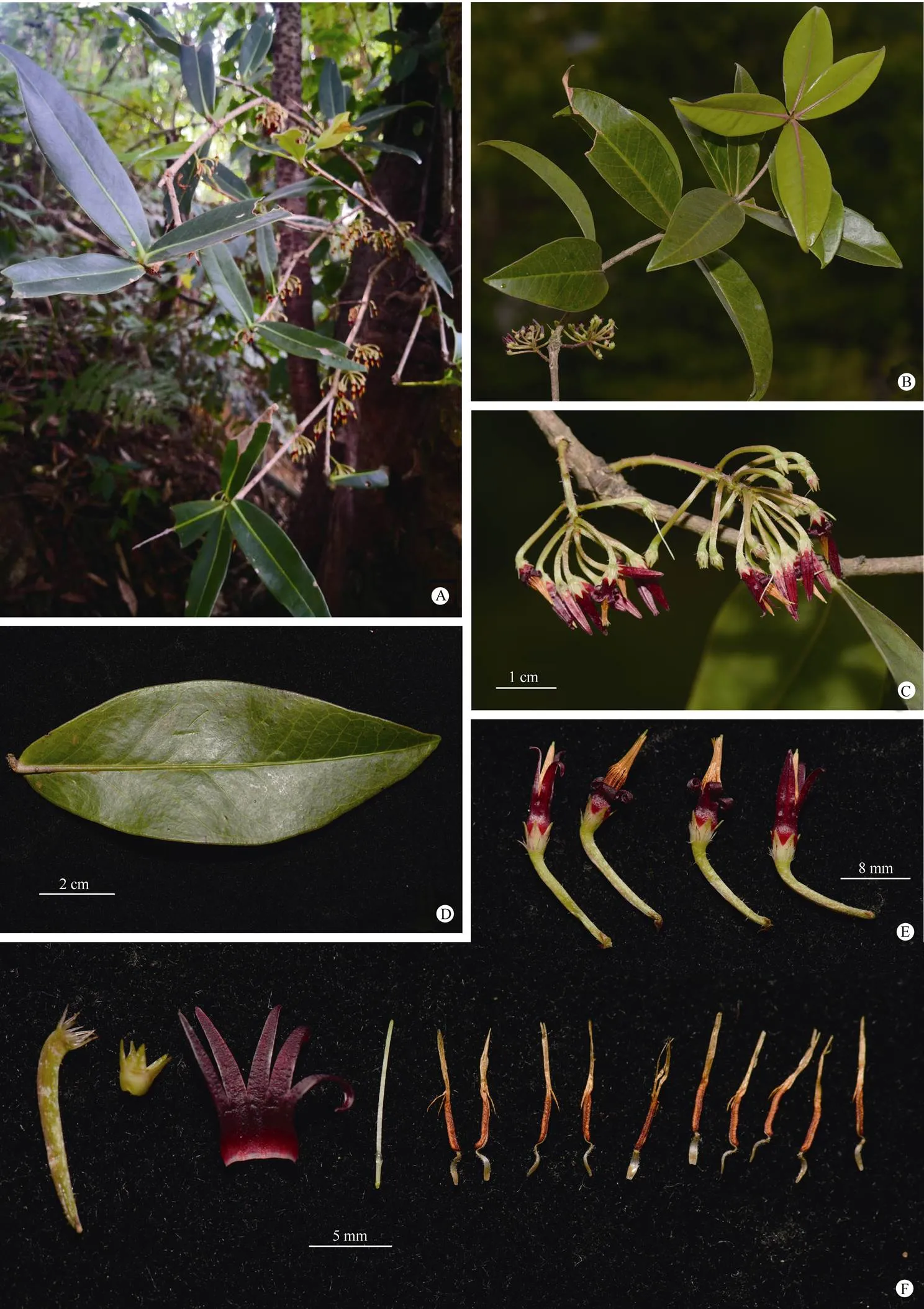
Fig. 1 Agapetes nana (Griff.) Hook. f. A: Habit; B: Flowering branch; C: Inflorescences; D: Leaf, adaxial view; E: Flowers; F: Flower dissection (from left to right): pedicel with epicalyx, ovary along with calyx, opened corolla, style, stamens. (Photographed: A by L. Y. Wang, taken from Tongbiguan Xiang, Yingjiang County; B-F by B. Yang, collected from Tongbiguan Xiang, Yingjiang County)
Airy Shaw indicated thatvar.Airy Shaw is different fromby its leaf shape and size (8.8–13.5 cm×3.3–5.0 cm vs. 5.0–9.5 cm× 1.5–2.4 cm)[9], according to our field observations and our collections from China and Myanmar, and our former discussion[11], the leaf shape and size with variation within population and among different popu- lations is understandable to be a universal pheno- menon, so we hold the opinion thatvar.Airy Shaw should be resolved as a synonym of(Griff.) Hook. f.
Voucher specimen: China. Yunnan: Yingjiang County, Tongbiguan Nature Reserve, 1 May 2020, Li- Yan Wang T0494 (HITBC); ibid., 12 Jan. 2021, Bin Yang & Ping-Yuan Wang T864 (HITBC).
[1] FANG R C, STEVENS P F.[M]//WU Z Y, RAVEN P H. Flora of China, Vol. 14Beijing:Science Press & St. Louis: Missouri Botanical Garden Press, 2005: 504–517.
[2] STEVENS P F, LUTEYN J L, OLIVER E G H, et al. Ericaceae [M]// KUBITZKI K. The Families and Genera of Vascular Plants, Vol. 6. Berlin & Heidelberg: Springer-Verlag, 2004: 145–194.
[3] STEVENS P F. Notes onand(Ericaceae) in Southeast Asia [J]. J Arnold Arbor, 1985,66(1): 471–490.
[4] KRON K A, POWELL E A, LUTEYN J L. Phylogenetic relationships within the blueberry tribe (Vaccinieae, Ericaceae) based on sequence data fromand nuclear ribosomal ITS regions, with comments on the placement of[J]. Amer J Bot, 2002, 89(2): 327–336. doi: 10.3732/ajb.89.2.327.
[5] TONG Y H. A systematic study of the genusD. Don ex G. Don (Ericaceae) [D]. Guangzhou: South China Botanical Garden, Chinese Academy of Sciences, 2014: 1–224.
[6] TONG Y H.sp. nov. (Ericaceae) from Xizang, China [J]. Phytotaxa, 2016, 252 (4): 289–292. doi: 10.11646/phytotaxa.252. 4.6.
[7] TONG Y H, WANG B M, XIA N H.(Ericaceae), a new epiphytic species ofser.from Yunnan, China [J]. Nord J Bot, 2019, 37(1): e02171. doi: 10.1111/njb.02171.
[8] CLARKE C B. Vacciniaceae [M]// HOOKER J D. Flora of British India, Vol. 3. London: L. Reeve & CO., 1881-1882: 442–455.
[9] AIRY SHAW H K. Studies in the Ericales: XI. Further new species and notes on theof continental Asia [J]. Kew Bull, 1958, 13(3): 468–514. doi: 10.2307/4118130.
[10] BANIK D, SANJAPPA M.[M]//SANJAPPA M, SASTRY A R K. Fascicles of Flora of India, Fascicle 25, Thiruvananthapuram: Botanical Survey of India, St. Joseph’s Press, 2014: 247–389.
[11] YANG B, DING H B, MAW M B, et al. Taxonomic studies onin Myanmar I:, a new species from Kachin State, and notes on three rediscovery species including two new records in Myanmar [J]. Phytotaxa, 2019,393(2): 105–118. doi: 10.11646/phytotaxa.393.2.2.
[12] AIRY SHAW H K. Studies in the Ericales: V. Further notes on[J]. Kew Bull, 1948, 3(1): 77–104. doi: 10.2307/4118929.
[13] HUANG S H.[M]// WU Z Y. Flora Xizangica, Vol. 3. Beijing:Science Press, 1986: 706–721.
腺苞樹蘿卜,中國杜鵑花科一新記錄種
王立彥1, 譚運洪2,3,4, 楊斌2,3,4*
(1. 云南銅壁關(guān)省級自然保護區(qū)管護局, 云南 德宏 678400; 2. 中國科學院東南亞生物多樣性研究中心, 內(nèi)比都 耶津 05282, 緬甸; 3. 中國科學院西雙版納熱帶植物園, 云南 勐臘 666303; 4. 中國科學院核心植物園保護生物學協(xié)同中心, 云南 勐臘 666303)
報道了中國杜鵑花科(Ericaceae)一新記錄種:腺苞樹蘿卜[(Griff.) Hook. f.]。該種以花萼筒基部具有一圈具柄的腺毛組成的副萼狀總苞,花冠筒裂至2/3,裂片反卷而與同屬其他種類明顯區(qū)別。該種原僅分布于印度東北部和緬甸北部,現(xiàn)首次在中國發(fā)現(xiàn)其分布。同時,提供了本種的描述和彩色圖片,并首次報道成熟的花部形態(tài),憑證標本保存于中國科學院西雙版納熱帶植物園標本館(HITBC)。
杜鵑花科; 樹蘿卜屬; 腺苞樹蘿卜; 新記錄
10.11926/jtsb.4326
2020–10–23
2021–01–22
This work was supported by the National Natural Science Foundation of China (Grant No. 31900180, 31970223), the Natural Science Foundation of Yunnan Province (Grant No. 202101AT070058), the Project of Southeast Asia Biodiversity Research Institute, Chinese Academy of Sciences (Grant No.Y4ZK111B01), and the Lancang-Mekong Cooperation (LMC) Special Fund.
WANG Li-yan (Born in 1971), female, Senior engineer, interesting in the management of nature reserves and plant taxonomy. E-mail:1751976899@qq.com
. E-mail: yangbin2018@xtbg.ac.cn
- 熱帶亞熱帶植物學報的其它文章
- Advances in Chemical Constituents and Pharmacological Activities of Pleuropterus multiflorus
- 成都地區(qū)19個木芙蓉品種的孢粉學研究及其分類學意義
- 秋石斛花青素提取液成分分析及其體外抗氧化活性和刺激性研究
- 龍珠果莖段離體培養(yǎng)和組培苗耐鹽性分析
- 谷子產(chǎn)量和品質(zhì)相關(guān)性狀的雜種優(yōu)勢及遺傳特性分析
- Cloning and Expression Analysis on PmPGK1 and PmGPIC Genes in Pinus massoniana