
Trump’s “Political Legacy” and an Outlook on the Biden Administration’s China Policy
2021-07-27 01:45:52ZhouQi
當(dāng)代世界英文版 2021年2期
Zhou Qi


Director, Institute of Global Governance and Development, Tongji University
During the four years of Trump presidency, China-US bilateral relations took heavy blows, after four decades of basic stability. The spread of the coronavirus in the United States and the threat it posed to Trumps reelection prompted the Trump Administration to double down and bring its tough policies toward China to a new level throughout the 2020 election year. His defeat has temporarily ended some of his most extreme measures against China, but his “political legacy” has already taken shape and, in many aspects, become hard to be abandoned or reversed by his successor.
The Trump Administrations “Political Legacy”
on China Policy
Though regarded as a political outsider, Trump pursued domestic and foreign policies in disregard of American political traditions, doing tremendous harm to both the US and the world. It is time to take stock of his administrations “political legacy” on China policy.
First, China was identified as a strategic competitor posing a security threat to the US. Both the National Security Strategy and the Defense Strategy Report, issued by the Trump Administration in December 2017 and January 2018 respectively, saw the current era as one of “great power competition” and saw China as a “revisionist competitor” that challenges “American power, influence, and interests, attempting to erode American security and prosperity.” These fundamental views on China were reaffirmed in the “US Strategic Approach to the Peoples Republic of China,” released on May 20, 2020. Now “great power competition” has been widely accepted by the strategic and diplomatic circles in the US, and China is unequivocally regarded as the biggest strategic competitor to the US.
Second, a trade war was fought to fix trade issues. The US blamed all of its economic problems on China. The Presidents 2017 Trade Policy Agenda, released in March 2017, just two months into the Trump presidency, asserted that every Americas economic indicator had continuously deteriorated since 2000, a year before Chinas WTO accession; the current global trading system was favorable to China, but not to the US; America should not ignore unfair trade practices in global markets in exchange for geopolitical advantages; to “Make America Great Again” required eliminating Chinas “unfair” trade practices. The Trump Administration began levying additional tariffs on Chinese imports in March 2018, forcing China into lengthy and tough trade negotiations. After rounds of talks, the two sides finalized the text of the phase one trade agreement. But the fundamental trade issues remain unsolved today.
Third, Trump opened the Pandoras Box, releasing a powerful anti-China force. A businessman by nature, Trump possesses neither a geopolitical sense, nor global strategic vision. The biggest damage his presidency had done to China-US relations was the coming together of a group of people in his White House who otherwise had no chance of serving key cabinet positions under any president, either from the Democratic Party or the Republican Establishment. For four years, amid Trumps record-setting cabinet reshuffles, those who had remained were people who were irrational and advocated extreme policies, obeyed Trump completely or shared his goals and approaches, especially who took a tough stand on China. They put together Trumps fragmentary, unsystematic China policy into a complete and systematic anti-China strategy, forming a powerful force in the Administration against China. Their rhetoric had not only poisoned the atmosphere for policy-making on China, but also made the implemented policies hard to reverse.
Fourth, the Trump Administration started direct attacks on the Communist Party of China (CPC) and Chinas social system. Trump blamed his setbacks in the 2020 election completely on China, made China his target and maximized his anti-China efforts. Between June and July 2020, his National Security Adviser OBrien, FBI Director Wray, Attorney General Barr and Secretary of State Pompeo delivered a planned series of China-bashing speeches, adopting an unprecedented tactic of separating the CPC from China and attacking Chinas socialist system. They misinterpreted and negated the policy successive US governments had pursued toward China, and painted China a direct threat to the political system, way of life and fundamental values of the West. They called on Western countries to rally around the US to form an ideological alliance to fight the CPC.
Fifth, “the human rights issue” was used as an excuse to interfere in Chinas internal affairs. Though paying little attention to ideology, Trump was more than willing to attack China by using “the human rights issue,” an effort meant to mobilize support to his tough stance and actions on trade issues with China. During his presidency, the Congress passed bills in a row, on Taiwan, Hong Kong, Xinjiang and Tibet, to interfere in domestic affairs, or support separatist forces, or accuse human rights violations in China. These acts, including Hong Kong Autonomy Act, Uyghur Human Rights Policy Act of 2020 and Taiwan Allies International Protection and Enhancement Initiative Act (Taipei Act), all got Trumps support. Some commented that Trump shaped the view among the Congress and public that China is not only a competitor, but a threat to Americas global leadership.
Sixth, the US seized opportunities to form international economic and trade or political alliances against China. At a secret meeting held in July 2018, the intelligence agencies of the Five Eyes agreed on a strategy to contain Huawei. Afterwards, the Trump Administration put constant pressures on American allies to exclude Huawei from their next generation telecom networks. The State Department released on August 3 a so-called 5G Clean Networks list, alleging 27 telecom operators in the world had blocked any equipment from Huawei and ZTE, and thus ensured a “5G Clean Path” and “the highest standards for security.” On May 30, 2020 Trump announced his plan to expand G7 to G11 by including Australia, Russia, the ROK and India, with the intension of further isolating China.
Seventh, the US took side on the South China Sea issue. Under Trumps presidency, the US toughened its policy on the South China Sea. On July 13, 2020, Secretary Pompeo declared that most Chinas maritime claims in the South China Sea were unlawful and urged countries in the region to reject those claims, a sea change from the US previous official position of not taking side on the South China Sea issue.
Eighth, the hi-tech sector was made a key area of great power competition. Hi-tech competition between the US and China had increased in intensity in lockstep with the growing recognition on the US side of how important it is to great power competition. It had spiraled as the trade war had escalated. In the wake of the Five Eyes strategy, the US brought criminal lawsuits against Huawei in early 2019, charging it with “bank fraud” and “sanctions violation.” China-US relations took a sharp turn for the worse amid the pandemic. In May 2021, the US put Huawei and its affiliates on the “Entity List,” imposing bigger sanctions and tightening restrictions on its access to chips that are crucial to wireless networks. This technological “decoupling” is applied not only to Huawei, but also includes restricting Chinese investment in American hi-tech companies, even attempting to cut off Chinas hi-tech supply chains.
Ninth, more and more restrictions were put on scientific exchanges. The Trump Administration strictly restricted entry of Chinese visiting scholars and students. The Justice Department and FBI played up some “visa fraud” cases, alleging that Chinese researchers and students engaged in economic espionage or theft of American technologies or intellectual property. They targeted renowned scientists who participated in Chinas overseas talent attraction program by arresting some of them and requiring American universities and academic institutions to report on any suspicious Chinese. Normal academic exchanges between China and the US were disrupted. Citing the alleged theft as an excuse, the Trump Administration stepped up restrictions on Chinese students applying to study STEM, tightened visa requirements for students (especially those suspected of military connections) studying robotics, quantum computing, semiconductor and AI, and imposed sanctions on some Chinese universities and entities that collaborated with the military.
Tenth, a countercurrent to globalization rose, catering to some domestic constituencies. Trumps objection to globalization was obvious, embodied in his “America first” dogma. Having no regard for the international trading system or rules, he paralyzed the WTO, used economic sanctions willfully, and even imposed tariffs on American allies on security grounds. He urged American companies to move their investment back home, and tightened immigration policy. He withdrew the US from the Paris Agreement, and renegotiated trade agreements, multilaterally and bilaterally, to make them more favorable to the US. He quit the World Health Organization as the pandemic became serious worldwide. The Trump Administration ignored virtually all global issues which should be addressed by the US and China working together in a globalized world, such as environmental protection, climate change, clean energy, narcotics, economic development, counter-terrorism and infectious diseases, perhaps except only one—nuclear non-proliferation, which he did pay attention to, specifically the DPRK nuclear issue.
After four years, China-US relations plummeted to the lowest point since they were established in the mid-1970s. The Trump Administrations relentless attack and slander against China led to a drastic change in American public opinion. According to Pews June-July 2020 polls, as high as 73% Americans had negative views of China, up by 26 percentage points from when Trump just took office; many more Republic Party supporters (83%) held negative views than Democratic Party supporters (68%).
Bidens Basic Policy Stance
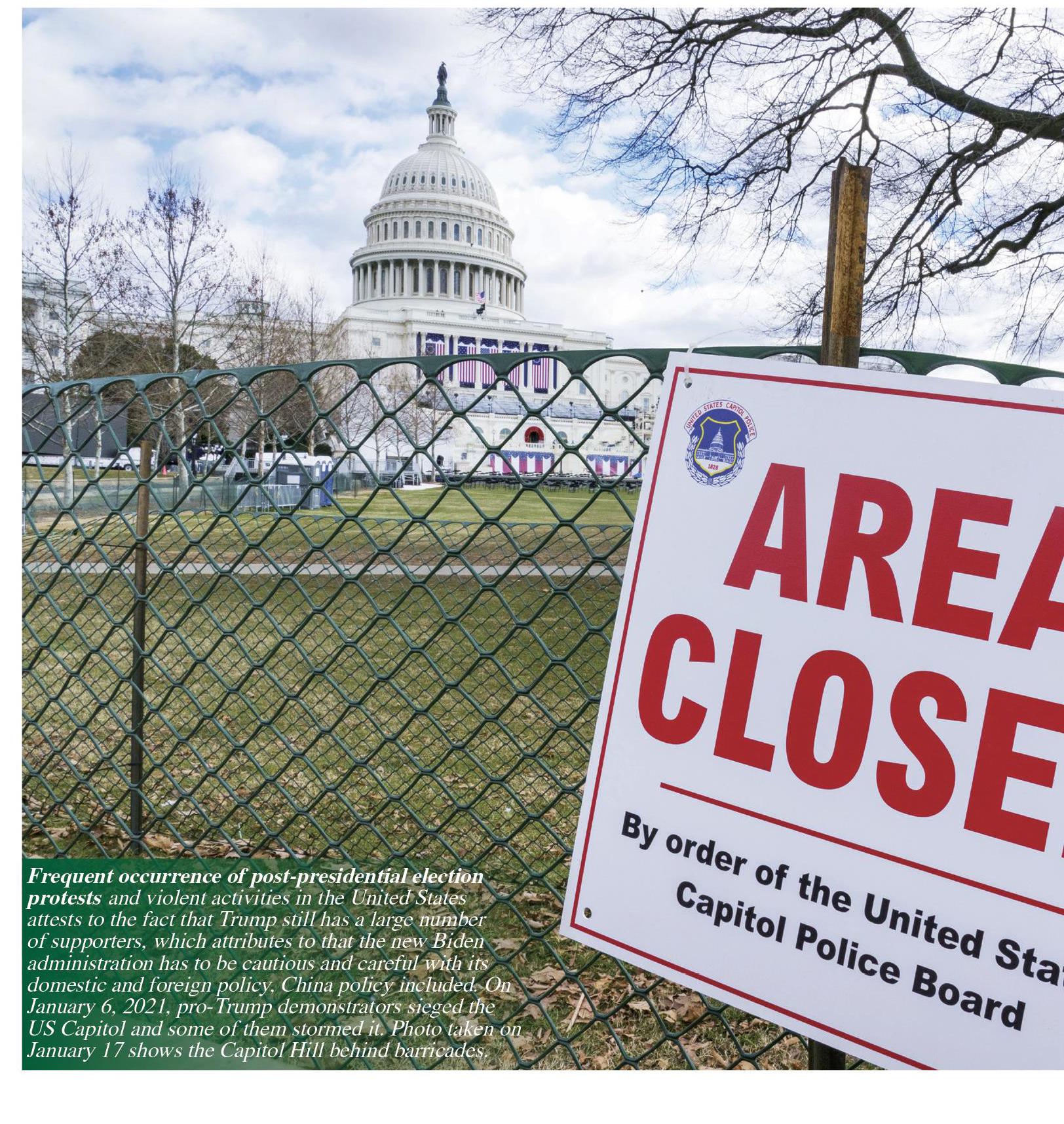
The 2020 presidential election results show that Trump won 74 million votes despite the economic downturn and pandemic. The eruption of protests and violence after the election also reveals that Trump still has numerous supporters. This is why the Biden Administration must be prudent with its policies, both domestic and foreign, including on China.
In terms of domestic policy, Biden recognizes the many grave challenges the US faces at home, the most urgent being handling the pandemic, reenergizing the economy, and rebuilding the fragile democracy. His administrations priorities will include: investing in domestic infrastructure, giving stronger support to research and development, investing more in education, promoting racial and gender equality, improving the health insurance system on the basis of “the Obama Care,” and reforming the immigration system. They aim at fixing Americas own problems so that it will be in a position of strength in the competition with China.
Many of the people Biden nominated for cabinet positions or appointed senior advisors for foreign or security affairs had held high positions in the Obama Administration, and Biden himself was vice president to Obama. Assumably, Biden would, to a certain extent, make his foreign and security policies in line with those of Obama and the traditions of the Democratic Party, to uphold “the liberal international order.” But two important reasons will prevent him from continuing Obamas policy on China. First, times have changed, and the US has completely abandoned the engagement policy and now sees China as a strategic competitor in an era of great power competition. Second, to win the trust and support of the vast number of voters and heal a divided society, Biden has to handle Trumps “political legacy” with care.
In terms of foreign policy, the main goal of the Biden Administration is to restore American global leadership by eliminating the negative impact of “Trumpism.” Strongly committed to shoring up democracy and the alliance system in the world, Biden has proposed to organize “a global Summit for Democracy to renew the spirit and shared purpose of the nations of the Free World, … bring together the worlds democracies to strengthen our democratic institutions.” The Biden Administration will again put diplomacy at the center of Americas foreign policy, set store by multilateral systems and seek international collaboration in tackling climate change, public health, new technology, WMD, terrorism, democracy, human rights, and other challenges to global governance. A “Green New Deal” and “democracy and human rights” will become the trademarks of Bidens policies.
On January 20, 2021, first day in office, President Biden signed 15 executive orders and two executive actions, to return to the Paris Agreement and WHO, ask Americans to wear masks for 100 days, halt funding for the construction of the border wall with Mexico, reverse the ban on US entry for passport holders from 12 Muslim countries, and undo more than 100 of Trumps “harmful policies” on climate change. The Biden Administrations first-100-day foreign policy priorities include rejoining and improving the Joint Comprehensive Plan of Action for Iran, hosting “a global Summit for Democracy,” withdrawing from Afghanistan and reassessing relations with China. These are his efforts to undo Trumps “political legacy”.
Possible Readjustments
to China Policy under Biden
Judging by Bidens foreign policy ideas and the recent arrangements and statements by his foreign policy team, his Administration may make the following changes to the China policy.
First, identify China as the biggest competitor, but not necessarily an adversary of the US. Despite the unprecedented political polarization of recent years, there has emerged a bipartisan consensus on China, and the crux of it is the US must adopt a tougher and more effective strategy to deal with competition from China. But to both the Democratic Partys platform and Biden himself, the biggest threat to the US comes from Russia; China, as the biggest competitor, poses the most important, long-term challenge to Americas national security and foreign policy, but it is not necessarily an adversary.
Biden has in fact accepted the “great power competition” concept and intended to handle relations with China under this framework. The creation in the National Security Council of the position of senior director for China shows the importance he places on relations with China. The appointment of Obama-era Assistant Secretary of State for East Asian and Pacific Affairs Kurt Campbell as Indo-Pacific Coordinator is a sign of some continuity between Bidens Indo-Pacific strategy and Obamas Asia-Pacific strategy.
Second, join hands with allies in stopping Chinas “unfair trade practices.” Biden called Trumps “trade war” with China both expensive and strategically meaningless, taking a heavy toll on American manufacturing, agriculture and taxpayers. But just as the Republicans, the Democrats too believe that China has long engaged in unfair trade practices. So the Biden Administrations trade policy will aim at reversing such practices as “stealing intellectual property, dumping products, illegal subsidies to corporations” and “forced technology transfers”.
However, because of their liberal ideas, compared with the Republicans, the Democrats are more willing to show respect for the international trade rules and system. So the Biden Administration is more willing to work closely with the allies to put more pressure on China in the WTO, and at the same time reform the organization, make new multilateral trade rules, including higher labor and environmental standards, and use such rules to restrict Chinas economic behavior and use the industrial subsidies, SOE reform and IP protection issues to exert greater pressure on China.
There is wide concern in and outside China about whether the Biden Administration will end the additional tariffs on Chinese imports. Biden, after winning the election, said he would not “immediately” lift tariffs placed by Trump on Chinese imports. His advisors also said Biden would look at the tariffs impact on the American economy and consult with allies before making a decision.
Third, take high-tech competition with China seriously, just like his predecessor. Biden has promised huge investment in such fields as telecom, AI and semiconductor, to ensure Americas advantage over China. His team has stressed that the US must restore its leadership in international institutions and rule-making, and establish systems of rules for 5G, AI and other sectors and technologies that are consistent with Western values, to rigorously regulate Chinese companies. They plan to work with technologically advanced democracies to develop, among others, new telecom technologies, so as to lessen dependence on Huaweis 5G equipment. Thus, whether the Biden Administration will reverse completely or partially the suite of measures Trump put in place to achieve a high-tech “decoupling” from China, including the restrictions on chips supply to Huawei, remains to be seen.
Fourth, make human rights and ideology feature more prominently in his China policy and hold the “moral high ground” to get ahead of China. Given the strong belief in human rights of Biden himself and the Democrats generally, his administration is expected to adopt firm and consistent policies, exert pressure on China on human rights issues, especially concerning Hong Kong and Xinjiang, and form a global “alliance of democracies” based on Western values to counter China.
On the Taiwan question, judging by now, the Biden Administration will not explicitly recognize Taiwan “independence,” or encourage it, but rather come back to the ambiguity policy to prevent the Taiwan question from triggering a military conflict between China and the US. But Biden did break a 42-year precedent tracing back to the establishment of diplomatic ties with China by inviting Taiwans representative to the US to his inaugural ceremony, indicating his administration feels little restrictions in developing substantive relations with Taiwan.
Fifth, anchor his China policy in Americas alliance system. Bidens team sees the alliances as a core competence in confronting China, a competence weakened by Trump but valued by Biden. In an interview with the New York Times in early December 2020, Biden said that the best strategy toward China is to rally all of Americas allies in Asia and Europe, and this would be a priority in the first few weeks of his presidency.
Finally, while engaging in great power competition with China, the Biden Administration, out of liberal ideas, will undoubtedly seek cooperation with China on certain global issues like climate change, environmental protection, infectious diseases and nuclear non-proliferation. In a nutshell, there is a tough journey to take before China and the US can get their relations fully back on track.
- 當(dāng)代世界英文版的其它文章
- Youth Development in Africa and China-Africa Youth Cooperation amid Covid-19 Pandemic
- African Continental Free-Trade Area and China-Africa Economic Cooperation: Impact and Strategy
- RCEP under Profound Changes Unseen in a Century: Features, Impacts and Opportunities
- RCEP and Asia-Pacific Regional Cooperation
- Once-in-a-century Changes under COVID-19:Features and Impacts
- Major-Country Relations, Global Governance and China’s Foreign Strategy in the Post-COVID Era