
S-Scheme Heterojunction Photocatalyst for CO2 Photoreduction
2021-07-13 09:56:18SwelmWagehAhmedAlGhamdiLijunLiu
物理化學學報 2021年6期
Swelm Wageh , Ahmed A. Al-Ghamdi , Lijun Liu
1 Department of Physics, Faculty of Science, King Abdulaziz University, Jeddah 21589, Saudi Arabia.
2 College of Chemistry and Chemical Engineering, Wuhan Textile University, Wuhan 430200, China.
Photocatalytic CO2reduction to solar fuels attracts great interest due to the growing fossil fuel shortage and global warming. Developing high-efficiency photocatalyst is the key for the solar fuel production1,2. TiO2, as an inert, nontoxic and earth-abundant semiconductor, has been widely used for photocatalytic CO2reduction. Like other monocomponent photocatalysts, unitary TiO2shows poor photocatalytic activity because of its rapid electron/hole recombination. TiO2-involved traditional type-II heterojunction is accepted to achieve efficient electron/hole separation3. However, as shown in Fig. 1a, the separated photogenerated electrons and holes will accumulate on the conduction band (CB) with less negative potential and the valence band (VB) with less positive potential, respectively. In general, less negative CB level and less positive VB level mean weaker photoreduction and photooxidation ability for the photogenerated electron and hole, respectively. From thermodynamic viewpoint, such charge transfer mechanism actually weakens the redox ability of the photogenerated carriers, which is unfavorable for the photocatalytic reaction.
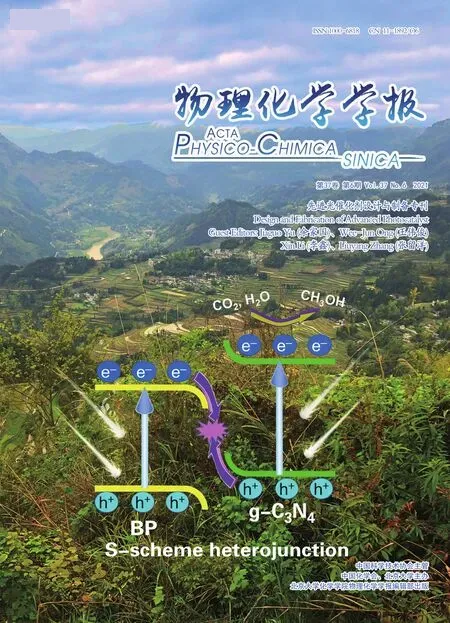
In 2019, Yu’s group proposed the concept of S-scheme (Stepscheme) heterojunction to the dilemma that traditional type-II heterojunction confronts4. As shown in Fig. 1b, S-scheme heterojunction consists of two n-type semiconductors including reduction semiconductor (RS) and oxidation semiconductor(OS). RS has more negative CB potential, thus, stronger reduction ability for its photoexcited electrons. On the contrary,OS has more positive VB potential and stronger oxidation ability for its photoexcited holes. Usually, RS has higher Femi level or smaller work function than OS. When such RS and OS semiconductors contact, their Fermi level difference drives electron transfer from RS to OS, resulting in RS and OS with the same Fermi level. Thus, the opposite charges are accumulated on their interface and form an internal electric field (IEF) pointing from RS to OS at the interfaces. Owing to the IEF and band bending, the useless photogenerated electrons on the CB of OS will transfer to RS and recombine with the useless holes on the VB of RS. However, the useful photogenerated electrons and holes will retain on CB of RS and VB of OS, respectively. This results in the formed heterojunction with strong reduction and oxidation ability. Obviously, the transfer pathway of the photogenerated electron and hole in S-scheme heterojunction is completely different from that of traditional type-II heterojunction, which enables the photocarriers with strong redox capability5–8.

Fig. 1 Charge transfer routes in (a) traditional type-II heterojunction and (b) S-scheme heterojunction.

Fig. 2 Charge-transfer processes in TiO2/CsPbBr3 S-scheme heterojunction: (a) after contact, (b) IEF-induced charge transfer,separation, and the formation of S-scheme heterojunction under UV-visible light irradiation.
Very recently, Jiaguo Yu (Wuhan University of Technology), Jingsan Xu (Queensland University of Technology), Shengyao Wang (Huazhong Agricultural University)et al.reported an S-scheme heterojunction of TiO2/CsPbBr3quantum dots (QDs) prepared by an electrostatic self-assembly method and used for photocatalytic CO2reduction(Nature Communications2020,11, 4613. doi: 10.1038/s41467-020-18350-7)9. In recent years, CsPbBr3QDs have attracted growing interest in photocatalysis owing to its narrow photoemission, visible light absorption, tunable band gap and effective CO2activation. TiO2and CsPbBr3are n-type semiconductors. The work function of TiO2is larger than that of CsPbBr3, implying that TiO2has a lower Fermi level than CsPbBr3before they contact. Upon hybridization, electrons flow from CsPbBr3to TiO2to enable them at the same Fermi level,which creates an IEF at TiO2/CsPbBr3interfaces directing from CsPbBr3to TiO2and bends their energy bands (Figs. 1b and 2a).Under UV-visible light irradiation, as proved byin situX-ray photoelectron spectroscopy (XPS) analysis, the photogenerated electrons in TiO2CB spontaneously transfer to CsPbBr3and recombine with the holes in CsPbBr3VB driven by the interfacial IEF and band bending. Finally, the electrons accumulating on CsPbBr3CB activate CO2molecules for photoreduction, and the holes aggregating on TiO2VB oxidize H2O molecules to O2(Figs. 1b and 2b). Clearly, such transfer of photogenerated charge carriers causes the electron from TiO2CB to CsPbBr3CB, suggesting the formation of S-scheme heterojunctions between TiO2and CsPbBr3upon contact. This unique TiO2/CsPbBr3S-scheme heterojunction greatly promotes the separation of electron-hole pairs and maintains their strong redox ability to foster efficient CO2photoreduction. The TiO2/CsPbBr3hybrid nanofibers exhibit an enhanced CO production rate (9.02 μmol·g?1·h?1) with reference to TiO2nanofibers (4.68 μmol·g?1·h?1) under UV-visible light irradiation. This work provides new insights into TiO2-based photocatalysts for efficient CO2photoreduction driven by Sscheme charge separation.
Briefly, we highlight an emerging S-scheme heterojunction of TiO2/CsPbBr3designed and fabricated by Xuet al.for efficient CO2photoreduction. This pioneering work offers great opportunity to deeply understand the S-scheme charge transfer and separation mechanism in the heterojunction. The novel concept along with its prospects would encourage collective efforts to develop more efficient S-scheme heterojunctions for solar-driven photocatalysis including water splitting, CO2reduction, and organic photosynthesis.
Acknowledgements:This project was funded by the Deanship of Scientific Research (DSR) at King Abdulaziz University, Jeddah (RG-50-130-41). The authors, therefore,acknowledge with thanks DSR for technical and financial support.
- 物理化學學報的其它文章
- Recent Progress of Perovskite Oxide in Emerging Photocatalysis Landscape: Water Splitting, CO2 Reduction, and N2 Fixation
- Review of Z-Scheme Heterojunctions for Photocatalytic Energy Conversion
- Fluorinated TiO2 Hollow Photocatalysts for Photocatalytic Applications
- TiO2-Supported Single-Atom Catalysts for Photocatalytic Reactions
- 微波輔助快速制備2D/1D ZnIn2S4/TiO2 S 型異質結及其光催化制氫性能
- Controllable Synthesis of g-C3N4 Inverse Opal Photocatalysts for Superior Hydrogen Evolution