鯉病毒性疾病發生與防控的研究進展
2021-06-30 03:21:44蔣昕彧王嘯宇裴超周勇李鵬飛孔祥會
南方農業學報 2021年2期
關鍵詞:防控
蔣昕彧 王嘯宇 裴超 周勇 李鵬飛 孔祥會

摘要:鯉(Cyprinus carpio L.)是我國重要的水產養殖品種之一,但隨著養殖密度和養殖規模的不斷擴大,其養殖生態系統受到不同程度破壞,各類疾病頻繁暴發,其中又以病毒性疾病的影響范圍最廣、死亡率最高,已成為制約鯉養殖產業可持續健康發展的瓶頸問題。文章通過綜述鯉春病毒血癥(Spring viraemia of carp,SVC)、錦鯉皰疹病毒病(Koi herpesvirus disease,KHVD)、鯉病毒性浮腫病(Viral edema of carp disease,VEC)和鯉痘瘡病毒病(Carp pox disease,CPD)等病毒性疾病的病原生物學、發生機理、流行特點及其防控策略,發現鯉病毒性疾病仍存在諸多問題亟待深入研究,包括KHV可感染多種鯉科近緣魚類,但為何只發展成為病毒攜帶者而不發病;養殖水溫是否是決定病毒感染的關鍵因素;病毒可通過哪些途徑逃避免疫監視而進入魚體;在不同感染階段病毒的傳播方式是否存在差異等。此外,由于目前尚缺乏高效的防控方法,加強檢疫和免疫防控仍是防控鯉病毒性疾病的主要手段。因此,今后要繼續加強對病毒致病機理和傳染途徑的研究,研發新型口服疫苗載體及傳送系統,并基于RNAi技術研制能有效防治病毒性疾病的藥物,以確保我國鯉養殖產業的健康可持續發展。
關鍵詞: 鯉;病毒性疾病;流行特點;防控策略;SVC;KHVD;VEC;CPD
中圖分類號: S941.41? ? ? ? ? ? ? ? ? ? ? ? ? ? ? ? ? ?文獻標志碼: A 文章編號:2095-1191(2021)02-0509-09
Abstract:Common carp(Cyprinus carpio L.) is an important economic fish species in China.? With the gradual increase of breeding range and density in aquaculture, the aquaculture ecosystems are being damaged to varying degrees, the diseases frequently break out in common carp. Among them, the influence range caused by viral diseases is the most extensive,? and the mortality is the highest. It has become a bottleneck problem restricting the sustainable and healthy development of carp breeding industry. In this paper, the pathogen biology, occurrence,? epidemic characters and prevention and control strategies of viral diseases in common carp such as spring viraemia of carp(SVC), koi herpesvirus disease(KHVD), viral edema of carp disease(VEC) and carp pox disease(CPD) were summarized, and the future research trends of viral diseases were prospected. There are still many problems to be further studied, such as why KHV could infect a variety of Cyprinidae related fishes, but the fish only carried virus not becoming a disease-causing? Whether the water temperature is a key factor for virus infection? How can viruses escape immune surveillance and infect fish? Whether there are differences in the transmission of viruses at different stages of infection? Since lack of effective methods to control the carp viral diseases, strengthening quarantine and immune control remains the main means of preventing and controlling viral diseases of carp. Therefore, in the future, the researchers should continue to strengthen the research on the pathogenic mechanism and transmission pathway of the virus, develop a new oral vaccine carrier and transmission system, and develop drugs that can effectively treat viral diseases based on RNAi technology, in order to ensure the healthy and sustainable development of carp breeding industry in China.
Key words: common carp; virus disease; epidemic characteristics; control and prevention strategies; SVC; KHVD;VEC; CPD
Foundation item: National Key Research and Development Program of China(2019YFD0900105); Scientific and Technological Project in Henan(202102110260); Construction Project of Innovative Scientific and Technological Team of Aquatic Animal Immunity and Disease Prevention and Control in Henan(201706081)
0 引言
鯉(Cyprinus carpio L.)是我國重要水產的養殖品種之一,近年來我國的鯉年均產量維持在296萬t左右,其養殖產業形成了巨大的社會效益和經濟效益。我國鯉養殖歷史悠久,據河南省賈湖遺址考古數據顯示,早在8000年前的新石器時代就開始馴養鯉(Nakajima et al.,2019)。但隨著鯉養殖密度和養殖規模的不斷擴大,其養殖生態系統受到不同程度破壞,導致疫病頻繁暴發而造成嚴重的經濟損失。至今,已發現多種病原微生物能侵染鯉,并造成暴發流行,其中又以病毒性疾病的影響范圍最廣、死亡率最高(朱霞等,2011),已成為制約鯉養殖產業可持續健康發展的瓶頸問題。鯉易感的病毒性疾病有鯉春病毒血癥(Spring viraemia of carp,SVC)、錦鯉皰疹病毒病(Koi herpesvirus disease,KHVD)及鯉病毒性浮腫病(Viral edema of carp disease,VEC)等,且這些病毒性疾病的死亡率均在50%以上,一旦大規模暴發流行,其病情很難控制,給鯉養殖業帶來重大經濟損失(高隆英等,2002;朱霞等,2011;陳昌福,2017)。為了更好地防控鯉病毒性疾病的暴發流行,本文通過綜述鯉病毒性疾病的病原生物學、發生機理、流行特點及其防控策略,以期為實際生產中鯉病毒性疾病的科學防控提供參考依據。
1 鯉春病毒血癥
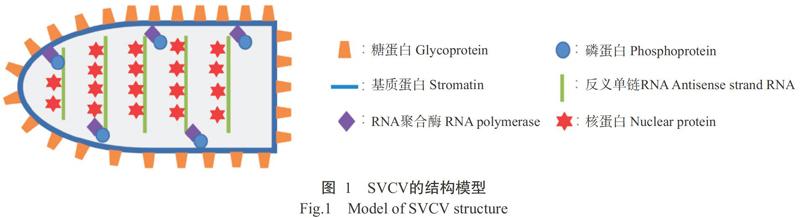
SVC是由鯉春病毒血癥病毒(Spring viraemia of carp virus,SVCV)引起的一種急性高致死率傳染病,已被世界動物衛生組織(World Organization for Animal Health,OIE)列為必須申報的疫病之一,也是我國農業農村部規定的二類動物疫病。SVCV是一類高致病性病毒,屬于彈狀病毒科(Rhabdoviridae),其病毒粒子長80~180 nm,直徑60~90 nm,形態與其他彈狀病毒相似,呈一面凸出而另一面扁平的子彈狀(Ahne et al.,2002)。SVCV遺傳物質為11 kb的反義單鏈RNA,包含5個開放閱讀框(ORF),分別編碼核蛋白(Nucleoprotein,N)、磷蛋白(Phosphoprotein,P)、基質蛋白(Matrix protein,M)、糖蛋白(Glycoprotein,G)及RNA依賴的RNA聚合酶(RNA-dependent RNA polymerase,L)(圖1)。上述5個病毒基因的排列順序為3'-N-P-M-G-L-5'(Teng et al.,2007;Stone et al.,2013;Ashraf et al.,2015;Zhang and Gui,2015),是彈狀病毒的典型特征。
1. 1 鯉春病毒血癥的發生及流行特點
SVCV于1971年在南斯拉夫首次被發現,隨后在美洲、亞洲和一些歐洲國家(英國、法國、德國、西班牙、丹麥、荷蘭和俄羅斯等)相繼報道有魚體感染SVCV(Hoffmann et al.,2005;Miller et al.,2007;Warg et al.,2007;Basic et al.,2009;Stone et al.,2013)。SVCV能感染多種鯉科魚類,其中鯉是主要易感宿主,不同年齡的鯉均可感染。仔魚和幼魚感染SVCV后,其死亡率相對于其他年齡階段較高,1齡仔魚的感染死亡率達70%,而成魚的感染死亡率相對較低。SVC主要在春季流行,該病的暴發與水溫密切相關,當水溫處于10~17 ℃時,SVCV最易感染鯉并造成高死亡率,進而導致SVC的暴發流行。已有研究表明,當水溫高于17 ℃時,SVCV可感染成年鯉;水溫處于22~23 ℃時,SVCV雖然可感染仔魚,但不會造成大規模發病(Ahne,1986)。這可能是由于水溫較高時,機體代謝旺盛,免疫系統處于活躍階段,由體液免疫產生的抗病毒類物質如γ干擾素(IFNγ),能有效抑制SVCV在魚體內復制;以及由細胞免疫產生的特異性抗體,促使被感染而不致死的鯉可抵御SVCV的二次感染。SVCV可通過魚類的排泄物和體表黏液進行傳播,同時可利用某些寄生蟲作為媒介進行傳播,排出體外的病毒顆粒仍具有較高感染活性。在4~10 ℃的自然水體中,SVCV感染活性保持周期長達4周,而在底泥中可維持6周。因此,在養殖過程中暴發SVC時需對養殖環境進行徹底消殺,才能有效消滅病原體(Ahne et al.,2002)。
1. 2 鯉春病毒血癥的典型癥狀及組織病理學變化
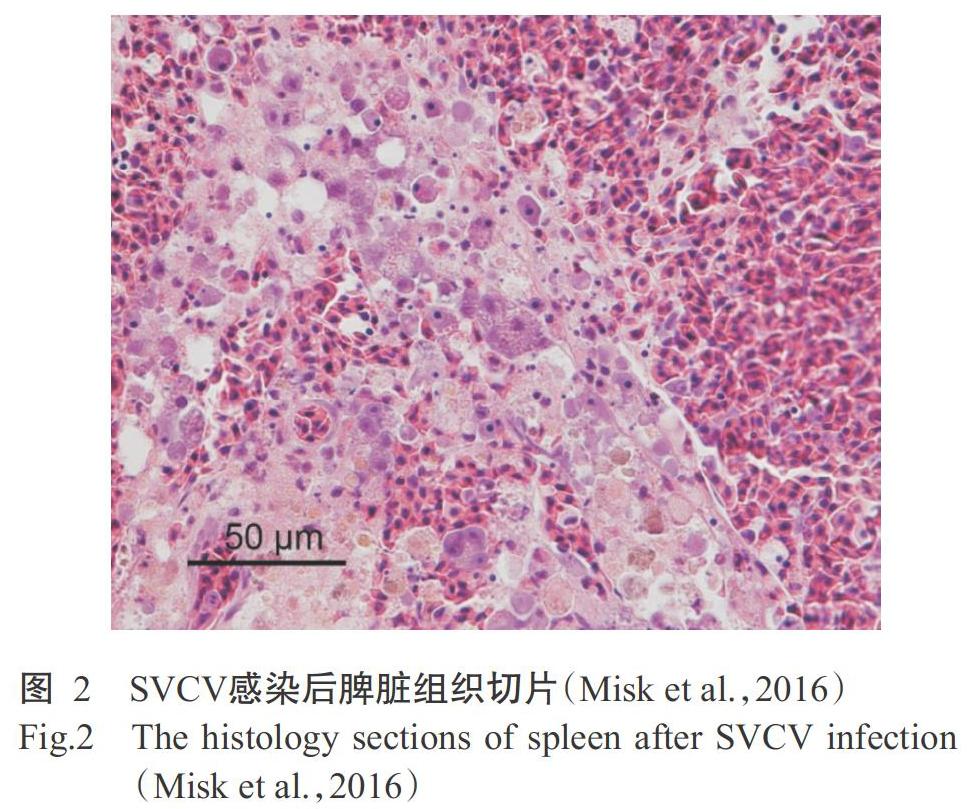
鯉感染SVCV后其體色變暗發黑,腹部腫大,鰓絲無血色,眼球突出,體表出現血色斑點,肌肉由于出血而呈鮮紅色;體內滲透壓遭到破壞,造成臟器出血、腹腔積水,進而引發腹膜炎癥和腸道炎癥,鰾出現血色斑點,部分魚體脾臟腫大(Ghasemi et al.,2014;Misk et al.,2016)。SVCV可在鯉的體內大量增殖,破壞魚體穩態,致使免疫力下降,臨床上常伴隨其他細菌或寄生蟲的繼發感染,且呈大規模暴發流行。SVC的組織病理學變化主要表現為:肝臟血管壁水腫,部分血管壁結構消失,肝實質充血,多灶性壞死及脂肪變性。脾臟水腫,網狀內皮細胞大量增生(Ghasemi et al.,2014);高鐵紅細胞內脂褐質儲存量增加,淋巴管明顯擴張,巨噬細胞和淋巴細胞腫大(圖2),部分細胞破碎(Ahne et al.,2002;Misk et al.,2016)。肝胰腺出現多灶性壞死和非化膿性炎癥,心臟呈心包炎及間斷性肌變性。在腸道中可見血管周炎和絨毛萎縮。體腎出現空泡,且有玻璃樣病變,腎小管堵塞(Misk et al.,2016)。鰾上皮細胞層形成不連續的多層結構,黏膜下層有出血現象(Ahne et al.,2002)。
1. 3 鯉春病毒血癥的診斷與防控
SVC可對鯉養殖業造成重大影響,因此快速檢測鑒定SVCV是控制SVC暴發的關鍵。我國針對SVC的診斷標準為:將病魚組織勻漿10倍梯度稀釋后,接種至生長約24 h的鯉上皮瘤細胞(EPC)、草魚性腺細胞(CO)或胖頭鱥肌肉細胞(FHM)中,接種的細胞板置于(20±2)℃培養箱中培養7 d。若接種勻漿稀釋液的細胞在培養過程中出現細胞病變效應(CPE),則立即采用實時熒光定量PCR、酶聯免疫吸附測定(ELISA)或間接免疫熒光法(IFAT)進行SVCV鑒定。但該方法操作繁瑣,試驗周期較長,難以實現快速檢測;且采用ELISA和IFAT時,SVCV易與其他彈狀病毒發生交叉反應,而導致假陽性結果(Way,1991;Rodák et al.,1993)。單克隆抗體是檢測SVCV的重要工具,但傳統的單克隆抗體制備方法繁雜,且對專業技術水平要求較高(Chen et al.,2008;Luo et al.,2014;Li et al.,2015)。因此,亟待研發新的檢測方法,替代傳統單克隆抗體檢測,實現簡便、快捷檢測鑒定SVCV。Liu等(2013)研發出一種可快速檢測SVCV的新型抗體,其原理是將SVCV特異性抗體可變區的單鏈片段,通過噬菌體表面展示的方法表達于噬菌體表面,而實現對SVCV的快速檢測。
鑒于PCR檢測方法的高靈敏性,已廣泛應用于SVCV檢測。高隆英等(2002)首次報道利用RT-PCR和半嵌套PCR擴增SVCV的糖蛋白基因序列,結果分別擴增獲得長度為714和606 bp的特異核酸序列片段,說明2種方法均可用于SVCV檢測。Koutná等(2003)研究表明,利用RT-PCR與巢式PCR相結合的方法能快速從細胞培養物和魚組織中檢測出SVCV,其靈敏度達10-1 TCID50/mL。傳統的PCR檢測需配備專門的儀器設備及具備熟練的RNA提取操作技術,不利于現場快速診斷。為此,Shimahara等(2016)依據編碼G蛋白基因序列設計一對特異性反轉錄引物,成功建立從魚體組織中精確檢出SVCV的方法,且適用于非實驗室條件下的常規診斷。
目前,SVCV防控的主要策略是嚴格控制疾病暴發期水體環境的穩定性,并及時清除和處理已被感染的病魚。由于病毒寄生于細胞內,至今尚無針對SVC的特效治療藥物,SVCV疫苗研發也還處于實驗室試驗階段。SVCV的G基因能編碼其衣殼糖蛋白,誘導宿主產生免疫應答反應,因此包含G基因的DNA疫苗得到廣泛關注(Kanellos et al.,2006;Emmenegger and Kurath,2008)。Kanellos等(2006)通過檢測10種表達G基因的DNA疫苗,結果發現這些DNA疫苗的免疫保護效果較弱,多數DNA疫苗的相對免疫保護率只有11%~48%。Emmenegger和Kurath(2008)研究證實,基于SVCV南美株G基因設計的DNA疫苗對錦鯉(Cyprinus carpio haematopterus)和金魚(Carassius auratus Linnaeus)具有較好的免疫保護力,其相對免疫保護率均在50%以上。可見,利用G基因設計的DNA疫苗可作為SVCV預防性治療的候選疫苗。
2 錦鯉皰疹病毒病
錦鯉皰疹病毒(Koi herpesvirus,KHV)又稱3型鯉皰疹病毒(Cyprinid herpesvirus 3,CyHV-3)(圖3),屬于異皰疹病毒科(Alloherpesviridae)鯉皰疹病毒屬(Cyprinivirus)(Waltzek et al.,2005;Hedrick et al.,2006)。目前,已分離鑒定出4種鯉皰疹病毒,分別為CyHV-1、CyHV-2、CyHV-3(KHV)及感染淡水鰻鱺(Anguilla japonica)的鰻鱺皰疹病毒(Anguillid herpesvirus 1,AngHV-1)。其中,CyHV-1常被稱為鯉痘瘡病毒,CyHV-2是引起皰疹病毒性造血器官壞死病的病原體。KHV是一種高致病性和高傳染性的病原微生物,通常存在7~15 d的感染潛伏期,鯉感染KHV后7 d內的累計死亡率可達80%以上(劉宗曉等,2006;羅璋等,2018;周瑤佳等,2018)。因其傳播特性和高致病性,OIE已將KHV引發的KHVD列為必須申報的動物疫病之一,也是全球進口檢驗檢疫必檢的疫病;在我國KHV是農業農村部規定的二類動物疫病病原之一。KHV對常見消毒試劑及紫外線的抵抗力較差,經35 ℃作用48 h或60 ℃作用30 min均可使其喪失感染能力。KHV在23 ℃的自然水體中存活不超過21 h,但在魚體分泌物和池塘底泥中存活時間較長。
2. 1 錦鯉皰疹病毒病的發生及流行特點
1998年,美國科學家分別從鯉和錦鯉中首次分離出KHV,之后在歐洲、美洲、非洲和亞洲相繼報道KHVD大規模暴發流行(Haenen et al.,2004;Hedrick et al.,2006)。KHV傳染性強、致死率高,但其宿主范圍單一,僅感染包括鯉在內的少數鯉科魚類,而不感染其他魚類,包括與鯉親緣關系較近的金魚、鰱(Hypophthalmichthys molitrix)、鯽(Carassius caras-sius)、草魚(Ctenopharyngodon idella)及羅非魚(Oreo-chroms mossambcus)等(Bergmann et al.,2010;Michel et al.,2010;Fabian et al.,2013)。KHV可在上述魚體內復制增殖,并將具有感染活力的病毒顆粒釋放到水體環境中,但不會表現出KHV感染的臨床癥狀。鯉對KHV尤為敏感,不同年齡段的鯉均可感染,且成魚較幼魚更易感(Bergmann et al.,2010;Michel et al.,2010)。KHV主要流行于秋季,當養殖水溫維持在18~28 ℃時易發病,在23~28 ℃時極易暴發流行;養殖水溫低于18 ℃時,KHV雖然也感染鯉,但無臨床癥狀,一旦溫度適宜,病毒暴發,帶毒魚體即表現出KHVD的典型臨床癥狀,可造成80%以上的死亡率。
KHV主要依賴于養殖水體進行傳染,水體中的病毒主要通過鰓組織進入魚體,也可通過后腸進入魚體(Gilad et al.,2004;Haenen et al.,2004;Pikarsky et al.,2004)。Costes等(2009)研究認為,KHV主要依賴皮膚進入魚體。但KHV感染48 h內,在無損傷且黏膜覆蓋完好的皮膚中檢測不到KHV;而通過浸泡感染鯉2~5 h,在被感染魚體的鰓組織和腸道中均能檢測到KHV,感染4~6 h后在鰓組織的巨噬細胞和腸道組織的淋巴細胞中也能檢測到KHV(Monaghan et al.,2015)。此外,KHV通過血液循環系統在感染后5~7 d可將病毒粒子運送到機體各組織和器官(Haenen et al.,2004)。
2. 2 錦鯉皰疹病毒病的典型癥狀及組織病理學變化
鯉感染KHV后的典型癥狀為:反應遲鈍,無法正常進食,在水體表面離群散游,或頭朝下懸垂于水面;體表黏液分泌異常,局部發白,部分表皮不分泌黏液,且表現出砂紙樣紋理結構;眼球凹陷,魚鰭出血甚至腐爛;病魚鰓絲末端潰爛(圖4),喪失生理功能,導致呼吸困難;剖開腹腔可觀察到體腎腫大,且伴有腹水(Oh et al.,2001;Gray et al.,2002)。組織病理學研究顯示,鯉感染KHV后其鰓上皮細胞發生退行性病變,在感染細胞中發現核內包涵體。肝臟、脾臟、腎臟和腸道薄壁細胞壞死,且在單核細胞/巨噬細胞內部發現被吞噬的細胞碎片。Hedrick等(2000)研究顯示,鯉感染KHV后其神經元細胞中出現核內包涵體,但在KHV感染過程中神經系統并未參與免疫應答反應。
2. 3 錦鯉皰疹病毒病的診斷與防控
感染KHV后患病鯉臨床癥狀明顯,首先可通過臨床病癥和流行病學進行初步診斷;其次可通過細胞培養技術進行診斷,感染KHV的鯉腦組織細胞系(CCB)經20 ℃培養5 d后可產生特異性細胞病變,具體表現為細胞體積變大,部分細胞發生融合及出現明顯的細胞質空泡化;最后可通過分子生物學技術進行確診,利用巢式PCR或環介導等溫擴增法(Loop-mediated isothernal amplification,LAMP)等分子檢測方法確定鯉是否感染KHV(Gunimaladevi et al.,2004)。我國防控KHV主要采取以預防為主的策略。KHV大規模暴發時應保持水質穩定,養殖水體的溶解氧含量需保持在5 mg/L以上,同時避免拉網及其他作業對魚體產生應激反應。目前,市場僅有一種獲批銷售的KHV商業化疫苗,即以色列生產的弱毒疫苗(KoVax Ltd./Phibro Animal Health Corp.)(Ronen et al.,2003;Perelberg et al.,2005)。此外,一些傳統疫苗和DNA疫苗也正在研發之中,并證實對KHVD有一定預防效果(Rosenkranz et al.,2008;Zhou et al.,2014;Boutier et al.,2015;Klafack et al.,2019;Schroder et al.,2019)。Matras等(2017)研究表明,螺旋藻胞外多糖可有效治療由KHV感染鯉引發的病癥,持續給藥4~6周能顯著降低KHV的感染發病強度。以色列烈日大學Vanderplasschen教授認為防治KHVD最有效的方法是接種疫苗,但KHV疫苗需滿足以下3個方面:(1)研發的KHV疫苗必須適用于大規模接種;(2)疫苗的成本效益比率應盡可能低,生產和管理成本過高是制約漁用疫苗推廣應用的重要因素;(3)疫苗的安全性需得到保證,且能產生較好的免疫效果,即相對免疫保護率接近100%(Boutier et al.,2019)。
3 其他病毒性疾病
3. 1 鯉病毒性浮腫病
鯉病毒性浮腫病(VEC)又稱錦鯉嗜睡病(Koi sleepy disease,KSD),其病原體為鯉浮腫病毒(Carp edema virus,CEV)。CEV是一種雙鏈DNA病毒,屬于痘病毒科(Poxviridae)。1976年CEV在日本首次被發現,隨后在世界各地迅速傳播(Haenen et al.,2014;Jung-Schroers et al.,2015;Swaminathan et al.,2016;Matras et al.,2017)。CEV主要感染鯉和錦鯉,是一種急性感染源,可造成87.5%的感染率及80.0%~100.0%的死亡率。感染CEV的魚體行動緩慢,呼吸功能減弱,常浮頭于水面,或側臥于池塘底部,呈昏睡狀,最終因缺氧而死。病魚體表潰爛,皮下組織水腫,鰓絲無血色、末端潰爛(Miyazaki et al.,2005)。
VEC常暴發于春秋兩季,暴發水溫一般維持在15~25 ℃。但也有研究顯示,當水溫在6~22 ℃時,CEV可感染鯉或錦鯉,并造成流行傳播(Oyamatsu et al.,1997;Amita et al.,2002);而水溫高于28 ℃時,CEV難以感染錦鯉,不會造成VEC大規模暴發流行。目前,尚未發現對CEV敏感的細胞系,故難以獲得大量純化的病毒粒子,而制約CEV基因組測序及其疫苗的研發(Swaminathan et al.,2016)。
3. 2 鯉痘瘡病毒病
鯉痘瘡病毒病(Carp pox disease,CPD)是由CyHV-1感染致病,因此CyHV-1又被稱為鯉痘瘡病毒(Carp pox virus)或乳頭瘤病毒(Papilloma virus)。CyHV-1是一種DNA病毒,與KHV同屬于皰疹病毒科(Alloherpesviridae)鯉皰疹病毒屬(Cyprinivirus)。CyHV-1的病毒核心為二十面體,外面有囊膜包被,病毒粒子核心和囊膜的直徑分別為113和190 nm (Sano et al.,2004)。
CyHV-1于1985年從日本患病錦鯉表皮組織中分離獲得,能感染EPC和FHM,造成這2種細胞系出現CPE,被感染的細胞發生空泡化,且在核內形成包涵體(Sano et al.,1985)。CyHV-1感染鯉的臨床癥狀表現為:感染初期魚體表出現白色斑點,并分泌大量白色黏液,隨著病情發展,體表的白色斑點范圍逐漸擴大,且逐漸凸起,形成增生物。增生物為上皮細胞與結締組織增生形成的乳頭狀凸起,其表面光滑呈石蠟樣或玻璃樣。增生物的主要成分為膠原纖維,能自然脫落,但在脫落部位又會重新出現增生物。CyHV-1常于流行春冬季,暴發流行時的水溫一般在10~16 ℃。當水溫高于22 ℃時,患病魚體能自然痊愈。CyHV-1對成魚的危害較小,其死亡率低于10%,但感染2周齡仔魚的死亡率可高達60%~90%。相對于其他病毒,CyHV-1的致病率和致死率均較低,且危害較小,因此針對CyHV-1的研究較少,通常認為該病毒是通過接觸傳染,但也有研究證實水生寄生蟲是其傳播媒介(Sano et al.,1985)。
4 展望
當前,針對鯉病毒性疾病的防控主要采取消滅傳染源、切斷傳播途徑及保護易感魚群。消滅傳染源是通過對池塘和塘泥進行徹底消毒,發病池塘水體需全面消殺;切斷傳播途徑主要通過加強苗種檢疫,對疫區親魚、苗種和成魚嚴格管控;保護易感魚群主要通過對敏感魚類注射疫苗或提高魚體免疫力。由于缺乏高效的防控方法,因此加強檢疫和免疫防控仍是防控鯉病毒性疾病的主要手段。疫苗的導入方式直接決定其免疫效果。疫苗通過腹腔注射方式導入魚體,可誘導魚體產生抗病毒免疫反應,但這種導入方式對魚體應激較大,且成本較高,難以實現大規模推廣應用(Adelmann et al.,2008)。魚類的黏膜組織在抵御病毒侵染過程中發揮重要作用(Costes et al.,2009;Gomez et al.,2013),但通過腹腔注射方式接種疫苗難以激活黏膜免疫系統。口服疫苗可成功激活魚體黏膜免疫系統,且這種疫苗導入策略已在多個魚種上成功誘導抗病毒免疫應答反應(Chen,2000;Liu et al.,2012),但口服疫苗需抵抗魚體消化系統的侵蝕才能到達后腸而能被黏膜免疫系統識別和吸收,因此,研發新型口服疫苗載體及傳送系統是今后魚類病毒疫苗的重點研究內容之一。
隨著集約化、工廠化養殖模式的推廣普及,尾水排放等環境污染問題日益加劇,同時為病毒性疾病的大暴發流行創造了條件。環境友好型生態養殖模式是水產養殖發展的必然趨勢,生態養殖需具備優良的養殖品種及優質的養殖環境和飼料,同時要構建完善的養殖生態系統。近年來,中藥等植物源藥物在水產養殖中的應用研究逐漸深入。趙倩等(2013)以嗜水氣單胞菌對鯉進行攻毒,結果發現中藥喂食組鯉的死亡率顯著低于基礎飼料組,且魚體溶菌酶活力顯著提高。謝炎福等(2015)研究表明,在黃河鯉基礎飼料中添加中藥制劑能顯著上調魚體超氧化物歧化酶(SOD)活性,同時降低丙二醛(MDA)含量。中藥制劑還具有凈化水質及抑制水體中病原微生物增殖的作用(湯菊芬等,2016;孟彬等,2018)。目前,利用中藥對鯉病毒性疾病進行防治的研究較少,中藥在鯉抵御病毒入侵過程中發揮的作用機理尚有待進一步探究。
KHV可感染多種鯉科近緣魚類,但為何只發展成為病毒攜帶者而不發病?養殖水溫是否是決定病毒感染的關鍵因素?病毒可通過哪些途徑逃避免疫監視而進入魚體?在不同感染階段病毒的傳播方式是否存在差異?可見,鯉病毒性疾病仍存在諸多問題亟待深入研究,以揭示病毒與魚體間的相互作用機理及病毒免疫逃逸的作用機制。近年來,RNA干擾(RNAi)技術在抗病毒藥物研發領域已取得長足進展,并獲準進行下一步臨床試驗(Gotesman et al.,2015)。因此,今后要加強對病毒致病機理和傳染途徑的研究,并基于RNAi技術研制能有效防治病毒性疾病的藥物,以確保我國鯉養殖產業的健康可持續發展。
參考文獻:
陳昌福. 2017. 日本魚病學者福田穎穗關于錦鯉皰疹病毒病和鯉病毒性浮腫病的癥狀描述與防控措施[J]. 當代水產,42(11):86-88. doi:10.3969/j.issn.1674-9049.2017.11. 029. [Chen C F. 2017. Description of symptoms and prevention and control measures of koi herpesvirus disease and koi viral edema disease by Yoshiho Fukuda,a Japanese fish disease scholar[J]. Current Fisheries,42(11):86-88.]
高隆英,史秀杰,劉葒,江育林. 2002. 用RT-PCR法快速檢測鯉春病毒血癥病毒基因[J]. 水生生物學報,26(5):452-456. doi:10.3321/j.issn:1000-3207.2002.05.005. [Gao L Y,Shi X J,Liu H,Jiang Y L. 2002. Detection of spring viremia of carp virus(SVCV) gene using reverse-polymerase chain-reaction(RT-PCR)[J]. Acta Hydrobiologica Sinica,26(5):452-456.]
劉宗曉,劉葒,江育林. 2006. 錦鯉皰疹病毒病的研究進展[J]. 檢驗檢疫科學,16(4):77-80. [Liu Z X,Liu H,Jiang Y L. 2006. Research progress of koi herpesvirus disease[J]. Quality Safety Inspection and Testing,16(4):77-80.]
羅璋,郝爽,張振國,孟一耕,史謝堯,馮守明. 2018. 錦鯉皰疹病毒天津株的分離與鑒定[J]. 水產學報,42(4):575-585. doi:10.11964/jfc.20170410788. [Luo Z,Hao S,Zhang Z G,Meng Y G,Shi X Y,Feng S M. 2018. Isolation and characterization of a strain of koi herpesvirus from diseased koi in Tianjin[J]. Journal of Fisheries of China,42(4):575-585.]
孟彬,孫敬鋒,呂愛軍. 2018. 發酵中草藥在水產養殖中的應用[J]. 水產科學,37(3):421-426. doi:10.16378/j.cnki. 1003-1111.2018.03.023. [Meng B,Sun J F,Lü A J. 2018. Application of fermented chinese herbal medicine in aquaculture[J]. Fisheries Science,37(3):421-426.]
湯菊芬,黃瑜,蔡佳,丘金珠,孫建華,徐中文,簡紀常. 2016. 中草藥復合微生態制劑對吉富羅非魚(Oreochromis niloticus)生長、腸道菌群及抗病力的影響[J]. 漁業科學進展,37(4):104-109. doi:10.11758/yykxjz.20150810002. [Tang J F,Huang Y,Cai J,Qiu J Z,Sun J H,Xu Z W,Jian J C. 2016. Effects of a compound probiotics combined with chinese herbal medicine on growth performance,intestinal flora and resistance to diseases of GIFT strain of Nile tilapia(Oreochromis niloticus)[J]. Progress in Fishery Sciences,37(4):104-109.]
謝炎福,代春梅,杜亞. 2015. 益生菌發酵復方中藥對黃河鯉生長性能和免疫性能的影響[J]. 黑龍江畜牧獸醫,(8):198-200. [Xie Y F,Dai C M,Du Y. 2015. Effects of probiotics fermentation compound Chinese herbs on growth performance and immune performance of yellow river carp[J]. Heilongjiang Animal Science and Veterinary Me-dicine,(8):198-200.]
趙倩,陳玉春,谷巍,李丕武. 2013. 益生菌發酵中草藥對鯉魚生長指標、生化指標及抗病力的影響[J]. 飼料與畜牧,(5):31-34. [Zhao Q,Chen Y C,Gu W,Li P W. 2013. Effects of Chinese herbs fermentation with probiotics on growth indexes,biochemical indexes and disease resistance of Cyprinus carpio[J]. Animal Agriculture,(5):31-34.]
周瑤佳,涂尊方,稅斐,陽瑞雪,汪開毓,耿毅,黃小麗,歐陽萍. 2018. 溫度對錦鯉皰疹病毒體外培養和致病性的影響[J]. 華南農業大學學報,39(4):20-24. doi:10.7671/j.issn.1001-411X.2018.04.004. [Zhou Y J,Tu Z F,Shui F,Yang R X,Wang K Y,Geng Y,Huang X L,Ouyang P. 2018. Effects of temperature on culture in vitro and pathogenicity of Cyprinid herpesvirus 3[J]. Journal of South China Agricultural University,39(4):20-24.]
朱霞,王好,李新偉,周井祥. 2011. 錦鯉皰疹病毒病的研究進展[J]. 中國獸醫科學,41(1):106-110. doi:10.16656/j.issn.1673-4696.2011.01.020. [Zhu X,Wang H,Li X W,Zhou J X. 2011. Advances in koi herpesvirus disease[J]. Chinese Veterinary Science,41(1):106-110.]
Adelmann M,K?llner B,Bergmann S M,Fischer U,Lange B,Weitschies W,Enzmann P J,Fichtner D. 2008. Development of an oral vaccine for immunisation of rainbow trout(Oncorhynchus mykiss) against viral haemorrhagic septicaemia[J]. Vaccine 26(6):837-844. doi:10.1016/j.vaccine.2007.11.065.
Ahne W. 1986. The influence of environmental temperature and infection route on the immune response of carp (Cyprinus carpio) to spring viremia of carp virus(SVCV)[J]. Veterinary Immunology and Immunopathology,12(1-4):383-386. doi:10.1016/0165-2427(86)90144-3.
Ahne W,Bjorklund H V,Essbauer S,Fijan N,Kurath G,Winton J R. 2002. Spring viremia of carp(SVC)[J]. Diseases of Aquatic Organisms,52(3):261-272. doi:10.3354/dao 052261.
Amita K,Oe M,Matoyama H,Yamaguchi N,Fukuda H. 2002. A survey of koi herpesvirus and carp edema virus in colorcarp cultured in Niigata Prefecture,Japan[J]. Fish Pathology,37(4):197-198. doi:10.3147/jsfp.37.197.
Ashraf U,Ye J,Ruan X D,Wan S F,Zhu B B,Cao S B. 2015. Usutu virus:An emerging flavivirus in Europe[J]. Viruses,7(1):219-238. doi:10.3390/v7010219.
Basic A,Schachner O,Bilic I,Hess M. 2009. Phylogenetic analysis of spring viraemia of carp virus isolates from Austria indicates the existence of at least two subgroups within genogroup Id[J]. Diseases of Aquatic Organisms,85(1):31-40. doi:10.3354/dao02069.
Bergmann S M,Jin Y,Franzke K,Grunow B,Wang Q,Klafack S. 2020. Koi herpesvirus(KHV) and KHV disease (KHVD)-a recently updated overview[J]. Journal of App-lied Microbiology,129(1):98-103. doi:10.1111/jam. 14616.
Bergmann S M,Sadowski J,Kie?piński M,Bart?omiejczyk M,Fichtner D,Riebe R,Lenk M,Kempter J. 2010. Susceptibility of koi×crucian carp and koi×goldfish hybrids to koi herpesvirus(KHV) and the development of KHV di-sease(KHVD)[J]. Journal of Fish Diseases,33(3):267-272. doi:10.1111/j.1365-2761.2009.01127.x.
Boutier M,Gao Y,Donohoe O,Vanderplasschen A. 2019. Current knowledge and future prospects of vaccines against cyprinid herpesvirus 3(CyHV-3)[J]. Fish and Shellfish Immunology,93:531-541. doi:10.1016/j.fsi.2019.07.079.
Boutier M,Ronsmans M,Ouyang P,Fournier G,Reschner A,Rakus K,Wilkie G S,Farnir F,Bayrou C,Lieffrig F,Li H,Desmecht D,Davison A J,Vanderplasschen A. 2015. Rational development of an attenuated recombinant cyprinid herpesvirus 3 vaccine using prokaryotic mutagenesis and in vivo bioluminescent imaging[J]. PLoS Pathogens,11(2):e1004690. doi:10.1371/journal.ppat.1004690.
Chen H. 2000. Recent advances in mucosal vaccine development[J]. Journal of Controlled Release,67(2-3):117-128. doi:10.1016/s0168-3659(00)00199-1.
Chen Z Y,Liu H,Li Z Q,Zhang Q Y. 2008. Development and characterization of monoclonal antibodies to spring viraemia of carp virus[J]. Veterinary Immunology and Immunopathology,123(3-4):266-276. doi:10.1016/j.ve-timm.2008.02.011.
Costes B,Raj V S,Michel B,Fournier G,Thirion M,Gillet L,Mast J,Lieffrig F,Bremont M,Vanderplasschen A. 2009. The major portal of entry of koi herpesvirus in Cyprinus carpio is the skin[J]. Journal of Virology,83(7):2819-2830. doi:10.1128/JVI.02305-08.
Emmenegger E,Kurath G. 2008. DNA vaccine protects ornamental koi(Cyprinus carpio koi) against North American spring viremia of carp virus[J]. Vaccine,26(50):6415-6421. doi:10.1016/j.vaccine.2008.08.071.
Fabian M,Baumer A,Steinhagen D. 2013. Do wild fish species contribute to the transmission of koi herpesvirus to carp in hatchery ponds?[J]. Journal of Fish Diseases,36(5):505-514. doi:10.1111/jfd.12016.
Ghasemi M,Zamani H,Hosseini S M,Karsidani S H,Bergmann S M. 2014. Caspian white fish(Rutilus frisii kutum) as a host for spring viraemia of carp virus[J]. Veterinary Microbiology,170(3-4):408-413. doi:10.1016/j.vetmic. 2014.02.032.
Gilad O,Yun S S,Zagmutt-Vergara F J,Leutenegger C M,Bercovier H,Hedrick R P. 2004. Concentrations of a koi herpesvirus(KHV) in tissues of experimentally infected Cyprinus carpio koi as assessed by real-time TaqMan PCR[J]. Diseases of Aquatic Organisms,60(3):179-187. doi:10.3354/dao060179.
Gomez D,Sunyer J O,Salinas I. 2013. The mucosal immune system of fish:The evolution of tolerating commensals while fighting pathogens[J]. Fish and Shellfish Immuno-logy,35(6):1729-1739. doi:10.1016/j.fsi.2013.09.032.
Gotesman M,Soliman H,Besch R,Elmatbouli M. 2015. Inhibition of spring viraemia of carp virus replication in an Epithelioma papulosum cyprini cell line by RNAi[J]. Journal of Fish Diseases,38(2):197-207. doi:10.1111/jfd. 12227.
Gray W L,Mullis L,LaPatra S E,Groff J M,Goodwin A. 2002. Detection of koi herpesvirus DNA in tissues of infected fish[J]. Journal of Fish Diseases,25(3):171-178. doi:10.1046/j.1365-2761.2002.00355.x.
Gunimaladevi I,Kono T,Venugopal M N,Sakai M. 2004. Detection of koi herpesvirus in common carp,Cyprinus carpio L.,by loop-mediated isothermal amplification[J]. Journal of Fish Diseases,27(10):583-589. doi:10.1111/j.1365- 2761.2004.00578.x.
Haenen O,Way K,Bergmann S M,Ariel E. 2004. The emergence of koi herpesvirus and its significance to European aquaculture[J]. Bulletin of the European Association of Fish Pathologists,24(6):293-307.
Haenen O,Way K,Stone D,Engelsma M. 2014. Koi sleepy disease(KSD) door ‘carp edema virus:Eerste detectie in Nederlandse koi[J]. Koi Wijzer,113:65-67.
Hedrick R P,Gilad O,Yun S,Spangenberg J V,Marty G D,Nordhausen R W,Kebus M J,Bercovier H,Eldar A. 2000. A herpesvirus associated with mass mortality of juvenile and adult koi,a strain of common carp[J]. Journal of Aquatic Animal Health,12(1):44-57. doi:10.1577/1548-8667(2000)012<0044:AHAWMM>2.0.CO;2.
Hedrick R P,Waltzek T B,McDowell T S. 2006. Susceptibility of koi carp,common carp,goldfish,and goldfish×common carp hybrids to cyprinid herpesvirus-2 and herpesvirus-3[J]. Journal of Aquatic Animal Health,18(1):26-34. doi:10.1577/H05-028.1.
Hoffmann B,Beer M,Schütze H,Mettenleiter T C. 2005. Fish rhabdoviruses:Molecular epidemiology and evolution[J]. Current Topics in Microbiology and Immunology,292(1):81-117. doi:10.1007/3-540-27485-5_5.
Jung-Schroers V,Adamek M,Teitge F,Hellmann J,Bergmann S M,Schütze H,Kleingeld D W,Way K,Stone D M,Runge M,Keller B,Hesami S,Waltzek T,Steinhagen D. 2015. Another potential carp killer?:Carp edema virus di-sease in Germany[J]. BMC Veterinary Research,11(1):114. doi:10.1186/s12917-015-0424-7.
Kanellos T,Sylvester I D,DMello F,Howard C R,Mackie A,Dixon P F,Chang K C,Ramstad A,Midtlyng P J,Russell P H. 2006. DNA vaccination can protect Cyprinus carpio against spring viraemia of carp virus[J]. Vaccine,24(23):4927-4933. doi:10.1016/j.vaccine.2006.03.062.
Klafack S,Fiston-Lavier A S,Bergmann S M,Hammoumi S,Schr?der L,Fuchs W,Lusiastuti A M,Lee P Y,Heredia S V,Consortium M S,Gosselin-Grenet A S,Avarre J C. 2019. Cyprinid herpesvirus 3 evolves in vitro through an assemblage of haplotypes that alternatively become dominant or under-represented[J]. Viruses,11(8):754. doi:10.3390/v11080754.
Koutná M,Vesel? T,Psikal I,H?lová J. 2003. Identification of spring viraemia of carp virus(SVCV) by combined RT-PCR and nested PCR[J]. Diseases of Aquatic Orga-nisms,55(3):229-235. doi:10.3354/dao055229.
Li Z M,Zhang Q,Luo P X,Liu G X,Wang M,Liu X Q. 2015. Monoclonal antibody against M protein of spring viremia of carp virus[J]. Monoclonal Antibodies in Immunodiagnosis and Immunotherapy,34(2):122-125. doi:10.1089/mab.2014.0056.
Liu H,Zheng X C,Zhang F,Li Y,Zhang X H,Dai H P,Hua Q Y,Shi X J,Lan W S,Jia P,Yuan L. 2013. Selection and characterization of single-chain recombinant antibo-dies against spring viraemia of carp virus from mouse phage display library[J]. Journal of Virological Methods,194(1-2):178-184. doi:10.1016/j.jviromet.2013.08.017.
Liu M,Zhao L L,Ge J W,Qiao X Y,Li Y J,Liu D Q. 2012. Immunogenicity of Lactobacillus-expressing VP2 and VP3 of the infectious pancreatic necrosis virus(IPNV) in rainbow trout[J]. Fish and Shellfish Immunology,32(1):196-203. doi:10.1016/j.fsi.2011.11.015.
Luo P X,Ruan X D,Zhang Q,Li Z M,Wang M,Liu X Q. 2014. Monoclonal antibodies against G protein of spring viremia of carp virus[J]. Monoclonal Antibodies in Immunodiagnosis and Immunotherapy,33(5):340-343. doi:10.1089/mab.2014.0025.
Matras M,Borzym E,Stone D,Way K,Stachnik M,Maj-Paluch J,Palusińska M,Reichert M. 2017. Carp edema virus in polish aquaculture-evidence of significant sequence divergence and a new lineage in common carp Cyprinus carpio(L.)[J]. Journal of Fish Diseases,40(3):319-325. doi:10.1111/jfd.12518.
Michel B,Leroy B,Raj V S,Lieffrig F,Mast J,Wattiez R,Vanderplasschen A F,Costes B. 2010. The genome of cyprinid herpesvirus 3 encodes 40 proteins incorporated in mature virions[J]. The Journal of General Virology,91(2):452-462. doi:10.1099/vir.0.015198-0.
Miller O,Fuller F J,Gebreyes W A,Lewbart G A,Shchelkunov I S,Shivappa R B,Joiner C,Woolford G,Stone D M,Dixon P F,Raley M E,Levine J F. 2007. Phylogene-tic analysis of spring virema of carp virus reveals distinct subgroups with common origins for recent isolates in North America and the UK[J]. Diseases of Aquatic Organisms,76(3):193-204. doi:10.3354/dao076193.
Misk E,Garver K,Nagy E,Isaac S,Tubbs L,Huber P,Al-Hussinee L,Lumsden J S. 2016. Pathogenesis of spring viremia of carp virus in emerald shiner Notropis atherinoides Rafinesque,fathead minnow Pimephales promelas Rafinesque and white sucker Catostomus commersonii (Lacepede)[J]. Journal of Fish Diseases,39(6):729-739. doi:10.1111/jfd.12405.
Miyazaki T,Isshiki T,Katsuyuki H. 2005. Histopathological and electron microscopy studies on sleepy disease of koi Cyprinus carpio koi in Japan[J]. Diseases of Aquatic Organisms,65(3):197-207. doi:10.3354/dao065197.
Monaghan S J,Thompson K D,Adams A,Kempter J,Bergmann S M. 2015. Examination of the early infection sta-ges of koi herpesvirus(KHV) in experimentally infected carp,Cyprinus carpio L. using in situ hybridization[J]. Journal of Fish Diseases,38(5):477-489. doi:10.1111/jfd.12260.
Nakajima T,Hudson M J,Uchiyama J,Makibayashi K,Zhang J Z. 2019. Common carp aquaculture in Neolithic China dates back 8,000 years[J]. Nature Ecology and Evolution,3(10):1415-1418. doi:10.1038/s41559-019-0974-3.
Oh M J,Jung S J,Choi T J,Kim H R,Rajendran K V,Kim Y J,Park M A,Chun S K. 2001. A viral disease occurring in cultured carp Cyprinus carpio in Korea[J]. Fish Pathology,36(3):147-151. doi:10.3147/jsfp.36.147.
Oyamatsu T,Matoyama H,Yamamoto K Y,Fukuda H. 1997. A trial for the detection of carp edema virus by using polymerase chain reaction[J]. Aquaculture Science,45(2):247-251. doi:10.11233/aquaculturesci1953.45.247.
Perelberg A,Ronen A,Hutoran M,Smith Y,Kotler M. 2005. Protection of cultured Cyprinus carpio against a lethal viral disease by an attenuated virus vaccine[J]. Vaccine,23(26):3396-3403. doi:10.1016/j.vaccine.2005.01.096.
Pikarsky E,Ronen A,Abramowitz J,Levavi-Sivan B,Hutoran M,Shapira Y,Steinitz M,Perelberg A,Soffer D,Kotler M. 2004. Pathogenesis of acute viral disease induced in fish by carp interstitial nephritis and gill necrosis virus[J]. Journal of Virology,78(17):9544-9551. doi:10.1128/ JVI.78.17.9544-9551.2004.
Rodák L,Pospí?il Z,Tomanek J,Vesel? T,Obr T,Valí?ek L. 1993. Enzyme-linked immunosorbent assay (ELISA) for the detection of spring viraemia of carp virus (SVCV) in tissue homogenates of the carp,Cyprinus carpio L.[J]. Journal of Fish Diseases,16(2):101-111. doi:10.1111/ j.1365-2761.1993.tb00853.x.
Ronen A,Perelberg A,Abramowitz J,Hutoran M,Tinman S,Bejerano I,Steinitz M,Kotler M. 2003. Efficient vaccine against the virus causing a lethal disease in cultured Cyprinus carpio[J]. Vaccine,21(32):4677-4684. doi:10.1016/ s0264-410X(03)00523-1.
Rosenkranz D,Klupp B G,Teifke J P,Granzow H,Fichtner D,Mettenleiter T C,Fuchs W. 2008. Identification of envelope protein pORF81 of koi herpesvirus[J]. The Journal of General Virology,89(4):896-900. doi:10.1099/vir. 0.83565-0.
Sano M,Ito T,Kurita J,Takanori Y,Watanabe N,Miwa S,Iida T. 2004. First detection of koi herpesvirus in cultured common carp Cyprinus carpio in Japan[J]. Fish Pathology,39(3):165-167. doi:10.3147/jsfp.39.165.
Sano T,Fukuda H,Furukawa M. 1985. Herpesvirus cyprini:Biological and oncogenic properties[J]. Fish Pathology,20(2/3):381-388. doi:10.3147/jsfp.20.381.
Schroder L,Klafack S,Bergmann S M,Fichtner D,Jin Y,Lee P Y,H?per D,Mettenleiter T C,Fuchs W. 2019. Generation of a potential koi herpesvirus live vaccine by simultaneous deletion of the viral thymidine kinase and dUTPase genes[J]. The Journal of General Virology,100(4): 642-655. doi:10.1099/jgv.0.001148.
Shimahara Y,Kurita J,Nishioka T,Kiryu I,Yuasa K,Sakai T,Oseko N,Sano M,Dixon P. 2016. Development of an improved RT-PCR for specific detection of spring viraemia of carp virus[J]. Journal of Fish Diseases,39(3):269-275. doi:10.1111/jfd.12357.
Stone D M,Kerr R C,Hughes M,Radford A D,Darby A C. 2013. Characterisation of the genomes of four putative vesiculoviruses:Tench rhabdovirus,grass carp rhabdovirus,perch rhabdovirus and eel rhabdovirus European X[J]. Archives of Virology,158(11):2371-2377. doi:10. 1007/s00705-013-1711-x.
Swaminathan T R,Kumar R,Dharmaratnam A,Basheer V S,Sood N,Pradhan P K,Sanil N K,Vijayagopal P,Jena J K. 2016. Emergence of carp edema virus in cultured ornamental koi carp,Cyprinus carpio koi,in India[J]. The Journal of General Virology,97(12):3392-3399. doi:10. 1099/jgv.0.000649.
Teng Y,Liu H,Lü J Q,Fan W H,Zhang Q Y,Qin Q W. 2007. Characterization of complete genome sequence of the spring viremia of carp virus isolated from common carp(Cyprinus carpio) in China[J]. Archives of Virology,152(8):1457-1465. doi:10.1007/s00705-007-0971-8.
Waltzek T B,Kelley G O,Stone D M,Way K,Hanson L,Fukuda H,Hirono I,Aoki T,Davison A J,Hedrick R P. 2005. Koi herpesvirus represents a third cyprinid herpesvirus(CyHV-3) in the family Herpesviridae[J]. The Journal of General Virology,86(6):1659-1667. doi:10.1099/vir.0.80982-0.
Warg J V,Dikkeboom A L,Goodwin A E,Snekvik K,Whitney J. 2007. Comparison of multiple genes of spring viremia of carp viruses isolated in the United States[J]. Virus Genes,35(1):87-95. doi:10.1007/s11262-006-0042-3.
Way K. 1991. Rapid detection of SVC virus antigen in infec-ted cell cultures and clinically diseased carp by the enzyme-linked immunosorbent assay (ELISA)[J]. Journal of Applied Ichthyology,7(2):95-107. doi:10.1111/j.1439- 0426.1991.tb00515.x.
Zhang Q Y,Gui J F. 2015. Virus genomes and virus-host interactions in aquaculture animals[J]. Science China. Life Sciences,58(2):156-169. doi:10.1007/s11427-015-4802-y.
Zhou J X,Xue J D,Wang Q J,Zhu X,Li X W,Lü W L,Zhang D M. 2014. Vaccination of plasmid DNA enco-ding ORF81 gene of CJ strains of KHV provides protection to immunized carp[J]. In Vitro Cellular and Deve-lopmental Biology. Animal,50(6):489-495. doi:10.1007/s11626-014-9737-2.
(責任編輯 蘭宗寶)
猜你喜歡
環球時報(2022-04-25)2022-04-25 17:20:21
今日農業(2021年4期)2021-11-27 08:41:35
今日農業(2021年15期)2021-10-14 08:20:18
今日農業(2021年6期)2021-06-09 08:05:12
學生天地(2020年8期)2020-08-25 09:11:52
人大建設(2020年3期)2020-07-27 02:48:40
人大建設(2020年2期)2020-07-27 02:47:58
人大建設(2020年2期)2020-07-27 02:47:54
今日農業(2019年14期)2019-09-18 01:21:44
基層中醫藥(2018年4期)2018-08-29 01:25:48