
Constraints on the kinetic energy of type-Ic supernova explosion from young PSR J1906+0746 in a double neutron star candidate?
2021-06-26 03:31:26YiYanYang楊佚沿ChengMinZhang張承民JianWeiZhang張見微andDeHuaWang王德華
Chinese Physics B 2021年6期
Yi-Yan Yang(楊佚沿) Cheng-Min Zhang(張承民) Jian-Wei Zhang(張見微) and De-Hua Wang(王德華)
1School of Physics and Electronic Sciences,Guizhou Education University,Guiyang 550018,China
2CAS Key Laboratory of FAST,National Astronomical Observatories,Chinese Academy of Sciences(CAS),Beijing 100012,China
3Astronomy Department,Beijing Normal University,Beijing 100875,China
4School of Physics and Electronic Sciences,Guizhou Normal University,Guiyang 550001,China
Keywords: neutron star,pulsar,astrophysics,high energy astrophysical phenomena
1. Introduction
The PSR J1906+0746, with a highly compact orbit, was discovered by Lorimeret al.using the Arecibo L-band Feedhorn Array(ALFA).[1]It is generally assumed to be a double neutron star(DNS)rather than neutron star–white dwarf system,although an alternative possibility is that the first-formed object could be a white dwarf.[2,3]Furthermore,the possibility that such a pulsar could in fact be strange quark stars also cannot be expelled.[4,5]Several studies have been carried out on this candidate DNS since its discovery.[1–3]Due to the companion mass, the substantial eccentricity of the binary orbit,the small spin-down age,the significant spin-down energy loss rate, and the relatively higher magnetic field, it is suggested that the pulsar in this DNS system could be a non-recycled and second-born neutron star(NS).[6]The recycled one should be an unusual pulsar or a potential candidate for another new double pulsar system.
The short-period orbit of DNS makes it valuable to allow exquisite tests of Einstein’s theory of general relativity and its prediction of the gravitational waves.[7]In addition, the coalescence of DNSs has been detected as the gravitational-wave(GW) source by LIGO.[8]It was suggested that the galactic birthrate of binaries similar to PSR J1906+0746 is about 60 Myr?1in the context of a simple calculation,which implies that PSR J1906+0746 will play an important role for predicting the inspiral rates of compact binary systems.[1,9]Because of its high magnetic field(~1012Gs,1 Gs=10?4T)and the lowest characteristics age (~113 kyr), PSR J1906+0746 offers unique insights and powerful constraints on our physical understanding of the formation process of compact objects and the path of binary star evolution.
A degenerate ONeMg core is formed for the 8M⊙–10M⊙star,in which the electron captures on24Mg and20Ne trigger the collapse of such a degenerate core.[10]When the ONeMg core mass approaches the Chandrasekhar mass, the core will collapse to a low-mass and -kick NS.[11]This type of supernova(SN)is called an“electron capture SN”.[12]It is argued that these low-mass NSs were formed by the electron capture collapse of the degenerate ONeMg cores of helium stars less massive than about 3.5M⊙.[13]The low eccentricity (0.085)of the orbit of PSR J1906+0746 indicates that the second-born NS received hardly any velocity kick at its birth. In combination with the low mass and higher magnetic field of the secondborn NS,it suggests that PSR J1906+0746 originated from an electron-capture collapse of a degenerate ONeMg core.[3]Its energy released during formation should not be higher than 1051erg of the usual SN-type Ic. The discovery of SN 2014ft,a type Ic SN with a fast-evolving light curve,indicates that it has an extremely low ejecta mass(≈0.2M⊙)and low kinetic energy(2×1050erg).[14]We interpret SN 2014ft as evidence for ultra-stripped SN that form NS in compact binary systems.
This manuscript is organized as follows: In Section 2,we will present more arguments for the second-form NS in PSR J1906+0746 on its forming by the electron-capture SN.In Section 3, we will discuss the mass loss during the formation of non-recycled pulsar, and give the energy limit for SN during electron capture. Finally,we will present conclusions and discussions in Section 4.
2. Evidence of electron-capture supernova
Until now, approximately 2700 pulsars have been detected in the ATNF Pulsar Catalogue,readers can refer to the following URL:
(https://www.atnf.csiro.au/research/pulsar/psrcat/).[15]
And, almost 400 supernova remnants (SNR) have been discovered in the Milky Way,but only approximately 100 pulsars are associated with SNRs,readers can refer to the following URL:
(http://www.physics.umanitoba.ca/snr/SNRcat/).[16]
We cross checked all of the SNRs,and no SNR matched the locations of PSR J1906+0746. Our explanation is as follows. The energy of a regular SN explosion is far greater than that of an electron-capture SN, and signs of radio emissions for SN explosions are easier to be detected. However,no x-ray photons have been observed near the J1906+0746 radio position.[4]This also confirmed that there is no SNR around PSR J1906+0746. If PSR J1906+0746 were the product of an SN explosion of massive core,then it would be most likely to produce a detectable SNR born in such a short time(~113 kyr)and a distance from 5 kpc to 10 kpc.
DNSs are not disrupted in the case of two SNs,this places strict limits on the nature of these systems’second SN explosion. By studying the recycling scenario of the double pulsar system,[17]the first-formed NS was spun up by transferring angular momentum from its companion, as a consequence, it will be more rapid rotation,then the second-formed NS,with a slower spin period,formed during the secondary SN explosion involving in electron capture or ultra-stripped type.[18–20]PSR J1906+0746 was originated from a high-mass x-ray binary(HMXB), which has undergone common-envelope phases.[2]The long-time interaction between the common-envelope and companion leads to a circularized orbit, resulting in faster spin-up NS. And the second-born, non-recycled NS detected with small mass, low eccentricity and velocity, higher magnetic field is formed in an electron capture SN explosion.[20]
According to the previous theoretical researches of DNS formation,[17]we briefly describe the evolution process of PSR J1906+0746 in the following. Two main sequence(MS)stars with masses of 8M⊙–12M⊙evolve as an observable HMXB after the first SN explosion.[20]In this stage, the more massive MS star experiences an SN to form an NS with the high magnetic field of about 1012Gs–1013Gs and spin period of 20 ms,like the initial case of Crab pulsar,and the orbital scale of binary system must be so close to ensure mass transfer. A HMXB system will form a PSR J1906+0746-like DNS system after the second MS star evolves to an NS,while the low-mass MS star (e.g.,~8.8M⊙) expands with Roche-lobe overflow and makes such a system unstable. The Roche-lobe overflow makes the magnetic field of unseen recycled NS(first-born)in PSR J1906+0746 decay two magnitude orders, and its spin period decreases to~10 ms–20 ms.[3]The un-stable mass transfer will result in a common envelope,in which it engulfs the first-born NS, and then it spirals in toward the common envelope. Dynamical friction makes NS spin faster and the companion triggers an ultra-stripped SN, leaving behind an NS with the remaining He core companion.[21]The He star then undergoes an SN, and the binary system eventually survives as a PSR J1906+0746-like system, with a short period recycled pulsar with magnetic fieldB ~1012Gs–1013Gs and spin periodP ~20 ms–50 ms,and a non-recycled pulsar(PSR J1906+0746)with magnetic field of about~1012Gs and spin period of 20 ms–30 ms that evolves to its present value of 144 ms by the magnetic dipole radiation.
The evolutionary trajectory of the magnetic fieldversusspin period of PSR J1906+0746 is shown in Fig. 1. In PSR J1906+0746 binary system, the magnetic field of the firstformed pulsar is likely to occur at~1012Gs at birth. After a period of evolution, the companion star (e.g.about 8M⊙–10M⊙) evolves and accretion happens, while the magnetic field of the first born NS decays to~109Gs by accreting matter of about 0.01M⊙from the companion. Later on, the companion occurs an electron capture SN, while the second NS is born with the normal magnetic field of~1012Gs.Thus,the DNS system survives with a pair of NSs,a short period recycled pulsar(first born)with magnetic field~109Gs,and a non-recycled pulsar(second born)with magnetic field of about 1012Gs.[22]

Fig.1. Diagram of magnetic field versus spin period of DNS,where the spin periods of three NSs(J1906+0746,J1755-2550,and 0737-3039B)are greater than 100 ms with the strong magnetic fields of about 1012 Gs.[1,23–25]The two blue solid arrow lines represent the general evolutionary trajectories of PSR J1906+0746, where PSR-A (PSR-B) stands for the recycled (non-recycled)NS.Dashed,dotted,and dashed–dot lines represent the characteristic ages of 105 yr,107 yr,and 109 yr,respectively,and two straight solid lines,from the upper to lower,stand for the spin-up lines with the accretion rates of 1018 g/s and 1015 g/s.[11]
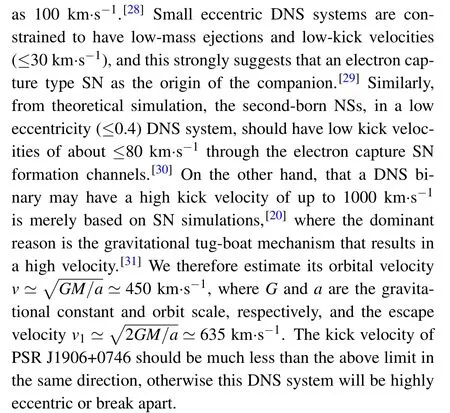
To prove the concept of the symmetric SN, several theoretical studies and simulations have been carried out, but there is currently no observational evidence to test them.[26]PSR J1906+0746 should have a much smaller kick velocity,which can be supported by the following arguments. Based on observational data, the average velocity of the proper motion for 322 pulsars is about 400(40) km·s?1.[27]Then,for the binary pulsars, their velocities are usually as low
We adopted a publicly available code dart board to simulate the kick velocity generated during the SN explosion for PSR J1906+0746, in which the Markov chain Monte Carlo methods wereused, readers canrefer to the following URL:(https://dart-board.readthedocs.io/en/latest/).[32]We obtained the kick velocity ranging from 5 km/s to 560 km/s at 99%level(also see Fig. 2). This simulation result of PSR J1906+0746 is consistent with that of previous work, where the kick velocity ranging from 5 km/s and 170 km/s is at 60%level,and from 5 km/s to 510 km/s is at 95% level.[33]Therefore, both simulations indicate that the kick velocity of PSR J1906+0746 has a relatively low value with high confidence level.

Fig.2. The one-dimensional(1D)histograms among the eight simulation parameters,involving the binary components initial masses: M1,i and M2,i;the initial separation,ai; the initial eccentricity,ei; the SN natal kick magnitude vk,the kick polar and azimuthal angle(θk and φk),and the system age(ti).The posterior distribution that produces PSR J1906+0746 is obtained by means of the code dart board. The three input parameters are the primary mass(M1),the secondary mass(M2)and the current orbital eccentricity of PSR J1906+0746 on the usage of dart board.[32]
3. Energy restriction
3.1. Theoretical calculation of exploding energy
During the formation of DNS,the new-born NS forming at second core collapse determined their final orbital characteristics due to mass loss and SN kick. If SN explosion is symmetric,we can obtain the expression for the pre-supernova mass of helium star(HeS)Mc,t,[20]

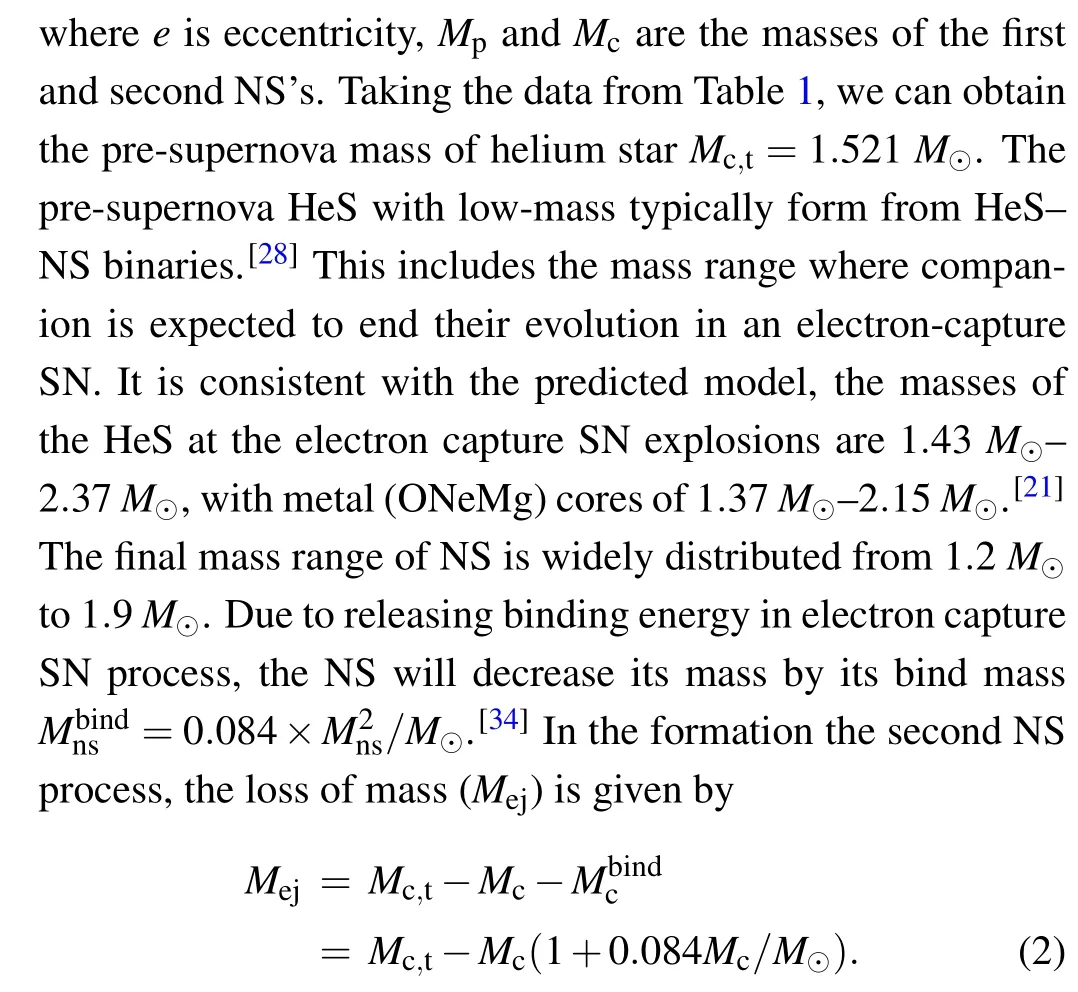
The loss mass is about 0.09M⊙for PSR J1906+0746.
New-born NS originated from low-mass SN explosions(including ultra-stripped SN[18])can be expected to have very small kick velocities,with very thin envelopes around their degenerate ONeMg or low mass iron cores. The SN is expected to release very low energy of the order of 1050erg. The explosion energy and NS baryon mass by performing neutrino radiation hydrodynamics simulations had been calculated,and the results matched well the model parameters from fitting light curves of SN 2005ek[19]. In the process of forming DNS,the mass of companion is about 1.3M⊙, the loss of companion mass =0.2M⊙, the explosion energy~5×1050erg. Onedimensional simulations of SN explosions from the collapse of ONeMg cores in spherical symmetry for progenitor stars in the 8M⊙–10M⊙range suggest that such SNs are powered by neutrino heating and by the neutrino-driven wind of the newly formed NS,and this events has a low explosion energy of about 1×1050erg,and this model is tightly related to the subluminous type II-P SN.[29]Two-dimensional(2D)and three-dimensional(3D)explosion simulations of electron capture SN have also been carried out and the explosion energies range from~3×1049erg to~1.6×1050erg.[26]In principle,the electron capture SNs are expected to come from stars with initial mass lying between 8M⊙–10M⊙which will lead to observation properties of low-luminosity type II-P SN. However,the simulated explosion energy(1×1050erg)of the lowluminosity type II-P SN was slightly lower than the explosion energy of the type Ic SN(2×1050erg)in an electron-capture SN model.[14,26,29]
The kinetic energy of SN and the mass of neutrino-heated post shock ejecta can be approximated by a roughly linear relationship[31]

where the parameterεis considered as a constant, in the order of magnitude of about (5–8)×1018erg·g?1.[31]We presume that the value of the total postshock mass as described by the parameter (transfer factor)βvis around unit (~1). If PSR J1906+0746 experienced the usual SN explosion, then the ejecta massMejis around 0.1M⊙,which gives the kinetic energy of this kind SN to be about(1–1.6)×1051erg.
3.2. Observational constraints of electron capture supernova exploding energy
Though PSR J1906+0746 is a young pulsar with an age of about 113 thousand years,there is no clear evidence to indicate any trace of its SNR nearby. In other words,for such a young NS system, its SNR should be visible at a distance of about 6 kpc if it is formed by the iron core SN explosion. Thus,no SNR in the low limited flux of x-ray luminosity around PSR J1906+0746 implies that its progenitor should have experienced a low energy electron capture explosion. To evaluate the electron capture explosion energy of the progenitor of young DNS PSR J1906+0746, as a reference, we select another young pulsar PSR J1509-5850 with a similar characteristic age of~154 kyr,which is derived by its spin period and its derivative(P=88.9 ms, ˙P=0.92×10?14s/s).[35]It has a known SNR, and is located in SNR G034.0+20.3 with a distance of about 3.8 kpc, and the observed tail flux of x-ray is 2×10?13erg·s?1·cm?2in 0.5 keV–8 keV band.[36]
A simple relationship between the total energy(E)of the NS progenitor explosion and the emission flux(f)of SNR can be approximately expressed as

as inferred from Eq.(18)in the review paper of SN.[37]
For both pulsars J1906+0746 and J1509-5850,their ages and distances are very similar,so we can estimate the ratioΦof the two explosion energies by the SNR flux ratio, as described below,

wheref1906+0746andE1906+0746(f1509+5850andE1509+5850)represent the SNR flux and SN explosion energy of J1906+0746(J1509-5850),respectively.
The measured 0.5 keV–8 keV flux of the feature around J1906+0746 has an upper limit of 3.1×10?14erg·s?1·cm?2.[6]Let us assume that the young pulsar PSR J1509-5850,located in SNR G034.0+20.3,is originated from a massive iron-core collapse SN explosion,with the progenitor stellar mass of about 15M⊙, the kinetic energy of such a type II iron-core SN explosion is approximately (1–2)×1051erg. According to Eq. (4), we can conclude that the upper limit of the electron-capture SN explosion energy for J1906+0746 should be (4–8)×1050erg, which is lower than the usual value for the iron-core SN explosion energy of (1–2)×1051erg.[38]
Theoretically, we obtained the kinetic energy of J1906+0746 undergone the usual SN explosion to be about(1–1.6)×1051erg,under the assumption that transfer factorβvis around 1 and the ejecta massMejis around 0.1M⊙. Observationally, we estimated the upper limit of the kinetic energy of the electron-capture SN explosion for PSR J1906+0746,found that this energy value is about(4–8)×1050erg by comparing with PSR J1509-5850. According to Eq. (3) (Eexp?εβvMej),we are taking the lower limiting value of theEexp~4×1050erg,and the upper limit value ofε ~8×10¹⁸erg·g?1.In the process of forming PSR J1906+0746,in fact,we calculated that the magnitude of parameterβvis about 0.25. This will result in the energy of the electron-capture SN explosion to be around(2.5–4)×1050erg.Therefore,we also put a rough constraint on the transfer factorβvfor this kind of SN explosion.
4. Conclusion and discussion
In this work, based on the x-ray flux limit, we presented that the young pulsar PSR J1906+0746 in DNS candidate system has experienced the electron-capture process of ultrastripped SN explosion, classified as the type-Ic SN. The estimated upper limit of its SN kinetic energy is consistent with the recent observation of type-Ic SN 2014ft with the kinetic energy of 2×1050erg,which is much less than that of the conventional Type-II iron-core SN of(1–2)×1051erg. Our result has presented a meaningful constraint on various simulations and models about the electron-capture SN explosion. As the neutrino-driven mechanism accounts for the electron-capture SN,the total mass of the neutrino heated ejecta determines the energy of the explosion.
Since PSR J1906+0746 is such a young pulsar at a distance of about 6 kpc,its SNR should be observable by optical telescope if it experienced iron-core SN explosion. However,its SNR has not yet been detected until now. One possibility is that the low energy type-Ic SN is attributed to the formation of PSR J1906+0746, which is termed as “ultra-faint” SN as recently observed.[14]
Because PSR J1906+0746 is located very close to the galactic plane, the gas and dust around this region are likely to absorb the x-rays emitted. The absorption of x-rays by hydrogen gas has been considered, and the hydrogen column density is obtained as aboutnH=0.7×1022cm?2by fitting an absorbed power-law model.[6]The x-ray emissions from the pulsar or its companion had not been detected, the reasons of which may be either the very high absorption or the xray pulse beams of PSR J1906+0746 do not sweep across the earth. However,a puzzling extended structure like a tilted ring around the pulsar has been tentatively detected.[6]The ringlike structure would be the unusual declaimed tentative pulsar wind nebula around an under-luminous PSR J1906+0746,most likely, as an indication of the remnant by a symmetric electron-capture SN.

- Chinese Physics B的其它文章
- Coarse-grained simulations on interactions between spectrins and phase-separated lipid bilayers?
- Computational model investigating the effect of magnetic field on neural–astrocyte microcircuit?
- Gas sensor using gold doped copper oxide nanostructured thin films as modified cladding fiber
- Exact explicit solitary wave and periodic wave solutions and their dynamical behaviors for the Schamel–Korteweg–de Vries equation?
- Suppression of ferroresonance using passive memristor emulator
- Suppression of ice nucleation in supercooled water under temperature gradients