
Clinical efficacy observation on pediatric massage for chronic cough in children
2021-06-22 06:37:06AnYangyang安洋陽ZhouXu周旭YeGuochuan葉國傳XiaLili夏麗麗
關鍵詞:特色
An Yang-yang (安洋陽), Zhou Xu (周旭), Ye Guo-chuan (葉國傳), Xia Li-li (夏麗麗)
Yangpu District Hospital of Traditional Chinese Medicine, Shanghai, Shanghai 200090, China
Abstract
Keywords: Tuina; Massage; Pediatric Tuina; Mo-rubbing Abdomen; Cough; Children, Preschool
Over the recent years, chronic cough tends to be more common among children. It directly affects their growth,development and quality of life. A chronic cough is a persistent cough that lasts longer than 3 weeks in children and does not respond to antibiotics or antitussives; however, there are no abnormal chest X-ray findings[1]. The standard medications for symptomatic treatment in Western medicine include antibiotics, antihistamines, corticosteroids and antitussives. Despite the efficacy in immediate relief from cough, these drugs may cause toxic or side effects. What’s more, children may reexperience coughing after stopping these medications[2].
In Chinese medicine, chronic cough in children is often treated with Chinese herbal formula, acupuncture,therapeutic massage (tuina), and applying herbal plaster to acupoints[3-5]. Pediatric massage is a system of manipulations based on traditional Chinese medicine(TCM). It utilizes specific points and meridians to strengthen the functions of Zang-fu organs, harmonize qi,blood, yin and yang and boost the immunity[6].Abdomen-rubbing manipulation acts to fortify the spleen and stomach, promote digestion, benefit the lung and thus alleviate coughing according to the fiveelement theory (cultivating the spleen-earth to assist the lung-metal)[7]. We treated chronic cough in children with pediatric massage combined with Mo-rubbing abdomen manipulation. The report is now summarized as follows.
1 Clinical Materials
1.1 Diagnostic criteria
The diagnosis in TCM was based on thePediatrics of Traditional Chinese Medicine[8]. The diagnosis in Western medicine was based on the Guideline for Diagnosis and Treatment of Chronic Cough in Chinese Pediatrics (2013 Revised)[9].
1.2 Inclusion criteria
Those who met the above criteria in both TCM and Western medicine; duration ≥4 weeks; aged younger than 14 years old; having not received other TCM therapies within the last 6 months (cautionary note: in case of other comorbidities, it has to be sure that no special treatment is needed during the trial and the implementation of treatment protocol will not be affected); having stopped other therapies (except for essential drugs) that may affect clinical assessment; and the informed consent signed by the parent or legal guardian.
1.3 Exclusion criteria
Children with infectious diseases; children with acute cough or cough secondary to other medical conditions;those having severe primary conditions involving the heart, brain, lung, liver, kidney or hemopoietic system;children with severe rickets or mental illness.
1.4 Elimination criteria
Those who didn’t meet with the inclusion criteria;those who had to stop the treatment due to unavoidable factors; those who failed to follow the treatment protocol; and those who failed to show up on time for the treatment.
1.5 Statistical methods
The SPSS version 18.0 statistical software was used for data analysis. The mean ± standard deviation (±s) was used to express measurement data in normal distribution. Thet-test was used for inter-group comparison at a single time point, and repeated measures multivariate analysis of variance for efficacy comparison at multiple time points. The median (lower quartile, upper quartile) [M (QL, QU)] was used to express measurement data in abnormal distribution. The nonparametric Wilcoxon rank-sum test was used for inter-group comparison at a single point. The Chi-square test was used for proportions of the enumeration data.The Mann-WhitneyUtest was used for inter-group comparison of ranked data. AP-value of less than 0.05 indicated a statistical significance.
1.6 General data
Since there are no reports regarding the treatment of chronic cough in children from the spleen, the experimental standard deviation was set for 1.25 and the expected effect differentiation value was 0.85. Based on the standard formula for sample size calculationn=2 [(u1+u2) σ/δ]2(σ is population variance, δ is the required discrimination index, i.e., the true value of mean difference between the observation group and control group, andu1andu2are theu-value corresponding toαandβ)[10], the probabilities of making a type Ⅰ error and type Ⅱ error were no less than 5%and 10% respectively, i.e.,α=0.05,β=0.1. The table of critical value ofushowst0.05=1.6449,t0.1=1.2816, andn=2 × [(1.6449 + 1.2816) × (1.252 ÷ 0.82)]2≈ 38. As a result, a total of 76 cases were needed, with 38 in each group. Considering a 20% dropout, 48 cases were needed in each group, 96 in total. A total of 96 children with chronic cough treated in our outpatient department between July 2018 and June 2019 were randomized into an observation group and a control group by SPSS 18.0-generated random number table, 48 cases in each group.There were 13 dropouts during the treatment, including 8 (5 cases discontinued treatment and 3 cases had acute coughing attack) in the observation group and 5 (1 case discontinued treatment and 4 cases had acute coughing attack). There were no statistical differences in age,duration and gender between the two groups (allP>0.05), indicating that the two groups were comparable(Table 1).

Table 1. Baseline data comparison between the two groups
2 Treatment Methods
2.1 Control group
The control group received usual pediatric massage manipulations.
Method: With a sitting or supine lying position of the children, the doctor conducted the following manipulations: Kai-opening Tianmen for 2 min (Figure 1),Ka-clipping and Na-grasping Lieque (LU 7) for 2 min(Figure 2), Na-grasping Hegu (LI 4) for 2 min (Figure 3),He-closing Yinyang (Figure 4) for 2 min, Yun-circular pushing Neibagua for 2 min (Figure 5), An-pressing and Rou-kneading Tiantu (CV 22), (Figure 6), Danzhong(CV 17), (Figure 7), Fenglong (ST 40) and Zusanli (ST 36),(Figure 8) for 5 min. The treatment lasted 15 min, 3 times a week and 12 times made up a course of treatment.
2.2 Observation group
In addition to the routine pediatric massage manipulations, the observation group received additional Mo-rubbing abdomen manipulation.
Method: After the routine pediatric massage manipulations, the doctor extended the palm, slightly flexed the wrist joint, placed the palm over the child’s abdomen and conducted circular rubbing clockwise via an active movement of the forearm, using the elbow joint as the pivot and the umbilicus as the center and gradually Mo-rubbing the whole abdomen (Figure 9).Clockwise Mo-rubbing for an excess syndrome and counterclockwise Mo-rubbing for a deficiency syndrome.The treatment lasted 5 min, 3 times a week and 12 times made up a course of treatment.
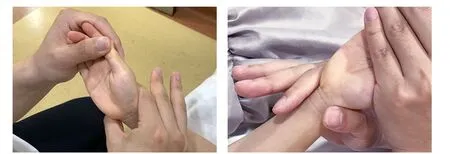
Figure 2. Ka-clipping and Na-grasping Lieque (LU 7)
2.3 Cautionary notes
Stop the treatment immediately in case of fussing,crying, gasping, dizziness or vomiting and help the child with a comfortable posture until the symptoms are relieved. It’s necessary to avoid hot, spicy and greasy food during the treatment.
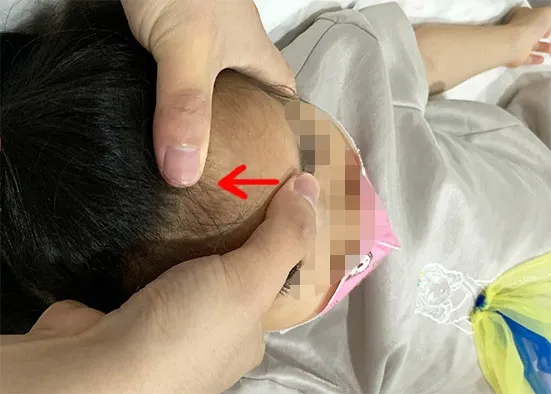
Figure 1. Kai-opening Tianmen
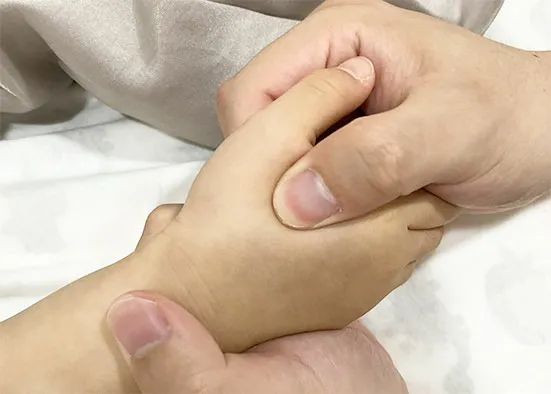
Figure 3. Na-grasping Hegu (LI 4)
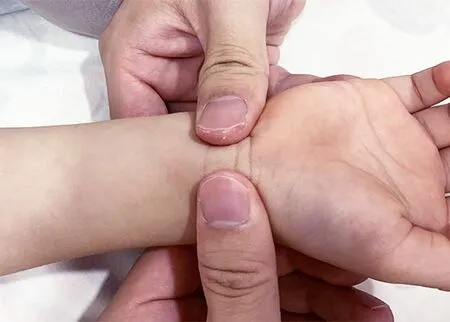
Figure 4. He-closing Yinyang
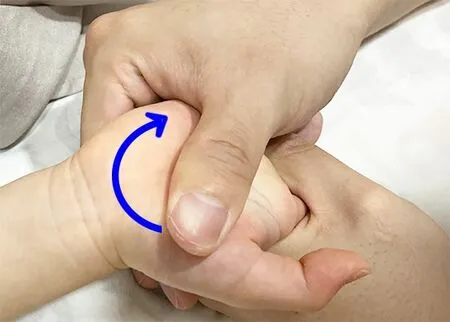
Figure 5. Yun-circular pushing Neibagua
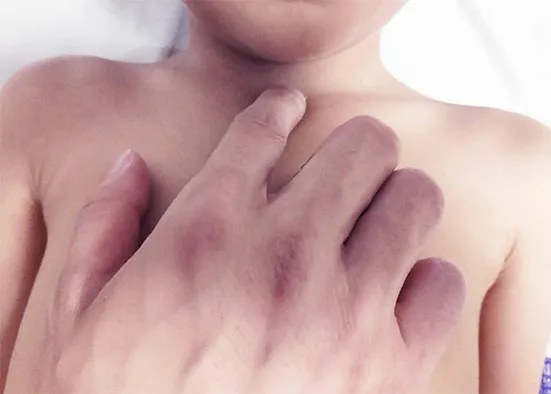
Figure 6. An-pressing and Rou-kneading Tiantu (CV 22)
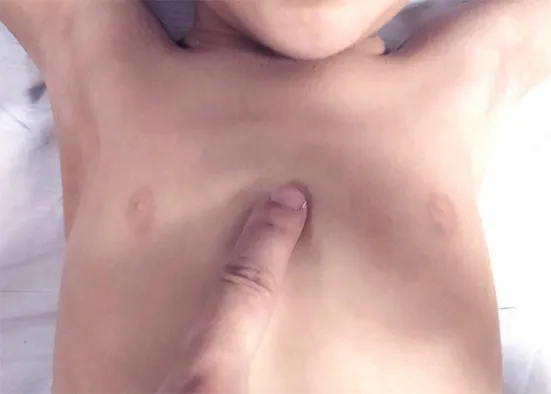
Figure 7. An-pressing and Rou-kneading Danzhong (CV 17)
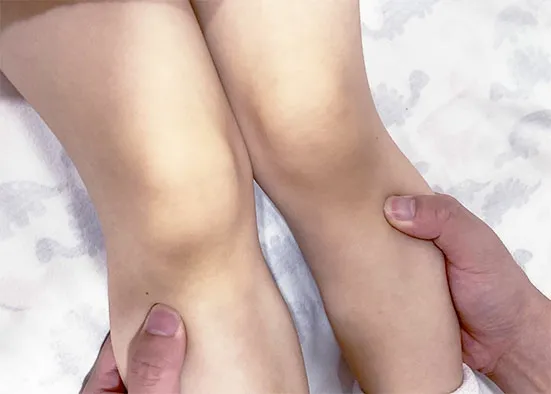
Figure 8. An-pressing and Rou-kneading Zusanli (ST 36)
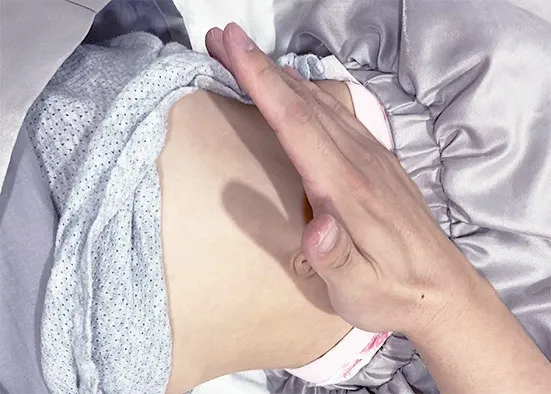
Figure 9. Mo-rubbing abdomen
3 Efficacy Observation
3.1 Observation items
The coughing scores during the day and at night were measured according to the ‘coughing score’ in the Guidelines for Diagnosis and Treatment of Cough[11]. The parents recorded and scored the 24 h coughing symptom(Total score = Daytime score + Night score), along with the scores after 3, 6, 9 and 12 treatments.
3.2 Efficacy criteria
The efficacy index was calculated using the Nimodipine method, which is, to be specific, the efficacy index = Pre-treatment coughing score - Post-treatment coughing score) ÷ Pre-treatment coughing score × 100%.
Clinical control: Symptoms and signs almost disappeared, the efficacy index ≥95%.
Markedly effective: Symptoms and signs improved notably, the efficacy index ≥70% but <95%.
Effective: Symptoms and signs improved, the efficacy index ≥30% but < 70%.
Invalid: Symptoms and signs were unchanged or worse, the efficacy index <30%.
3.3 Results
3.3.1 Clinical efficacy comparison
After 12 treatments, the overall response rate in the observation group was 92.5%, versus 86.0% in the control group, showing a statistical difference (P<0.05)and indicating that combined routine pediatric massage and Mo-rubbing abdomen manipulations obtained better efficacy than pediatric massage manipulations alone (Table 2).
3.3.2 Changes in total coughing score
After 12 treatments, the test of normality and homogeneity of variance on between-group difference in total coughing score before and after treatment showedP>0.05, indicating a normal distribution and an equal variance. The independent samplet-test showed there were no between-group differences in total coughing score before treatment and after 3, 6, and 9 treatments (allP>0.05), indicating a similar efficacy in the two groups during the first 3 weeks of treatment. There was a statistical between-group difference in total coughing score after 12 treatments (P<0.05), indicating a better efficacy in the observation group than in the control group (Table 3).
According to repeated measures analysis of variance,the test of ShaPiro-Wilk normality and homogeneity of variance on between-group difference in total coughing score before and after treatment showedP>0.05,indicating a normal distribution and an equal variance.Mauchly's test of sphericity showedP=0.13, indicating that the covariance matrix is spherical. There were within-group statistical differences in total coughing scores at 5 time points (F=204.82,P<0.05), along with a significant association between the score and time(F=4.50,P<0.05) and between-group statistical differences (F=4.72,P<0.05). There were no betweengroup statistical differences before treatment and after 3,6 and 9 treatments (P>0.05); however, there was a between-group statistical difference after 12 treatments,indicating a lower coughing score in the observation group than in the control group (Table 4 and Table 5).

Table 2. Efficacy comparison between the two groups (case)
Table 3. Comparison of coughing score between the two groups (±s, point)

Table 3. Comparison of coughing score between the two groups (±s, point)
Note: T0=Coughing score before treatment; T3=Coughing score after 3 treatments; T6=Coughing score after 6 treatments; T9=Coughing score after 9 treatments; T12=Coughing score after 12 treatments
Group n T0-T3 difference T0-T6 difference T0-T9 difference T0-T12 difference Observation 40 0.86±1.59 1.92±1.60 2.87±1.36 4.94±1.87 Control 43 1.14±1.32 2.11±1.54 2.79±1.44 3.96±1.53 t-value -0.87 -0.54 0.27 2.64 P-value 0.38 0.59 0.79 0.01
Table 4. Between-group comparison in total coughing score before and after treatment (±s, point)

Table 4. Between-group comparison in total coughing score before and after treatment (±s, point)
Group n Before treatment After 3 treatments After 6 treatments After 9 treatments After 12 treatments Observation 40 7.56±0.98 6.70±1.19 5.64±1.02 4.69±1.06 2.62±1.43 Control 43 7.68±0.98 6.55±1.21 5.58±0.83 4.90±1.09 3.73±1.12 t-value -0.58 0.59 0.31 -0.88 -3.96 P-value 0.57 0.55 0.76 0.38 0.00

Table 5. Analysis of total variance
4 Discussion
So far the etiology of chronic pediatric cough remains unclear in Western medicine. It’s believed that environment and heredity are two major factors[12]. The standard medications for symptomatic treatment include antitussives, antihistamines, anti-inflammatory drugs, antibiotics, corticosteroids or digestive system agents[13]. However, these medications may cause adverse reactions and result in poor compliance. The pain-free pediatric massage is easy to be accepted among the children and their parents. Numerous literatures have shown that therapeutic massage manipulation is safe, acting fast and effective for chronic cough in children[14-17].
For cases in the observation group, we used Kaiopening Tianmen to calm and refresh the mind; Kaclipping and Na-grasping Lieque (LU 7) and Hegu (LI 4) to remove wind, clear heat and release the exterior; Heclosing Yinyang to harmonize qi and blood and balance yin and yang; Yun-circular pushing Neibagua to soothe the chest, regulate qi and resolve phlegm; Rou-kneading Tiantu (CV 22), Danzhong (CV 17) and Fenglong (ST 40)to resolve phlegm, circulate qi and stop coughing; and Rou-kneading Zusanli (ST 36) to fortify the spleen,strengthen the body and boost the immune system[18-19].
For small children, their spleen is immature. In TCM,spleen deficiency may generate turbid phlegm. Also,their lung is tender and susceptible to be affected by cough and phlegm. In Chinese medicine, the spleen is the source of phlegm and the lung is the container of phlegm.
Applying massage manipulation to key abdominal points can regulate the spleen and stomach: massaging Shenque (CV 8) can strengthen the spleen, harmonize the stomach, warm yang and dissipate cold; massaging Fuyinyang can promote gastrointestinal motility and benefit digestion; massaging Zhongwan (CV 12) can benefit qi, fortify the spleen and down-regulate stomach qi; and massaging Tianshu (ST 25) can ascend the clear and descend the turbid[20]. Mo-rubbing abdomen manipulation can reinforce spleen qi and resolve phlegm-dampness. Consequently, this study combined Mo-rubbing abdomen manipulation to observe the efficacy of ‘treating the lung problems from the spleen’for chronic cough in children.
From the perspective of modern anatomy, the abdominal area is full of nerve endings, nerve plexus and nerve bundles, which innervate abdominal and pelvic organs and blood vessels[21]. Slow, rhythmic abdomen rubbing can activate gastrointestinal motility, promote blood and lymph circulation, reinforce digestion and regulate gut flora[22-24]. The composition and functional change in gut flora can, in turn, influence the respiratory tract via the common mucosal immune system[25]. As a result, Mo-rubbing abdomen manipulation can regulate the gut flora, modulate the lung functions via the ‘gutlung’ axis and thus improve coughing.
The study findings have suggested that there was a between-group statistical difference in overall response(P<0.05). There was a between-group statistical difference in the score difference between before treatment and after 12 treatments (P<0.05). The total effective rate in the observation group was 92.5%, versus 86.0% in the control group. This indicates that routine pediatric massage alone or in combination with Morubbing abdomen manipulation both can improve chronic cough in children; but the combination makes a better effect. This might be explained in two aspects:Mo-rubbing abdomen manipulation enhanced the effect of strengthening the spleen and reinforcing qi, therefore,playing a role of cultivating the spleen-earth to assist the lung-metal, and benefiting the Wei-defensive qi; in addition, it improved the gut flora and thus increased children’s defense ability. We have reasons to believe that the relapse rate and recurrent symptom score in the observation group will be lower than those in the control group. However, this requires further investigation.
Conflict of Interest
The authors declare that there is no potential conflict of interest in this article.
Acknowledgments
This work was supported by 2017 Shanghai Upgrading Project for Characteristic Technology of Traditional Chinese Medicine Diagnosis and Treatment (上海市2017年度中醫特色診療技術提升項目, No. zyjx-2017042).
Statement of Informed Consent
Informed consent was obtained from the guardians of the recruited children in this study.
Received: 30 March 2020/Accepted: 16 July 2020
猜你喜歡
英語世界(2023年10期)2023-11-17 09:19:28
幼兒園(2021年17期)2021-12-06 02:35:20
今日農業(2021年10期)2021-11-27 09:45:24
今日農業(2021年17期)2021-11-26 23:38:44
今日農業(2021年17期)2021-11-26 23:38:44
英語學習(上半月)(2019年9期)2019-10-10 02:17:36
知識經濟·中國直銷(2017年10期)2017-11-07 02:39:51
陜西教育·綜合版(2015年5期)2015-06-28 06:17:52
短篇小說(2014年12期)2014-02-27 08:32:59
云南中醫學院學報(2011年1期)2011-07-31 18:24:34
 Journal of Acupuncture and Tuina Science2021年3期
- Journal of Acupuncture and Tuina Science的其它文章
- Efficacy of acupuncture in treating chronic non-specific low back pain
- Therapeutic efficacy observation of acupuncture plus medicine for laryngopharyngeal reflux due to liver-qi stagnation and spleen deficiency
- Clinical study of warm needling moxibustion plus intra-articular injection of sodium hyaluronate for chondromalacia patellae
- Effects of acupuncture plus spinal manipulations on physical functioning and biochemical indicators in patients with ankylosing spondylitis
- Effect of mild moxibustion on cancer-related fatigue,serum ghrelin and adiponectin in patients undergoing chemotherapy after colorectal cancer surgery
- Clinical efficacy observation of acupoint threadembedding in treating obese patients with food addiction