
First principles study of behavior of helium at Fe(110)–graphene interface?
2021-05-06 08:56:26YanMeiJing荊艷梅andShaoSongHuang黃紹松
Chinese Physics B 2021年4期
Yan-Mei Jing(荊艷梅) and Shao-Song Huang(黃紹松)
Key Laboratory of Material Modification by Laser,Ion and Electron Beams(Dalian University of Technology),Ministry of Education,Dalian 116024,China
Keywords: Fe(110)–graphene,helium,interface,first principles calculations
1. Introduction
With the rapid development of advanced nuclear energy systems, the need for the development and application of structural materials with higher radiation tolerance has increased.[1]Point defects (vacancies and interstitials) generated by high-energy neutrons can evolve into extended defects such as voids and interstitial clusters within the structural materials at elevated temperatures. In addition,a certain number of helium (He) are produced by the (n, α) transmutation reaction.[2]Owing to the low solubility of He atoms,their diffusion and aggregation results in the precipitation and nucleation of He bubbles.[3]The synergistic interaction of these defects leads the mechanical properties of the structural material to degrade.[4–10]Increasing the fraction of interface/boundaries in materials is an important strategy to enhance the irradiation effect tolerance by providing more defect recommendation sites.[11–14]In particular,multilayer metallic systems such as W/Cu,[15]Cu/Nb,[16]and Cu/V[17]systems have been studied extensively as structural materials for mitigating radiation damage.
Further, graphene has attracted much attention due to its highly dense interface,[18–20]with a two-dimensional structure packed by a single layer of C atoms. Several studies reported their results on the radiation damage resistance of copper–graphene, nickel–graphene, and vanadium–graphene nanocomposites through molecular dynamics and experiments,[21–23]it was found that the metal–graphene nanocomposite had less defects remaining in the bulk region after collision cascades, illustrating the self-healing performance. However, the atomic mechanism was still unknown,especially for the interaction between the graphene and metal substrates. Furthermore, as is well known, stainless steels, in which Fe is the basic element in the matrix (with more than 80 wt%),are the most commonly constructive and prospective materials in nuclear systems. As stated, He is an important product of neutron transmutation,affecting many of the properties of structural materials with point defects.[24–29]Thus,previous studies promoted us to figure out whether the Fe–graphene interface can affect the behaviors of intrinsic defects and act as a good He permeation barrier. In this study, we aim to investigate the potential usage of steel–graphene with multiply interface structures for tolerating the radiation damage. Therefore, using ab initio calculations, we investigate the energetical stability of the Fe–graphene system, the formation of the intrinsic defects, and the behaviors of an interstitial He atom. The rest of this paper is organized as follows.The method of first-principles calculations, and calculational equations are presented in Section 2. In Section 3,the results of the behaviors of the intrinsic defects, and He atoms in the Fe(110)–graphene system are discussed. The major findings are summarized in Section 4.
2. Computational method
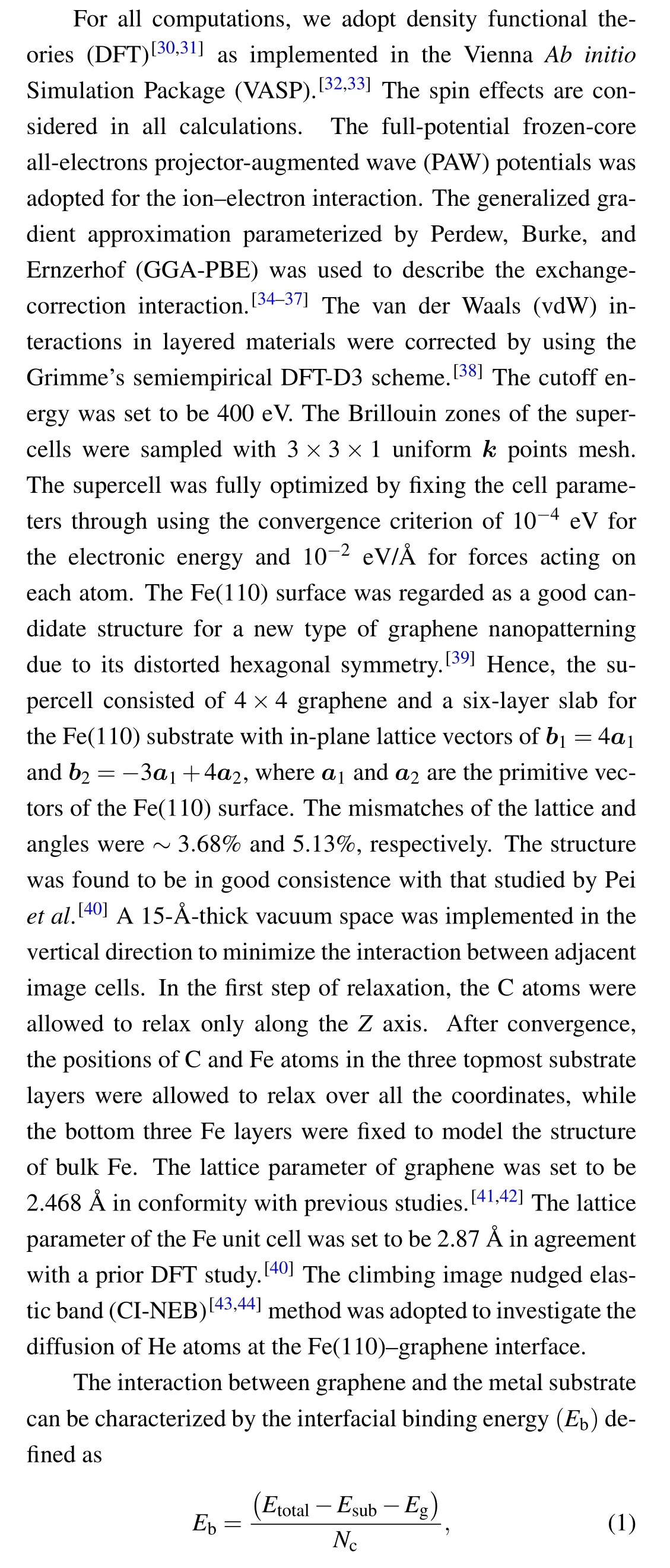
where Etotal,Esub,and Egare the energy of the composite system, standalone substrate, and graphene, respectively, and Ncis the number of C atoms in the graphene sheet.
The binding energy of two defects, A and B, in the Fe(110)–graphene system is given by[45]

Here, E(A) or E(B) is the total energy of a single defect in the structure, E(AB) is the total energy of a supercell with two defects, and E(perfect) is the total energy of the prefect structure without any defects. Following this convention, the positive binding energy corresponds to exothermic defect formation reaction,implying an attractive interaction between A and B.
The formation energy of a single vacancy or an interstitial atom(Ef)in the Fe(110)–graphene structure is defined as

where E(defect) and E(perfect) are the total energy of the Fe(110)–graphene system with and without a point defect,respectively; E(Fe)represents the cohesive energy per Fe atom in bcc Fe, E(C) denotes the energy per C atom in graphene;E(He) is the energy of an isolated He atom; m=1, n=0 ,and p=0 for an Fe vacancy in the Fe layer;m=0,n=1,and p=0 for a C vacancy in the graphene layer;m=?1,n=0,and p=0 for an Fe interstitial atom;m=0,n=?1,and p=0 for a C interstitial atom;m=0,n=0,and p=?1 for an He interstitial atom.
3. Results and discussion
3.1. Structure and bonding properties
Figure 1 shows the structure of the Fe(110)–graphene interface; a Moir′e pattern forms in the Fe(110)–graphene, with a large corrugation of the graphene layer. Owing to the lattice mismatch between the Fe substrate and graphene,C atoms occupy various adsorption sites on the Fe substrate.[46]The results indicate that the interaction between the Fe substrate and graphene is strong. In this case, it is vital to investigate the equilibrium binding distance and binding energy of the Fe(110)–graphene system.According to the equilibrium binding distance, the interaction between graphene and the substrate can be divided into two classes:[41]one is represented by an equilibrium binding distance,d of ≤2.3 ?A which indicates strong interaction or chemisorption, and the other belongs in weak interaction or physisorption. According to Eq. (1), the binding energy of the Fe(110)–graphene structure is 0.05 eV/C and the binding distance is ~2.13 ?A while the previously reported experimental and theoretical value are ~2.09 ?A and 2.10 ?A respectively.[39,47]From the energy and distance viewpoint, the binding between the Fe substrate and graphene is strong. The graphene layer on the Fe(110)substrate exhibits a similar binding behavior to that observed on other metal substrates such as Ni,Co,and Pd.[48–50]
The total density of states (TDOS) of the Fe(110)–graphene system and local density of states(LDOS)between graphene and the topmost Fe layer are shown in Fig.2.The Fed orbital significantly affects the TDOS near the Fermi level.Thus, the metal substrate determines the Fermi level of the composite material. The strong hybridization of the Fe-d state and C-p state in the LDOS indicates that a strong covalent bond forms between the Fe atom and C atom, similar to the previously reported cases of graphene on Rh(111)[51]and Ni(111).[52]The small interfacial distance can result in the overlap of the wave functions of the d electrons of the metal and p electrons of graphene,leading to orbital hybridization.
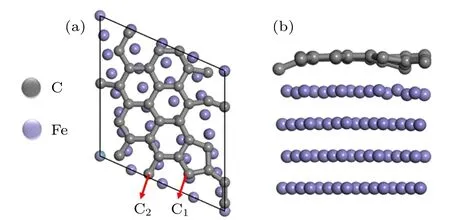
Fig.1. Structure of Fe(110)–graphene system,showing(a)top view and(b)side view of structure,with purple and gray balls representing Fe atom and C atom,respectively.
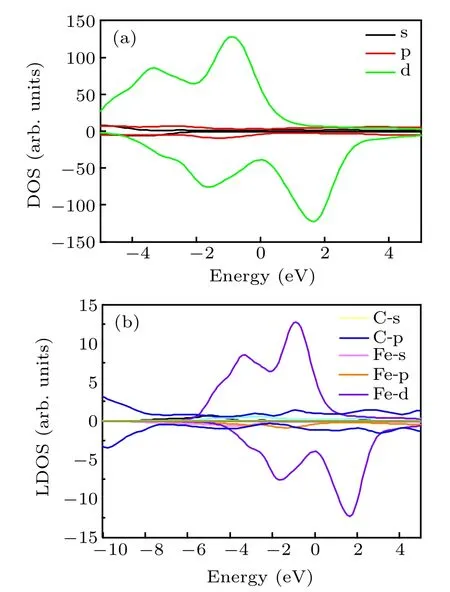
Fig.2. (a)Total density of states(TDOS)of Fe(110)–graphene system and(b) local density of states (LDOS) between graphene and the topmost Fe layer,with colored solid lines showing projected DOS from s,p,d orbitals,respectively.

Weser et al.[53]and Dedkov et al.[54]reported a magnetic moment of approximately 0.05μB–0.1μBper carbon atom for the C atoms of a graphene layer contacting a ferromagnetic Ni(111) substrate. In this work, the magnetic moment of C1was found to be ?0.036μB,which forms an antiferromagnetic couple with the nearest Fe atom. On the other hand,the magnetic moment of the C2atom was approximately+0.022 μB.This result is consistent with that reported by Liu et al.[47]The magnetic moments of C atoms in Fe(110)–graphene are attributed to the Fe3d–C2p orbital hybridization.
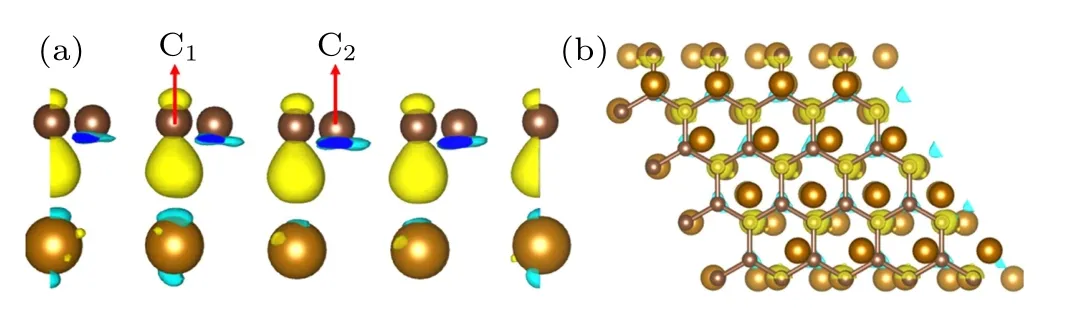
Fig.3. Differential charge density of Fe(110)–graphene interface region(isovalue: 0.005 e/?A3),showing(a)side view and(b)top view of interface,where big and small balls represent Fe and C atoms,respectively,blue contour denotes electron depletion region,and yellow contour refers to electron accumulation region.
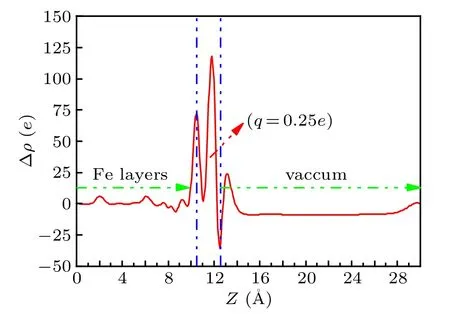
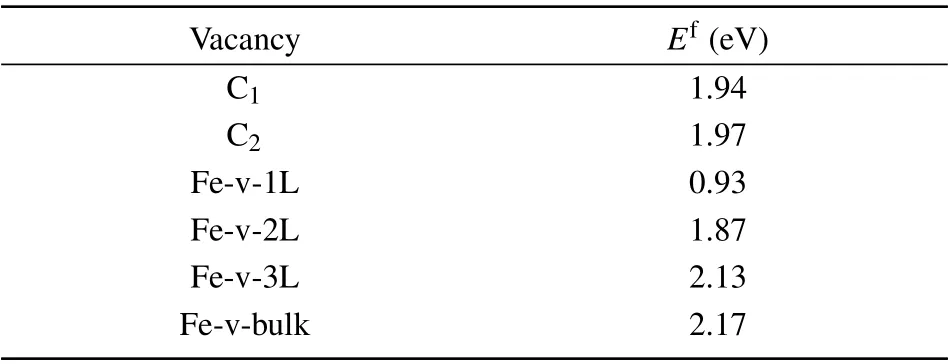
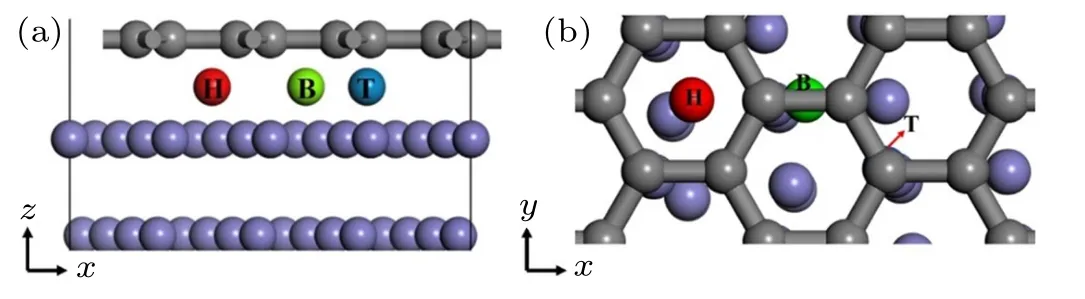
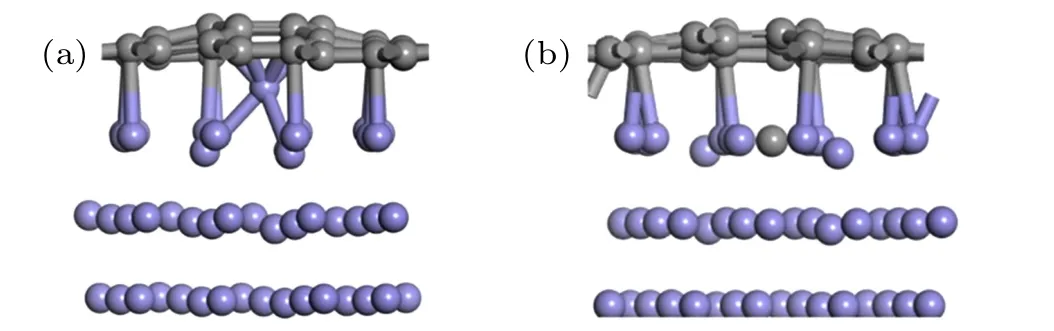
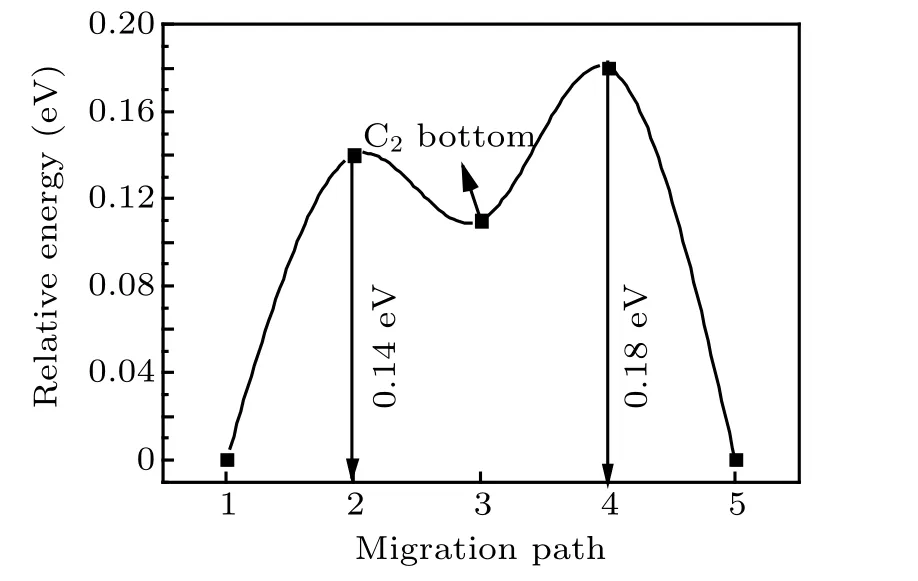
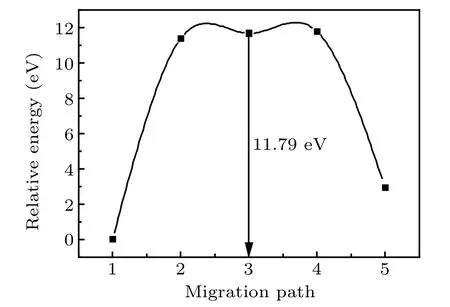
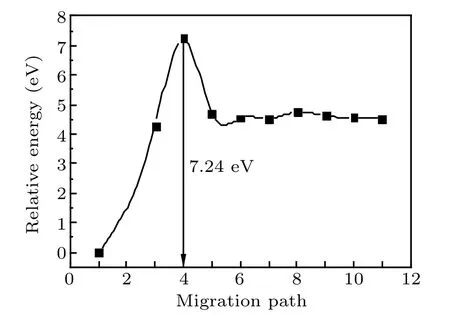
Fig.4. Interlayer charge difference in Fe(110)–graphene interface region(?ρ = ρinterface ?ρFe ?ρC). Area between red line and 0 line displays the value of electron depletion or accumulation. Value at interface around 10.43 ?A The formation energy values of single vacancies of the C and Fe atoms in different layers in Fe(110)–graphene are calculated, and the results are listed in Table 1. The formation energy of the C vacancy in a single graphene layer is also calculated. The single graphene layer is obtained by removing all the Fe atoms in the Fe(110)–graphene system. That is,the single graphene layer is the same as the graphene layer in the Fe(110)–graphene in terms of the initial size and shape. The C vacancy formation energy in the single graphene layer is 8.09 eV,in agreement with previously calculated results.[55,56]However, it is slightly larger than the experiment value of 7.0±0.5 eV.[15]The C vacancy formation energy values of the two types of C atoms(i.e.,C1atom and C2atom)in Fe(110)–graphene are 1.94 eV and 1.97 eV, respectively, which are lower than those for the single graphene layer. This indicates that the C vacancy prefers to form in Fe(110)–graphene. The result is consistent with that reported for Cu/graphene/Cu.[56]The hybridization of C atoms in graphene changes from sp2to sp3due to its interaction with the metal. Consequently,the strength of the in-plane C–C bond is weakened.[57]The formation energy of the Fe vacancy increases with the number of Fe layers increasing. The formation energy of the Fe vacancy in the third layer is close to that in bulk Fe(~2.17 eV).Hence,it is reasonable for us to fix the three bottom Fe layers. The Fe vacancy formation energy for the topmost layer is lower than those for the other layers and bulk Fe, indicating that Fe vacancies prefer to form at the interface rather than stay in bulk Fe. This phenomenon can be attributed to the fact that the interaction between Fe and graphene is weaker than the binding of Fe–Fe in bulk Fe. Table 1. Formation energy values of C vacancies and Fe vacancies in Fe(110)–graphene system. The abbreviations: 1L,2L,and 3L express 1 layer,2 layers,and 3 layers,respectively. Apart from vacancies, interstitial atoms are also formed under the neutron irradiation condition. Figure 5 illustrates three different interstitial sites at the interface. The symbols,H,T,and B represent the hollow,top,and bridge position,respectively. The relative stabilities of the single interstitial C atom and Fe atom at the three sites are investigated. The interstitial Fe atom prefers to stay at the hollow site,and its formation energy is ~1.83 eV,which is lower than the formation energy for the tetrahedral site in bulk Fe.In addition,the interstitial atoms have a notable effect on the atomic configurations of the neighboring atoms. The interstitial Fe atom pushes the graphene layer up and affects the configuration of the Fe layers(see Fig.6(a)). The interstitial C atom prefers to stay in the Fe layer(Fig.6(b)),and its formation energy is 1.41 eV.These results suggest that the interstitial atoms can be easily trapped at the interface. Therefore, the interface is regarded as a sink that can trap intrinsic defects. Fig.5. Three candidate sites at Fe(110)–graphene interface (only part of atoms in an interface are displayed here for clarity), showing(a)side view and (b) top view of structure, where red, green, and blue balls represent hollow,bridge,and top sites,respectively. Fig.6. (a)Structure of interstitial Fe atom and(b)structure of the interstitial C atom at Fe(110)–graphene interface,with purple and gray balls representing Fe and C atoms,respectively. Under long-term neutron irradiation, a certain number of He atoms can be produced by the (n, α) transmutation reaction.[58–60]Then,He bubbles can form at the interface and grain boundaries,thereby resulting in the He embrittlement of the structural material.[56,61,62]Therefore,it is critical to investigate the effects of He atoms at the interface. After optimization, it is found that the interstitial He atoms at the T and B sites are unstable and spontaneously move to the H site. Thus,an interstitial He atom prefers to stay stably at the H site and the bottom of the C2site, the formation energy values for an interstitial He atom at these sites are 2.09 eV and 3.07 eV,respectively. Considering the energetics, the H site is the most stable, whereas the bottom of C2site is a metastable for He atoms. According to Fig.3, the H site and bottom of C2site have low electron density, and previous studies have shown that He atoms tend to be stable in areas with a low electron density.[62–64] Fig.7. Diffusion barrier profile of intersitital He atom at Fe(110)–graphene interface, indicating that He atom migrates from stable hollow site to the nearest neighboring hollow site, and diffusion path passes through another stable site of C2 bottom. Further, the diffusion of He atoms at the interface is vital for the formation of He bubbles. Therefore, He migration in Fe(110)–graphene is studied by the CI-NEB method. The energy for He migration between the two nearest neighbor H sites is calculated, and the result is presented in Fig.7. The value for this process is ~0.18 eV. In addition, the binding energy of two He atoms at the interface is ~1.36 eV.The interaction between He atoms is attractive,which is the driving force for its aggregation. As the migration barrier is small and the binding energy of He atoms is relatively large,the He atoms tend to aggregate at the interface. Graphene is impermeable to standard gases, including the He gas.[65]The He atom has a 1s closed shell electronic structure, and it does not interact chemically with graphene.Leenaerts et al.[66]preformed first principles calculations to investigate the penetration of He atoms through a graphene monolayer with a C vacancy.The diffusion barrier of graphene with a C vacancy is found to be ~18.8 eV with local density approximation (LDA) and 11.7 eV with GGA. Owing to the large migration energy, graphene can act as a barrier to impede the penetration of thermal equilibrium He at a temperature when the graphene layer remains stable. In this work,the penetration of He atoms is studied with a C vacancy in the Fe(110)–graphene system. First, a He atom is placed in vacuum far from the graphene surface to determine its stable site.After this optimization, the vertical distance between the He atom and interface is found to be ~2.896 ?A. Then, the migration of He atoms between the comfortable site and H site is investigated, and the result is presented in Fig.8. The migration energy is ~11.79 eV in this case. The high energy barrier restricts the diffusion of He across the graphene layer to reach the interface. The result illustrates that the impermeability of graphene is not reduced by the presence of Fe layers.Once some He atoms penetrate the graphene structure to reach the interface,they are trapped there and aggregated into larger species. Fig.8. Migration energy of He atom in Fe(110)–graphene system with a C vacancy: He atom migrates from vacuum to hollow site at interface though a C vacancy in graphene layer. At the same time,the He formation energy at the tetrahedral interstitial site in the Fe substrate is 5.00 eV, larger than that at the interface. This phenomenon strongly indicates that the Fe(110)–graphene interface acts as a sink that traps He atoms. In order to study the role of graphene, we calculate the diffusion barrier of a single He atom in a structure with seven Fe layers. The migration path is shown in Fig.9. The diffusion barrier is 7.24 eV,which is obviously lower than that for the Fe(110)–graphene system. Hence,it is concluded that the graphene acts as a buffer layer. Thus, the low formation energy and high diffusion barrier of He atoms at the interface delay the detrimental effects of He and allow the structural material to remain in service for longer. Fig.9. Diffusion barrier of a single He atom in structure with seven Fe layers,showing that barrier between vacuum and the first Fe layer is ~7.24 eV. The behaviors of point defects and He atoms are investigated via ab initio calculations based on DFT, and the results are compared with those of bcc Fe (bulk) and a single graphene layer. The conclusions drawn from the present study are as follows. (i)A strong interaction and an intense Fe-3d–C-2p orbital hybridization are responsible for the stable graphene structure on the Fe(110)substrate. (ii) Vacancies and interstitial atoms are easily formed at the interface, and the interface can act as a sink for point defects. (iii)The He atoms require a large energy barrier to penetrate the graphene layer with a C vacancy and the binding energy of the He atoms is larger at the interface. This means that the interface impedes the diffusion of He atoms,and serves as a sink that traps the He atoms. Acknowledgement The authors are grateful to the Supercomputing Center of Dalian University of Technology and the Project of Nuclear Power Technology Innovation Center of Science Technology and Industry for National Defense for the computational support(Contract No.HDLCXZX-2019-ZH-28).3.2. Formation and stability of intrinsic defects
3.3. Stability and diffusion of He atoms at interface
4. Conclusions
- Chinese Physics B的其它文章
- Quantum annealing for semi-supervised learning
- Taking tomographic measurements for photonic qubits 88 ns before they are created*
- Instability of single-walled carbon nanotubes conveying Jeffrey fluid?
- Relationship between manifold smoothness and adversarial vulnerability in deep learning with local errors?
- Weak-focused acoustic vortex generated by a focused ring array of planar transducers and its application in large-scale rotational object manipulation?
- Quantization of the band at the surface of charge density wave material 2H-TaSe2?