
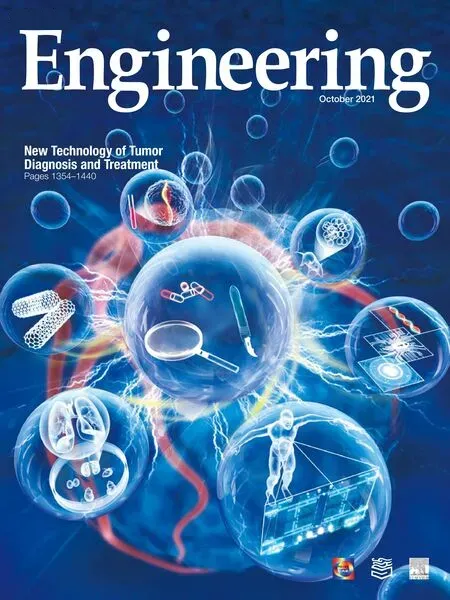
Editorial for the Special Issue on New Technology of Tumor Diagnosis and Treatment
2021-04-24 03:11:18HongyangWangShengliYang
Engineering 2021年10期
Hongyang Wang, Shengli Yang
a Fudan University Shanghai Cancer Center, Shanghai 200032, China
b International Cooperation Laboratory on Signal Transduction & Key Laboratory of Signaling Regulation and Targeting Therapy of Liver Cancer, Ministry of Education &Shanghai Key Laboratory of Hepatobiliary Tumor Biology, Eastern Hepatobiliary Surgery Hospital, Second Military Medical University, Shanghai 200438, China
c Shanghai Institute Nutrition and Health, Chinese Academy of Sciences, Shanghai 200031, China

Cancer is a global public health threat and a leading cause of death in China. In 2020, the number of new cancer cases around the world reached approximately 19.3 million, and about 10.0 million cancer-related deaths occurred. Tumor diagnosis and treatment remain a huge challenge due to the diversity of cancer etiology, the complicated mechanism and long process of tumorigenesis, and the significant heterogeneity between individuals.
As cancer is a systemic disease, tumor diagnosis is multidisciplinary.Tumor treatment has evolved from the initial conventional surgery, radiotherapy, and chemotherapy to the current multimethod and multidisciplinary comprehensive treatment. With the continuous deepening and advancement of research in disease biology, we have gained a better understanding of cancer. The development of science and technology also promotes the emergence of new strategies and means for tumor diagnosis and therapy, which is helpful in increasing the survival rates of patients with cancer around the world.
Cancer is a progressive disease that can gradually induce alternations in the tumor microenvironment, destroy immune surveillance, and further spread the biological components of a tumor into the peripheral circulation.Due to the biological characteristics of tumorigenesis, biofluids such as blood, urine, and cerebrospinal fluids can be used to detect a tumor. Recently, liquid biopsy has been a rising field in diagnostics and patient follow-up for multiple types of cancer. For example, our team has established a cell-free DNA (cfDNA)-based diagnostic model called the ‘‘HIFI” method,which exhibits high sensitivity and accuracy in hepatocellular carcinoma (HCC) detection. In rectal cancer (RC), circulating tumor DNA(ctDNA)plays an important role in monitoring chemotherapy and radiotherapy response and assessing the risk of tumor recurrence.Analysis of the urine microRNA transcriptome has identified a new biomarker for prostate cancer,which is a supplement to current diagnostic methods for aggressive prostate tumors.In addition to liquid biopsy, there are various other techniques for the precision diagnosis of cancer, such as nanotechnology. For example,nanobiosensors are extremely sensitive and can detect various protein biomarkers in a relatively short time. Photodynamic technology with light-sensitive and fluorescent materials also exhibits good performance in detecting malignancies such as prostate cancer and bladder cancer. Single-cell analysis with mass cytometry has advantages in cell typing due to its high-dimensional nature,and is therefore applicable to the clinical diagnosis of cancer.
New technologies can also shed light on novel therapeutic regimes for cancers.Applying clustered regularly interspaced short palindromic repeats (CRISPR)/Cas9 gene-editing systems to tumor diagnosis and treatment may lead to a revolution in medicine.The use of various nanoparticles(e.g.,polymeric,lipid-based,and inorganic) to deliver therapeutic agents increases the efficacy of drugs against cancer and reduces side effects. Single-cell genomics reveals the genetic and phenotypic diversity of a person at the single-cell level,which can help to achieve precise and individualized tumor treatment. Organoids with a structure and function similar to those of the original tissues have been used to explore the pathogenic characteristics of cancers, thereby facilitating drug screening and effectively guiding clinical practice.Artificial intelligence(AI)has made great contributions to tumor treatment in the fields of chemotherapy,radiotherapy,and immunotherapy.Collectively, a large number of emerging technologies provide massive data on cancer, facilitate the early and dynamic detection of tumors, greatly promote the development and screening of anti-tumor drugs, and improve the individualized treatment of cancer.Introducing and summarizing novel international trends,technologies, and methods in tumor diagnosis and treatment will effectively promote the development of oncology disciplines and the clinical application of new technologies, thereby promoting the early prevention, early diagnosis, and precision treatment of cancer and around the world.
In this special issue, we include eight articles that report on novel strategies for the diagnosis and therapy of multiple types of cancers, with a focus on the abovementioned aspects.
Salman et al. systematically discuss FMS-like tyrosine kinase 3 (FLT3) inhibitors—the most well-studied targeted agents in acute myeloid leukemia (AML)—as a model for other emerging targeted agents that have already been approved or are currently in development. They also highlight the dramatic contribution targeted therapies have made to current practice in cancer treatment.
Montero-Calle et al. report on their establishment of a multiplexed biosensing platform to detect colorectal cancer (CRC) by identifying CRC-specific autoantigens targeted by autoantibodies via liquid biopsy. This approach exhibits high diagnostic efficacy in discriminating CRC patients and individuals with premalignant lesions from healthy individuals.
Wu et al. reveal that intrahepatic cholangiocarcinoma (ICC)patients with a high level of CD4+CD45RO+CXCR3+T cells in their peripheral blood mononuclear cells (PBMCs) are sensitive to gemcitabine-combined chemotherapy. Profiling the immune contexture of PBMCs at single-cell level through cytometry by time-offlight (CyTOF) is practical for predicting potential response to chemotherapy in ICC.
Rezk et al.provide an overview of how the mechanical properties of tumor tissues differ from those of normal breast tissue and non-cancerous lesions,and how novel biomaterial models allow us to understand the mechanical properties of the extracellular environment.They also highlight the need for biomaterial models that can mimic the tumor microenvironment, which would guide the development of novel mechano-based therapies against breast cancer metastasis.
Mu et al. point out that a complex formed by the interaction of cluster of differentiation 44(CD44)and integrin α6β4 activates target cells to generate a pre-metastatic niche by stimulating cytokines, proinflammatory factors, and growth factors that ultimately support tumor metastasis. The role of CD44 in tumor metastasis suggests that exosomal CD44 holds promise as a biomarker for the detection and treatment of pancreatic cancer.
Volpe et al.focus on the realization process of a microfluidic tool,from its computer-aided design(CAD)to its proof-of-concept application as a capture device for circulating tumor cells.Moreover,the low cost of the materials used, the customizable methods, and its biological applications make this tool suitable for clinical practice.
Zhang et al. develop three-dimensional (3D) scaffold platforms to explore the physical factors involved in separating nasopharyngeal carcinoma 43 (NPC43) cells from immortalized nasopharyngeal epithelial 460 (NP460) cells. They find that NPC43 cells and NP460 cells can be well separated using stiff two-layer scaffold platforms with a 40/10 μm ridge/trench (R/T) grating on the top layer and a 20/10 μm R/T grid on the bottom layer. The development of engineered platforms to distinguish normal cells from cancerous cells may serve as an alternative way to diagnose and treat cancer.
Abou-Alfa et al. review studies on tumor-derived molecular components that are detectable in the peripheral circulation,including circulating tumor DNA (ctDNA) and circulating tumor RNA (ctRNA), in order to explore their potential as non-invasive biomarker candidates for the diagnosis of early HCC.
It is our hope that the articles in this special issue will help to cultivate innovative thinking and broaden our vision in the development of new strategies for tumor diagnosis and treatment.With the persistent efforts that have been made for decades against one of humanity’s greatest enemies—namely, cancer—we have already made significant achievements in understanding the enemy.Hopefully, continuous input will push forward the boundaries of our understanding and extend the range of anti-cancer strategies in the new era.
- Engineering的其它文章
- Engineered Hybrid Materials with Smart Surfaces for Effective Mitigation of Petroleum-Originated Pollutants
- Diffractive Deep Neural Networks at Visible Wavelengths
- Co-Estimation of State of Charge and Capacity for Lithium-Ion Batteries with Multi-Stage Model Fusion Method
- A Predictive Instrument for Sensitive and Expedited Measurement of Ultra-Barrier Permeation
- Clinical Characteristics and Outcomes of Severe or Critical COVID-19 Patients Presenting No Respiratory Symptoms or Fever at Onset
- Mass Spectrometry Analysis of Newly Emerging Coronavirus HCoV-19 Spike Protein and Human ACE2 Reveals Camouflaging Glycans and Unique Post-Translational Modifications