
Bio-Review 2021:Inspiring the future of Biochemical Engineering
2021-04-12 00:48:47YanSun
Yan Sun
Department of Biochemical Engineering,School of Chemical Engineering and Technology and Key Laboratory of Systems Bioengineering and Frontiers Science Center for Synthetic Biology (Ministry of Education),Tianjin University,Tianjin 300350,China
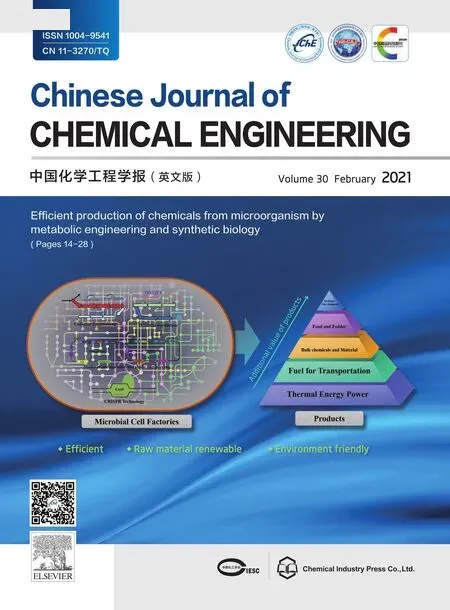
Biochemical Engineering(BCE)discipline had largely developed from fermentation technology studies from 1950s through 1960s when fermentation emerged as the core technology able to address multiple industrial needs ranging from health care products such as antibiotics;food products such as single cell proteins,amino acids,organic acids,and vitamins;liquid fuels and chemicals such as ethanol and acetic acid;and industrial enzymes.During the development,bioreactors had been the core issue of BCE research because industrial production of these products needs high-efficient large-scale fermenters(bioreactors).Therefore,various innovative bioreactors,including sensors for online monitoring and process control,were designed,of which air-lift bioreactors were representative since they possessed high oxygen supply efficiency.By the end of 1970s,recombinant DNA and cell fusion technologies matured and made the production of heterologous human proteins possible by microbial fermentation and animal cell cultures.Since then,bioseparations targeting the recovery and purification of therapeutic biologics,such as insulin,cytokines,antibodies,DNA,viruses and cells,began to attract more attention of biochemical engineers because high-purity production of the biologics was costly,involving multiple steps with different techniques represented by centrifugation,cell disruption,membrane separation and chromatographic methods such as affinity,ion-exchange and hydrophobic interaction chromatography.Moreover,heterologous expression of therapeutic proteins often leads to the formation of inclusion bodies that need to be renaturedin vitroto recover natively folded active proteins.Therefore,protein refolding had been a research focus since 1980s till the last decade.Also,the development of molecular biology and genetic engineering facilitated the move of engineering research of biochemical systems from bioreactors into cells,including the metabolic pathway and various omics (genomics,proteomics,metabolomics,etc.),so we have witnessed the flourishing development of metabolic engineering till today.More importantly,the outcomes of metabolic engineering research played an important role in making the concept of synthetic biology become real,and since about 2010,synthetic biology/biotechnology aiming at making “artificial biosystems”by synthesized genomes has evolved as a fundamental research focus of systems biology/biotechnology.Nowadays and in the foreseeable future,the development of synthetic biology/biotechnology together with innovative protein engineering and separation technology would greatly promote biological production of chemicals that have had to rely on traditional chemical processes.
The past year 2020 was special due to the COVID-19 pandemic.The novel coronavirus greatly affected our life,and also made us think in a different way during the lockdown.To minimize the influence and leave something for reminiscence,I proposed in May of the year to launch a Special Issue(SI)of invited BCE reviews for publication early in 2021,and was strongly supported by the CJChE staffs.More impressively,most of the experts unhesitatingly accepted my invitations and submitted their manuscripts on time.Now we are delighted to release Bio-Review 2021 containing 29 invited review articles in four groups.
(1) Synthetic Biotechnology and Metabolic Engineering
There are 12 contributions in this area,over 40% of the 29 reviews,reflecting the current research emphasis in BCE.The first three reviews focused the biosynthesis of some important products.Ouyanget al.[1]critically discussed the key issues in the biosynthesis of diamines as alternative to traditional fossil fuelbased diamines with emphasis on the synthesis of aliphatic and aromatic diamines from renewable biomass.Tanet al.[2]summarized the metabolic engineering and synthetic biology strategies to achieve efficient microbial production of bulk chemicals and high value-added chemicals.Chenet al.[3]reviewed the emergence and development of food synthetic biology that enables establishing cell factories for a sustainable food protein supply.Considering the rapid progress of academic research on metabolic engineering and its remarkable achievements in industrial applications,Zhaoet al.[4]analyzed the current state of metabolic engineering in China and comprehensively compared with other key countries based on the publication data from 2015 to September 2020.On the production of terpenoids,Zhonget al.[5]focused the role of oxygen in regulating terpenoids biosynthesis from the viewpoints of cellular carbon metabolism,energy metabolism and terpenoid anabolism.On the biosynthesis of phenolic compounds for nutraceutical,pharmaceutical and cosmetic applications,Yuanet al.[6]discussed recent advances and challenges in the construction of artificial pathways,improvement of pathway efficiency,alleviation of metabolic burden and side-reactions,use of genetic circuits for dynamic regulation and high throughput screening.Liet al.[7]discussed the challenges in the microbial biosynthesis of complex phytochemicals by engineering microorganisms and enzymes to address the increasing concern of environmental sustainability.Suet al.[8]focused on an ascomycete fungal genus,Trichoderma,as a host strain for efficient recombinant protein/enzyme production.Another chassis,cyanobacteria,was looked into by Zhanget al.[9]as“photosynthetic cell factories”to produce renewable fuels and chemicals directly from CO2driven by solar energy with the cutting-edge synthetic biology.Liuet al.[10]critically reviewed the biotechnological strategies and approaches to enhance the biosynthesis of steviol glycosides in a plant,Stevia rebaudiana.Jianget al.[11]presented their interests in the utilization of wastes and/or by-products as feedstock for the microbial production of L-malate.Finally,Yuet al.[12]comprehensively review the strategies for the design of efficient and stable artificial microbial consortia to complete important tasks such as lignocellulose degradation,valuable product synthesis,human health care,bioremediation and sustainable energy.From the introduction,it is seen that the 12 papers cover a broad range of products and chassis systems for efficient biosynthesis as well as the fundamental issues involved in the bioprocesses.
(2) Biocatalysis and Bioreactor Engineering
Five review papers on biocatalysis and bioreactors are collected.Guoet al.[13]reviewed the engineering efforts to improve cytochrome P450s,the most widely studied monooxygenase,for useful natural and non-natural reactions.Xuet al.[14]focused on microfluidics with immobilized enzymes as enzymatic microreactors for application in biocatalysis.Yinget al.[15]summarized different chemoenzymatic catalysis types with emphasis on the classic dynamic kinetic resolutions and cofactor regeneration.Huanget al.[16]described the methods for degradation of zearalenone,a mycotoxin that frequently contaminates crops and animal feed,by focusing on the biological approaches and further challenges in biodegradation.Zhuanget al.[17]extensively discussed the effects of scale-dependent flow fields developed within bioreactors on strains,a key issue in large-scale biological processes.
(3) Bioseparations and Analysis
We got four papers related to downstream bioprocessing of small-molecule bioproducts and biomacromolecules as well as the monitoring and control of the processes.Xiuet al.[18]reviewed the use of ionic liquids for the recovery of bioproducts based on salting out extraction.Integrated bioprocesses based on the salting out extraction with ionic liquids as solvent were also summarized.Shi and Sun [19]discussed the ligands designed based on or derived from protein A for affinity purification of antibodies with perspectives on the commercialization of the ligands.Towards improvement of downstream processing,Yaoet al.[20]introduced Raman spectroscopy technology for effective bioprocess monitoring and control.Fanget al.[21]described single-molecule techniques that make monitoring the dynamic changes of proteins at single-molecule level a reality.Not limited in downstream bioprocesses,widespread applications of the techniques in biological processes are expected.
(4) Biomedical Engineering
Biomedical engineering for enhanced healthcare practice has long been an important subdiscipline of BCE,and the eight review papers cover a broad spectrum of this active research area.Zhenget al.[22]reviewed the interplay of the fibrillar aggregation of two amyloid proteins related to Alzheimer’s disease (β-amyloid)and type 2 diabetes(amylin).Zhanget al.[23]analyzed the potential and challenges of ionic liquids for applications in biopharmaceutical engineering.Xinget al.[24]focused on the health engineering issue by summarizing the development and culture systems of organoids and by discussing the use of microfluidic technology to solve the technical challenges.Considering the importance of essential oils (EOs) as additives in daily chemicals like perfume and personal care products,Maet al.[25]highlighted the benefits and functional properties of EOs preparations and characterization methods as well as the future development of EOs capsules.Last but not least,we got four papers addressing the drug delivery and wound healing issues.Liet al.[26]discussed the bio-based synthesis of noble metal nanoparticles for biological applications such as antimicrobial and wound healing agents,anticancer drugs and bio-imaging.The two review papers contributed by Fanet al.[27,28]discussed the systemic and local delivery of ginsenosides and recent advances in hydrogels development for wound dressing applications.Finally,towards targeted therapy,Liuet al.[29]summarized the platforms and methodologies utilized to develop and engineer therapeutic monoclonal antibodies and antibody-drug conjugates,including the past and predictive market trend of therapeutic antibodies.
The reviews were contributed by experienced researchers in the respective areas.I appreciate all the experts as well as their collaborators and students who have contributed to this SI.Bio-review 2021 covers the majority of the interdisciplinary BCE research,and besides the reasons for launching the SI as mentioned above,its aim was really to create a resource that can be used as a gateway to the BCE field for early-career researchers,namely inspiring the future of BCE.Therefore,I hope you can enjoy reading these contributions as much as I did,and welcome more contributions to CJChE from young chemical and biochemical engineers.
 Chinese Journal of Chemical Engineering2021年2期
- Chinese Journal of Chemical Engineering的其它文章
- Molecular design,synthesis strategies and recent advances of hydrogels for wound dressing applications
- Monoclonal antibody-based cancer therapies
- Recent advances in systemic and local delivery of ginsenosides using nanoparticles and nanofibers
- State of arts on the bio-synthesis of noble metal nanoparticles and their biological application
- Concepts,processing,and recent developments in encapsulating essential oils
- Engineering organoid microfluidic system for biomedical and health engineering:A review