
智慧急救對顱腦創傷手術治療患者預后的影響
2021-03-24 11:10:08馮方軍徐龍彪溫桂菲王成斌杜王維
中國現代醫生 2021年3期
馮方軍 徐龍彪 溫桂菲 王成斌 杜王維


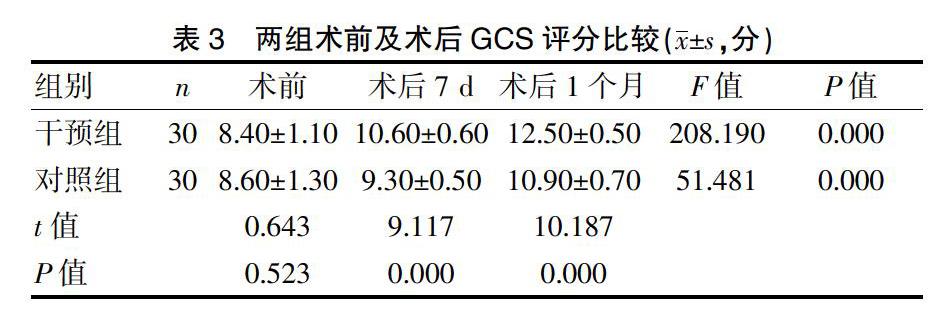
[摘要] 目的 探討智慧急救對顱腦創傷手術治療患者預后的影響。 方法 選擇2018年6月至2020年1月在我院手術治療的顱腦損傷患者60例為研究對象,隨機分為干預組與對照組,每組各30例。對照組采用常規急救措施,干預組采用智慧急救措施。比較兩組術中不良反應發生率,術后GCS評分、FMA評分及GOS評分。 結果 ①干預組術中心率>100次/min的發生率顯著高于對照組,差異有統計學意義(P<0.05)。②術后7 d、1個月干預組GCS評分均顯著高于術前,差異有統計學意義(P<0.05);術后1個月對照組GCS評分顯著高于術前,差異有統計學意義(P<0.05);術后7 d、術后1個月,干預組GCS評分顯著高于對照組,差異有統計學意義(P<0.05)。③術后3個月,兩組FMA評分均顯著高于術后1個月,差異有統計學意義(P<0.05);術后1個月與術后3個月,干預組FMA評分均顯著高于對照組,差異有統計學意義(P<0.05)。④干預組GOS評分優于對照組,差異有統計學意義(P<0.05)。 結論 智慧急救可優化顱腦創傷手術急救流程,改善患者的預后。
[關鍵詞] 智慧急救;顱腦創傷;手術治療;預后
[中圖分類號] R651.1? ? ? ? ? [文獻標識碼] A? ? ? ? ? [文章編號] 1673-9701(2021)03-0005-04
The influence of intelligent emergency on the prognosis of patients undergoing craniocerebral trauma surgery
FENG Fangjun? ?XU Longbiao? ?WEN Guifei? ?WANG Chengbin? ?DU Wangwei
Operating Room, Zhuji People′s Hospital in Zhejiang Province, Zhuji? ?311800, China
[Abstract] Objective To explore the impact of the intelligent emergency on the prognosis of patients undergoing craniocerebral trauma surgery. Methods Sixty patients with craniocerebral injury who were surgically treated in our hospital from June 2018 to January 2020 were selected as the research objects and randomly divided into the intervention group and the control group, with 30 cases in each group. The control group used conventional first-aid measures, and the intervention group used intelligent emergency measures. The incidence of adverse reactions, postoperative GCS score, FMA score, and GOS score was compared between the two groups. Results ①The incidence of heart rate>100 times/min during the operation in the intervention group was significantly higher than that in the control group, and the difference was statistically significant (P<0.05). ②The GCS score of the intervention group 7 days and 1 month after the operation was significantly higher than that before the operation, and the difference was statistically significant(P<0.05). The GCS score of the control group 1 month after the operation was significantly higher than that before the operation, and the difference was statistically significant (P<0.05). Seven days after surgery, and one month after surgery,the GCS score of the intervention group was significantly higher than that of the control group, and the difference was statistically significant(P<0.05). ③The FMA scores of the two groups at three months after the operation were significantly higher than those at one month after the operation, and the difference was statistically significant(P<0.05). One month and three months after the operation, the FMA score of the intervention group was significantly higher than that of the control group, and the difference was statistically significant(P<0.05).④The intervention group′s GOS score was significantly different from that of the control group(P<0.05). Conclusion Intelligent emergency can optimize the emergency procedures of craniocerebral trauma surgery and improve the prognosis of patients.
既往研究顯示,優化急救流程,可提高重癥顱腦外傷急診手術患者的救治效果[7]。唐文[7]的研究結果顯示,通過優化急救流程,縮短院前急救時間、院內急救時間,可提高急救成功率,降低術后不良風險事件的發生率。都基剛等[8]研究顯示,重度顱腦外傷患者的院前急救治療,可以改善患者的神經功能損傷,提高患者的生活質量。智慧急救是近年來提出的一種急救概念,與近年來物聯網的發展密切相關。智慧急救系統在急救車接診患者后通過讀取患者的身份信息,即可在車載電腦自動調取健康檔案,供接診醫護人員調閱。在急救車上,可自動采集患者的醫療數據,包括生命體征、心電圖等,保存這些數據,并能實時將這些數據傳輸給急診科,使急診科醫護人員及時了解患者的具體情況,并能制訂相應的處置措施,提前做好準備,為及時提供院內急救提供條件,縮短入院后向急救人員了解患者情況的過程,縮短急救時間[9-12]。急救人員在救護車上就可以通過平板填寫電子急救病例,對患者的病情進行初步判斷,并且對處置方法等都記錄在案,這些信息也可實時傳給急診科接診醫護人員,讓急診醫護人員對患者病情提前了解。院前急救告知系統可詳細通告目前出診急救車的狀況,使院內醫護人員實時了解急救車的出診信息,做好接診準備[13-15]。通過信息的實時傳遞,急診科醫護人員還可以與急救人員進行會診。在實地信息的分享過程中,還可以及時協調醫院急救搶救室資源、CT等輔助檢查資源、特殊藥物準備,急救搶救室資源,手術室資源、ICU床位等,在院前就為接診后患者的處置提前做好準備,縮短協調時間,為爭分奪秒搶救患者提供條件[16-18]。院前急救信息共享將急救信息完整地傳遞給醫院的急診中心,將交接內容提前向急診接診人員推送,減少了交接不清,病情交接信息之后等情況,縮短交接時間,提高交接效率[19-20]。
本研究中,干預組應用智慧急救系統,通過協調院前院內急救,縮短了患者急救時間,改善患者的預后,并且患者在術中的不良反應發生率也相對較低。智慧急救系統是基于物聯網的一種新的急救概念,隨著我國信息技術的發展,相信其在醫療系統會有更廣闊的的應用空間。
綜上所述,智慧急救可優化顱腦創傷手術急救流程,減少術中不良反應情況,改善患者的預后。
[參考文獻]
[1] 朱晨,孟華,朱杰.基于云架構的區域智慧急救平臺設計[J].中國衛生信息管理雜志,2020,17(1):57-61.
[2] 朱愛華,金吉明,吳艷杰,等.智慧急救下的現代急救云平臺在胸痛綠色通道中的應用效果[J].廣西醫學,2020, 42(4):499-501.
[3] 凌曉陽.持續顱內壓監測在中重型顱腦損傷治療中的應用價值[D].南京:南京醫科大學,2018.
[4] Reith FC,Van den Brande R,Synnot A,et al. The reliability of the Glasgow coma scale:A systematic review[J].Intensive Care Med,2016,42(1):3-15.
[5] Michaelsen SM,Rocha AS,Knabben RJ,et al.Translation,adaptation and inter-rater reliability of the administration manual for the Fugl-Meyer assessment[J].Rev Bras Fisioter,2011,15(1):80-88.
[6] McMillan T,Wilson L,Ponsford J,et al.The Glasgow outcome scale-40 years of application and refinement[J].Nat Rev Neurol,2016,12(8):477-485.
[7] 唐文.優化急救護理流程對重癥顱腦外傷急診手術患者的救治影響分析[J].中國現代醫生,2020,58(2):173-175,179.
[8] 都基剛,任美英,王德仙.重型顱腦外傷患者院前急救治療對神經功能損傷的影響[J].吉林醫學,2020,41(1):165-166.
[9] 張露,王雅雯,陳萍萍,等.院前急救與5G網絡醫療護理未來趨勢及應用[J].世界最新醫學信息文摘(連續型電子期刊),2020,20(60):296-297.
[10] 程兆輝,賀知菲,吳開明.智慧醫療背景下心腦血管疾病醫療救治信息平臺[J].解放軍醫院管理雜志,2020, 27(4):350-353.
[11] 張小亮,王忠民,戴作雷,等.基于“綠色醫囑”模式的急診多中心智慧急救系統建設思考[J].中國數字醫學,2020, 15(2):42-44.
[12] 余榮貴,陳維.智慧醫療急救服務體系建設與研究[J].中國急救復蘇與災害醫學雜志,2019,14(4):379-382.
[13] 周敬梅,曹敏,涂智輝,等.助力智慧城市的宜昌智慧急救模式的應用與研究[J].醫學信息,2019,32(6):27-28.
[14] 譚偉良,楊齊英,周振祥,等.蘇州智慧急救模式探索與實踐[J].中華災害救援醫學,2019,7(6):347-349.
[15] 吉洪煦,湯景云,顧嘉奇,等.基于區域智慧急救的卒中中心系統設計與應用[J].中國衛生信息管理雜志,2019, 16(5):593-595.
[16] 李晨,韓翔,吳丹紅.智慧醫療對優化急診救治流程的意義[J].復旦學報(醫學版),2019,46(1):95-97.
[17] 仲毅俊.RFID技術在院外急救設備管理上的應用研究[J].中國急救復蘇與災害醫學雜志,2018,13(8):790-793.
[18] 王鑫,劉紅梅.“互聯網+”與智慧急救的發展探討[J].中華災害救援醫學,2016,4(3):159-162.
[19] 謝明,梁紅璇,張亮.建立“互聯網+”智慧院前急救模式的探討[J].災害醫學與救援(電子版),2018,7(1):1-3.
[20] 劉軍,謝云,汪方,等. 5G應用于嚴重多發傷救治的探索[J].中華急診醫學雜志,2019,28(10):1242-1244.
(收稿日期:2020-10-23)
