
Experimental study of sheath potential coefficient in the J-TEXT tokamak
2021-03-22 08:04:10WeiZHAO趙偉LinNIE聶林LongwenYAN嚴(yán)龍文MinXU許敏RuiKE柯銳JieYANG陽(yáng)杰ZhipengCHEN陳志鵬ZhanhuiWANG王占輝YaliWANG王雅麗andTEXTTeam
Plasma Science and Technology 2021年3期
Wei ZHAO (趙偉), Lin NIE (聶林), Longwen YAN (嚴(yán)龍文), Min XU (許敏),Rui KE (柯銳), Jie YANG (陽(yáng)杰), Zhipeng CHEN (陳志鵬), Zhanhui WANG(王占輝), Yali WANG (王雅麗) and J-TEXT Team
1 Southwestern Institute of Physics, Chengdu 610041, People’s Republic of China
2 College of Electrical and Electronic Engineering, Huazhong University of Science and Technology,Wuhan 430074, People’s Republic of China
Abstract Sheath potential coefficient α is a key parameter,which is used to estimate plasma potential(Vp)for edge plasma physics study.Recently, a series of experiments has been carried out under hydrogen plasmas in the J-TEXT tokamak with swept probe, which is employed for currentvoltage (I-V) characteristic measurement.Electron temperature is evaluated from I-V curve by three-parameter fitting method, and the electron energy probability function shows that electron distribution is Maxwellian both outside and inside of last closed flux surface (LCFS).Plasma potential is obtained by crossing point between I-V exponential fitting curve and electron saturation current extrapolating line, which is in good agreement with first derivative probe technique.The α coefficient profile in the vicinity of the LCFS is obtained,which is in the range of 2.1-3, and decreases from outside to inside of LCFS.
Keywords: Langmuir probe, sheath potential coefficient, EEPF
1.Introduction
Langmuir probes have been widely applied for plasma measurement and research since its simple and efficient use.They can simultaneously measure multiple plasma parameters like electron density (ne), electron temperature (Te) and floating potential (Vf) with high spatial and temporal resolutions.An important application of Langmuir probe diagnosis is to estimate the plasma potential, which can be calculated by the formulaVp=Vf+αTewhen α coeffciient is known andVfandTeare measured.In unmagnetized plasmas the coefficient α can be reliably estimated by Langmuir probe theoretical models[1-3].In some cases of tokamak plasma, the theoretical coefficient α is used for physics research:α= 3 is used for blob and hole observation in the boundary plasma of EAST tokamak[4], and this value is also used for intermittent convection transport research in the boundary of the DIII-D tokamak[5].In ASDEX-U and HL-2A tokamakα= 2.8 for deuterium and in TEXTOR tokamakα= 2.5 for hydrogen are used to study turbulent transport for calculation Er×B folw respectively[6-8].However, the real α is impacted by the effect of strong magnetic field, secondary electron emission, ion temperature,diffusion, impurity, etc [2].In [9], the experimental evaluation of α coefficient on HL-2A is different from the theoretical models, the region of α coefficient is 2-3 outside last closed flux surface (LCFS),and the α coefficient increases to about 5 inside LCFS.However, the reversed trend is found from the experimental results in the J-TEXT tokamak in this text.It means that the measurement of the real sheath potential coefficient for plasma potential evaluation and relative physics study is very important.According to the formulaVp=Vf+αTe,the α coefficient can be calculated when the parameters ofVp,VfandTeare known.The conventional method to obtain these parameters is three-parameter fitting method (equation (1)) or four-parameter fitting method (equation (2)).Where the probe currentI(V)is the function of the probe potentialV,the ftiting parameters are ion saturation current(Isi),Vf,Teand slope of the ion currentAnother way is first derivative probe technique(FDPT) which can provide plasma parameters and electron energy probability function (EEPF).
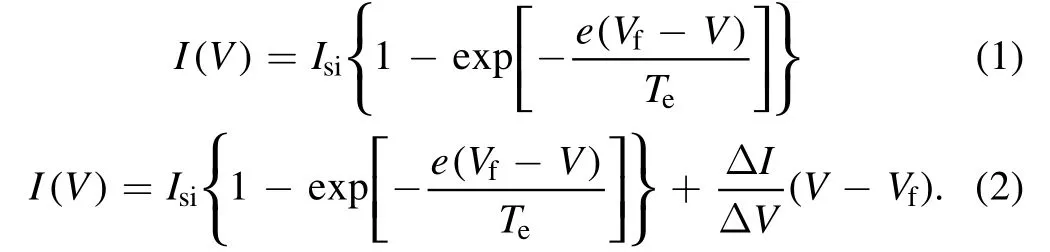
In DITE tokamak, three-parameter fitting is used belowVfand confirms that Langmuir probe is reliable in the presence of strong magnetic fields [10].In TdeV tokamak, the results obtained from four-parameter fitting of flush probe agree with the measurements of standard cylindrical probe [11, 12].In RFX, four-parameter fitting is used for non-saturation ion current I-V characteristic [13].In CASTOR tokamak, three-parameter and four-parameter fitting methods are used to study ion sheath expansion [14].In COMPASS tokamak, three kinds of methods including the FDPT, three-parameter and four-parameter fitting are used for calculating plasma parameters[15].In[16],Langmuir probe measured the electron energy distribution function at intermediate and high pressures and in a magnetic field, and then obtained the plasma parameters.References[17,18]discussed the theory of probe and how to use EEPF to obtain plasma parameters.References [19-21] derived how to use EEPF to obtain plasma parameters and showed that the electron distribution is bi-Maxwellian near LCFS in ISTTOK,CASTOR, COMPASS tokamaks and TJ-II stellarator.
Systematic experiments have been carried out under hydrogen discharges in the J-TEXT tokamak to study the sheath potential coefficient α.In the experiments,two floating probes and a voltage swept probe are employed to simultaneously measure the floating potential and I-V characteristic;triple probe is used for crosscheckingTefrom swept probe.The floating potential is used to calculate turbulent propagation velocity in poloidal direction to indicate the location of LCFS and thus to get the relative position between probes and LCFS.Profiles of electron temperature, floating potential and plasma potential are derived from I-V characteristic.Then,sheath potential coefficient profile can be obtained.FDPT is used for I-V characteristic analysis to confirm the plasma potential obtained from three-parameter fitting, and EEPF indicates that the assumption of three-parameter fitting is valid since electron distribution is Maxwellian.
2.Experiment setup
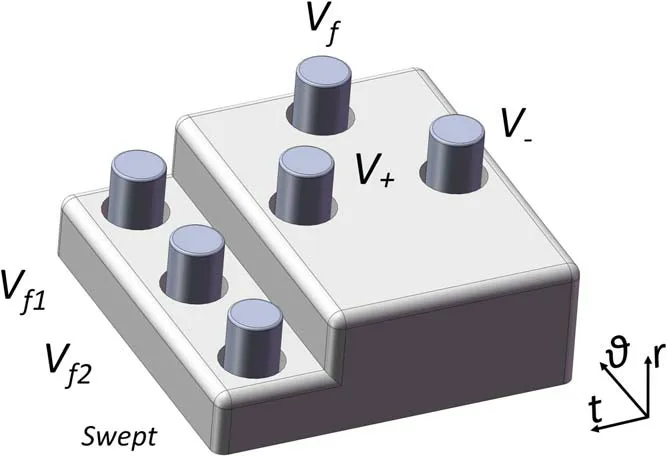
Figure 1.The 2-step probe array used in experiments: a triple probe(Vf ,V+ and V? ) on the first step and a standard swept probe and two floating probes (s wept, Vf 1, Vf2) on the second step.
J-TEXT tokamak has a major radius R = 105 cm and a minor radius a = 25.5 cm.A fast reciprocating probe array installed on the top of tokamak is used to carry out the experiments under Ohmic discharges.As shown in figure 1, the probe array has a triple probe on the first step and a standard swept probe as well as two floating probes on the second step, which can be moved about 50 mm at the speed of 1 m s?1in the vertical direction.The radial distance(Δr)between the 2 steps is 2.5 mm.All of the tips are cylindrical with the height and diameter of 2 mm, the effective collection area isAeff= 8 mm2on the first step andAeff= 4 mm2on the second step since half of probe tip is shielded by the first step.The poloidal distance between adjacent probes is 5 mm.In experiments, a 10 kHz sinusoidal wave with peak-peak value of voltage 300 V is applied for swept probe.The rough estimation of the swept probe circuit bandwidth can be calculated by the formula10 kHz, which means that the effect of capacitance on wave transmission can be ignored, where the parameters of shunt resistor and cable capacitance areRshunt= 13 Ω and C = 1.4 nF,respectively.The rest two tips on the second step are operated in floating mode with 5 mm poloidal distance.They are used for detecting the position of LCFS by measuring turbulent propagation velocity in poloidal direction.The bandwidth of the conditioning channels is higher than 300 kHz.The analog signals are sampled by a 12 bit digitizer with 2 MHz sampling frequency.
3.Experimental results
3.1.Main plasma parameters
The sheath potential coefficient measurement experiments were carried out during J-TEXT tokamak Ohmic discharges under limiter configuration, of which the main parameters with time evolution are shown in figures 2(a)-(c): the plasma currentIp~ 150 kA, the toroidal magnetic fieldBt~ 2.2 T, the lineaveraged electron densityne~ 2.5 × 10¹⁹m?3.The vertical displacement of plasma and the position of fast reciprocating probes are shown in figures 2(d) and (e).According to figure 2(d),it can be found that the vertical displacement of the plasma is less than 1.5 mm during probe movement.This means that the plasma is almost kept at the same radial position,which is important for the experiment measurement since Langmuir probe is very sensitive to the position of plasma,especially in the large gradient regions.Figure 2(e)shows how the displacement of probe varies with time.Figure 2(f) shows the turbulence poloidal velocity measured by the two floating tips and estimated by time delay estimation (TDE) method in this period.It is clear that the turbulence poloidal velocity changes from ion diamagnetic drift direction (positive) to electron diamagnetic drift direction (negative) at ~251 ms,which implies that the probe passes the LCFS at that time.

Figure 2.The main parameter evolutions of an Ohmic discharge.(a) The plasma current; (b) the toroidal magnetic field; (c) the lineaveraged electron density; (d) the plasma vertical displacement;(e) the displacement of fast reciprocating probes; (f) the poloidal velocity profile of turbulence estimated by the two floating tips with TDE method.
3.2.Experimental measurement and estimation
When the plasma contacts with a solid surface which is electrically isolated, the potential drop spontaneously arises between the plasma and the solid surface,a method based on probe theory under unmagnetized,pure,Maxwell distribution plasma conditions is used for this purpose [2]:

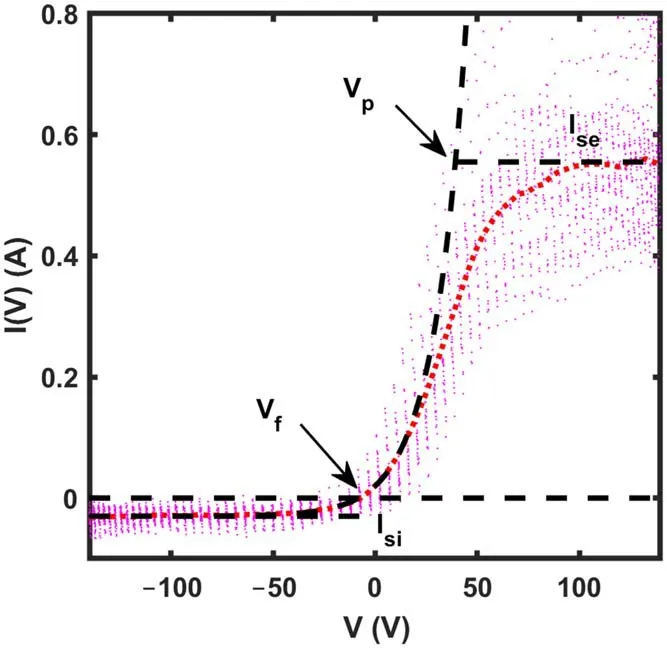
Figure 3.Typical I-V characteristic.
whereVpandVfare plasma potential and solid surface floating potential,Ti,miandTe,meare ion temperature, mass and electron temperature, mass respectively,δis secondary electron emission and α is probe sheath coefficient.It should be noted that some factors can impact the coefficient in tokamak plasma, such as strongly toroidal magnetic field, secondary electron emission, different electron and ion temperatures,which may change the theoretical coefficient α different from the real value.In order to obtain the practical coefficient, the following systematic experiments have been carried out on J-TEXT tokamak.
In experimental study, the probe sheath coefficient α is calculated from the formulawhich means that plasma potentialVp,floating potentialVfand electron temperatureTeshould be obtained firstly.These parameters are estimated from the I-V characteristic of swept probe.As the probe is inserted into the plasma region with a radial velocity of 1 m s?1and the applied frequency of sweeping voltage is 10 kHz, the probe can move roughly 1 mm during 10 sweeping cycles.Figure 3 shows the typical I-V characteristic of the original data in 20 periods with pink points and the averaged value with red dotted line, the black exponential dash line is the fitting curve obtained by means of the three-parameter method,IseandIsiare the electron saturation current and ion saturation current respectively.
From figure 3, there are three important information obtained: (1) electron and ion currents are saturated in the deeply biased voltage region; (2) floating potentialVf=?8.2 V is estimated at ( )I V= 0 A; (3) plasma potential is aboutVp= 39.2 V obtained by intersection between the fitting line of exponential andIseextrapolation line.
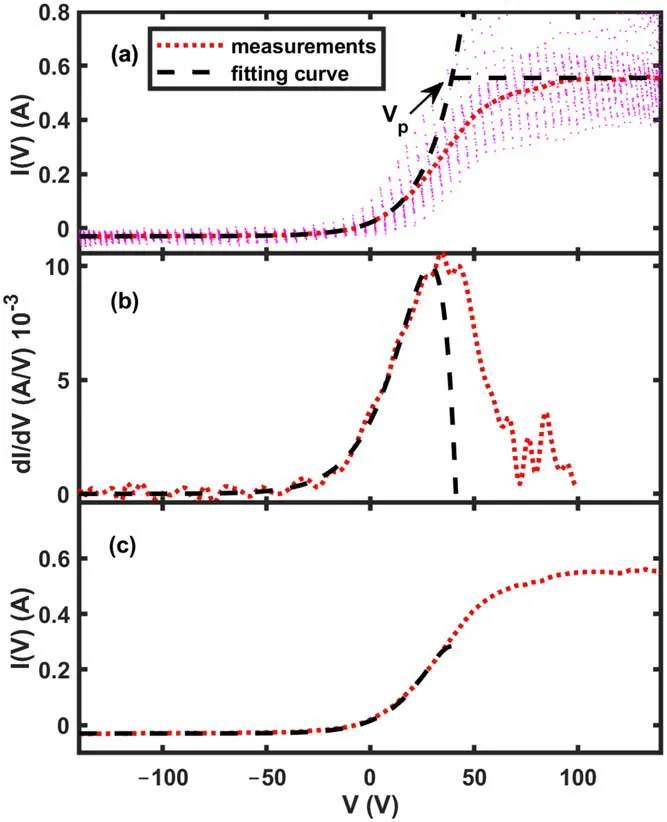
Figure 4.(a) Typical I-V characteristic andVp estimated by threeparameter fitting; (b) first derivative of the experimental I-V curve(red) and fitted curve withVp estimated by three-parameter fitting(black); (c) the experimental I-V (red) and the best fitted curve(black) after iteration.
In strongly magnetized plasma, the distortion of electron part in I-V characteristic above the floating potential is observed.As the magnetic field increases, the electron part current is gradually depressed.Based on this, first derivative of I-V characteristic method is used to estimate the plasma potential in [15, 20, 21].In J-TEXT plasma, the cylindrical probe is perpendicular to the magnetic field lines, the diffusion parameterthen the EEPF can be estimated by the first derivative of the probe current as:wheref(ε) is the EEPF,r=1 mm is the probe radius, the characteristic size of turbulenceL= 1 cm,the geometric factorγvaries from 0.71 to 4/3, B ~2.2 T, the electron Larmor radiusrL(B,ε)is in the order of 10?2mm,Uis the probe potential relative to the plasma potentialVp,εis the electron energy.The plasma potential estimation procedure is reviewed in[15,20],the first is to calculate the fitted I-V characteristic, and then use it to compare with the experimental one.If there is a discrepancy,then correction plasma potential is used to repeat the above procedure until obtains the best agreement between the fitted calculation and the measured I-V characteristic, as shown in figure 4(c).Usually, the plasma potential is shifted (0.1-0.4)Teto the positive side with respect to the maximum of the first derivative (the value ofTeexpressed in eV).In [15], a seed plasma potential is estimated for the iteration calculation, but in this text,the plasma potential calculated by three-parameter fitting before is used for the seed plasma potential,which is a good starting point for iteration calculation.As shown in figures 4(a) and (c), the plasma potential estimated from three-parameter fitting is a very good seed for FDPT calculation and the two plasma potentials agree with each other,the difference is less than 3 V (or 8%) for current curve.

Figure 5.Experimental EEPF at different positions relative to LCFS,all EEPF curves show that the electron distribution is Maxwellian one near the LCFS.

Figure 6.Measured results: (a) floating potential profile; (b) plasma potential profile;(c)electron temperature profile;(d)electron density profile; (e) sheath potential coefficient profile.
The I-V characteristic with three-parameter method for evaluating plasma parameters is based on the assumption of Maxwellian electron distribution.However, some experimental evidence shows that the electron distribution is non-Maxwellian in tokamak plasmas [9, 15, 20-22].In order to confirm the reliability of results, the EEPF is calculated as shown in figure 5.Looking on the figure,from bottom to top,the three lines are corresponding to the EEPF at different positions relative to the LCFS,the bottom line is red(12 mm),then black in the middle (0 mm) and blue on the top(?18 mm).During the probe insertion into plasma, the proportion of high-energy electrons is increased, but the EEPF shows that the electron distribution is still Maxwellian distribution at the three positions.In fact,all EEPF curves in the experiments indicate that the electron distribution is Maxwellian distribution in the probe region.
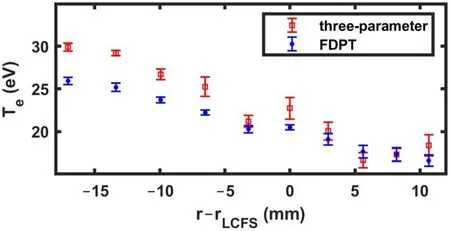
Figure 7.Electron temperature profiles retrieved by the FDPT and three-parameter fitting method.In the confined plasma, the electron temperatures are obtained by different techniques.Three-parameter fitting obtains the higher temperature,while the rough estimation by first derivative gives the lower temperature.
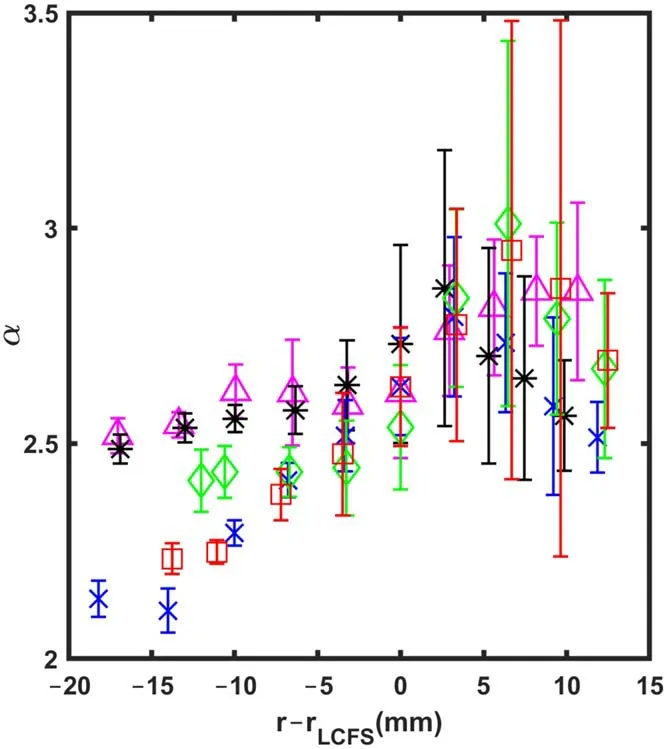
Figure 8.Sheath potential coefficient profiles of 5 shots.
Figure 6 shows the profiles of parameters estimated from I-V characteristic near LCFS.In the figure 6(a), the floating potential increases slowly with the probe movement from -8 to 0 V until LCFS, then gradually decreases to ?38 V at last.As shown in figure 6(b), the plasma potential has similar trend as floating potential, which increases slowly from about 40 V to about 60 V, and then decreases.In figure 6(c), the electron temperature monotonically increases from 17 eV outside of the LCFS to 30 eV inside of LCFS.The electron density profile is shown in figure 6(d).Figure 6(e) is the sheath potential coefficient profile;it decreases from about 3 outside of LCFS to about 2.5 inside of LCFS.Figure 7 presents the profiles of the electron temperature profiles retrieved by the FDPT and three-parameter fitting method,and a good agreement is observed.The results of plasma potential and electron temperature, confirm the consistency of the FDPT and three-parameter fitting for precise evaluation of the plasma parameters in tokamak edge plasma.Figure 8 shows the sheath potential coefficient profiles of 5 discharges.It is clear that the experimental values are different from the value(α= 2.5)roughly estimated by formula(3)using the assumptionTi=Teandδ= 0.Overall, the sheath potential coeffciient generally increases and reaches the maximum near LCFS, then gradually decreases with the probe moving into the plasma within the range from about 3 to 2.1.It should be noted that the error is dominated by the fitted error since I-V characteristic is the simple average of 20 periods from original data.
4.Conclusion and discussion
The floating potential, electron temperature and plasma potential have been evaluated from I-V characteristic by three-parameter fitting method.The profiles of sheath potential coefficient α and EEPF are also obtained in this paper.The results in J-TEXT tokamak show that the range of sheath potential coefficient α is between 2.1 and 3, and decreases gradually from outside to inside of LCFS, and the electron distribution is Maxwellian in the edge and SOL in the experiments.Some phenomena are different from other tokamaks, such as CASTOR, HL-2A and COMPASS, for example,there exists bi-Maxwellian electron distribution near the LCFS, and the coefficient α increases gradually from outside to inside of LCFS in HL-2A tokamak.For the EEPF difference, a possible explanation is due to the different electron-electron collision property [23].For HL-2A experimental parameters of plasma inside LCFS 20 mm:density isne~ 3 ×10¹⁸m?3, bi-Maxwellian electron temperatures are high electron temperatureTeh~90 eV and low electron temperatureTel~40 eV.The collision length for the averaged energy electrons in the distribution is~1016(Te[e V])2/ne[m?3] .Moreover, the connection length inside LCFS 20 mm is ~25 m in HL-2A, which is just satisfied for collision length of the high temperature plasma:Thus the bi-Maxwellian distribution still exists but gradually decreases along the radial direction.In J-TEXT experiments, the density and temperature inside LCFS 20 mm arene~ 9 ×10¹⁸m?3and 30 eV, the collision length is only ~1 m.The connection length in J-TEXT is ~14 m.These results indicate that the bi-Maxwellian is hard to exist in the edge of J-TEXT tokamak.However, the?18 mm EEPF in some shots’data seem a little different from Maxwllian EEPF while other shots’data seem Maxwellian.In figure 9, the bi-Maxwellian approximation was used to analyze the data.The results show that low and high temperatures are 22 eV and 39.8 eV respectively,and effective temperature23.5 eV is different from the temperature from Maxwellian EEPF (26 eV).Although the bi-Maxwellian distribution is occurred only at the deep position inside of LCFS sometimes, we speculate that ?18 mm may be the place where EEPF changes from bi-Maxwellian to Maxwllian in J-TEXT tokamak.It is interesting and worthy to further study in future.
As for the different tendency of α profile in J-TEXT,according to the formula (3), the α is related toand δ.Recently, many experiments show that theincreases from SOL to the edge and the coefficient δ will increase with temperature rising, which may be the reason for the decreasing in J-TEXT.In some devices, such as HL-2A,the electron distribution is bi-Maxwellian in the edge,thus the high temperature electron dominates the floating potential and makes it further away from plasma potential, in turn, leading to the increase of α.
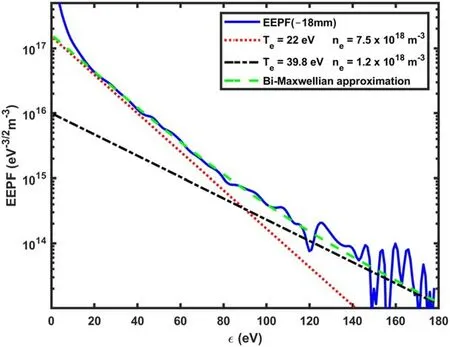
Figure 9.Bi-Maxwellian approximation at the position of ?18 mm,the experimental EEPF (blue) is fitted by bi-Maxwellian approximation (green).The low temperature is 22 eV (red) and the high temperature is 39.8 eV (black).
Acknowledgments
This work is supported by the National Key Research and Development Program of China (No.2018YFE0309103),National Natural Science Foundation of China (Nos.11875020, 11705052, 11875124 and U1867222), the ITER Organization and China Domestic Agency for the support of this work (ITER5.5.P01.CN.05).
 Plasma Science and Technology2021年3期
- Plasma Science and Technology的其它文章
- In-situ reduction of silver by surface DBD plasma:a novel method for preparing highly effective electromagnetic interference shielding Ag/PET
- Preliminary study of an open-air watercontacting discharge for direct nitrogen fixation
- Simulations of standing wave effect, stop band effect,and skin effect in large-area very high frequency symmetric capacitive discharges
- Oblique propagation of nonlinear ionacoustic cnoidal waves in magnetized electron-positron-ion plasmas with nonextensive electrons
- Experimental study of ELM-induced filament structures using the VUV imaging system on EAST
- Nonlinear evolution and secondary island formation of the double tearing mode in a hybrid simulation