
Mechanically tunable broadband terahertz modulator based on high-aligned Ni nanowire arrays?
2021-03-11 08:33:20WenfengXiang相文峰XuanLiu劉旋XiaoweiHuang黃曉煒QingliZhou周慶莉HaizhongGuo郭海中andSongqingZhao趙嵩卿
Chinese Physics B 2021年2期
Wenfeng Xiang(相文峰), Xuan Liu(劉旋), Xiaowei Huang(黃曉煒),Qingli Zhou(周慶莉), Haizhong Guo(郭海中), and Songqing Zhao(趙嵩卿)
1Beijing Key Laboratory of Optical Detection Technology for Oil and Gas,China University of Petroleum,Beijing 102249,China
2Key Laboratory of Terahertz Optoelectronics,Ministry of Education,Department of Physics,Capital Normal University,Beijing 100037,China
3School of Physical Engineering,Zhengzhou University,Zhengzhou 450001,China
4School of Arts and Sciences,China University of Peteoleum-Beijing at Karamay,Karamay 834000,China
Keywords: high-aligned Ni nanowire arrays, flexible THz-wave modulator, mechanical control, modulation depth
1. Introduction
Terahertz(THz)wave intensity modulation has garnered tremendous attention in wireless communication,superlenses,THz imaging,spectroscopy,and strain sensing. However,the investigation of effective THz manipulation devices is still in the primitive stage of development. With the rapid development of the field of THz wave technology,important progress for realizing the tunable THz wave by using different materials and design such as liquid crystal, grapheme, photonic crystals and metamaterialsetc has been achieved.[1–6]Recently,one-dimensional (1D) metal and/or semiconductor nanomaterials are of particular interest for use in THz modulation,as they exhibit a broader tuning range,wider operating bandwidth and higher anisotropic optical properties.[7]For example, Xu et al. reported a mechanically tunable THz polarizer with the modulation depth (MD) of 365% in the range of 0.2 THz–1.2 THz by using buckled carbon nanotube(CNT)sheets on rubber substrate.[8]Docherty et al. proposed an ultrafast terahertz polarization modulator employing unaligned single-walled CNTs,in which the modulation depth of 27 dB and switching speed of several picosecond were achieved.[9]Baig et al. present a photoinduced active THz polarization modulator based on GaAs nanowires (NWs) with a modulation depth of 8 dB and a switching speed of ~5 ps.[10]In addition, the polarization-dependent transmission of THz wave under optical excitation for the titled Ag NW arrays on Si substrate was reported.[11]
Based on above reports,there are two challenges to overcome for the fabrication of the high performance 1D nanomaterial THz tunable devices. One is the orientation order of 1D nanomaterial arrays. The better the order of arrays is,the greater the anisotropic optical effect is. The other one is the density of 1D nanomaterials. When the THz polarization is parallel to the 1D nanomaterial axis, the absorption of THz wave is strongly depended on the density of 1D nanomaterials. The extinction ratio(ER)of the CNT-sheet polarizer was improved from 28 dB to 37 dB as the number of CNT layers increased from 25 to 75.[12]Many efforts were focused on the alignment of CNTs, and lots of alignment methods have been proposed.[13]However, there is still a lack of effective arrangement method for other 1D nanomaterials. In addition,the density control of 1D nanomaterials is almost depended on changing the number of 1D nanomaterial layers.[12]Owing to transfer and/or stacking the layers onto a desired substrate manually,the scalable production of devices is impeded.
Ni NWs can be self-assembly aligned in liquid under a parallel external magnetic field. Moreover,the Ni NW density in arrays can be easily tuned by changing the density of Ni NWs in suspension and/or the volume of suspension during the self-assembly process.[14]In this paper,we present a mechanically tunable broadband THz modulator based on the highaligned Ni NW arrays (NiNWAs) on elastic polydimethylsiloxane (PDMS) substrate. The experiments demonstrate mechanical stretching can effectively enhance the anisotropic properties of the aligned NiNWAs. Moreover,the MD change follows the strain linearly as the strain increases from 0 to 6.5%, and the tunable range of modulation depth is from 0 to 85%.
2. Samples and experimental setup
The Ni NWs used in this study were synthesized via chemical reduction method. Chemical reduction method in synthesis Ni NWs is the low cost,facile process,environmental friendly and high-yield approach. Moreover, the diameter and length of Ni NWs can be facilely controlled by changing the synthesis parameters. The details of the synthesis process were described elsewhere.[15]The high-aligned NiNWAs were prepared on PDMS substrates by using a magnetic alignment technology in alcohol at 50?C.Firstly,a 2 cm×2 cm substrate is fixed at a bottom of beaker and 10 ml suspension with a certain quality Ni NWs was poured into the beaker;Secondly,two parallel magnets with a 4 cm×4 cm surface area are fixed on a bracket; lastly, the beaker is placed between two magnets under a 0.1-T magnetic field. After the volatilization of alcohol, the aligned NiNWAs is formed. In order to form a symmetrical sandwich structure, a PDMS capping layer with the same thickness of PDMS substrate was coated on top of the above NiNWAs. In addition, the NiNWAs were prepared on the polyethylene(PE)substrates to investigate the anisotropic properties of aligned NiNWAs. In all experiments described,the Ni NWs have approximately a length of 6 μm, and diameter of 200 nm. Figure 1(a) shows the scanning electron microscope(SEM)image of the aligned NiNWAs with a NW density of 2.5×109cm?2. The optical micrograph of the NiNWAs between the two PDMS layers is shown in Fig.1(b). A high-aligned NiNWAs was observed. Inset of Fig.1(b)shows photograph of the PDMS/NiNWAs/PDMS structure with its flexibility.
A standard THz time-domain spectroscopy (THz-TDS)system was used to investigate the aligned NiNWAs. The excitation source was a Ti:sapphire laser with center wavelength of 800 nm, pulse duration of 100 fs, and repetition rate of 80 MHz. Photoconductive antennas were used for emission and detection of THz pulses. Angle dependent transmission measurement was carried out to characterize the anisotropic properties of the aligned NiNWAs on PE substrate. After each measurement,the sample was rotated with respect to the normal of its surface at an interval of 30?. A plastic test jig with two clamps was used to investigate the tunable performance of the PDMS/NiNWAs/PDMS structure, as shown in Fig.1(c). The initial space of two clamps is 1 cm. When a sample is fixed on the jig, the NW axis of Ni NW arrays in the sandwich structure is parallel to the stretch direction of the moved clamp. The THz transmission response was measured in discrete stretching steps.At each stretching step,the sample length is elongated by 50μm;i.e.,0.5%stain is changed.

Fig.1. (a) SEM image of the aligned NiNWAs on PE substrate, (b) optical micrograph of the aligned NiNWAs between two PDMS layers. Inset shows the photograph of the PDMS/NiNWAs/PDMS structure, (c)top view of the plastic test jig.
3. Results and discussion
Figure 2(a)shows the features of transmitted THz pulses through the aligned NiNWAs on the PE substrate. The angle θ between the Ni NW alignment direction and the polarization direction of the THz wave was varied from 0?to 360?at interval of 30?. Figure 2(b) presents an angular dependent transmission of the peak of THz wave. The peak amplitude of THz wave has a periodic change with an increasing of θ.Here,0?and 90?represent the alignment direction of Ni NWs parallel and perpendicular to the polarization of the electric field of a THz pulse,respectively. A strongly anisotropic properties of the aligned NiNWAs depended on the polarization of THz wave was observed. In order to evaluate the anisotropic properties of aligned NiNWAs, the degree of polarization (DOP)and ER of THz wave as a function of frequency were calculated. The DOP and ER were defined as[16]

where T⊥and T‖are the transmittance of THz wave for the cases of θ =90?and 0?, respectively. Figure 2(c) shows the DOP and ER of the NiNWAs on the PE substrate. The DOP and ER increase with increasing frequency. The value of DOP increases from 96.5% to 99.1% as the frequency increased from 0.3 THz to 1.8 THz. The average values of DOP and ER are about 97.2%and 20.5 dB in this frequency range, respectively.

Fig.2. (a) THz TDS, (b) the peak amplitude, and (c) DOP and ER of THz pulse through the aligned NiNWAs on PE substrate.
Figure 3(a)shows the THz transmission power(T)spectra of the PDMS/NiNWAs/PDMS structure when θ = 0?.The T gradually decreased with the stain increasing, indicating the absorption of THz wave becomes stronger. In 1D nanomaterial arrays, the array ordering and density of 1D nanomaterials have an important influnce on the transmission intensity of THz wave,[17]and mechanical stretching can effectively enhance the array ordering and density of 1D nanomaterial arrays.[8]Because the NiNWAs are high aligned, the intensity modulation of THz wave through the PDMS/NiNWAs/PDMS structure is mainly determined by the variation of Ni NW density. In our previous report,we found that the transmission intensity of THz wave decreased with the Ni NW density increasing.[14]Therefore,the Ni NW density in PDMS/NiNWAs/PDMS structure increases with the strain increasing. Figure 3(b) shows the T for the PDMS/NiNWAs/PDMS structure with different strains. The linear relation between the T and the strain is observed as the strain is below 6.5%. When the strain is higher than 6.5%,the T of THz wave is almost a constant. This is to say,the Ni NW density in arrays is close to its maximum.In addition,it is pointed out that a absorption peak was observed at ~1.67 THz in Fig.3(a),which is induced by water vapor in the chamber.

Fig.3. THz transmission power spectra as a function of (a) frequency, and(b)strain for the PDMS/NiNWAs/PDMS structure under various strains.
The DOP of the PDMS/NiNWAs/PDMS structure with different strains was shown in Fig.4(a). When there is no strain,the DOP increases from 97%to 99.4%as the frequency increased from 0.3 THz to 1.8 THz, which is in agreement with that of the NiNWAs on PE substrate as shown in Fig.2(c).The DOP increased with the increasing strain. Moreover, the variation of DOP is particularly noticeable as the frequency is blow 1.2 THz. Under the strain of 6.5%, the DOP is almost a constant(99.7%)in the whole frequency range. No significant increase of the DOP occurred as the strain is above 6.5%.Figure 4(b)shows the ER variation of THz wave as the function of strain. Similarly, the ER gradually increases with the increase of strain. When the strain increased from 0 to 6.5%,the ER increased from 24.8 dB to 32.7 dB at 1.22 THz. The average value of ER is 29.5 dB at 6.5% strain. These results showed that anisotropic properties of the aligned NiNWAs can be effectively improved by mechanical stretching.

Fig.4. (a) DOP and (b) ER for the PDMS/NiNWAs/PDMS structure under various strains.
The intensity modulation of THz transmission by the PDMS/NiNWAs/PDMS structure has been discussed. The MD was defined as[8]

where Tnand T0are the transmission power of THz wave at the strain of n%and 0% as θ =0?, respectively. The MD of the PDMS/NiNWAs/PDMS structure as a function of frequency is shown in Fig.5(a). No peaks were observed except for a slight decrease in MD value with the increasing frequency,indicating that the NiNWAs have no selective absorption of THz wave in the whole frequency range. When the strain is 6.5%,the MD decreased from 87.2%to 79.5%with the frequencies ranging from 0.3 THz to 1.8 THz, and the average value of MD is 85%. Meanwhile, the MD was distinctively enhanced with the increasing strain. Figure 5(b) shows the variation of MD for the PDMS/NiNWAs/PDMS structure with different strains. A linear relationship is observed for the variation of MD regarding strain when the strain is blow 6.5%;i.e.,the MD of THz wave can be linearly tuned from 0 to ~85%as the strain increased from 0 to 6.5%. Moreover, the MD changes by 15% for per change of strain 1%. It is indicated that PDMS/NiNWAs/PDMS structures have a good intensity modulation of THz wave. Therefore, the PDMS/NiNWAs/PDMS structures support a possible way to fabricate a new kind of THz wave modulator.
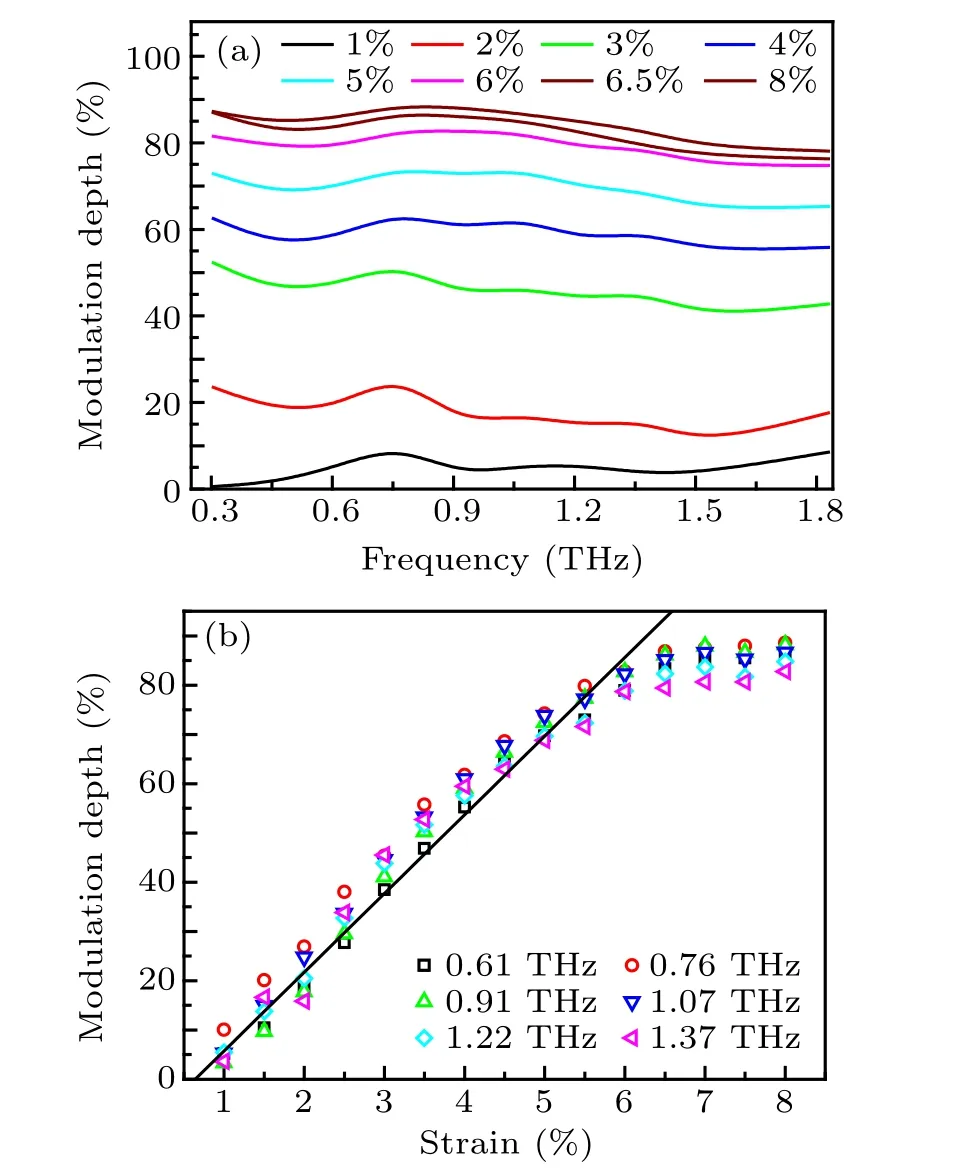
Fig.5. Modulation depth of the PDMS/NiNWAs/PDMS structure as a function of(a)frequency and(b)strain.
4. Conclusions
In summary, the PDMS/NiNWAs/PDMS structure has been fabricated, and its intensity modulation characteristics with different strains were investigated. The mechanical stretching can effectively enhance the anisotropic properties of the aligned NiNWAs. The average values of the DOP and ER are 99.7% and 29.5 dB when the strain is 6.5%, respectively, which are higher than those for the aligned NiNWAs on PE substrate. When the strain increased from 0%to 6.5%,the variation of MD in the THz frequency range from 0.3 THz to 1.8 THz follows the strain linearly, and the tunable range of MD is from 0 to 85%. Moreover, in terms of 1% strain change resolution,the detectable MD is about 15%. The concerning modulated mechanism of THz wave is mainly resulted from the change of NW density in aligned NiNWAs following the mechanical stretching. This mechanically tunable device can be easily fabricated with lost-cost,reliable techniques and promises to provide a means of for realizing novel THz devices.

- Chinese Physics B的其它文章
- Statistical potentials for 3D structure evaluation:From proteins to RNAs?
- Identification of denatured and normal biological tissues based on compressed sensing and refined composite multi-scale fuzzy entropy during high intensity focused ultrasound treatment?
- Folding nucleus and unfolding dynamics of protein 2GB1?
- Quantitative coherence analysis of dual phase grating x-ray interferometry with source grating?
- An electromagnetic view of relay time in propagation of neural signals?
- Negative photoconductivity in low-dimensional materials?