
Distribution of Panama’s narrow-range trees:are there hot-spots?
2021-02-28 09:13:46ElizabethTokarzandRichardCondit
Forest Ecosystems 2021年4期
Elizabeth Tokarz and Richard Condit
Abstract
Keywords: Narrow endemic trees,Biodiversity hot-spots,Panama,Rarefaction,High elevations,BIEN database,Narrow-range
Background
Species with narrow ranges are vulnerable to extinction compared to widespread species due to small population size and narrow environmental tolerance (Hubbell et al.2008; Sykes et al. 2020). Yet these reputed rare species can contribute substantially to local and regional diversity(Heegaard et al.2013).Maintaining their populations in the face of anthropogenic pressure requires knowing where they occur (Jenkins et al. 2013). If many scarce species are concentrated in a particular region or habitat, then localized conservation efforts can cover multiple species (Brown et al. 1995) as well as protect a unique habitat (Griggs 1940). But ‘hot-spots’ of narrow endemic species may not coincide with areas of high overall diversity(Prendergast et al.1993),so it is important to understand the distribution of narrow-range species separately from widespread species.In diverse tropical forests,ranges are seldom known completely, and aggregating across many species offers a way not only to identify hotspots but also to improve inference in poorly-explored regions.
Panama is highly diverse due to its strong precipitation and soil gradients(Gentry 1982; 1992;Condit et al.2004; Condit et al. 2011; Condit et al. 2013; Barthlott et al.2005),and it has many tree species with narrow ranges(Condit et al. 2020). In particular, the country is divided into a relatively dry Pacific slope and a wet Caribbean slope(Condit et al.2002;Condit et al.2004).The mountain chain running the length of the isthmus creates a division between the two slopes(Condit et al.2011).The Caribbean slope is wet forest according to the Holdridge system (Holdridge 1967), while the Pacific slope is variable, including dry and moist forest with some pockets of wet. True Holdridge dry forest occurs only in the isolated‘arco seco’in the provinces Herrera and Los Santos, and is home to an unusual flora. Examples of trees restricted to the dry zone includeProsopis juliflora(the mesquite,Fabaceae)andGyrocarpus americana(Hernandiaceae). The Choco region along the Caribbean of eastern Panama into Colombia, and the high mountains of western Panama into Costa Rica are two other such proposed diversity hotspots in Panama that may encompass areas rich in these narrow endemics (Stattersfield et al.1998; Monta?ez and Angehr 2007; Pérez-Escobar et al.2019; Fagua and Ramsey 2019). Our goal is a rigorous assessment of the number of narrow-range tree species relative to total diversity, and whether the proposed hotspots are indeed concentrations of narrow endemics, as they are hereafter called.
We have established many tree plots in Panama(Condit 1998;Condit et al.2002;Condit et al.2013),but those tree species with the smallest ranges seldom appear in plots(Condit et al. 2020). Our assessment thus requires wider data collecting, only possible by databases that combine records from many observers(Maitner et al.2017).Using two large online sources, we completed full range estimates of all tree species known in Panama,verifying both the species and their coordinates using expert knowledge(Condit et al.2020).Here we are concerned with trees having the narrowest ranges,ornarrow endemics(Rabinowitz 1981;Magurran 2004;Espeland and Emam 2011;Flather and Sieg 2007). We calculate regional endemicity using two definitions:1)the proportion of narrow-range species relative to all species,and 2)the total number of narrowrange species,and we test the hypothesis that endemicity thus defined is concentrated in certain regions,including the proposed hot-spots of the previous paragraph.These narrow endemics may be found outside of Panama as well,but their range confines them to the region of southern Central America.
Methods
Narrow-range species
A checklist of all tree species in Panama ≥ 3 m tall was thoroughly vetted, eliminating invalid names, harmonizing taxonomic synonyms, and confirming records within the country by cross-checking several floras,starting with the Missouri Botanic Garden’sFlora Mesoamericana(Condit et al.2020).The full list is available in Condit et al. (2019). All records with coordinates for those confirmed species were then collected from public, online sources at BIEN (Maitner et al. 2017) and the Missouri Botanical Garden(http://legacy.tropicos.org/Home.aspx).Duplicate sets of coordinates within any species were discarded. Further details can be found in Condit et al.(2020).
The global range size – Panama and elsewhere –of a species was estimated as the area of the minimum convex polygon enclosing all occurrences, excluding large bodies of water (Condit et al. 2020). We then employed the IUCN Red List range size criterion for a status of vulnerable, 20,000 km2(IUCN Standards and Petitions Committee 2019), to define narrow endemics. There were 448 species with at least three sets of coordinates whose range was below this limit,plus 46 more species with 1-2 records that we assume met this criterion. Those 494 were defined as narrow endemics, and the remaining 2549 species as the control group with wide ranges. By this definition, 16.3% of all tree species in Panama belonged in the narrow-range category.
Elevation
We downloaded shuttle radar topography at 90-m resolution from the CGIAR Spatial Data Consortium(http://srtm.csi.cgiar.org/srtmdata/). These were interpolated using the R raster package (Hijmans 2020) to estimate the elevation of every tree record in Panama. Our first question is whether narrow endemics are concentrated at certain elevations, so we divided Panama into bands of 250 m vertical range from sea level to 1000 m ASL,one band 1000-1500 m, one band 1500-2000 m, and a final band>2000 m. We increased the elevation range in bands at higher elevations to augment the total species count in each band because fewer species occur at higher elevations. The maximum elevation in our dataset was 3933 m. Then we counted the number of narrow-range and widespread species in each band(Fig. 1). We also estimated the sample size per elevation band as the number of distinct records (eliminating duplicate coordinates within species) for both groups of species (Table 1). The elevation bands vary greatly in area, with the band area generally shrinking as elevation increases.
Climatic provinces
To evaluate whether narrow-range tree species occur disproportionately relative to this division between Pacific and Caribbean slopes, we utilized Panama’s political provinces, most of which are either on the Caribbean or the Pacific slope. The province of Veraguas is one exception, so we split it into two at 8.51°N. latitude,creating North Veraguas on the Caribbean and South Veraguas on the Pacific. The province of Darien also crosses the isthmus, but it was not divided because themountain spine does not continue that far east, and the wet-dry contrast breaks down.Finally,the provinces Herrera and Los Santos were combined because they are small and adjacent, and they are mostly dry forest. We utilize the old province borders of Panama, prior to demarcation of Native American comarcas, because the original borders split the Caribbean and Pacific slopes better(Fig.2).
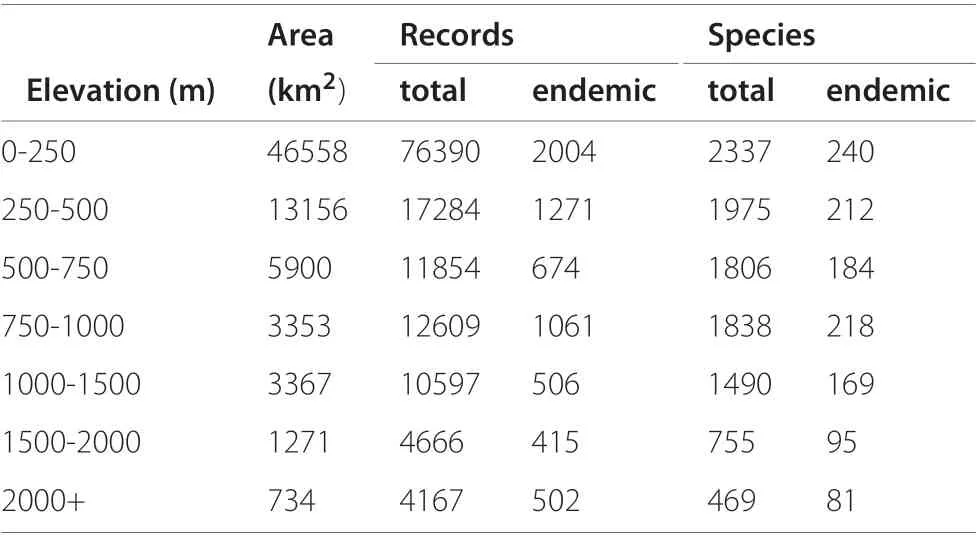
Table 1 Area,collection effort,and observed species richness of Panama across elevation zones.Endemic species are defined as those with ranges <20,000 km2
In most of Panama, the central mountain ridge dividing Caribbean and Pacific is<1000 m elevation. In the far west,however,elevations are higher,including a region>1500 m,up to 3400 m,in two western provinces(Fig.1).We thus created an additional high-elevation ‘province’spanning Bocas del Toro and Chiriqui, leaving the lowlands of Chiriqui on the Pacific slope and Bocas del Toro on the Caribbean slope.The high-elevation province combines the two highest elevation bands (Table 1). As with elevation bands, the number of species and number of records in narrow endemic and widespread groups were counted in each province (Table 2). Again, the provinces varied greatly in land area. The high-elevation province was the second-smallest at about one-eighth the area of the largest province (Darien) and just a few hundred square kilometers larger than the smallest province(North Veraguas).
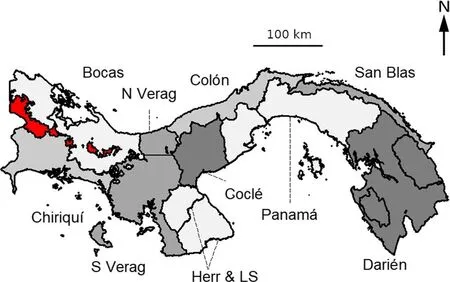
Fig.2 Panama province map.The high elevation‘province’(>1500 m)is red.Abbreviated names:Bocas=Bocas del Toro;N Verag=North Veraguas(north of 8.51°N.),S Verag=South Veraguas(the Veraguas sections are colored the same),Herr&LS=Herrera and Los Santos(combined in analyes;the line within demarcates the two provinces).Two enclosed areas within Darién are indigenous comarcas,considered part of Darién in analyses.The line within Panama province is a division between east and west sections,but we followed the older designation and combined all in one
Identifying hot spots for narrow endemic tree species
In order to identify hot spots for narrow-range tree species occurring in Panama, we used two test statistics.One is simply the number of narrow endemic species in every sampling unit,based on rarefaction to a fixed sample. The second is the ratio of narrow endemic to total species,again from a rarefied sample.The 1000 replicates of rarefied samples produce a standard deviation, which we report as the standard error (SE) of each estimate of rarefied species richness and rarefied proportion narrow endemic species. In those cases where the rarefied sample size ≤the full sample (two provinces, one elevation zone),rarefaction was carried out with replacement so the result would not be the exact number of species with an SE of 0;otherwise,sampling was without replacement.We interpret ±2×SE as 95% confidence limits, and consider estimates with non-overlapping confidence intervals to be statistically distinct.
Rarefaction
The sampling effort and the surface area in the different elevation bands, and in different provinces, varied considerably,so a direct comparison of species counts in the units is biased. By rarefying to a fixed sample size in each elevation band, or province, we accounted for differences in land area as well as variation in collection effort.All rarefaction calculations were performed in base R version 1.2.5001(R Core Team 2020).
The elevation zone>2000 m had the fewest occurrences (4167, all species combined), so that was set as the rarefaction sample for elevation comparisons.In each zone, we randomly extracted 4167 occurrences, without replacement, 1000 different times, except for in the highest elevation band.For rarefaction of province occurrences,we chose a sample of 3205,which was the second smallest.We avoided sampling with the 2280 occurrences of Herrera-Los Santos because we deemed that sample size to be too small to represent most provinces.We also repeated the province rarefaction with the smaller sample,and the trends were unaffected,so we do not report it.
Species-accumulation with sample size was also tested to examine the magnitude of biases in collection effort.Across the entire nation of Panama, random draws were made using sample sizes
N=1000×(0.5,1,2,5,10,15,25,40,46.1,75,100,125)occurrences,with 1000 replicates at each sample size.This creates an accumulation curve,showing how the number of narrow-range and widespread species, and their ratio,increased with sample size. We also created an accumulation curve from within one of the provinces,using 1000 replicates of the same samples up to 46.1×10³km2,which is the number of specimens that have been collected in the province (Table 2). We chose the province with the most samples,the one named Panama(not to be confused with the identical country name),because we thought this province would be most representative of the country as a whole.
Data available
A supplementary data archive includes the full species list with range sizes available for download(Condit et al.2019).
Results
Elevation
The ratio of narrow endemic species to all species increased with elevation, from 5.5% in the lowest elevation band to 17.2%at the highest(based on fixed sample sizes for comparison) (Table 3). The other ratios were 9.9%,9.0%,10.8%,10.2%and 12.7%at the elevation bands of 250-500 m,500-750 m,750-1000 m,1000-1500 m and 1500-2000 m, respectively. Based on confidence limits of (2×SE), the percentages at high elevation and at low elevation were statistically distinct from the remaining elevation zones(Table 3).When accounting for band area,this also held true with narrow endemic species density.The highest elevation band had 0.099 narrow endemicspecies per km2,while the lowest elevation band had 0.001 narrow endemic species per km2.The other bands ranged in density from 0.010 narrow endemic species per km2to 0.073 narrow endemic species per km2, with the density generally increasing with increased elevation.
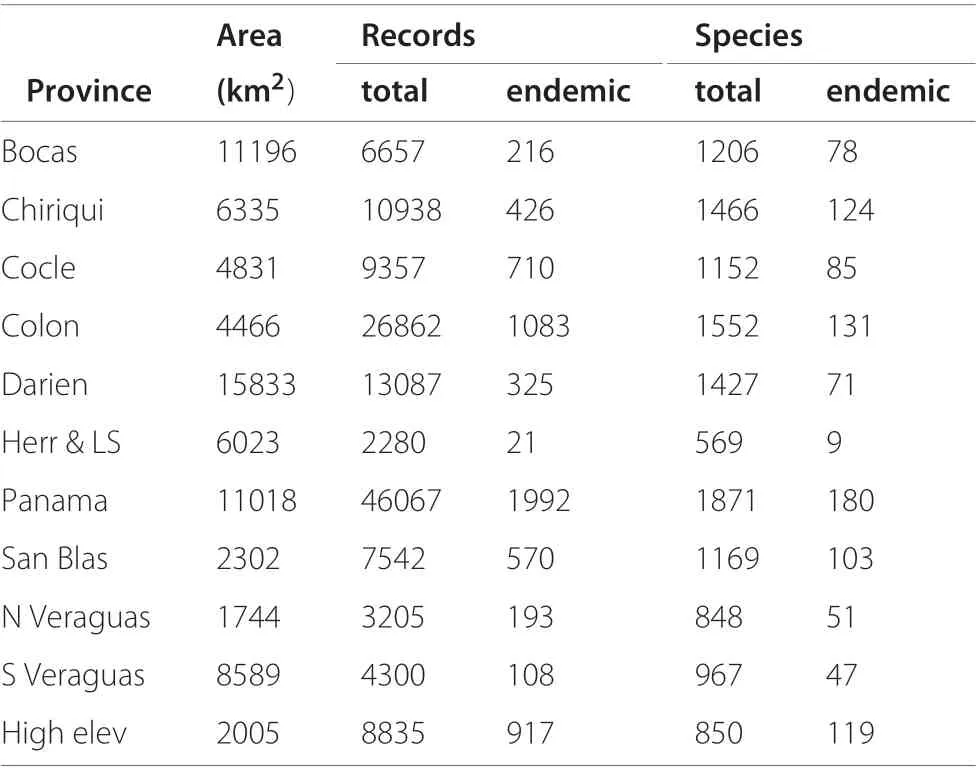
Table 2 Area,collection effort,and observed species richness of Panama across provinces.Herr&LS is the combined Herrera and Los Santos provinces.High elev is the zone ≥1500 m elevation,which combines the two highest elevation bands(Table 1).Endemic species are defined as those with ranges <20,000 km2
Mean species counts in the seven rarefied bands,from lowest to highest elevation, were 1181.7 total (65.2 endemic), 1346.8 (133.8), 1327.4 (119.1), 1332.1 (143.5),1154.2 (117.6), 733.1 (92.9) and 421.3 (72.5). The total number of species (endemic plus widespread) in fixed samples was similar from 0-1500 m, then dropped abruptly and significantly at elevations above 1500 m.There were thus two opposing trends with increasing elevation – fewer total species but a higher percentage endemic,and this meant that the total number of narrow endemic species peaked at mid-elevation,in the 750-1000 m zone(Table 3).
Province
The ratio of narrow endemics to all species was very low in Herrera/Los Santos, the driest zone (1.5%), and it was highest in the montane‘province’(14.9%).Both those extremes were statistically distinct from the remaining provinces. Other provinces had 4-9% narrow endemics,with 4.1% in Darien (1028.4 mean total species), 4.5% in S. Veraguas (883.0), 5.7% in Bocas del Toro (989.5), 6.0%in N. Veraguas (848.0), 6.4% in Colon (958.1), 6.8% in Chiriqui (1038.7), 7.3% in Cocle (902.6), 7.4% in Panama(1031.6)and 8.4%in San Blas(959.3)(Table 4).The total number of species (endemic and widespread) in fixed samples was 850-1050 in most provinces,but significantly lower in the high-elevation province(637.9 total species)and much lower in Herrera/Los Santos (520.1 total species) (Table 4). The total number of narrow endemic species in fixed samples was high in San Blas(80.9 narrow endemic species) and the high-elevation province (94.8),and also in lowland Chiriqui(<1500 m)(71.1).The number of narrow endemics was significantly lower in several provinces,especially so in Herrera/Los Santos(7.7).In the remaining provinces,the narrow endemic species counts were 39.6, 42.2, 51.0, 56.5, 63.0, 65.9 and 76.3 in S. Veraguas,Darien,N.Veraguas,Bocas del Toro,Colon,Cocle and Panama, respectively. Again, when accounting for province area,the high-elevation province had the greatest density of narrow endemic species, at 0.047 narrow endemic species per km2. San Blas had the next greatest density at 0.035 narrow endemic species per km2.
Rarefaction
The total number of species and of narrow-range species increased steeply with sample size with<10,000 records,but reached a plateau beyond 25,000 (Fig. 3). The ratio of endemic to total species also increased steeply in small samples,continued a much slower rise beyond 25,000,andfinally reached 16.3%in the entire country.Within a single province,the proportion of endemic species rose quickly in small samples, but stabilized at 9.5%, well below the proportion in a sample of the same size drawn from the entire country(Fig.3).
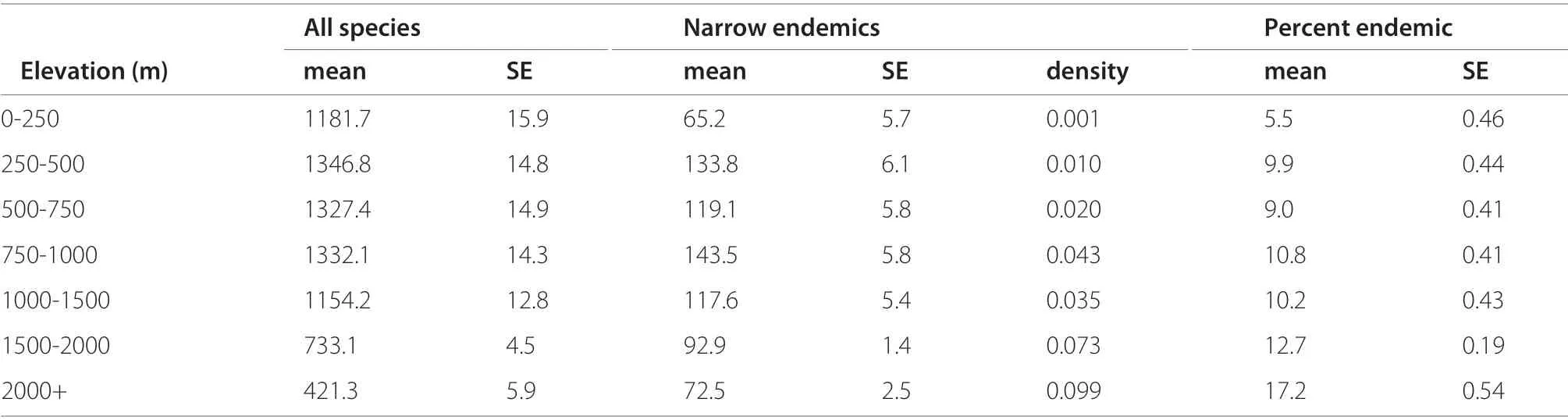
Table 3 Number of total tree species,number of narrow-range species,and the percent narrow endemics in elevation zones of Panama,calculated from subsamples of 4167 records in each zone,with standard errors(SE)among replicates of the rarefied subsamples
Discussion
Defining hot-spots using the proportion of narrow-range tree species relative to all species,we found that the highest mountains of Panama,>1500 m elevation,stood out.The proportion of narrow-range species was much higher there than the rest of the country.The Caribbean slope of eastern Panama,in the Choco biogeographic province,did not stand out by this measure.The dry forests of Panama,known for their unusual, restricted flora, had the lowest proportion of narrow endemics.
The results changed,however,when counting the total richness of narrow-range tree species, rather than their proportion.The total number of narrow endemics at high elevation was similar to the total number in San Blas Province of the Choco region, and other provinces were only slightly behind.This was possible simply because the montane region had far fewer species in total.Dry forests of Herrera-Los Santos provinces, on the other hand, had few narrow endemics whether counting the total number or their proportion.
Although rarefying the samples eliminated the influence of area,the high-elevation area also had the greatest density of narrow-range species,in both the elevation and the province analyses.
Previous studies have reported the greatest proportion of narrow endemics at high elevations in the Neotropics(Zizka et al.2018;Knapp 2002)and globally(Steinbauer et al.2016).At the same time,these high elevation Neotropical forests have fewer plant species overall(Gentry 1988),and there is a global pattern of diversity peaking at mid-elevations(McCain 2005;Rahbek 1995;Beck et al.2017).Our results parallel both these findings. It is not clear,however,that anyone has put the two patterns together:a higher proportion of endemics but fewer total species at high elevation means,in our analysis,that there were only slightly more narrow-range species in the high elevation zone of Panama than in other areas.A next step in fortifying the case for hotspot conservation status might be to determine if one of these regions has a higher incidence of unique narrow endemics that do not occur in other elevation bands or provinces.In some cases,focusing on plant communities at a more local level may be more effective at identifying true hotspots(Crain et al.2014).
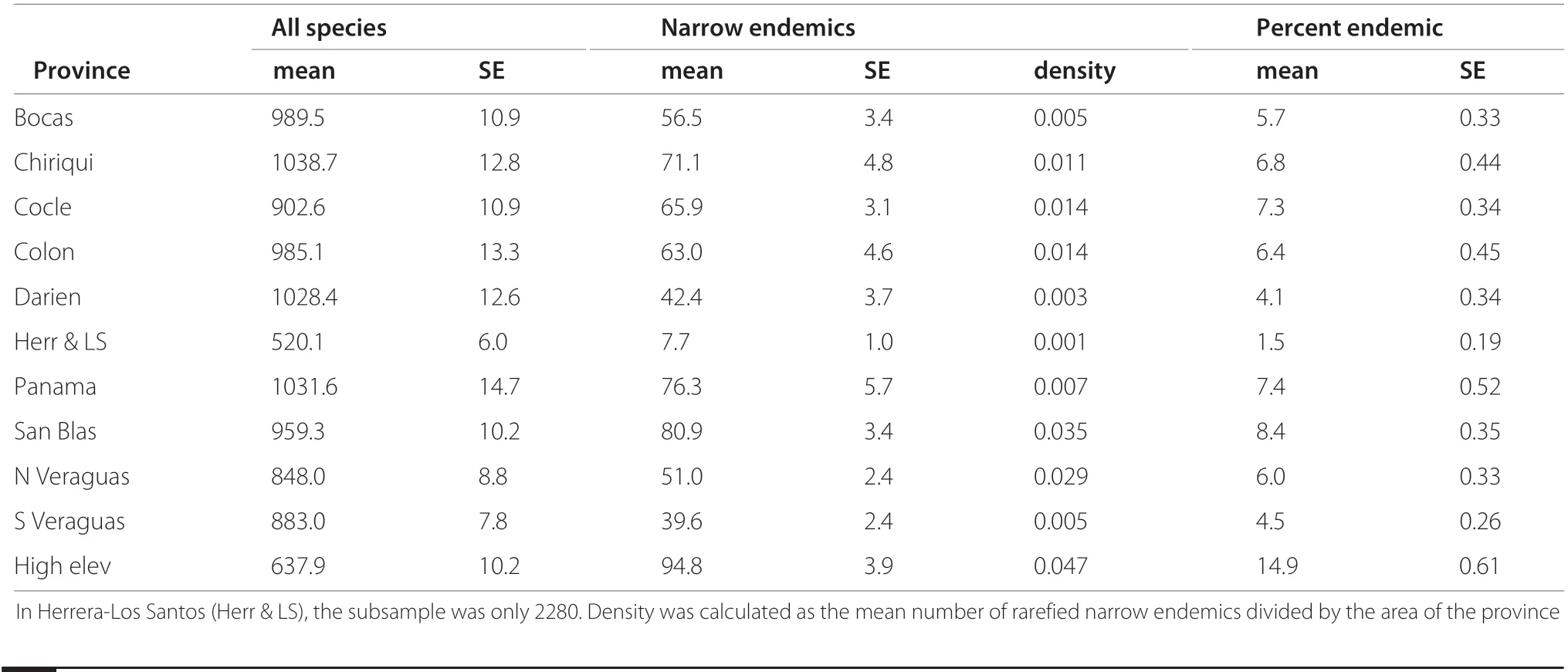
Table 4 Number of total tree species,number of narrow-range species,and the percent narrow endemics in Panama provinces,calculated from subsamples of 3205 records in each province,with standard errors(SE)among replicates of the rarefied subsamples
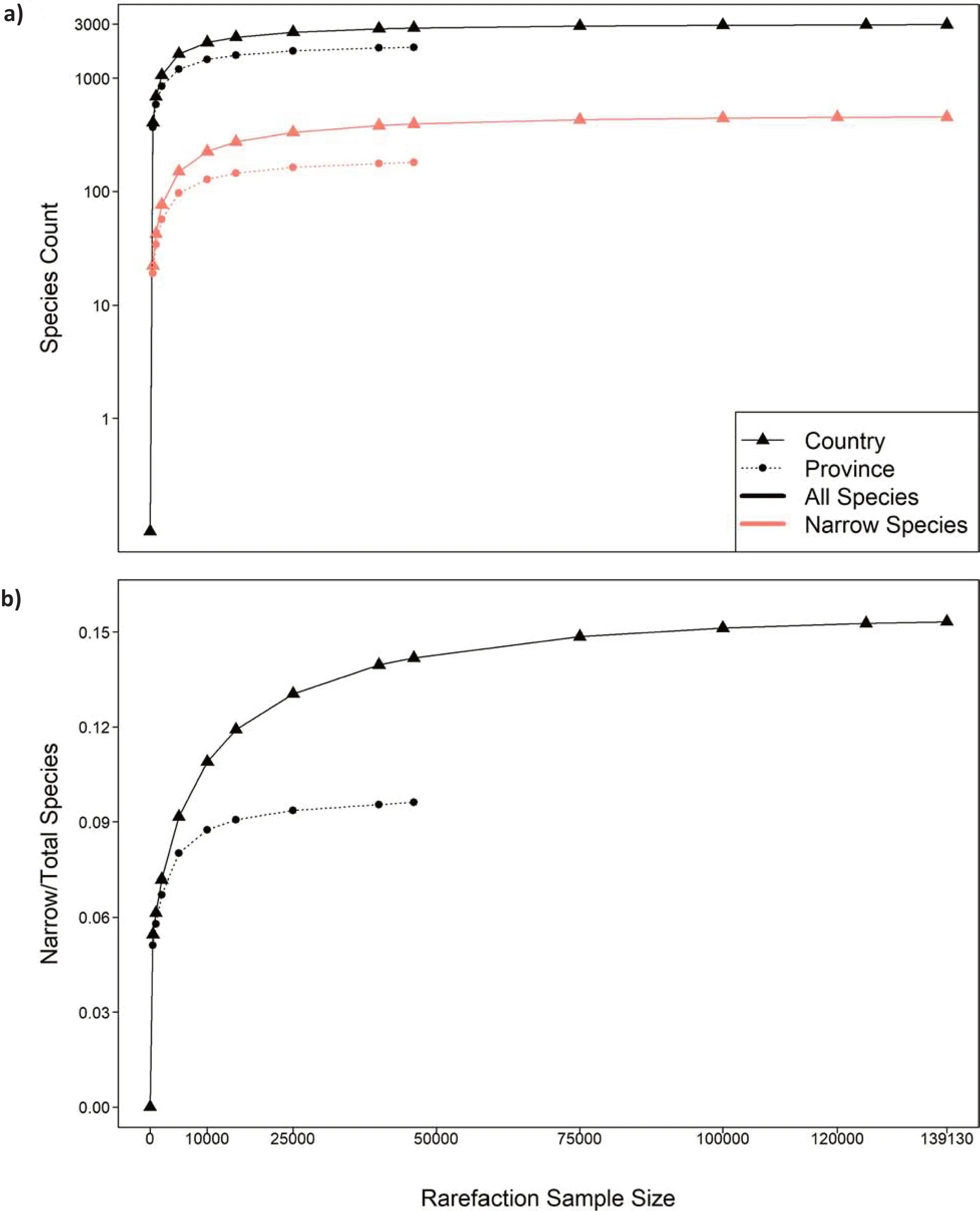
Fig.3 Rarefaction.Each panel shows species counts or ratios in randomly drawn subsamples of various sizes drawn from all records(see Methods).a)Total number of species(black)and narrow endemics(red).Solid lines are results when samples were taken from the entire nation of Panama;dashed lines from within one province(the province named Panama).b)The ratio of endemic species to total species.The solid line is from the entire country,the dashed from within the single province named Panama
High endemism and overall richness of the Choco region, including the Caribbean forests of San Blas Province in Panama, is widely quoted (Fagua and Ramsey 2019; Pérez-Escobar et al. 2019). Our work in tree plots shows high local diversity in these wet forests of the Caribbean (Condit et al. 2005; Pérez et al. 2005), but this does not address total richness(gamma diversity)or endemism. Our results here do not favor unusually high endemism in San Blas,as the proportion of narrow-range species there was only slightly higher than the rest of Panama.
The dry forest zone of Panama is small, and it harbors unusual species for a wet tropical climate whose populations within Panama are small and isolated. Though locally rare, however, these species have wide ranges across the Neotropics,for example,Prosopisoccurs from the southern USA to Chile. We found tree richness and endemism far lower in the dry forest zone of Panama than anywhere else in the country. Our plot inventories also show lower tree diversity in dry areas(Pérez et al.2005).
Conclusion
Narrowly distributed tree species comprised a higher proportion and density of the tree communities at elevations greater than>1500 m in Panama. At lower elevation and across the rest of Panama, the proportion and density of these narrow endemics was lower. Our study joins many others that highlight the importance of high-elevation habitats as hot-spots for diversity and conservation (K?rner 2004; Nogué et al. 2012; Rahbek et al.2019).
At the same time,our results show higher overall species richness at low and mid-elevations. Hence, the gradient in total richness and the gradient in percentage endemics are opposite,so the total richness of narrow-range species(not the proportion)is constant across the elevation gradient.The fact that low or mid-elevation forests have the highest species richness is well known, and conservation efforts in low elevation forests, despite a low percentage of narrow range trees,is certainly as important as efforts directed toward the small areas at high elevation.Perhaps finding where narrow-range species concentrate in the low elevations will maximize conservation efforts in these parts.
Acknowledgements
R.Foster and R.Pérez initiated and maintained the tree checklist of Panama.The staff of the Center for Tree Science at the Morton Arboretum provided scientific advice.
Authors’contributions
ET wrote the manuscript.RC directed plot censuses and inventories,assembled floristic records,and calculated range sizes.The authors read and approved the final manuscript.
Funding
The Center for Tree Science at the Morton Arboretum provided financial support for the lead author.Funding for various phases of the work was provided by the Smithsonian Institution and the National Science Foundation(US).
Availability of data and materials
A supplementary data archive shows additional results(Condit et al.2019).All species names,synonyms,and the full data,including all individual records and estimated range sizes,are available there for download.
Declarations
Ethics approval and consent to participate
The research involved no human subjects.Permission from owners was always obtained for working in parks or on private land in Panama.
Consent for publication
Not applicable.
Competing interests
The authors declare that they have no competing interests.
Received:20 April 2021 Accepted:3 August 2021

- Forest Ecosystems的其它文章
- Linkage of microbial living communities and residues to soil organic carbon accumulation along a forest restoration gradient in southern China
- Simultaneous optimization of even flow and land and timber value in forest planning:a continuous approach
- Mature stand developmental stage has ceased to constitute the most suitable habitat for the capercaillie in the Augustów Forest,Poland
- Forest disturbances and the attribution derived from yearly Landsat time series over 1990–2020 in the Hengduan Mountains Region of Southwest China
- Nutrient resorption strategies of three oak tree species in response to interannual climate variability
- Topography modulates effects of nitrogen deposition on microbial resource limitation in a nitrogen-saturated subtropical forest