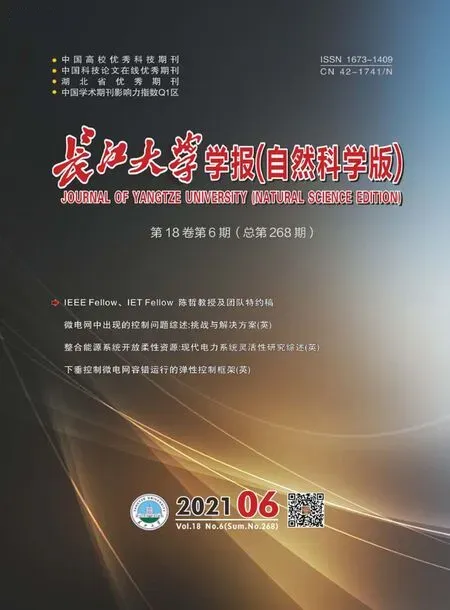
Opening flexible resources by integrating energy systems: A review of flexibility for the modern power system
2021-02-16 07:15:04XIYufeiCHENZheWANGYanboLUNDHenrik
長江大學學報(自科版) 2021年6期
關鍵詞:示意圖
XI Yufei, CHEN Zhe, WANG Yanbo, LUND Henrik
1.Department of Energy Technology, Aalborg University, 9220, Aalborg, Denmark 2.Department of Development and Planning, Aalborg University, 9000 Aalborg, Denmark
[Abstract] Although the power system itself has had some ability to accommodate changes, the flexibility has become one of the most noteworthy focuses of modern power systems, with the increasing level of grid-connected variable renewable energy (primarily, wind and solar).On the one hand, the integration of energy systems by combining electricity, heat, gas and other energy sources makes it possible for end-users to switch consumed energy flexibly.On the other hand, the opening of markets and smart energy rates/pricing promote public utilities and regulators to obtain cheap renewable and storage resources, which reduce the curtailment of renewable energy.In this context, this paper aims at discussing how to improve the flexibility of the power systems to accommodate the increasing penetration of renewable energy.First, the flexibilities of the supply-side and demand-side of power system are summarized.Then how to take the advantages of both the supply-side and demand-side flexibility to optimize the flexibility of the whole power system is introduced, lastly the key applications and development trends of integration and optimization of flexibility are introduced.Hopefully, this paper will provide a reference for future research and engineering projects on flexibility.
[Key words] flexibility;modern power system;demand response management;renewable energy;integrated energy system
1 Introduction
With the increase of cost efficiency and competitiveness of renewable resources, they have gradually become more important alternatives to traditional power plants[1].However, the operational challenge of power systems brought by intermittent resources requires planners to actively encourage the system to accommodate this random variability[2].This makes the requirements for flexibility in modern power systems higher than ever.
In recent years, breakthroughs have been made in emerging technologies for renewable energy power generation, power storage, smart houses and electric vehicles.Coupled with the coordination among energy sectors such as transportation, heating, gas, etc., all the evolutions have created conditions for the feasibility of multiple flexible solutions for the power system.In addition, the open market and rate design are promoting the development of new business models that support flexibility.The new definitions of roles in the market are triggered.For example, system operators are trying to connect those available and flexible small-scale suppliers with the power system.Meanwhile, consumers are no longer passive receivers but are evolving into active market participants.
This paper looks at various sources of flexibility available in modern power systems and their potential for contributing to a more affordable, reliable and resilient power system capable of accommodating large amounts of variable renewable resources.The remainder of the paper is organized as follows: Section 2 gives an overview of flexibility approaches in the power system mainly including supply-side and demand-side.Section 3 discusses the applications and benefits of the flexibility approaches in the integrated energy systems and open markets.The conclusions are drawn in Section 4.
2 Flexibility for the power system
Traditional power systems have always had some ability to accommodate changes in supply and demand.However, flexibility has still been especially prized in modern power systems with higher penetration of renewable energy[3].At the same time, new supply-side technologies such as fast-ramping and fast-cycling generation, the new demand-side technologies like controlled electric-heating and storage, as well as improved transmission capabilities, have created a good prospect for grid flexibility.
2.1 Supply-side flexibility
2.1.1 Increasing resource diversity and geographic coverage
Renewable resources offer lower-cost supply alternatives than fossil resources, and their combination of use increases the system flexibility as well.For example, wind resources (in two regions) and solar generation in Texas had different, but complementary, load capacity profiles[3].Expanding the geographic coverage of available resources creates an opportunity to utilize multiple resources.These resources can produce a smooth profile that closely approximates system demands.Cases in ref.[4] show that increasing resource and geographic diversity not only reduces curtailments but also improves price fluctuations.
2.1.2 Inverter-based capabilities
The supply-side advanced technologies such as inverter-based wind, solar, and batteries can provide the power system with important capabilities, including disturbance ride-through, reactive and voltage support, frequency regulation and dispatchability[5].These resources are useful in managing the grid due to their excellent ability of quick response.
2.2 Demand-side Flexibility
In general, system operators dispatch generation to satisfy the determined load on a system.Now, the technology of demand-side management allows controlling energy demand to meet available supply.Traditional demand response (DR) simply focused on load shedding/shifting to relieve grid stress.The integration of energy systems provides an open environment, in which the DR can be responsive to the needs of other grids or energy systems, so that the power systems access the latent demand-side flexibility from different energy systems.Based on the terminology illustrated in Lawrence Berkeley National Laboratory (LBNL)[6], various DR services applicable to different periods are introduced as follows(Fig.1).

Fig.1 Timeframes of shaping, shifting, shedding and shimmy loads圖1 按時間度量的基礎負荷,可轉移負荷,可切除負荷及搖擺負荷
2.2.1 Shaping load
Shaping load is a DR program that modifies load curve shapes through long-term price response or behavioural campaigns[7].The characteristics of the load shapes represent the energy consumption patterns of power systems.On the one hand, the load shape can permanently move consumption patterns through the implementation of time-of-use rates.On the other hand, the shape can access loads that can be occasionally curtailed to provide peak capacity through traditional curtailable rates.
2.2.2 Shifting load
Shifting load is a DR program that encourages the movement of energy consumption from times of high demand to times when there is surplus renewable generation.This is similar to the permanent load shifts under shaping load but is accomplished through different incentives which may result in a more flexible shift that only occurs when needed (rather than a permanent load shape change).For example, electric-vehicle (EV) stations and storage can charge and store the cheaper electricity.Heating, ventilation and air conditioning (HVAC) buildings can provide heating and cooling while effectively shifting load[8].Moreover, shifting load could also provide a fast-acting flexible resource to help address system net load ramp issues.
2.2.3 Shedding load
Load shedding, or load reduction, is usually done as a controlled option to respond to unplanned events to protect the power system from a total blackout.The load shedding is similar to the occasional curtailment capability in shape.Here, it is envisioned as more flexible and offering consumers more options in how and when to participate, including advanced lighting, interruptible appliances and air conditioning cycling among others.
2.2.4 Shimmy load
The fast response load can shimmy back and forth to dynamically adjust demand on the system, which is able to alleviate short-run ramps and disturbances at timescales ranging from seconds up to an hour.These resources can provide frequency regulation, local voltage support, and ramping reserves.
3 Integrating and optimizing flexibility
Section 2 has introduced the types of resources that can provide flexibility in the power system.Thus, this section focuses on how to take advantage of these opportunities and optimize flexibility, and discusses the key applications that have been carried out in the open environment of integrated energy systems.
3.1 Composite demand with controllable load
The integration of energy systems enables end-users to have multiple options to fulfill their energy demands.In return, end-users with controllable load, distributed generation and storage can adjust power flows in synergy with the upper network’s needs to provide demand-side flexibility[9].For example, the CoSES Laboratory in TU Munich emulates a small microgrid, in which the end-users are simulated as buildings with photovoltaic power (PV) generation, electric vehicle (EV) chargers and electric heaters[10].Fig.2 shows the schematic diagram of a smart building.The energy demands of the buildings can be divided into heat demand (domestic water and space-heating service) and non-heat demand (electric appliances, electric heating and EV chargers with storage).The non-heat demand is met through the power network, and the heat demand can be met through the district heating (DH) network or electric heating such as air conditioners and heat pumps.

Fig.2 The schematic diagram of a smart building圖2 智能建筑示意圖
Such buildings are able to participate actively in the DR programs including load curtailment, load shifting, and substitution[11].Load curtailment is usually not considered due to the loss of comfort.We find that virtually all major household uses can be shifted from the peak period using smart, responsive technologies.Exploiting this flexibility can dramatically cut peak demand.In addition, cheap prices encourage buildings to use EV and electric storage to make up the power difference during the valley period.Since electricity can be converted to heat by using electric heating devices, a smart building help limit the energy needed to provide space conditioning, which is a key strategy for making electric heating more economical for consumers.
3.2 Smarter retail pricing and rate design
Traditional energy charges are quickly proved to be an unstable form of profitability, as customers may pursue other alternatives to avoid payment.Such energy charges are difficult to accurately capture customers’ consumption patterns that vary widely.Furthermore, the impact of such charges on customers with normal usage and those with low usage is disproportionate.Time-varying pricing or rate design can allocate costs more equitably, make bills more predictable and be easier for customers to understand[12].In ref. [13],utilities are moving from traditional demand charges to the smarter time-of-use (TOU) energy rates, and many pricing pilots show that ratepayers can respond to pricing.In ref.[14], The Extended Stay America motel chain cooperates with STEM in California and installs an energy management system that can be operated remotely using artificial intelligence and smart algorithms.STEM operates the system to minimize the demand charges to the hotels, save money for customers, and also operates it as a virtual power plant (VPP) to provide services to the utilities.
3.3 System planning and market opening
Designing modern power systems often relies on cost-minimized capacity expansion and scheduling models under technical, economic and policy constraints[15].In general, the energy scheduling, associated capacity required on peak days and reserve margin are the key points of system planning.Meanwhile, system planning can consider providing ramp and regulation flexibility services that ensure sufficient dispatchable generation to match short-term load fluctuations.From a long-term perspective of system planning, the generators with higher efficiency but lower flexibility will be gradually replaced by those with lower efficiency but higher flexibility.Furthermore, inter-regional grid interconnection fully uses the complementarity between flexibility and energy resources.Inter-regional transmission can provide more services at a lower cost than local options.For example, during the summer of hydropower peak and the winter wind power peak, complementary renewable energy can be traded between regions leading to a higher renewable accommodation.
Market opening is an another measure of increasing flexibility.In ref.[16], regulators could support plans that benefit from market procurement of solar, wind and storage resources.Xcel Energy received a large number of various wind energy, solar and battery bids at very low prices in 2016.This means that public utilities are not the only companies that can obtain flexible resources through the market process, but regulators can also play a role in soliciting cost-effective bids for renewable energy and storage.Another example is opening a wholesale market to aggregated, distributed energy resources and storage.In California, the Electricity Storage and Distributed Energy Resources (ESDER) Initiative completed in 2018 provides for a bidding mechanism that allows aggregated behind-the-meter resources to provide the services of load usage and load curtailment.
4 Conclusion
The focus of this paper is to overview the flexibility of modern power systems.In order to enable the grid to accommodate more renewable energy, the potential flexibility covering generation, conversion, storage and consumption is discussed in detail.In fact, a more favorable circumstance achieved by energy integration and market opening makes the described flexibility no longer limited to the power system itself.The energy conversion between different energy systems allows the demand-side of the grid to have more options to meet customers' needs at a lower cost.The cross-regional interconnection of power systems makes full use of the complementarity of renewable resources so that the grids as a whole have better renewable accommodation.Today, flexible power generation, transmission capacity, system operation and demand management all help to improve the flexibility of power systems.This is an opportunity for regulators and public utilities to guide and support modern power systems to be more flexible and economical, and achieve decarbonization.
猜你喜歡
《學習方法報》歷史中考版(2023年21期)2023-11-09 07:40:38
數學小靈通(1-2年級)(2020年9期)2020-10-27 03:24:18
當代貴州(2019年41期)2019-12-13 09:28:56
娃娃樂園·3-7歲綜合智能(2016年1期)2016-10-25 09:32:48
中國共青團(2015年7期)2015-12-17 01:24:38
中學生數理化·八年級物理人教版(2014年1期)2015-01-09 08:50:45
中國扶貧(2014年8期)2014-06-27 15:33:39
中國扶貧(2014年8期)2014-06-27 04:09:02
中學生數理化·八年級物理人教版(2014年2期)2014-04-02 08:50:44
能源(2014年3期)2014-03-27 09:55:20