Two Newly Recorded Species of Astrochapsa from China
2021-02-05 03:26:28JUYanhuLIMinWANGChangyuYUZhenlianJIAZefeng
熱帶亞熱帶植物學(xué)報 2021年1期
JU Yan-hu, LI Min, WANG Chang-yu, YU Zhen-lian, JIA Ze-feng*
Two Newly Recorded Species offrom China
JU Yan-hu1, LI Min1, WANG Chang-yu1, YU Zhen-lian2, JIA Ze-feng1*
(1. College of Life Sciences, Liaocheng University,Liaocheng 252059, Shandong, China; 2. Shenxian Agricultural Bureau,Shenxian 252400, Shandong, China)
Twospecies,and, are reported from China for the first time based on the morphological, anatomical and chemical characteristics.ischaracterized by the crustose thallus with a compact surface, rounded to angular apothecia in outline, hyaline and muriform ascospores sized 30–75m×10–25m, and absence of lichen compounds detected.ischaracterised by the crustose thallus,usually angular-rounded to irregular apotheciain outline with a strongly raised, jagged to typically lobed, upright to recurved margin, hyaline or slightly brownish and densely muriform ascospores (55–90m×22–28m), and presence of stictic acid.
Lichenized fungi;Thelotremataceae;; New record
The genusParnmen, Lücking & Lumbsch was divided from the genusA. Massal in 2012 following a phylogenetic analysis[1]. Compared tos. str., the genusis characterized by the more frequently dense cortex, recurved apothecial margin, and exclusively non- distoseptate and non-amyloid ascospores[1]. Eighteen species, includinganddescribed ass. lat. species from 1923 to 2012, were introduced intoSubsequently, eleven new species such asSipman,Poengs. & Lumbsch andErtz & Borgato, were added to this genus[2–10]. A total of 29 species are currently accepted in the genus worldwide[8–10].
Some smaller related genera have also been reported from China in recent years, such asStaiger & Kalb[11–12],A. Massal.[13],Fée[14],Fée[15], andKalb[16]. Up to now, only one species of,(Zahlbr.) Lücking & S. Joshi (=Zahlbr.), has been known from Fujian in China[17]. During our ongoing studies on Thelotremataceae in China, another two species ofwere found and reported here.
1 Materials and methods
Specimens examined in this study are deposited in the Herbarium of Crytopams, Kunming Institute of Botany, Academia Sinica-Lichenes (KUN-L) and the Fungarium of the College of Life Sciences, Liaocheng University (LCUF). The morphology and anatomy were observed using a stereomicroscope OLYMPUS SZX16 and light microscopes OLYMPUS BX53. Sections of thalli and ascomata were mounted in water, in which K (a 10% aqueous solution of potassium hydroxide), C (a saturated solution of aqueous sodium hypochlorite) and I (Lugol’s iodine) test were taken. The lichen substances were detected using thin-layer chromatography (TLC)[18–20].
2 Results
Two species ofin family Thelotre- mataceae (lichenized Ascomycota: Ostropales) are described as new to China here. The specimens was taken from southern China.
Parnmen, Lücking & Lumbsch, PLoS ONE 7(12): e51392, 8 (2012)
Type species:(Berk. & Broome) Parnmen, Lücking & Lumbsch, PLoS ONE 7(12): e51392, 8 (2012)
Thallus crustose with dense cortex; apothecia erumpent, disc exposed, rounded to irregular in out- line with lobulate to usually recurved margin; exci- pulum usually brown; ascospores septate to muriform, fusiform-ellipsoid to oblong-cylindrical, with slightly thickened septa and subdistoseptate, hyaline to rarely brown, non-amyloid ascospores; the chemistry ofis frequently stictic acid group substances or no substances.
(Nyl.) Parnmen, Lücking & Lumbsch, PLoS ONE 7 (12): e51392, 9 (2012). (Fig. 1: A–D)
≡Nyl., in Hue, Nouv. Arch. Mus. Hist. Nat., Paris, 3 sér. 3: 163 (1891).
≡(Nyl.) Zahlbr., Denk- schr. Kaiserl. Akad. Wiss. Wien, Math.-Naturwiss. Kl. 83: 110 (1909)
≡(Nyl.) Frisch, Biblthca Lichenol. 92: 120 (2006).
Thallus crustose, yellow or brown, continuous, slight uneven, slightly glossy; upper surface compact or slightly mealy. Apothecia erumpent or immersed, angular rounded to irregular in outline, 0.25–0.35 mm in diam, margin raised but often eroded, jagged to usually lobed; disc brownish, exposed, usually pruinose; proper margin dark brown, fissured and recurved, striated. Excipulum absent, not carbonized, 7–10m thick; epithecium dark brown, 12–20m thick; hymenium clear, limpid, 100–125m high; asci clavate to fusiform, 65–110m×18–30m; asco- spores 2–6/ascus, fusiform, hyaline, muriform, 10– 14×4–6 loculate, thick-walled, halonate, 30–75m× 10–25m, I-; paraphyses simple, straight, unbranched, about 30m in length, tips expanded and adspersed with brownish granules.
Chemistry:K-, C- and P-; no lichen componds detected by TLC.
Substrate:Onrock.
Distribution:Africa (Sierra Leone, Mozambique); America (French Guiana, Brazil); Asia (Malesia, Thailand, India)[21–22]. New to China.
Specimens examined:CHINA. Yunnan, Xinping County, Mt. Mopanshan, alt. 2 420 m, 20 Dec. 2008, L.S. Wang 08-29821 (KUN-L).
Remarks: The species is characterized by its pale-olive thallus lacking secondary compounds, pale brown apothecial disc, distinctly white pruinose, round to angular apothecia with fissured and recurved margins, and hyaline muriform ascospores. It is similar toA. Massal.and(Nyl.) A. Frisch in havingecorticate brownish to olive-grey thallus, rounded to angular apothecia and pruinose disc, butcan be distinguished by the transversely septate ascospores, andconsistently bearing a single larger ascospore in the asci[13,22]. The substrate of.was bark as previously reported[21–22], but the specimen examined in this study was collected on the rock. The species is actually more likein disc and asco- spores, and it has ever been listed as.by Papong et al. in the FIELD GUIDES (https:// fieldguides.fieldmuseum.org/guides/guide/545, 2013), we also suggest that this species should be introduced into the genusand as synonym asin the future based on the weakly recurved margin of apothecia and fusiform ascospores with thickened septa and rounded lumina. Because of the lack of its molecular data, let’s do this name under genusfor the moment.
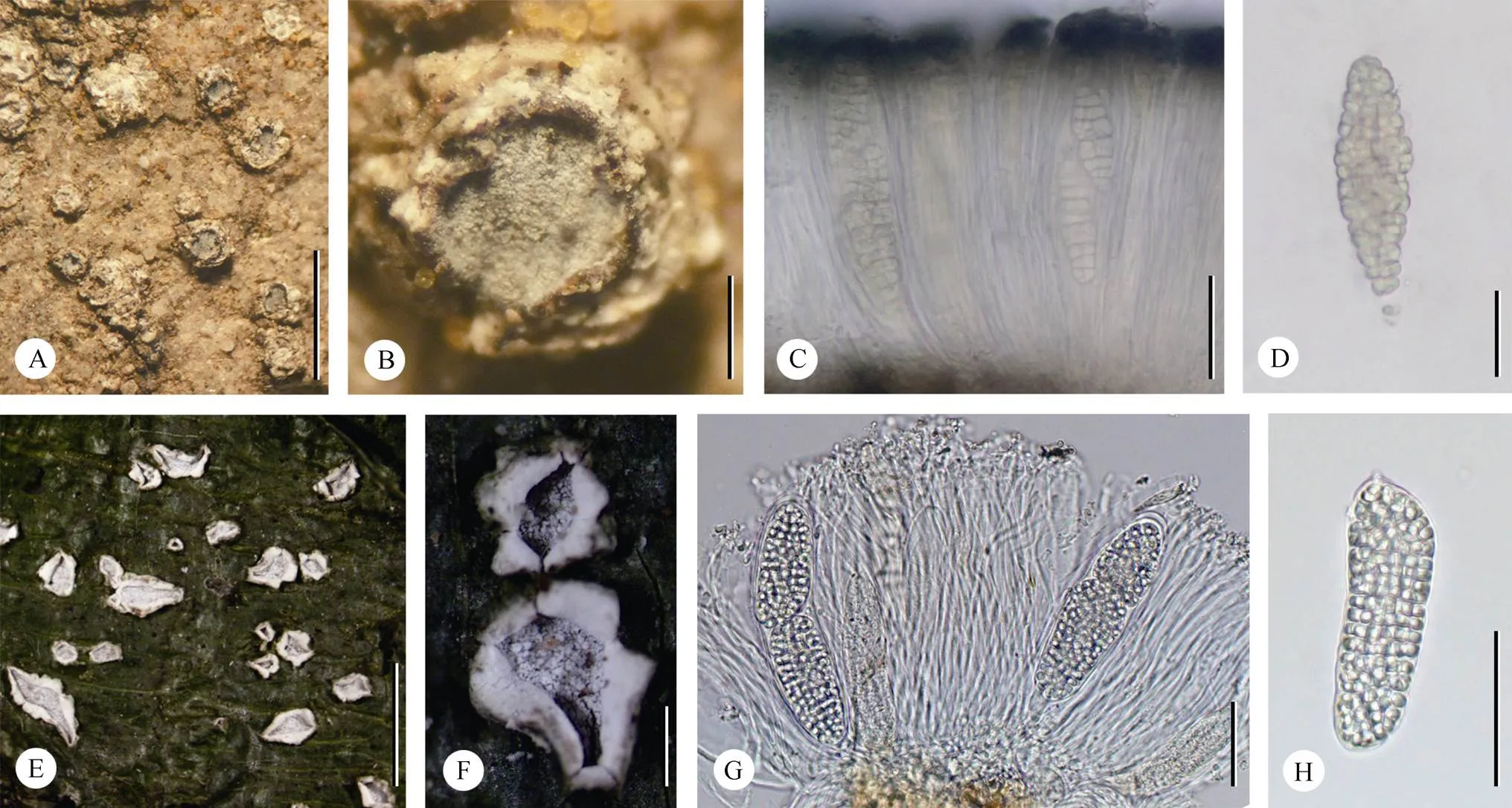
Fig. 1 Astrochapsa pseudophlyctis (08-29821, KUN-L) (A-D) and A. zahlbruckneri (HN19100, LCUF) (E-H). A, E: Thallus (Bar=1 mm); B, F: Ascomata (Bar=100 μm); C: Hymenium with asci (Bar=50 μm); D, H: Ascospore (Bars: D=20 μm, H=50 μm); G: Hymenium with 2-spored asci (Bar=50 μm).
(Redinger) Parnmen, Lücking & Lumbsch, PLoS ONE 7(12): e51392, 9 (2012). (Fig. 1: E–H)
≡Redinger, Ark. Bot. 26A (1): 93 (1934).
≡(Redinger) Frisch, Biblioth. Lichenol. 92: 123 (2006).
Thallus corticolous, crustose, usually grey-olive to brownish-olive, continuous; upper surface compact and slightly uneven to verrucose, weakly splitting, a thin white medullary layer usually present. Apothecia dispersed, angular-rounded to elongate, sometimes irregular in outline, simple or sometimes branched, 0.8–2.1 mm×0.45–0.65 mm; margin thick, strongly raised, jagged to typically lobed, upright to recurved, with a compact, white inner surface. Disc partly exposed with slightly lobulate margin, white pruinose. Epithecium dark brown, 35–50m thick, carbonized at both ends and bottom; hymenium 130–160m high, limpid, non-amyloid; asci clavate, colorless, 120–150m×25–35m; ascospores 1–2/ascus, hyaline or slightly brownish, densely muriform, 55–90m× 22–28m, with rounded ends and a narrow halo, I-; para- physes parallel, straight, simple to sparingly branched in the upper half, tops slightly thickened.
Chemistry:K+ yellow, C-, P+ orange; containingstictic acid by TLC.
Substrate:Onbark.
Distribution:Africa (Cameroon); Southern America (Brazil); Asia (Thailand)[21]. New to China.
Specimens examined:CHINA.Hainan, Chang- jiang County, Bawangling National Reserve,alt. 490 m, 8 Dec. 2019, Y. H. Ju HN19100 (LCUF).
Remarks:The species is characterized by its grey-olive to brownish-olive thallus, clear hymenium, usually white pruinose apothecial disc, 1–2(–4)- spored asci, hyaline ascospores in various size (usually 62–95m×25–27m), and presence of stictic acid. It is similar tointhallus, hymenium and ascomata, but the latter species has longer and much narrower ascospores (90–130m×17–25m)[8].
Acknowledgments We are grateful to Prof. Li-song Wang (Kunming Institute of Botany, Chinese Academy of Science) for providing the lichen materials.
[1] PARNMEN S, LüCKING R, LUMBSCH H T. Phylogenetic classify- cation at generic level in the absence of distinct phylogenetic patterns of phenotypical variation: A case study in Graphidaceae (Ascomycota) [J]. PLoS ONE, 2012, 7(12): 1–13. doi: 10.1371/journal.pone.0051392.
[2] SIPMAN H J M. New species of Graphidaceae from the Neotropics and Southeast Asia [J]. Phytotaxa, 2014, 189(1): 289–311. doi: 10. 11646/phytotaxa.189.1.21.
[3] LüCKING R. Three new species of thelotremoid Graphidaceae from tropical Africa [J]. Phytotaxa, 2014, 189(1): 176–179. doi: 10.11646/ phytotaxa.189.1.12.
[4] FERRARO L I, LüCKING R, APTROOT A, et al. New Graphidaceae from northern Argentina [J]. Phytotaxa, 2014, 189(1): 137–146. doi: 10. 11646/phytotaxa.189.1.9.
[5] LüCKING R. Thelotremoid Graphidaceae from the NYBG herbarium: New species, range extensions, and a forgotten lichen [J]. Opuscula Philolichenum, 2015, 14: 1–57.
[6] WEERAKOON G, NGO K M, LUM S, et al. On time or fashionably late for lichen discoveries in Singapore? Seven new species and nineteen new records of Graphidaceae from the Bukit Timah Nature Reserve, a highly urbanized tropical environment in South-East Asia [J]. Lichenologist, 2015, 47(3): 157–166. doi: 10.1017/S0024282915 000043.
[7] LIMA E L, LüCKING R, CáCERES M E S. Three new species of Graphidaceae (Ostropales, Ascomycota) from atlantic forest in north- east Brazil [J]. Phytotaxa, 2016, 278(2): 163–170. doi: 10.11646/phyto taxa.278.2.6.
[8] BORGATO L, ERTZ D. A new species of Astrochapsa (Graphidaceae) from Martinique, with a world-wide key to the species [J]. Phytotaxa, 2018, 371(2): 102–110. doi: 10.11646/phytotaxa.371.2.4.
[9] JOSHI S, UPRETI D K, DIVAKAR P K, et al. A re-evaluation of thelotremoid Graphidaceae (lichenized Ascomycota: Ostropales) in India [J]. Lichenologist, 2018, 50(6): 627–678. doi: 10.1017/S002428 2918000439.
[10] POENGSUNGNOEN V, BUARUANG K, VONGSHEWARAT K, et al. Three new crustose lichens from Thailand [J]. Bryologist, 2019, 122(3): 451–456. doi: 10.1639/0007-2745-122.3.451.
[11] JIA Z F, LI J, YANG M Z.(Graphidaceae), a lichen genus new to Guangxi [J]. Guihaia, 2017, 37(2): 231–233. doi: 10.11931/guihaia.gxzw201504003.
[12] LIU F Y, DOU M Z, ZHENG X J, et al. A new record species of lichen genusto China [J]. J Liaocheng Univ (Nat Sci), 2018, 31(1): 80–82. doi: 10.19728/j.issn1672-6634.2018.01.012.
[13] XU L L, WU Q H, WANG Q D, et al.(Graphidaceae, Ostro- pales), a lichen genus new to China [J]. J Trop Subtrop Bot, 2016, 24(5): 495–498. doi: 10.11926/j.issn.1005-3395.2016.05.003.
[14] JIA Z F, LüCKING R, LI J, et al. A preliminary study of the lichen genus(Graphidaceae) in China [J]. Mycosystema, 2018, 37 (7): 881–895. doi: 10.13346/j.mycosystema.180062.
[15] XU L L, JIA Z F. Lichen genusand species.new to China [J]. J Fungal Res, 2015, 13(3): 132–135. doi: 10.13341/j. jfr.2014.1066.
[16] DOU M Z, YAO Z T, JIA Z F., a newly record lichen genus to china [J]. J Trop Subtrop Bot, 2019, 27(6): 726–730. (in Chinese) doi: 10.11926/jtsb.4035.
[17] JIA Z F, LüCKING R. Resolving the genusMüll. Arg. in China [J]. MycoKeys, 2017, 21: 13–32. doi: 10.3897/mycokeys. 21.11986.
[18] CULBERSON C F, KRISTENSSON H. A standardized method for the identification of lichen products [J]. J Chrom A, 1970, 46: 85-93.
[19] CULBERSON C F. Improved conditions and new data for identi- fication of lichen products by standardized thin-layer chromatographic method [J]. J Chrom A, 1972, 72(1): 113-125.
[20] WHITE F J, JAMES P W. A new guide to microchemical techniques for the identification of lichen substances [J]. Brit Lich Soc Bull, 1985, 57(Suppl.1): 1–41.
[21] BUARUANG K, BOONPRAGOB K, MONGKOLSUK P, et al. A new checklist of lichenized fungi occurring in Thailand [J]. MycoKeys, 2017, 23: 1–91. doi: 10.3897/mycokeys.23.12666.
[22] JOSHI S, UPRETI D K, NAYAKA S. The lichen genus(Graphi- daceae) in India [J]. Mycotaxon, 2012, 120(1): 23–33. doi: 10.5248/ 120.23.
中國星裂衣屬二新記錄種
巨延虎1, 李敏1, 王長鈺1, 于振蓮2, 賈澤峰1*
(1. 聊城大學(xué)生命科學(xué)學(xué)院,山東 聊城 252000;2. 山東省莘縣農(nóng)業(yè)局,山東 莘縣 252400)
基于形態(tài)學(xué)、解剖學(xué)和化學(xué)特征,報道了2種星裂衣屬()中國新記錄種:假皰星裂衣()和察氏星裂衣()。假皰星裂衣的主要識別特征是地衣體殼狀,皮層較為致密,子囊盤圓形至不規(guī)則形,子囊孢子無色,磚壁型,大小為30~75m×10~25m,未檢測到次級代謝產(chǎn)物。察氏星裂衣的主要識別特征是地衣體殼狀,子囊盤圓形至不規(guī)則形,盤緣凸起外翻且其內(nèi)表面為白色,子囊孢子無色或淺棕色,磚壁型,大小55~90m×22~28m,含有斑點酸。
地衣型真菌;疣孔衣科;星裂衣屬;新記錄
2020–04–29
2020–08–08
10.11926/jtsb.4242
This work was supported by the National Natural Science Foundation of China (Grant No. 31750001, 31700018).
JU Yan-hu, male, PhD, interesting in taxonomy of lichened fungi. E-mail: juyanhu@163.com
. E-mail: zfjia2008@163.com