
Brief Guide for Authors
2020-12-20 16:55:22
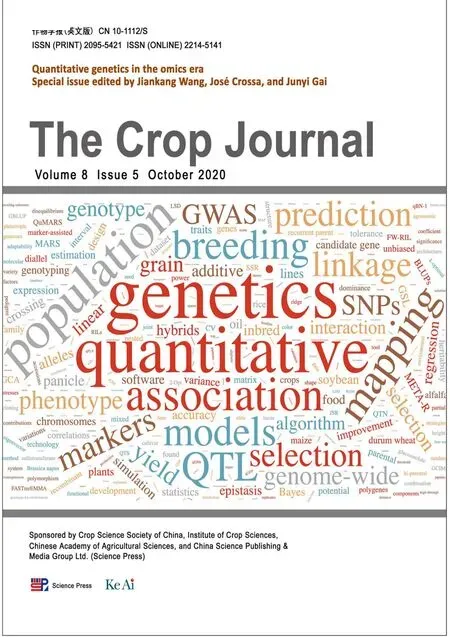
The Crop Journal 2020年5期
The Crop Journalis a bimonthly scientific journal co-sponsored by the Crop Science Society of China and the Institute of Crop Science, Chinese Academy of Agricultural Sciences, and China Science Publishing & Media Group Ltd. It is published by Science Press and KeAi (founded by China Science Publishing &Media Ltd. and Elsevier).
General requirements
Contributions submitted toThe Crop Journalmust be original works of the author(s) that have not been previously published or simultaneously submitted to any other journals.Experiments measuring crop yield should be conducted in at least two locations or growing seasons with replications. All results should be supported by appropriate statistical analyses.
Scope
■ crop germplasm enhancement and utilization;
■ crop breeding and genetics;
■ crop physiology and metabolism;
■ crop ecology and production;
■ plant-microbe interaction and crop resistance;
■ health beneficial and nutritionally enhanced plant; and
■ methodologies and techniques across fields of crop science.
Editorial review and acceptance
Article acceptance for publication will be based solely on the quality and originality of the research and its significance to science and technology. All manuscripts will be peer-reviewed by two or more anonymous reviewers, and final acceptance or rejection will be decided by the Editorial Board. Authors are encouraged to suggest three to five qualified reviewers. Final decisions on manuscripts will be made within three months of submission. Papers are usually published in chronological order of acceptance.
Preparation of manuscripts
The manuscripts should be formatted in Microsoft Word. All pages should be numbered consecutively in the bottom right-hand corner, beginning with the title page.
Manuscripts in general should be organized in the following order:
■ Title
■ Name(s) of author(s)
■ The institutions at which the work was carried out and their postal addresses
■ Abstract (200–300 words) followed by 4–7 keywords
■ Introduction
■ Materials and methods
■ Results
■ Discussion
■ Conclusions (optional)
■ Acknowledgments
■ References
Title should be clear, descriptive, and specific. On the footnote of the first page, E-mail addresses and full telephone numbers of the corresponding author and/or the first author should be provided. Acknowledgments should describe financial support for the research including the names of funding sources and grant numbers, the contributions of colleagues or institutions, etc.
All measurements must be in SI or SI-derived units.
Abbreviations should be used sparingly, and only where they ease the reader’s task by reducing repetition of long technical terms. Initially write the term in full, followed by an abbreviation in parentheses, and use the abbreviation thereafter.
Upon its first use in the title, abstract, text, and materials and methods, the common name of a crop should be followed by its scientific name (genus, species, and authority) in parentheses. However, for well-known species, the scientific name may be omitted from the title.
The references should include only works that have been published or accepted for publication. Unpublished data and personal communications should not be listed in the references but may be mentioned in the text. References cited in the text should be numbered in the order of citation. All authors’ names should be listed in a reference. If the works are not published in English, the actual language should be indicated in parentheses.
Examples
[1] J.L. David, M. Zivy, M.L. Cardin, P. Brabant, Protein evolution in dynamically managed populations of wheat:adaptive responses to macro-environmental conditions,Theor. Appl. Genet. 95 (1997) 932–941.
[2] J.C. Yang, P. Wang, L.J. Liu, Z.Q. Wang, Q.S. Zhu,Evolution characteristics of grain yield and plant type for mid-seasonindicarice cultivars, Acta Agron. Sin. 32(2006) 949–955 (in Chinese with English abstract).
[3] L.T. Evans, Crop Evolution, Adaptation and Yield,Cambridge University Press, New York, 1993.
[4] F.G.H. Lupton, Physiological bases of heterosis in wheat,in: A. Janossy, F.G.H. Lupton (Eds), Heterosis in Plant Breeding, Academic Press, New York, 1974, pp. 71–80.
Tables and figures
All tables and figures should be cited in the text, and numbered according to their sequence in the text. For the convenience of reviewers, the tables and figures should be arranged together with the main text document (see the sample). Once the manuscript is accepted by the Editorial Board, high-resolution photographs should be provided for publication.
Other requirements for tables
■ Each table should have a brief and self-explanatory title.
■ Column headings should be brief, but sufficiently explanatory. Standard abbreviations of measurement units should be given in parentheses.
■ Tables should be prepared with the table feature in Word, not with tabs, spaces or graphics boxes.
■ Extra space should be placed between columns, instead of using vertical lines to separate columns.
■ Any explanation essential for understanding the table contents should be added as a footnote at the bottom of the table.
Other requirements for figures
■ Each figure should have a brief and self-explanatory title.
■ Photographs and drawings for graphs and charts should be prepared with clear contrast of black and white.
■ Line width or size and symbols should be sufficient for clarity of figure contents.
■ It is preferred for photographs, especially color ones, to be grouped into one or more plates. The maximum length and width are 240 mm (not including the caption) and 170 mm, respectively, for a full page.
■ Legends should be concise and comprehensive: i.e., a figure and its legend must be understandable without reference to the text, including definitions/explanations of any symbols, abbreviations, and units of measurements mentioned in the figure.
■ Graphs and diagrams should be drawn by computer.
Submission of manuscripts
Manuscripts should be submitted through the Editorial System(https://ees.elsevier.com/cj/).
Publication fees
The Article Processing Charge (APC) is USD 990. Authors who require more information (e.g., about waivers or discounts as provided by the owners of the journal), please contact the editorial office [e-mail: cropjournal@caas.cn].
- The Crop Journal的其它文章
- Quantitative genetic studies with applications in plant breeding in the omics era
- Use of family structure information in interaction with environments for leveraging genomic prediction models
- META-R:A software to analyze data from multi-environment plant breeding trials
- Modeling and simulation of recurrent phenotypic and genomic selections in plant breeding under the presence of epistasis
- A sulfotransferase gene BnSOT-like1 has a minor genetic effect on seed glucosinolate content in Brassica napus
- Genome-wide prediction in a hybrid maize population adapted to Northwest China