Instructions for Authors
2020-12-20 15:25:02
臨床肝膽病雜志 2020年1期
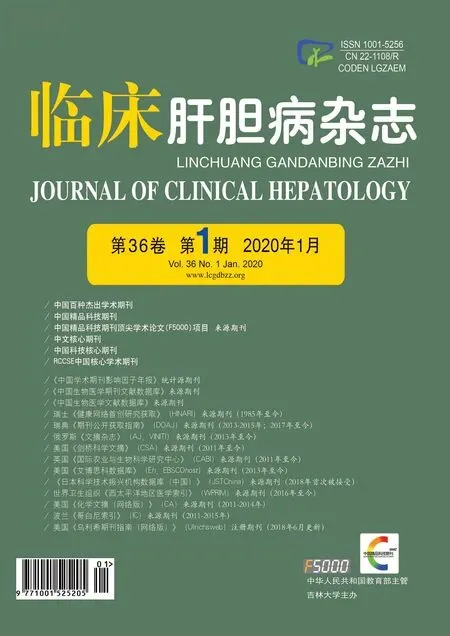
JournalofClinicalHepatology(JCH, ISSN 1001-5256, CN 22-1108/RJCH), founded in 1985, is a national academic journal published by Jilin University under Ministry of Education of the People’s Republic of China. JCH is included in Chinese Core Journal and Source Journals for Chinese Scientific and Technical Papers and Citations and RCCSE Chinese Core Academic Journals, Top 100 Outstanding Academic Journals of China, is awarded Outstanding S&T journal of China(Fourth Session), and is one of the source journal for Top Articles in Outstanding S&T journals of China(F5000), and is indexed in Abstract Journal(AJ), Chemical Abstracts (CA), Cambridge Scientific Abstracts (CSA), Index of Copernicus (IC), Centre for Agriculture and Bioscience International (CABI), Global Health (GH), EBSCOhostOnline Research Databases (EBSCOhost), Directory of Open Access Journals (DOAJ), Health Inter Network Access to Research Initiative(HINARI), The Western Pacific Region Index Medicus (WPRIM), Japan Science & Technology corporation(JST China) and Ulrich’s Periodicals Directory (UPD). Besides, JCH is the first journal specializing in hepatobiliary and pancreatic diseases in China.
JCH is designed mainly for clinicians and researchers, and publishes articles about experimental and clinical research on hepatobiliary and pancreatic diseases as well as the clinical experiences in diagnosing and treating the diseases, including Editorial, Expert Forum, Clinical Guide, Original Article, Review, Case Report, Case Discussion, Medical Progress, conference overview, etc.
1 Journal Style
1.1GeneralstyleThe articles should be valuable for research and clinical practice, based on reliable information and valid data, and written concisely, clearly, and regularly. The important data must be subjected to accurate statistical analysis. The length of article should be within 8000 Chinese characters (not including tables, figures, and references) for Original Article and Review and not more than 3000 Chinese characters for Experience Exchange and Case Report, but it depends on specific circumstances for Comment, Expert Forum, and Meeting Notes. The whole text should be single-spaced in 10.5 pt Song (for Chinese characters) or Times New Roman (for English words). The tables and figures should be numbered consecutively.
1.2TitleThe title should be concise, specific, and to the point, with a length not more than 20 Chinese characters, and a subtitle can be used if necessary. The English title should be identical to the Chinese title in meaning, and the definite article and indefinite article can be omitted in the English title. Capitalize only the first letter in the title (proper nouns and abbreviations should be written in a standard way).
1.3AuthorsandtheiraffiliationsThe full names of authors should be listed below the title and separated with a comma. The institutional affiliation of each author should be written in the following format: “department, institution, city (and province, needed only when the city is not the capital of the province), and postal code”, e.g., “Department of liver Diseases, Jilin University First Hospital, Changchun 130021”. For multiple authors at different institutions, type superscript numbers after their names, and separate their institutions with a semicolon. The information on all affiliations should be placed in the middle under the authors’ names.
1.4KeywordsThere should be 3-5 key words for the original article, which are separated with a semicolon. For the English version of abstract, there should be key words in English, which are corresponding to those in Chinese, with all letters in lowercase (except proper nouns). The key words are placed below the abstract. The key words are preferably the terms from the Medical Subject Headings (MeSH), but other terms may be used as key words if necessary.
1.5CLCnumberPlease select 1-2 CLC numbers according toChineseLibraryClassification(5th Edition)
1.6AbstractIt includes an abstract in both Chinese and English for the original article and review. The abstract is a one-paragraph short article written in third person, without tables, figures, citations, comments, and explanations. Use an informative abstract of about 500 Chinese characters, which is composed of four subsections (Objective, Methods, Results, and Conclusions), for the original article; use a subsection-free indicative abstract of about 300 Chinese characters for the review. The content of the abstract in English should be identical to that of the abstract in Chinese. The abstract in English should include an English title, Pinyin of authors’ names (only the first three authors need to be listed and followed by “et al.” if there are more than three authors), the institutional affiliation of the first author and the city (and province, needed only when the city is not the capital of the province) where the institution is located, which are also written in English, and postal code. Put surname in front of given name for both Chinese authors and those from abroad, with a space in between. For the name of each Chinese author, capitalize all letters of the surname (Pinyin) and the first letter of the given name (Pinyin), e.g., ZHANG Ying, LYU Xiuli, and ZHUGE Hua.
1.7FundedprojectPlace the information on funded project at the footer of the title page in the following format: “Funded Project: Project supported by the Natural Science Foundation of China (Grant No.).
1.8FirstauthorandcorrespondingauthorThe brief introduction to the first author should be at the footer of the title page, in the following format: “Introduction: name (year of birth), gender, professional title, highest academic degree earned, and research direction”. Only the name and email need to be included in the information on the corresponding author, in the following format: “Corresponding author: name and email”. Place the information on the corresponding author just below the introduction to the first author.
1.9ReferencesAccording toRulesforDocumentationofBibliographicReferences(GB/T 7714-2005), references should be consecutively numbered using superscript Arabic numerals (in square brackets) in the order they are cited in the text. List all authors for each reference, but if there are more than three, list the first three plus et al. Put surname in front of given name for all authors; for foreign authors, capitalize the first letter of the surname, followed by initials of the given name(s). The names of international journals should be abbreviated according to Index Medicus, while the names of Chinese journals should be spelled out. Include the publication type symbol, year, volume number, issue number, and page numbers in each reference. Examples are as below:
a. Monograph, Collected papers
[Serial number] Main authors. Title [Publication type symbol]. Place of publication:
Publisher, Year of publication: Page numbers.
b. Journal article
[Serial number] Main authors. Title [Publication type symbol]. Name of journal, Year, Volume number (issue number): Page numbers.
1.10TablesandfiguresThe tables and figures, used only where the words are not sufficient for clarity, should be numbered consecutively in the order they appear in the text. Type Figure (Table) 1 if there is only one figure (table) in the paper. A title should be provided below the figure or above the table. The table should be in the form of three-line table and numbered using superscript Arabic numerals (in half parenthesis), e.g., 1), and other symbols such as * cannot be used.
1.11MeasurementunitBased onChinaStatutoryMeasurementUnitsenacted by the State Council of the People’s Republic of China, unit symbols should be used according toLegalUnitsofMeasurementinMedicalApplicationedited and published by China Medical Association. Use negative power instead of slash to indicate division if there are more than one slash in the composite unit of measurement, e.g., type ng·kg-1·min-1instead of ng/kg/min. Do not intermingle slash and negative power in the unit of measurement. Both parameter value and tolerance should be followed by measurement units. If the parameter value and tolerance have a common measurement unit, parenthesize the parameter value and tolerance and add a measurement unit after them, e.g., (34.5±12.6) ng/L. All variable symbols should be in italics.
1.12NumberThe century, decade of century, year, month, day, and time based on solar calendar, as well as count and measurement, should be expressed in Arabic numerals. Do not abbreviate the year number, e.g., “1989”. For percentage range and deviation, do not omit the percent sign (%) of the first number, e.g., 5%~92%. Type multiplied values followed by size units in the following format: 3 cm×4 cm×5 cm. There should be a 1/4 Chinese character spacing every three digits before and after the decimal point, e.g., 1 234.765 4, but which does not apply to serial number, year number, page number, numbered designation of a military unit, model number of instrument, and standard number.
1.13StatisticalsymbolWrite statistical symbols according toStatisticsNoneandSymbols(GB3358-82) and in italics. Represent the arithmetic mean of a sample withand the median withM; represent the standard deviation withs; represent standard error withs; representt-test witht; representF-test withF; represent chi-square test withχ2; represent correlation coefficient withr; represent degree of freedom withν; represent probability withP(test values such astvalue,χ2value, andqvalue should be given in front ofPvalue).
1.14AbbreviationIn general, do not use abbreviations in the title. When an abbreviation is necessary in the text, use its full term at the first mention, followed by a parenthesis containing the Chinese abbreviation or full term in English plus its English abbreviation (separated with a comma). Widely accepted abbreviations can be used directly. Do not use line break within an abbreviation.
1.15LevelsandarrangementThere are usually not more than 4 levels of text, with a small dot between each two neighboring digits of the level number, e.g., 1, 1.1, 1.1.1, and 1.1.1.1. All level numbers should be placed at the beginning of a line. Each level of title occupies one line, but the third (or more) level of title should be followed by the text with a Chinese character spacing in between if there is no lower levels.
2 Instructions for Submission
2.1Author’sresponsibility
The author should read and comply withUniformRequirementsforManuscriptsSubmittingtoBiomedicalJournalsby International Committee of Medical Journal Editors (ICMJE) (www.icmje.org), in terms of requirements for manuscript preparation, duplicate publication, conflict of interests, ethical requirement, etc. The research project must be approved by the institutional ethical committee and in accordance with Declaration of Helsinki (2008) developed by World Medical Association (http://www.wma.net/); written consent must be obtained from all study participants; any experiment involving animals must follow the guidelines for animal use in research enacted by the state or society.
2.2Waystosubmitamanuscript
2.2.1OnlinesubmissionPlease visit the official website of JCH (lcgdbzz.org); click on “Submission System” to register (the username and password are used in the inquiry of manuscript processing, so please remember them); log into the system, and fill in the blanks following the submission steps and requirements; click on “Submit” to compete the submission of manuscript. The author can search for the status of manuscript processing, revise the returned manuscript, and communicate with the editorial staff via the system. Online submission can accelerate the publication.
2.2.2EmailsubmissionEmail submission is usually not allowed if the submission system works normally. If the submission system is under maintenance or being upgraded, please send your manuscript (in Word format) as an attached file to the email address shown at the bottom, and indicate the telephone, institutional affiliation, mail address, and postal code of the first author. Please include “submission” plus the name of the first author in the email subject for the manuscript submitted by email only, include “electronic version as a supplement” plus the name of the first author in the email subject for the manuscript submitted by email as an addition to the hardcopy mailed, and include “revised manuscript” and manuscript number in the email subject for the revised manuscript.
2.2.3HardcopysubmissionIf you cannot submit your manuscript online for some reason, please send the manuscript printed on A4 paper and its electronic version (in Word format) stored in an optical disc to the editorial office by registered mail. Please indicate the telephone, institutional affiliation, mail address, and postal code of the first author in the hardcopy.
2.3Attentions
2.3.1The author must take responsibility for the content of manuscript. According to Copyright Law, the editors of JCH hold the right to delete or revise the nonsubstantial content of manuscript, and please inform us in advance if you do not accept that. Please contact us before you resubmit the manuscript in review to a different journal, as submission elsewhere is prohibited, and the author bears all the consequences of it. One-off payment of remuneration will be made to the author for the use of copyright if the manuscript is accepted. JCH holds the right to publish the accepted manuscript in print, on CD-ROM, and online, and any portion of the paper is not allowed to be published elsewhere without the consent from JCH. Online access to the full-text content of JCH can be obtained in China Academic Journal Network Publishing Database, Wanfang Data-Digital Periodicals, and Chinese Core Periodicals (Selected) Database. If the author does not approve to record the full-text content in the above network databases, please inform us during submission so that we can handle it properly.
2.3.2JCH is a peer-reviewed journal. The manuscripts from members of editorial board, reviewers, and funded projects above the municipal level are free of charge and given priority for review. The editors return suggestions for revision in the same way the manuscript is submitted, and the author should revise the manuscript in time according to the suggestions. The returned manuscript that is not resubmitted within one month is considered to be withdrawn. The author can apply to re-review the manuscript and provide a written explanation of the content to be re-reviewed if disagreeing to the suggestions. Page charges are required for publication, and additional color printing fee is needed for color graph. Publication is delayed by one issue if the page charges are not paid within half month after the acceptance letter is sent and canceled if the page charges are not paid within one month after the acceptance letter is sent. Remuneration may be paid after publication, and two copies of current issue of journal will be provided.
2.3.3If the manuscript is supported by the national, provincial, ministerial, or municipal foundation or for a key project, note it at the footer of the title page, e.g., “Project supported by the Foundation of ×× (Grant No.) ”, and include a copy of foundation certificate as an attached file. The manuscript will be given priority for publication if the relevant information is true.
2.3.4Manuscript withdrawal for any reason is handled according to the following rules: If the author has paid page charges and typesetting has not been started yet, manuscript withdrawal can be approved according to the circumstances, and deduct part of service fee. If the typesetting has been started but page make-up has not been done yet, withdrawal is approved, but the page charges are not refunded; if the page make-up has been done and changes cannot be made anymore, withdrawal is not approved, and the author claims responsibility for duplicate publication if it happens.
3 Contact Us
Mail address: Editorial Office of Journal of Clinical Hepatology, 519 Dongminzhu Street, Changchun, Jilin, China
Postal code: 130061
Tel:+86-431-88782542/3542
Email: lcgdb@vip.163.com
Website: www.lcgdbzz.org
Micro blog: http://weibo. com/lcgdbzz
Wechat: lcgdbzz1985