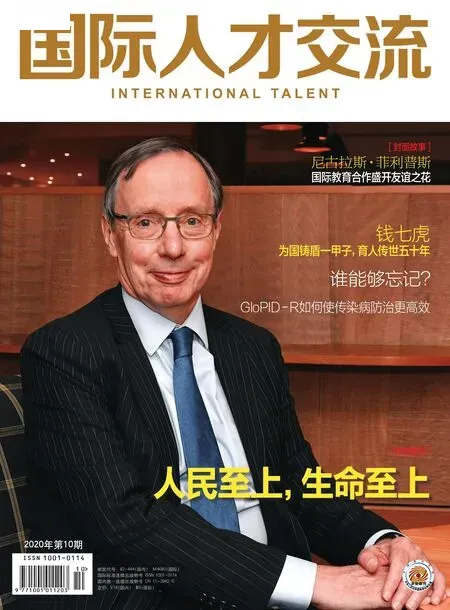
The Flower of Friendship Blooms Through International Educational Collaborations
---An Interview with Mr. Nicholas Kennard Phillips,Associate Professor from the University of Warwick
2020-11-27 02:52:49ByJessica
國際人才交流 2020年10期
By Jessica
Nicholas Kennard Phillips is an expert in financial education, and currently the head of China Programmes for WMG, University of Warwick. On January 17th,2020, he was invited to participate the Spring-Festival Symposium for Foreign Experts in the Great Hall of the People, where Premier Li Keqiang met all the foreign experts.
Be fascinated by China
Question: What is your impression of China basically from the cultural perspective?
I have always been fascinated by the complexities of China’s history and culture. I have now been closely involved with China for over 10 years, and people often say to me that “you must be an expert on China by now”.My answer would be that I am only now beginning to understand just how little I know about China. The historical complexities, coupled with the unprecedented rate of growth over the last two decades have resulted in a society which in many ways is the envy of much of the world, and is set to achieve even greater heights in the future.
Question: What makes you to work for the University of Warwick as Head of China Programmes? Specifically, what is your work experience in China?
My role with WMG, Warwick University is as Head of China Programmes. I am also Deputy Director of Overseas Programmes. This means that I am primarily responsible for the relationship with our collaborative partners in China, and also for short courses delivered to Chinese institutions both in China and the U.K.. Founded by Lord Kumar Bhattacharyya, WMG is a department of Warwick University that links the University to business in general and manufacturing industry in particular. We aim to provide courses that are not only academically excellent, but industrially relevant.
For most of my career in Higher education, I have been involved in student exchanges and students studying abroad, firstly through the Erasmus exchange programme within Europe, and latterly in Asia. I, myself, have been a visiting professor at universities in France and Austria.
I first visited China in 2006 whilst I was working for another U.K. University. The visit to Shenzhen University was to review the performance of students on a collaborative programme. It became clear to me that firstly some of the reported issues on these programmes didn’t exist, whilst the benefit to the students, if the course was properly handled, was large in terms of the students’ personal development.
Since starting work for Warwick University, I have taught on courses in Beijing, Shanghai, Hang Zhou, Wuhan and Hong Kong, and am now academic manager for the MSC Programme and Project Management that we run in collaboration with Beijing City University.
Build the relationship maximizing individual Strengths
Question: What are your observations and thoughts from the collaborative programmes between the University of Warwick and its partners in China? How are they proceeding? And what about the collaboration prospects in the future?
Historically WMG has collaborated with a number of universities and businesses in China. Our original work was with China Aerospace Science and Technology Corporation, and we have worked with a number of other state-owned enterprises and government bodies. Last year, for instance, we delivered a course for the State Tax Authority.
We have developed a good relationship with Beijing City University and our degree with them, although not without its challenges, is starting to recruit good numbers of students. As with any collaboration, it is important to recognize what the other partner brings to the relationship, and to build the relationship maximizing these individual strengths.
I am talking to a number of other technical universities,exploring ways to bring WMG’s industrial expertise to more students in China, through local universities. This is both in the education and research areas. We already have extensive cooperation with North China University of Technology and we are exploring similar arrangements with other universities.
In the current circumstances of the Corona virus, we have tried to stand with our collaborative University partners in difficult circumstances. We were the first part of Warwick University to deliver modules through online teaching, focusing our efforts on students who were studying for a Masters on a full time, one year,programme.
Question: According to a variety of the world university rank sources, it is widely accepted by the industry insiders that the average development level of China’s higher education is still not high enough compared with those developed western countries? In which aspects do you think China should make more efforts?
I don’t think I am in a position to make specific comments on China’s education system, but If I can widen the question to higher education in general, I would highlight two areas that higher education worldwide needs to address.
Firstly, on higher education’s links with industry. WMG was founded to bridge the gap between HE and industry,thus looking at the application of engineering and business topics into the industrial sector. If left alone,academics tend to retreat into their ivory towers and most universities would benefit from making certain of their STEM subjects more applied, firstly with links into industry and secondly by employing more staff with industrial experience.
Secondly, on the adaptation of the internet age. I think many universities have failed to adapt to the internet age,where so much material is now available at the touch of a button. The critical evaluation of sources of information becomes important. If used properly, this ease of access can lead to a much richer education experience, yet too often this availability is not exploited enough by the university.
Internationalisation in higher education
Question: Currently China is dedicating to realize internationalisation in higher education. What do you think of the effective ways of realizing “internationalisation” on the part of universities?
Within any university these days there is normally an International Office, or some such, responsible for International issues. They tend to affect, and deal with, a small group of staff and students who are open to international travel and experiences. The difficult trick is for a university to implement policies so that internationalisation affects all students, whether they want to travel or not.
Ideas and pedagogy that do this have been given the title“Internationalisation at Home”. Some of the suggestions coming from this area include straight-forward ideas like changing syllabuses to reflect the international environment as well as notions of “virtual mobility” by having, for example, guest lectures delivered over the internet by staff from partner institutions. I know of universities who have academic based competitions and collaborations between groups of students from their collaborative partners.
The recent policy on tighter quality control on 3+1,2+2 and 4+0 types of degree programmes in fact helps to make higher education’s internationalisation more effective and stringent. We at WMG, Warwick have always been profoundly proud of our academic excellence, and the Chinese MOE’s approach is indeed very encouraging to us.
Question: You are a native Englishman but have established a circle of Chinese friends. Would you please share with the audiences what “real skills” or abilities should be equipped in cross-cultural communication?
I have never really thought about this before. I am lucky enough to have taught international students for most of my time in higher education. I know I have made my fair share of cultural blunders in this time, but, despite this, now have friends from many different countries.I hope to treat all people I meet with equal respect and consideration, and also to be aware that sometimes our own cultural upbringing may contain biases that are only exposed when we meet people from other cultures.