Abstracts
2020-11-17 07:44:08
國(guó)際展望 2020年2期
Abstracts
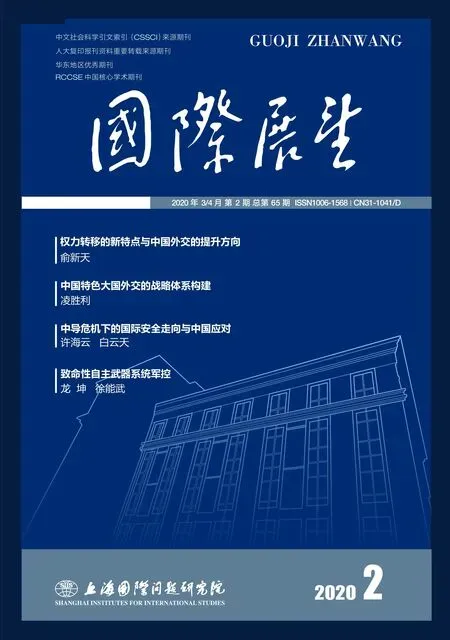
New Features of Power Transition and Future Highlights in China’s Diplomacy
Abstract: A key element of the era of great changes unprecedented in the past century is the new round of power transition in international relations, which has the following features: First, for the first time over the past five centuries, power has begun to shift from the West to non-Western emerging countries, from one hegemon to other centers of gravity on the increasingly multitiered, multilateral and multi-player “grand chessboard.” Success of a nation depends on whether it can meet the needs of its people and the world for equitable development. Second, the significance of individual regions is especially prominent during the transition process. In particular, Asian countries will become locomotives of world economic growth. Different countries in Asia, big or small, are making efforts to increase their influence in the region. Amid greater competition among regional organizations and institutions, countries in Asia tend to hold an open and inclusive stance toward major powers and strive for balanced and complex security. Notably, most of them try to avoid taking sides between China and the United States. Third, a fake proposition as it is, the U.S. advocacy for unity of the West against Chinese “ideological intrusion” manifests a growing crisis of international common understanding. The core of ideological conflict in the future is international cooperation for peace and development against narrow nationalism, radical populism, extremism, and terrorism. To become a new type of major power, China’s diplomacy must be adjusted to such new features of power transition and new demands of the world, highlighting a total departure from traditional major-power thinking and strategies, reemphasizing the importance of Asia in international relations and further integrating itself with other regional countries, as well as promoting common understanding of the world while trying to escape from the discourse trap of traditional ideological competition. As China keeps rising, its innovation in thinking, culture, and ideology, achieved by reinvigorating the spirits of inclusiveness and harmony deeply rooted in traditional Chinese culture, will make greater contribution to the world.
Keywords: power transition, regional cooperation, international common understanding, new type of great power, Chinese diplomacy
On Constructing a Strategic Framework for China’s Diplomacy
Abstract: Since the 18th Party Congress in late 2012, with the formulation and implementation of a set of ideas, initiatives, and measures, China has built up and improved a strategic framework involving the environment, objectives, interests, approach, and planning for its great power diplomacy. The assessment of China’s strategic environment takes full account of not only Beijing’s domestic development opportunities and challenges but also worldwide trends and trajectories. The Chinese dream of great national rejuvenation and global vision of the world as a community with a share future are the overarching goals of China’s diplomacy. Beijing has specified a wide range of core national interests regarding its security, politics, and economics, but has yet to prioritize them in a tiered structure. In terms of strategic approach, China’s diplomacy needs to give full play to state direction, social participation, and individual initiative complete with a toolkit of security, economic, political, and diplomatic instruments. Temporal, geographical, and thematic factors must be fully considered in the process of strategic planning. To better serve China’s peaceful development, strategic framework building must include completing the transitions from power politics to rules-based politics, major power diplomacy to great power diplomacy, and economic-oriented planning to strategy-centered planning.
Keywords: great power diplomacy, Chinese characteristics, framework building, strategic planning
António Guterres’s UN Reform Agenda and China’s Constructive Role
Abstract: The United Nations Secretary-General is one of the most important advocates and initiators of UN reform. Mr. António Guterres has devoted considerable time and energies to promoting UN reforms since assuming office in early 2017. His reform proposal aims to establish a governance structure centered around conflict prevention and increase integration among different “pillars” of the UN system. His ambitious agenda may help overcome UN’s institutional fragmentation and increase the coherence of the complex UN system. Better coordination among the three pillars, namely, peace and security, development, and human rights is also in line with the 2030 Agenda for Sustainable Development. However, the tension between national sovereignty and UN autonomy may hamper the latest round of reform efforts, and the South-North divide presents additional challenges. As a UNSC permanent member and rising great power, China should become a prominent actor in the latest reform efforts by narrowing the South-North gap, promoting new ideas about great power compact and compromise, building broad-based consensus on global governance, and advocating BRI cooperation within the UN system.
Keywords: UN reform, China’s role, 2030 Agenda, international development cooperation, North-South dialogue
The INF Dispute, International Security, and China’s Response
Abstract: The INF dispute is generated in a post-Cold War geostrategic landscape where the rules and directions regarding the nuclear balance of power are changing. These changes can be attributed to a shifting international security environment, major changes in the global nuclear arms control regime, populist and neoliberal backlash against the prevailing nuclear security concept, growing U.S.-Russia nuclear asymmetry, and the absence of relevant ideas and institutions about strategic stability. As the dispute adds new uncertainty to the nuclear arms control regime, reform is urgently needed. For America, the dispute presents more challenges but also strategic options and deepens transatlantic disagreement on European and international nuclear posture. The INF crisis also forces Russia to be involved in a renewed great power arms race with the United States. China should approach the INF dispute with sufficient strategic flexibility and do its best to curb its repercussions. At the same time, Beijing must also articulate its own nuclear security concept to compensate for the absence of post-Cold War theory on nuclear security and strategic stability.
Keywords: INF, nuclear arms control, crisis, U.S.-Russia relations
Controlling the Killer Robot: Problems, Paths, and Strategies
Abstract: Lethal autonomous weapon systems present a major challenge to international security and humanitarianism and have become an issue of international concern. Controlling the killer robot is difficult right now as its definition is still being debated and political obstacles are hard to overcome. Moreover, accountability and military utility also make lethal automatic weapons control difficult. This article attempts to build a legal and institutional framework for autonomous weapons control by giving definition and laying out principles. It argues that the current international laws and arms control regimes should serve as the basis of killer robot control and the United Nations Convention on Certain Conventional Weapons a guiding principle. China should be an active participant in automatic weapons control. On the other hand, preparing for the scenario in which arms control regarding automatic weapons fail, China should also accelerate AI development and implementation of its military-civil fusion strategy.
Keywords: lethal autonomous weapons systems, arms control, Convention on Certain Conventional Weapons, United Nations
Rallying Europe Against China: The Trump Administration’s Scorecard
Abstract: Strategic assessments by the two presidential administrations of Barack Obama and Donald Trump situate the European Union and China on two ends of Washington’s strategic spectrum: ally and adversary. This strategic perception is the foundation of U.S. policies toward Europe and China. Washington’s strategic logic is that balancing China requires a strong and submissive Europe and Washington should transform the EU into a power polar in lockstep with the United States. But at present such a logic has its own flaws. A strong Europe won’t be as submissive as Washington wishes it to be. The Trump administration’s Indo-Pacific strategy has weakened the EU’s willingness to join Washington in containing China because Brussels has a different strategic perception of Beijing’s strategic intention. On the other hand, transatlantic coordination against China may also improve if the EU integration comes to a halt, Russia’s threat to the EU grows, and European populism is increasingly directed at China. In the face of an intensifying great power competition and the likelihood of strengthened transatlantic coordination, Beijing should support EU’s further integration, improve neighborhood diplomacy, especially China-Japan relations, and work toward a new strategic culture that emphasizes peaceful great power competition by promoting the Belt and Road Initiative.
Keywords: U.S. China policy, transatlantic coordination, U.S.-EU relations, Europe Transformation Plan
Defense Cooperation and EU’s Strategic Autonomy
Abstract: The European Union’s latest foreign policy position paper calls for its strategic autonomy in a fast-changing international landscape. However, due to its long-standing strategic dependence on the United States, the EU lacks the motivation and ability to pursue complete autonomy. As defense autonomy is the precondition of strategic autonomy, and defense capacity building is an urgent task for the EU. For supranational multilateral organization, defense capacity building depends on high-quality defense cooperation among member states. This article illustrates the specific measures and key projects of defense cooperation of the EU, and believes that the closer defense cooperation can significantly enhance the Union’s defense and security capabilities. However, EU strategic autonomy still faces multiple internal and external constraints, for example, whether internal cohesiveness is sufficient to formulate a real EU strategy and whether the United States and Russia will help or hinder the process. These constraints make the prospect of EU strategic autonomy unclear. However, from another point of view, it is indeed the best time for the EU to achieve strategic autonomy. For China, the advantages of EU strategic autonomy outweigh the disadvantages. China and the EU have room for cooperation in promoting EU strategic autonomy and shaping the international multilateral order.
Keywords: EU, strategic autonomy, defense cooperation, defense autonomy, PESCO