必修4第3—4單元階段檢測題
2020-10-29 05:45:16蔡敏
考試與評價·高一版 2020年5期
蔡敏
第一部分:聽力部分 (15分)
第一節:
聽下面五段對話,每段對話后有一個小題,從題中所給的A, B, C三個選項中選出最佳選項。(5分)
1. Where does the conversation probably take place?
A. In a garage. ? ? ? ? ? ? ? B. In a gas station. ? ? ? ? C. In a parking area.
2. What course did the man take last year?
A. Computer. ? ? ? ? ? ? ? ? ? B. Physics. ? ? ? ? ? ? ? ? C. Chemistry.
3. What are they talking about?
A. Space war. ? ? ? ? ? ? ? ? ? B. Space shuttle. ? ? ? ? ? ? C. Space station.
4. What's the woman thinking about?
A. Getting a part-time job. B. Doing better in her job. C. Changing her job.
5. Why does the woman give a treat?
A. She has some good news. B. She wins the lottery. ? ? C. She wants some help.
第二節:
聽下面兩段對話,每段對話后有幾個小題,從題中所給的A, B, C三個選項中選出最佳選項。(6分)
聽第6段材料,回答第6、7題。
6. How about Ray Blune's books?
A. Horrible. ? ? ? ? ? B. Humorous. ? ? ? ? ? C. Serious.
7. What does the man need to buy in the bookshop?
A. A novel. ? ? ? ? ? ? B. A textbook. ? ? ? ? ? C. Children's books.
聽第7段材料,回答第8—11題。
8. What are the speakers firstly talking about of the book?
A. The inspiration. ? ? ? ? ? B. The content. ? ? ? ? ? C. The sales.
9. What can we know about making the book into a movie?
A. It has been done. ? ? ? ? B. It's just begun. ? ? ? ? ? C. It will be done probably.
10. Why do the books attract children?
A. They're easy to read. ? B. They are pictures with the words.
C. They're fun and adventurous.
11. What does the writer say about the book?
A. He may keep writing it. B. The story is complete. ? C. It has no ending.
第三節:
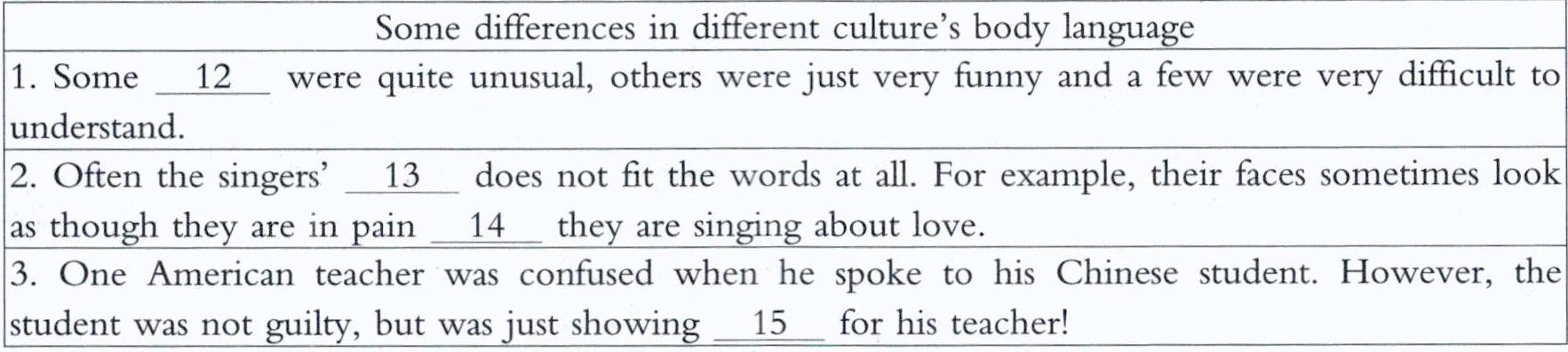
聽下面一段材料,將第12—15題的信息補充完整,每小題不多于3個單詞。(4分)
第二部分:閱讀理解 (共兩節,滿分40分)
I. 閱讀下列短文,從每題所給的四個選項(A、B、C和D)中,選出最佳選項。(30分)
A
New York's best classes for kids include sports classes, performing arts classes, art classes, language programs and baby classes. Make sure your kids are ready for new adventures with these super-cool offerings!
92nd Street Y Classes
At this institution your musician can learn how to play an instrument. After-school classes examine different musical pieces and encourage work in a group setting. At the end of the program, mini Mozarts can impress their family and friends at open-house performances. Plus, when they're not jamming, kids can take advantage of homework help in the Clubhouse, where they are divided up by grade level. Ages 5-15.
The Cliffs at LIC
After a day of fighting the academic obstacle course at school, your favorite achievers can reach new heights on a rock-climbing wall. The Cliffs, offerings allow developing bodies to build muscle strength. For example, introductory sessions teach climbers how to tie safety knots (結) as well as other basics, mastering them with hands-on games and activities. The Cliffs at LIC, Long Island City. Ages 6-18.
Staten Island Skating Pavilion
This large area maintains its year-round frosty temperatures for ice-skating fun. Courses are offered every day for a variety of interests and skill levels, and public and freestyle sessions are available for children who want to spend some afternoons there without instruction. Ages 4 and up.
West Side YMCA
If your child wants to learn how to swim, you'd be pressed to find more options than those offered at the Y. Kids are grouped by age and capability. The courses cover personal safety and stroke techniques. If your offspring prefer dry land, the Y also offers dance, basketball and football. Visit website for class descriptions and detailed price information. Ages 5-18.
1. Who is the passage intended for?
A. Elementary school teachers. ? ? ? ? ? B. Parents with under-age children.
C. Families looking for attraction. ? ? ? ? D. Children around school age.
2. Which event will you attend for occasional homework help?
A. 92nd Street Y Classes. ? ? ? ? ? ? ? B. The Cliffs at LIC.
B. West Side YMCA. ? ? ? ? ? ? ? ? D. Staten Island Skating Pavilion.
3. What does Staten Island Skating Pavilion provide?
A. A mini open-house performance at the end of the program.
B. Introductory lessons on how to overcome the learning obstacles.
C. Teaching of skating in divided groups according to their age.
D. Cold temperatures all the year round for ice-skating.
B
There was a young man born in a poor family. Once he was asked to write a paper about what he wanted to be and do when he grew up. That night he wrote an even-page paper describing his goal of some day owing a horse ranch (農場). He wrote his dream in great detail and he even drew a diagram (圖表) of a 4000-square-foot house that would sit on a 200-acre dream ranch. He put a great deal of his heart into the project and the next day he handed it in to his teacher.
Two days later, he received his paper back. However, on the front page was a large red F. The boy with dream asked “Why did I receive an F?” The teacher said, “This is an unrealistic dream for a young boy like you. You have no money and you have no resources, so there is no way you could ever do it.” Then the teacher added, “If you rewrite this paper with a more realistic goal, I will reconsider your grade.”
The boy went home and thought about it long and hard. He asked his father what he should do, his father said, “Look, son, you have to make up your own mind on this, however, I think it is a very important decision for you.”
Finally, after sitting with it for a week, the boy turned in the paper, making no changes at all. He stated, “You can keep the F and I will keep my dream.”
Recalling the story, the teacher was sitting in the boy's 400-square-foot house in the middle of 200-acre ranch. When the teacher was leaving, he said, “Look, Monty, I can tell you this now, when I was your teacher, I was something of a dream stealer. During those years, I stole a lot of kid's dreams. Fortunately, you had enough gumption (毅力) not to give up on yours.”
4. What did the boy want to do when he grew up?
A. To be a teacher. ? ? ? ? ? ? ? ? B. To be a writer.
C. To raise a lot of animals. ? ? ? ? D. To have a big horse ranch.
5. Why did the boy receive an F?
A. He didn't hand in the paper. ? ? ? B. The teacher didn't like him.
C. He put very little effort into the project.
D. The teacher didn't think his dream realistic.
6. Which of the following is TRUE according to the passage?
A. The teacher recalled the boy's grad. B. The boy made changes in the paper.
C. The boy achieved his dream in the end.
D. The father persuaded the boy to change his mind.
7. What's the best title for the passage?
A. An Unrealistic Dream ? ? ? ? ? B. Follow Your Dream
C. An F Paper ? ? ? ? ? ? ? ? ? ? D. A Stubborn Boy
C
When I read a post about taking someone to the movies, I was reminded of something that happened a couple of years ago.
I used to drink Cokes and they had a competition where there was a code inside the bottle cap. You went to a website and entered the code and maybe you won something. I won some free Cokes. But then I won the Grand Prize! I was surprised and pleased.
The Grand Prize was free movies for a year. They pointed out that one movie a week was what free movies for a year meant. All of the tickets had a deadline (截止日期) later than a year from the day I received them. So I must use them in the following year. I used quite a few taking friends to movies we all wanted to see.
But the best thing I did with them was that I donated 22 tickets (all I had left by that time) to the local Women's Transition House, a place where women and their children could go when avoiding a bad situation in general and get help to make a new start.
My workplace team had decided to help people in need, so we collected donations for that particular New Year's Day. I knew that the Women's Transition House provided some childcare for the women so they could go for job interviews and things like that.
I put those tickets in a box and wrote a note on the outside, asking the Women's Transition House staff to give movie tickets to women there over the holidays to have something fun to do, with or without their children. It made me really happy to do this.
8. How did the author get the tickets?
A. By visiting a website by chance. ? ? ? B. By using some Cokes to get them.
C. By attending a knowledge competition. D. By winning the prize for drinking Cokes.
9. How many tickets did the author and his friends use?
A. About 22. ? ? B. About 30. ? ? C. About 52. ? ? D. About 365.
10. Which of the following best describes the author?
A. Lucky and caring. ? ? ? ? ? ? ? ? ? B. Creative and careful.
C. Responsible and cheerful. ? ? ? ? ? ? D. Thankful and generous.
11. What does the Women's Transition House offer?
A. Jobs to women in need. ? ? ? ? ? ? ? B. Help to women in trouble.
C. Free movie tickets to women. ? ? ? ? D. Skills of job interviews to women.
D
Children all around the world are familiar with fairy tales such as “The Little Mermaid” (《美人魚》), “The Princess and the Pea” and “The Emperor's New Clothes”. The colorful characters from the stories made us laugh and cry throughout our childhood.
The stories are the creation of Danish writer Hans Christian Andersen. The year 2005 marks his 200th birthday. To celebrate, the China Puppet Theater in Beijing, is holding a series of shows based on his classic fairy tales.
Andersen was born in the poor area of Odense, Denmark, on April 2, 1805. His early life was not easy. His father was a shoemaker and his mother worked as a washerwoman. He received little early education. As a child he was very emotional and was laughed at for being feminine (女性化的) and tall.
In 1816, his father died and Andersen was forced to go out to work, first in a tailor's shop and then at a tobacco factory. At the age of 14, Andersen moved to Copenhagen to start a career as a singer and actor. He struggled for three years until he had to leave the theater when his voice broke in 1822.
Andersen went to a grammar school after he left the theater. Having done well he was admitted to Copenhagen University in 1828. He began to publish his fairy tales in 1835. They came out in small numbers until his death. Andersen died on August 4, 1875. His home in Osdense is now a museum and thousands of people visit it every year.
12. Which of the following is the best title for the passage?
A. Fairy Tales Show Coming to Beijing ? B. Andersen's Unhappy Childhood
C. Popular Danish Writer Andersen ? ? ? D. Three Familiar Fairy Tales
13. From the paragraph, when did his fairy tales come out?
A. In 1822. ? ? ? ? B. In 1828. ? ? ? ? ? C. In 1835. ? ? D. In 1875.
14. In memory of Andersen, ____.
A. “The Emperor's New Clothes” is read by adults
B. Andersen's tales have been known just in China
C. a series of shows are being held in Beijing
D. Andersen's fairy tales have never been widely read
15. What does the third and fourth paragraph mainly tell us?
A. Andersen received education. ? ? B. Andersen's parents died.
C. Andersen began to write tales. ? ? D. Andersen's childhood life.
II. 根據短文內容,從短文后的選項中選出能填入空白處的最佳選項。選項中有兩項為多余選項。(10分)
There are times when people come into your life, and you know at once that they are sure to be there. They serve some sort of purpose, teach you a lesson or help figure out who you are or who you want to become. You never know who these people may be: your classmate, neighbor, teacher, long-lost friend or even a real stranger. But _1_, you know that at that very moment they will affect your life in some serious way.
_2_. However, on reflection you realize that without getting over them you would have never realized your potential ability and strength.
Everything happens for a reason and nothing happens by chance or with good or bad luck. ? _3_. Without these small tests, life would be like a smooth road to nowhere. The people affecting your life, and the successes and failures you experience, help to create who you are and who you become.
Even the bad experiences can be learned from. In fact, they are probably the most important ones. If someone hurts you, forgive them, _4_.
_5_, for you may never be able to experience it again. Talk to people you have never talked to before, and really listen. You should set your sights high, hold your head up, tell yourself you are a great individual and believe in yourself. Create your own life and then go out and live it with absolutely no regrets.
Most importantly, if you love someone, tell him or her, for you never know what tomorrow may have in store.
A. when you look eyes into them
B. because you are likely to get addicted to them
C. Don't forget to embrace those unpleasant moments
D. Make every day count and appreciate every moment
E. Illness, injury and love all occur to test the limits of your soul
F. Sometimes things happening to you may seem challenging at first
G. for they have helped you learn about trust and the importance of being cautious
第三部分:語言知識運用 (共四節,滿分65分)
I. 根據所給單詞的首字母和短文意思,寫出空缺處各單詞的完全形式。(10分)
Agriculture and irrigation have affected the r (1) and fall of many great civilizations (文明). Without agriculture, our way of living would not be l (2) what it is today. Without irrigation, we would not have agriculture.
Agriculture is the f (3) of crops. It provides most of the world's food supply and
h (4) support the economy (經濟).
I (5) is the act of moving water from one place to another and is used in farming to water crops, but many problems have begun to appear about the water s (6) in the world, e (7) in the United States.
Without agriculture and irrigation the United States, as well as many other countries, would not be as d___(8) or as stable (穩定的) as they are today. The United States' economy is greatly affected and often d___(9) by agricultural p (10).
II. 單項選擇。(15分)
1. The part that China in international relation (關系) is important.
A. plays B. makes C. acts D. has
2. was in 1979 I graduated from university.
A. That; that B. That; when C. It; which D. It; that
3. Your performance in the driving test didn't reach the required standard., you failed.
A. In the end B. After all C. In other words D. At the same time
4. Mary is the only one of the students who from America in our school.
A. is B. are C. have been D. had been
5. Today CCTV offers a great of pro-grammes to meet the different needs and of the viewers.
A. deal; likes B. variety; tastes C. many; interests D. number; habits
6. They plant trees, and the young trees grow taller.
A. year by year; year after year B. year after year; year by year
C. year after year; year after year D. year by year; year by year
7. He likes traveling, which his knowledge of the world.
A. increases B. rises C. improves D. adds
8. After the new technique was introduced, the factory produced tractors in 1998 as the year before.
A. as twice many B. as many twice C. twice as many D. twice many as
9. We'll have to finish the job.
A. long it takes however ? ? ? ? ? B. it takes however long
C. long however it takes ? ? ? ? ? D. however long it takes
10. We have got to be and buy only what we can afford.
A. real B. actual C. practical D. true
11. It was raining heavily. Little Mary felt cold, so she stood to her mother.
A. close B. closely C. closed D. closing
12. He sent me an E-mail, to get further information.
A. hoped B. hoping C. to hope D. hope
13. she couldn't understand was fewer and fewer students showed interest in her lessons.
A. What; what B. That; what C. That; that D. What; that
14. The boy was last seen near the West Lake.
A. missing; playing B. missing; play C. missed; played D. missed; to play
15. I really appreciate to relax with you on this nice island.
A. to have had time B. having time
C. to have time D. to having time
III. 完形填空。(30分)
Thanksgiving is right around the corner! Of course a big dinner with turkey is necessary, but being thankful is more important. What can you be thankful for? The following story may _1_you:
Thanksgiving Day was coming. The first grade teacher gave her class a _2_ assignment—to draw a picture of something that they were thankful for.
It's a tradition to _3_ the holiday with turkey and other good things of the season. These, the teacher thought, would be the _4_ of most of her student's picture. And they were.
But Douglas, that weak little boy, drew a _5_ kind of picture. He drew a hand. Nothing else. ?Just a(n) _6_ hand. ?His abstract image caught the _7_ of his peers. Whose hand could it be? One _8_ guessed it was the hand of a farmer, because farmers raise turkeys. Another suggested a police officer, because the police _9_ and care for people. And so the _10_ went—until the teacher almost forgot the young _11_ himself.
When the children had _12_ to other assignments, she paused at Douglas' desk, bent down, and asked him whose hand it was. The little boy said in a _13_ voice, “It's yours, teacher.”
The teacher _14_ the times she had taken Douglas' hand and walked with him here or there, as she had done with the _15_ students. How often had she said, “Take my hand, Douglas, we'll go outside.” Or, “Let me _16_ you how to hold your pencil.” Or, “Let's do this together.” Douglas was most _17_ for his teacher's hand.
There are too many things that we are used to and _18_ to feel thankful for, just like the teacher's hand. _19_, it's never too late to realize what you have and _20_ your heartfelt thankfulness.
1. A. admire ? ? ? ? B. inspire ? ? ? ? ? ? ? C. praise ? ? ? ? ? D. improve
2. A. class ? ? ? ? ? B. school ? ? ? ? ? ? ? C. fun ? ? ? ? ? ? D. fool
3. A. celebrate ? ? ? B. memorize ? ? ? ? ? ? C. pass ? ? ? ? ? ? D. spend
4. A. textbooks ? ? ? B. thoughts ? ? ? ? ? ? C. products ? ? ? ? D. subjects
5. A. difficult ? ? ? ? B. different ? ? ? ? ? ? C. important ? ? ? ? D. imaginative
6. A. strong ? ? ? ? ? B. weak ? ? ? ? ? ? ? C. empty ? ? ? ? ? D. full
7. A. imagination ? ? B. inspiration ? ? ? ? ? C. expression ? ? ? D. information
8. A. child ? ? ? ? ? B. friend ? ? ? ? ? ? ? C. teacher ? ? ? ? ? D. professor
9. A. promise ? ? ? ? B. provide ? ? ? ? ? ? C. prevent ? ? ? ? D. protect
10. A. argument ? ? ? B. quarrel ? ? ? ? ? ? C. competition ? ? ? D. discussion
11. A. singer ? ? ? ? ? B. dancer ? ? ? ? ? ? C. artist ? ? ? ? ? D. musician
12. A. carried on ? ? ? B. gone on ? ? ? ? ? ? C. taken on ? ? ? ? D. held on
13. A. high ? ? ? ? ? B. low ? ? ? ? ? ? ? ? C. loud ? ? ? ? ? ? D. small
14. A. recalled ? ? ? ? B. reminded ? ? ? ? ? ? C. recognized ? ? ? D. wasted
15. A. other ? ? ? ? ? B. others ? ? ? ? ? ? ? C. another ? ? ? ? D. else
16. A. watch ? ? ? ? ? B. lead ? ? ? ? ? ? ? ? C. show ? ? ? ? ? D. suggest
17. A. hopeful ? ? ? ? B. thankful ? ? ? ? ? ? C. helpful ? ? ? ? D. regretful
18. A. continue ? ? ? ? B. stop ? ? ? ? ? ? ? ? C. forget ? ? ? ? ? D. remember
19. A. Frequently ? ? ? B. Comfortably ? ? ? ? C. Completely ? ? ? D. Fortunately
20. A. convey ? ? ? ? B. research ? ? ? ? ? ? C. congratulate ? ? D. express
IV. 閱讀下面材料,在空白處填入適當的內容(不多于三個單詞)或括號內單詞的正確形式。
(10分)
The Water Splashing (潑灑) Festival of the Dai ethnic minority (少數民族) falls on April 13th to April 15th. It is the New Year for the Dai people of Xishuangbanna, Yunnan Province, a festival ? _1_ (send) off the old and greet the new.
During the festival, which lasts three days, people _2_ (dress) in their best clothes and participate in a variety of rich and _3_ (color) activities. Dragon boat racing, fireworks displays and other _4_ ?(perform) such as Peacock Dance are held on the first day. And _5_ most popular event is water's plashing on the second day. People splash water on each other, _6_(hope) to take away sicknesses and disasters. The wetter you get, the _7_ (lucky) you will be. The last day is usually for the young people to play games _8_ a way to express their love for each other.
The Water Splashing Festival _9_ (vivid) exhibits the Dai's respect for water and the culture of music, dance, food, and costumes. It is also a cultural bridge between Xishuangbanna and Southeast Asian countries _10_ share the same festival culture of water's plashing.
第四部分:寫作 (滿分30分)
假設你是李華,下周將是你校的英語閱讀周,請寫信邀請你班外教Dr. David參加,內容包括:
1. 閱讀周的時間、地點;
2. 閱讀周設立的目的和活動安排;
3. 邀請他參加。
注意:1. 詞數100左右,開頭和結尾已經給出,不計入總詞數;
2. 可適當增加細節,以使行文連貫。
Dear Dr. David,
Good news! We will celebrate our English Reading Week in the school library next week,
________________________________________
________________________________________
________________________________________
________________________________________
________________________________________
Looking forward to your reply.
Yours,
Li Hua
猜你喜歡
閱讀(快樂英語中年級)(2024年9期)2024-10-23 00:00:00
時代英語·高三(2024年3期)2024-09-03 00:00:00
科學大眾(2022年11期)2022-06-21 09:20:52
科學大眾(2021年21期)2022-01-18 05:53:48
科學大眾(2021年17期)2021-10-14 08:34:02
閱讀(快樂英語高年級)(2020年8期)2020-01-08 02:21:16
智慧少年·故事叮當(2018年11期)2018-05-14 11:48:18
意林(繪英語)(2017年5期)2017-05-15 02:17:23
臺聲(2016年2期)2016-09-16 01:06:53
海外英語(2006年8期)2006-09-28 08:49:00