
Clinical observation on Yi Jin Jing(Sinew-transform ing Qigong Exercises) plus tuina on the neck for stiff neck
2020-10-23 09:52:48WuYinjun吳銀君ZhuGaofeng朱高峰XuJia許佳
Wu Yin-jun (吳銀君),Zhu Gao-feng (朱高峰),Xu Jia (許佳)
Jiaxing Hospital of Traditional Chinese Medicine, Zhejiang 314000,China
Abstract
Keywords: Tuina; Massage;Yi Jin Jing; Physical and Breathing Exercises; Exercise;VisualAnalog Scale; Stiff Neck;Neck Pain
Stiff neck is an acute medical condition w ith simple neck stiffness and lim ited activity, which falls under the category of neck tendon injury[1-2].Due to incorrect sleep posture or improper pillow height, the head and neck muscles remain in a state of hyperextension or hyperflexion, thus leading to a series of symptoms such as acute muscle spasm, rigidity, pain and even difficulty rotating the neck[3]. This disease is mainly seen in young adults, and often occurs in w inter and spring[4]. At present, acupuncture, tuina, Chinese and also Western medications are mostly used for this condition[5], but the effect of medication is slow, and a relapse is often seen after acupuncture or tuina treatment alone.Therefore, this study investigated the effect of Yi Jin Jing (Sinew-transform ing Qigong Exercises) plus tuina on the neck for this disease in order to address the concern of relapse.
1 Clinical Materials
1.1 Diagnostic criteria
The diagnostic criteria for stiff neck described inCriteria of Diagnosis and Therapeutic Effect of Diseases and Syndromes in Traditional Chinese Medicine[6]were referred. Without history of trauma, the stiff neck was mostly caused by improper sleep posture or contraction of w ind-cold; acute onset, aching pain presented on one side of the neck after sleep, and could radiate to the upper limbs or back, w ith lim ited range of motion,and the pain could be aggravated by movement;in severe cases, the head could tilt to the affected side;the affected side often had spasm of the neck muscle,tenderness of sternocleidomastoid muscle,trapezius muscle, rhomboid muscle and levator scapulae muscle;in addition, mass or nodule could present in stressed muscles.
1.2 Inclusion criteria
Those who met the above diagnostic criteria; aged between 20 and 50 years old w ith no other treatments since the onset of the disease;agreed to take the treatment in this study and signed the informed consent.
1.3 Exclusion criteria
Those who had a history of cervical spondylosis or fracture, w ith symptoms of dizziness, limb numbness,etc; those w ith severe diseases of heart, lung or kidney;women in pregnancy or lactation; those afraid of tuina therapy;those who could not complete Yi Jin Jing (Sinew-transform ing Qigong Exercises)exercise; those who could not insist on receiving treatment or cooperate according to the prescribed time; those who were receiving other treatments,such as oral medications.
1.4 Statistical methods
The SPSS version 22.0 statistical software was used for data analysis.Measurement data which met the normal distribution were expressed as mean ± standard deviation (±s). Pairedt-test was used for intra-group comparison before and after treatment, while groupt-test was used for comparisons between the two groups.Measurement data which did not meet the normal distribution were expressed as median(lower quartile,upper quartile)[M(QL,Qu)],and nonparametric test was adopted.P<0.05 indicated statistical significance.
1.5 General data
A total of 60 cases w ith stiff neck who received treatment from the Jiaxing Hospital of Traditional Chinese Medicine between June 2018 and May 2019 were recruited in the study. They were divided into an observation group and a control group according to the sequence of visiting the hospital, w ith 30 cases in each group. During treatment, in the observation group, 1 case m issed the contact and 1 case could not practice as required, so these 2 cases dropped out; in the control group, 1 case withdrew from the treatment due to a cold and 1 case due to a business trip, so these 2 cases dropped out. The final data of 28 cases in each group were statistically analyzed. There were no significant between-group differences in gender, age and disease duration(allP>0.05),indicating that the two groups were comparable (Table 1).
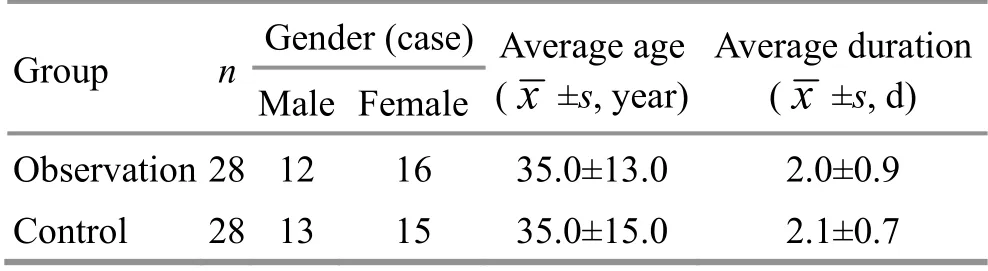
Table 1.Com parison of the general data between the two groups
2 Therapeutic Methods
2.1 Control group
Patients in the control group were given tuina on the neck (Figure 1).
Acupoints: Fengchi (GB 20), Fengfu (GV 16), Fengmen(BL 12), Jianzhongshu (SI 15), Bingfeng (SI 12), Jianjing (GB 21), Tianzong (SI 11) and Quepen (ST 12).
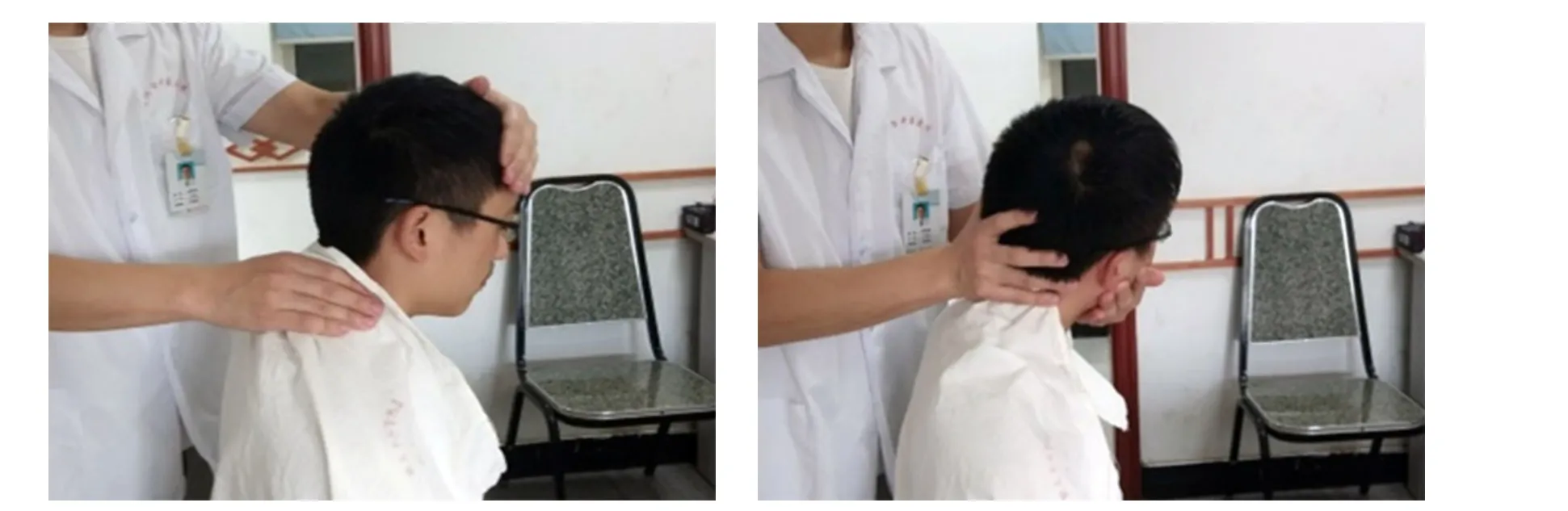
Figure 1. Tuina on the neck
Methods:Na-grasped and Rou-kneaded the neck,Gun-rolled the neck and back for 3-5m in; Na-grasped the soft tissue 5 cm away from the cervical spine,and Tanbo-plucked the neck for 3-5 m in;Yao-rocked the neck 10-5 times;obliquely Ba-pulled the left and right sides of the neck once respectively;Anrou-Pressed and kneaded the selected points 30 s for each point;Na-grasped the muscles on both sides of spinous process of cervical spine as well as the points Fengchi(GB 20),Jianjing (GB 21)and Tianzong (SI 11);Ca-scrubbed the neck[7].This treatment lasted for 30 min each time, once a day.
2.2 Observation group
Patients in the observation group practiced Yi Jin Jing (Sinew-transform ing Qigong Exercises)[7]on the basis of tuina therapy. Movement 3 (supporting the sky w ith the palms) and Movement 7 (nine demons drawing their swords)were adopted.The practice of these two movements was guided by Wu Yin-jun.
Supporting the sky w ith the palms: Stood w ith feet shoulder-w idth apart.Slow ly lifted the hands to the front of the chest w ith the four fingers together, rotated w rists until the palms turned upward with the fingertips of the hands 3-6 cm apart; lifted the hands above the top of the head, with the palms upward and 3 cm between two hands fingertips;the head leaned backward with the eyes looking towards the back of the hands; separated the feet w ith toes touching the floor and lifted the heels off the floor, meanwhile touching the palate w ith the tongue; at the end, took a deep breath, then exhaled slow ly, slow ly put down the hands,and returned to the ready posture (Figure 2).
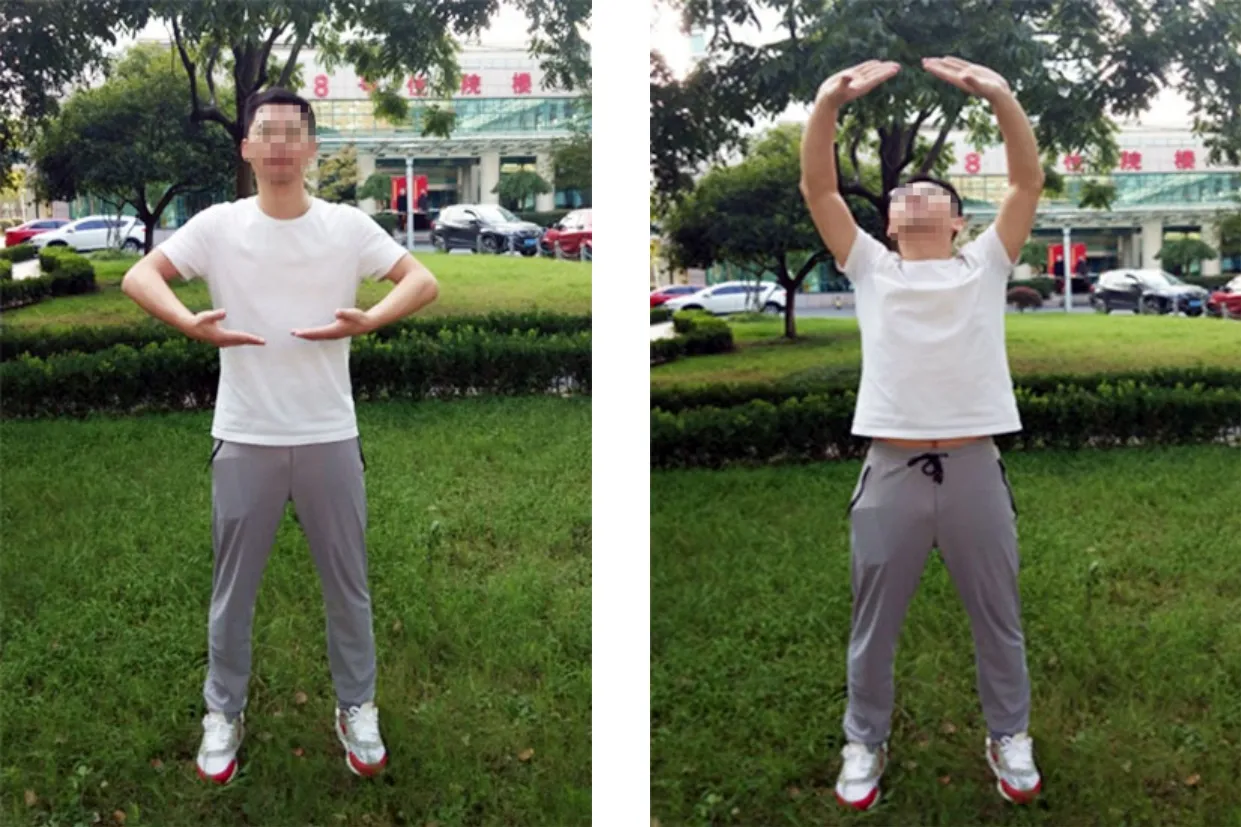
Figure 2.Supporting the sky w ith the palms
Nine demons draw ing their swords: With the feet together,the arms dropped naturally by the sides.Strode the left foot one step to the left,to shoulder-width apart.Lifted the right hand over the head w ith the palms upward,elbows straight and fingertips to the left.Bent the elbow,extent the shoulder outward, held the hand around the neck, and bent the head slightly forward; pressed the left hand downward, bent the elbow and rotated inward. Moved the forearm and the back of the hand from the waist to the upper back. Pressed the back of the palm close to the upper back, w ith the palm backward and the finger tips upward; the head leaned backward, pressed the neck with the right palm, with the two forces exerted for 7 times, and naturally opened the five fingers of both hands close to the back; at the end, took a deep breath, then exhaled slow ly, and returned to the ready posture. Repeated in the opposite direction (Figure 3).
Practiced the exercises for 30 m in each time, once a day and for 5 d.
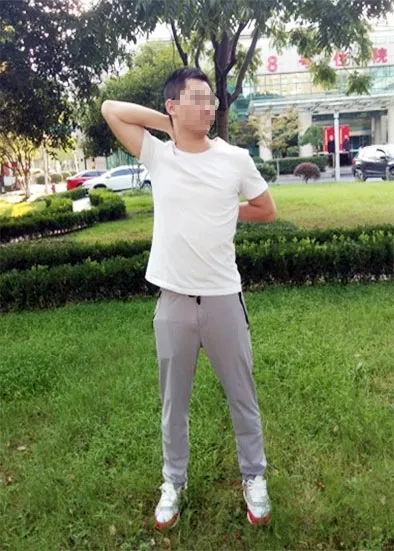
Figure 3.Nine demons draw ing their swords
3 Observation of the Therapeutic Efficacy
3.1 Observed items
Visual analog scale (VAS) score was observed before treatment, and after 1 time, 3 times and 5 times of treatment to evaluate the degree of neck pain[8].Specifically, drew a long straight line of 10 cm on the paper, marking 0 point at one end and 10 points on the other. 0 point meant no pain, 10 points meant the most unbearable pain, and the m iddle part meant different degrees of pain. Asked the patient to draw a mark on this line according to his own feeling to indicate the degree of pain and recorded it as the VAS score.
3.2 Efficacy evaluation criteria[9]
Recovery: After treatment, the symptoms of the neck such as pain,stiffness and movement disorder disappeared, and the function of the neck returned to normal.
Markedly effective: After treatment, the symptoms of the neck such as pain, stiffness and movement disorder were relieved obviously,and the neck function was partially recovered.
Failure: After treatment, the symptoms of the neck did not significantly improve, obvious pain, stiffness and movement disorder still presented,and the neck function did not improve.
3.3 Results
3.3.1 Comparison of the efficacy
After 5 times of treatment, the total effective rate was 92.9% in the observation group versus 82.1% in the control group, show ing statistical significance (P<0.05),which suggested that the clinical efficacy in the observation group was more significant than that of the control group. Check Table 2 for details.
3.3.2 Comparison of the VAS score
Before treatment, there was no significant betweengroup difference in the VAS score (P>0.05). After 1, 3 and 5 times of treatment,the VAS score was significantly decreased in both groups (allP<0.05), and the VAS score in the observation group was significantly lower than that in the control group at the same time point (allP<0.05). The results showed that the two treatments both could relieve the neck pain, but Yi Jin Jing (Sinew- transform ing Qigong Exercises) plus tuina on the neck achieved a better effect than tuina alone.Check Table 3 for details.

Table 2.Com parison of the efficacy between the two groups(case)
Table 3.Comparison of VASscorebetween the two groups (±s,point)

Table 3.Comparison of VASscorebetween the two groups (±s,point)
Note:Compared w ith that before treatment in the same group,1)P<0.05;compared w ith the control group at the same time point,2) P<0.05
Group n Before treatment After once of treatment After 3 timesof treatment After 5 timesof treatment Observation 28 5.3±0.9 3.8±1.01)2) 1.6±0.51)2) 0.3±0.31)2)Control 28 5.5±1.1 4.6±0.81)3.3±0.71) 1.5±0.51)
4 Discussion
Stiff neck is a common acute condition[10],mainly presenting neck pain,difficulty leaning the head forward and backward,lim ited cervical movement,head deviated to the affected side, facing to the healthy side,and spasm of sternocleidomastoid muscle or trapezius muscle.It ismainly due to improper sleep posture or pillow height, which makes the head and neck muscles stay in a state of hyperextension or hyperflexion, thus leading to a series of symptoms such as acute muscle spasm,rigidity and aching pain.Traditional Chinese medicine (TCM) holds that it occurs as a result of wind-cold and external pathogens invading the body and obstructing the maridians and collaterals. Obstructions lead to pain, and thus the neck pain appears[11-12]. Treatment should focus on relaxing sinews and activating blood flow in addition to warming meridians and unblocking collaterals[13-15]. The etiology and treatment of stiff neck can be seen in ancient literature.Ling Shu(Spiritual Pivot)holds that this disease is closely related to the Bladder Meridian and Small Intestine Meridian[16].AndShang Han Lun(Treatise on Cold Damage Diseases) classifies stiff neck into exterior deficiency w ith sweat pattern and exterior excess w ithout sweat pattern[17]. The selected points for stiff neck mainly belong to Taiyang Meridians of Hand and Foot, and modifications can be made according to patients' symptoms[18]. Studies show that Movement 3(supporting the sky w ith the palms)in Yi Jin Jing (Sinew-transform ing Qigong Exercises) can relieve the spasm of cervical muscles[19]because it has a gentle backward movement of the head, which can relieve the difficulty of the neck in backward extension. Movement 7 (nine demons drawing their swords) can fully exercise and stretch the splenius capitis and sternocleido- mastoid muscle,promote the recovery of cervical rotation[20], and stretch the muscle region of the Small Intestine Meridian of Hand Taiyang to relieve their spasm and tension.
This study showed that tuina on the neck alone and Yi Jin Jing (Sinew-transform ing Qigong Exercises) plus tuina both can relieve the neck pain in patients w ith stiff neck and promote the functional recovery. The later can achieve a better effect than the former,and can consolidate the effect after treatment,and thus is worthy of clinical application.
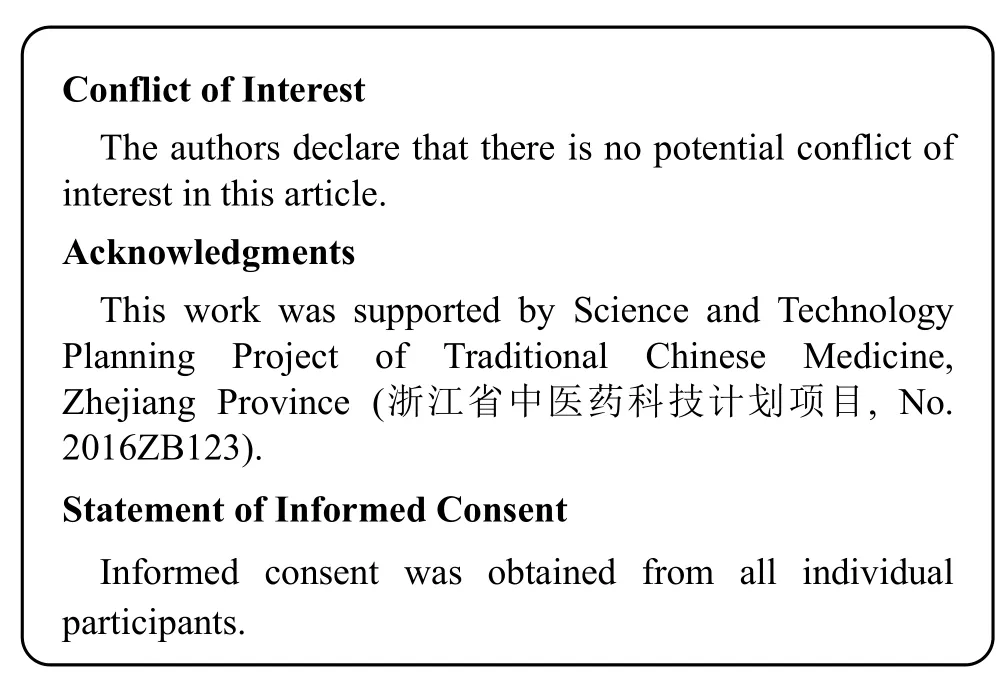
Conflict of Interest The authors declare that there is no potential conflict of interest in thisarticle.Acknow ledgments This work was supported by Science and Technology Planning Project of Traditional Chinese Medicine,Zhejiang Province (浙江省中醫(yī)藥科技計劃項目,No.2016ZB123).Statement of Informed Consent Informed consent was obtained from all individual participants.
Received:13 November 2019/Accepted:21 January 2020
猜你喜歡
老年教育(老年大學(xué))(2022年8期)2022-08-24 10:13:24
今日農(nóng)業(yè)(2021年8期)2021-07-28 05:56:04
現(xiàn)代臨床醫(yī)學(xué)(2021年3期)2021-07-16 07:36:44
中國民間療法(2021年5期)2021-06-09 09:21:42
書香兩岸(2020年3期)2020-06-29 12:33:45
浙江國土資源(2019年10期)2019-10-31 03:17:00
中等數(shù)學(xué)(2018年7期)2018-11-10 03:29:10
中等數(shù)學(xué)(2018年4期)2018-08-01 06:36:36
知識經(jīng)濟(jì)·中國直銷(2017年7期)2017-07-24 14:12:41
中國衛(wèi)生(2016年11期)2016-11-12 13:29:24
 Journal of Acupuncture and Tuina Science2020年5期
- Journal of Acupuncture and Tuina Science的其它文章
- Clinical observation on electroacupuncture plus Yi Jin Jing (Sinew-transform ing Qigong Exercises) for knee osteoarthritis
- Clinical efficacy comparison of moxibustion w ith different doses for knee osteoarthritis
- Clinical observation of acupuncture and traction plus Ba Duan Jin (Eight-brocade Exercise) for improving discogenic low back pain
- Clinical observation on acupoint injection for back pain in patients w ith primary osteoporosis
- Efficacy evaluation of acupuncture plus rehabilitation training for post-stroke deglutition disorders of qi-deficiency blood stasis pattern
- Clinical observation of acupuncture plus Frenkel exercises for ataxia after cerebral stroke