
What is the U.S. Intention to Withdraw from the Treaty on Open Skies?
2020-10-19 00:55:56ZhouLi
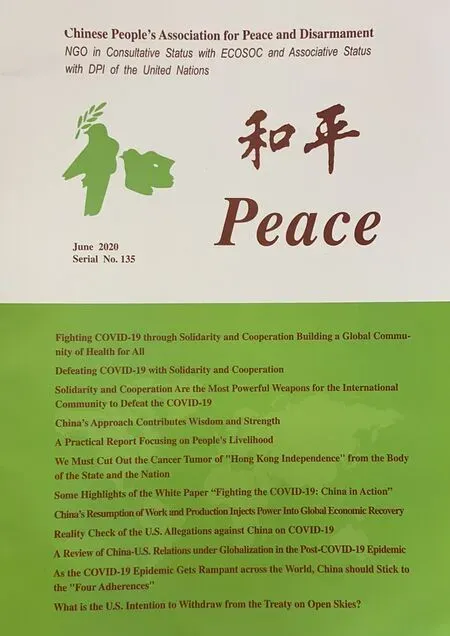
Peace 2020年2期
Zhou Li
What is the U.S. Intention to Withdraw from the Treaty on Open Skies?
Zhou Li
CPAPD Vice President and former Vice Minister of the IDCPC Senior Researcher of Chongyang Institute of Finance, Renmin University of China
I. The U.S. Announcement of withdrawal from the Treaty on Open Skies
On May 21, 2020, U.S. Secretary of State Pompeio issued a statement, saying that the United States will submit notice of its decision to withdraw from the Treaty on Open Skies to the Treaty Depositaries and to all other States Parties to the Treaty. Effective from May 22, 2020, the United States will no longer be a party to the Treaty and will stop living up to the commitments and obligations under the Treaty. The announcement claims that Russia has flagrantly and continuously violated the Treaty in various ways for years, including the following specific acts:
1) Russia has refused access to observation flights within a 10-kilometer corridor along its border with the Russian-occupied Georgian regions of Abkhazia and South Ossetia;
2) Russia’s designation of an Open Skies refueling airfield in Crimea, Ukraine, is similarly an attempt to advance its claim of purported annexation of the peninsula.
3) Russia has also illegally placed a restriction on flight distance over Kaliningrad (outside of Russia territory);
4) In 2019, Russia unjustifiably denied a shared American and Canadian observation flight over a large Russian military exercise
5) Russia uses open sky images in its observation flight operations in the United States, targeting key infrastructure in the United States and Europe with precision guided conventional weapons, etc.
In short, Russia did not use the Open Skies Treaty as a mechanism to enhance mutual trust and confidence-building by increasing military transparency, but rather weaponized the Treaty and made it a tool of intimidation and threat.
The statement concluded by stressing that the United States remains committed to effective arms control that advances U.S., Allies, and partner security. But we cannot remain in arms control agreements that are violated by the other side, if Russia demonstrates a return to full compliance with this confidence-building Treaty, but without such a change of course from the Kremlin, our path will lead to withdrawal in six months’ time.
On the same day, the U.S. Department of Defense also issued a statement similar to that of the State Department, stressing that Russia should not be allowed to repeatedly damage the security and interests of the United States, and that it should strive to comply with treaties that are beneficial to all parties and that all parties to the treaties fulfill their responsibilities.
U.S. national security assistant O'Brien said Russian planes used the Open Skies Treaty to fly over the White House in Washington, D.C., over civilian infrastructure, and track the location of the president, including Camp David and Trump National Golf Club in New Jersey. The U.S. side cannot tolerate Russian side actions.
Trump also told reporters on the 22nd that the United States will withdraw from the Open Skies Treaty after Russia fails to comply with it. The United States is likely to reach a new agreement on the arms control treaty, or do something to revive it, including involving China.
II. The Reaction of Russia and other parties concerned
The American statement aroused strong opposition from Russia. On May 22, Russian Deputy Foreign Minister Ryabukov said that he had received an official note from the U.S. Embassy in Russia on its decision to start the relevant procedures for withdrawing from the Open Skies Treaty. The U.S. accusations against Russia are unfounded, and the U.S. conditions for continuing to implement the Open Skies Treaty are "absolutely unacceptable." The withdrawal of the United States does not affect the validity of the treaty, but will seriously undermine European security. Russia will continue to abide by all the provisions of the treaty, and hopes that the signatories will also continue to earnestly implement the Treaty.
Russia's Foreign Ministry issued a statement on the same day condemning this U.S. act. The statement said Trump and Pompeio announced that the United States decided to withdraw from the Open Skies Treaty. From the perspective of European security, this step is very deplorable, because the Treaty is the most important factor to guarantee European security. What's more, the Treaty was originally signed on the initiative of the United States.
However, Russia is not surprised by the U.S. decision. This Washington’s decision shows that the United States attempts to completely tear up all arms control agreements and agreements to strengthen confidence-building in the military field. The United States ignored the interests of its allies. The U.S. authorities’ withdrawal from the treaty is the same as the withdrawal from the IMF, both first lodged willfully accusations against Russia. Russia has responded to the demands of the United States dozens of times through diplomatic channels and in open manner. Now the U.S. side has publicized new accusations that stigmatize Russia having used the opportunity of the implementing the Treaty by the United States and Europe to obtain information on their key infrastructure as the target of high-precision weapons strike. But the United States never mentioned it to Russia. The United States tried to create the illusion of its full implementation of the agreement, but did not respond to the Russian request or delay in fulfilling its obligations. Russia is willing to dialogue with the U.S. side, which must be based on mutual respect for each other's interests and concerns. Russia will continue to fulfill its treaty obligations and carry out relevant cooperation with other signatories.
On May 26, the Russian Foreign Ministry issued another informal instrument, pointing out that the reason with which the United States accused other countries of violating the treaty was untenable, in fact, it was the United States itself that violated the treaty. The document also expounds the Russian position from the perspective of technical parameters. Russian Foreign Minister Sergei Lavrov said at the press conference of the Collective Security Treaty Organization that Russia will weigh the measures to be taken from the perspective of national interests as the United States withdraws from the Open Sky Treaty.
On May 28, the Russian Foreign Ministry once again refuted the accusations of Washington against Russia’s violation of the Open Skies Treaty, and announced that it would impose new restrictions on the United States, that is, plan to ban American aircrafts participating in summer observation missions from staying overnight at three airports in Russia.
On May 30, President Putin chaired a Russian security meeting to discuss and adopt the next policy measures after the U.S. announcement of the withdrawal from the Treaty.
Germany and Sweden first expressed regret over the withdrawal of the United States from the Open Skies Treaty. German Foreign Minister Heiko Maas tried to persuade the United States to reconsider the decision: "I am very regrettable that the U.S. government announced its intention to withdraw from the Open Skies Treaty. This Treaty is an important part of the European arms control architecture. We will step up our efforts with partners of the same faith to get the U.S. government to reconsider this decision. He also called on Russia to resume full compliance with the Treaty. Swedish Foreign Minister Annie Lindh said that the Treaty has played an important role in strengthening confidence-building and security in Europe. Sweden will continue to encourage all signatories to fully comply with it and hopes that the United States will reconsider its decision.
Borrelli, European Union's high representative for foreign affairs, expressed puzzlement at the sudden U.S. withdrawal of the Treaty, saying that the Open Skies Treaty is a key element in the implementation of the arms control structure and an important measure to strengthen trust and security. The Treaty provides transparency and predictability. This is an important contribution to European and global security and stability. Unilateral withdrawal is clearly not the solution to the problem

The U.S. decision to withdraw from the Treaty on Open Skies takes the European allies by surprise.
Zhao Lijian, spokesman of the Chinese Foreign Ministry, expressed deep regret for the announcement of the U.S. withdrawal from the Treaty, stressing that the U.S. move is the same as a series of "withdrawals" actions recently. It is another negative manifestation of the U.S. adherence to cold war thinking, the pursuit of "America First" and unilateralism, and going back on its international commitments. This move by the United States is not conducive to maintaining military mutual trust and transparency among regional countries, nor in favor of safeguarding the security and stability of relevant regions, but will also have a negative impact on the process of international arms control and disarmament.
III. The background, signing and main contents of the Treaty
The concept of "open skies" was first proposed by President Eisenhower of the United States at a meeting with President Bulganin of the Soviet Union Council of Ministers in Geneva in 1955. Eisenhower suggested that the United States and the Soviet Union should agree that, as a means of mutual prevention of surprise attack, the two sides should be allowed to conduct observation flights in the skies above territory of both the United States and the Soviet Union. This proposal was subsequently rejected by Khrushchev, then the First Secretary of Central Committee of the Communist Party of the Soviet Union (CPSU).
In the year 1989, President George Bush of the United States made this proposal again to Gorbachev, General Secretary of the CPSU. After several twists and turns, it was finally agreed that a multilateral international treaty, the Skies Open Treaty, should be signed by a big group of countries (including the major countries of NATO and some countries of the former Council For Economic Mutual Assistance), in order to allow non-armed reconnaissance aircrafts of one country (one of the contracting countries) to fly unimpeded in the airspace of one of the contracting countries with prior notification. The purpose of the Treaty is to enhance transparency and reduce the risk of conflict and promote mutual confidence-building among countries concerned by improving the mechanism of monitoring military activities and abiding by existing arms control treaties.
On March 24, 1992, representatives of 23 member states of the Organization For Security And Cooperation in Europe (then known as OSCE), including the United States, Britain, France, Russia, Germany and Italy, signed the Open Skies Treaty in Helsinki. The Treaty entered into force in 2002. By 2017, 35 countries had become parties to the Treaty. The depositories of the Treaty are the governments of Canada and Hungary. The Russian Federation officially ratified the Open Skies Treaty on 26 May 2001, but actually is a participant in its activities from the very beginning.
According to the Treaty, every state party to the Treaty is obliged to provide, upon request, other state parties to the Treaty with the opportunity to permit observation flights in their airspace. The Treaty consists of a preamble, 19 articles and 12 annexes. Among them, there are detailed provisions on how to carry out observation flights. For example, the coordinated flight route does not involve truly confidential military facilities, the annual quota for the number of over-flights, the aircraft cannot be equipped with weapons, and the equipment (aerial cameras) installed on the aircraft shall be inspected by the representatives of the state signatory to the Treaty. When observation flight is carried out, it is necessary to have representatives of the observation state party concerned accompanying the flight, and the specific flight schedule needs to be informed in advance.
In Russia, the airports designated for taking off and landing of observation aircrafts include Kubinka (Moscow State), Ulan-Ude (East Siberia), Magadan (Far East) and Vorkuta (Komi republic), etc. Among them, Kubinka air force base became the first base for Russia to implement the Open Skies Treaty on April 19, 1994. In 2017, under the quota, Russia and Belarus (considered one state party) were entitled to 42 observation missions to states parties to the Treaty, while other states parties were entitled to 34 observation flights over Russian territory.
IV. Foreseeable consequences of the withdrawal
As an international multilateral arms control treaty, the Open Skies Treaty has been smoothly and successfully implemented for nearly 30 years since the Cold War. It has made contributions to maintaining the restraint of the signatory states in their respective arms deployment, strengthening mutual confidence-building and security guarantee in the military field, and maintaining global strategic security and stability. The historical position of the Treaty cannot be denied.
The announcement of the unilateral withdrawal of the United States from the Open Skies Treaty is a well planned move by the Trump Administration to implement the "America First" policy. It is not because of sudden thinking impulse, nor because of actual violations of the Treaty, but because of the important strategic measures closely linked with the two major arms control treaties, namely, the United States is determined to withdraw from the INF and the new START Treaty (The Treaty between the U.S. and the Russia on Measures for the Further Reduction and Limitation of Strategic Offensive Arms, also known as the New START Treaty), which expires on February 5, 2021. The purpose is to break the existing global military system of security checks and balances, especially the relatively balanced situation of arms control with Russia, to resume nuclear tests, and begin to promote the establishment of unilateral absolute military superiority, and further to set up new military bases in Europe, Asia and some countries deemed necessary by the United States, and update the anti-missile systems to tighten the encirclement of Russia and China, so as to lay a new foundation for military security for the United States to continue to push forward the unilateral initiative and power politics without hindrance in the next few decades to come.
Another attempt of the United States to withdraw from the Treaty is to force Russia engage in a new round of arms race with the United States, turn a large amount of Russian funds for economic development and improvement of people's livelihood to arms R & D and manufacturing, so that Russia's economy is more difficult to improve, and Russia will bear a heavy burden, and become fundamentally weakened in its comprehensive national strength. Trump has repeatedly proposed that China should also join the arms control negotiations initiated by the United States and Russia, and also has another sinister intention to linger China's economic development and restrict China's military strength.
We should also note that unlike in the past, Trump's announcement of the withdrawal from the Open Skies Treaty has not been disputed and criticized by the Democratic Party and the Congress. This once again shows that no matter how fiercely the U.S. Republican Party and the Democratic Party fight for top office and launch a brutal contest for the general election, yet their attitudes and positions are consistent in dealing with such major strategic issues as maintaining the global strategic balance and stability and dealing with Russia and China that hold high the banner of multilateralism. We must not have any more illusions at all.
Source: Chinanet.com.cn
Think.China.com.cn
- Peace的其它文章
- We Must Cut Out the Cancer Tumor of "Hong Kong Independence" from the Body of the State and the Nation
- Defeating COVID-19 with Solidarity and Cooperation--Keynote Speech by H.E. Xi Jinping, President of the People's Republic of China At the Extraordinary China-Africa Summit On Solidarity Against COVID-19
- Keynote Speech at Joint Webinar with the Canadian Peace Congress
- Reality Check of the U.S. Allegations Against China on COVID-19
- As the COVID-19 Epidemic Gets Rampant across the World, China should Stick to the "Four Adherences"
- A Review of China-U.S. Relations under Globalization in the Post-COVID-19 Epidemic