
Ammonia should be considered in field experiments mimicking nitrogen deposition
2020-10-09 06:16:44PANYupnTIANShiliWUDinminXUWnZHUXiyinLIUChunynLIDjunFANGYuntinDUANLiLIUXujunnWANGYusi
PAN Yupn ,TIAN Shili,WU Dinmin ,XU Wn,ZHU Xiyin,LIU Chunyn,LI Djun,FANG Yuntin,DUAN Li,LIU Xujunn WANG Yusi
aState Key Laboratory of Atmospheric Boundary Layer Physics and Atmospheric Chemistry(LAPC),Institute of Atmospheric Physics,Chinese Academy of Sciences,Beijing,China; bKey Laboratory of Geographic Information Sciences,Ministry of Education,School of Geographic Sciences,East China Normal University,Shanghai,China; cCollege of Resources and Environmental Sciences,China Agricultural University,Beijing,China; dNational Climate Center,China Meteorological Administration,Beijing,China; eKey Laboratory of Agro-ecological Processes in Subtropical Region,Institute of Subtropical Agriculture,Chinese Academy of Sciences,Changsha,Hunan,China; fCAS Key Laboratory of Forest Ecology and Management,Institute of Applied Ecology,Chinese Academy of Sciences,Shenyang,Liaoning,China; gState Key Laboratory of Environmental Simulation and Pollution Control,School of Environment,Tsinghua University,Beijing,China
ABSTRACT Excess nitrogen deposition has significant impacts on water eutrophication, soil acidification,eleveted greenhouse gas emissions, and biodiversity loss. These impacts mostly derive from conventional manipulative experiments in the field by adding nitrogen solution directly onto grassland or forest floors.For forest ecosystems,previous field experiments have usually ignored the nitrogen cycles in the canopy, which are important in responses to airborne nitrogen input.Although whole-forest canopy nitrogen fertilization has recently been conducted to promote our understanding of nitrogen deposition processes,spraying nitrogen solution onto plants still largely ignores the dry deposition of ammonia (as well as other gaseous reactive nitrogen species). To date, there have been a limited number of field studies that have investigated the bi-directional exchange of ammonia between the atmosphere and plants, not to mention the impacts of ammonia on natural ecosystems.Due to the increasing trend of atmospheric ammonia concentrations worldwide and its dominant role in nitrogen deposition and haze pollution, the next generation of experiments should mimick nitrogen deposition on natural ecosystems by further considering the dry deposition of ammonia.
KEYWORDS Nitrogen deposition;wet deposition;dry deposition;ammonia;air pollution
Since the early 20th century, the global nitrogen (N)cycle has been significantly altered by increasing fertilizer production and fossil fuel combustion (Pan et al.2016; Vitousek 1997). Globally, reactive N production increased from 15 Tg N yr?1in 1860 to 187 Tg N yr?1in 2005(Gruber and Galloway 2008).More than half of this human-produced N was ultimately returned to the ground via wet and dry deposition. Following Europe(Dise and Wright 1995) and North America (Fenn et al.1998), East Asia has become a new hotspot of atmospheric N deposition over recent decades (Pan et al.2012;Xu et al.2015). When the additional N deposition exceeds the N demand of natural ecosystems,cascading environmental problems may occur, including water eutrophication, soil acidification, eleveted greenhouse gas emissions, and biodiversity loss (Fowler et al. 2013;Galloway et al.2003;Huang et al.2015).
To quantify the impacts of atmospheric N deposition on natural ecosystems, manipulative field experiments mimicking N deposition have been extensively conducted, e.g., by adding N solution directly onto grassland or forest floors(Fang et al.2009;Mo et al.2007;Xia,Niu, and Wan 2009) (Figure 1(a)). However, these conventional experiments tend to focus on underground processes and ignore the imapcts of N deposition on the canopy,which plays an important role in the N cycle of forest ecosystems(Zhang et al.2015).
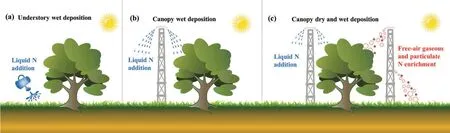
Figure 1. Manipulative field experiments mimicking N deposition: (a) conventional understory liquid N addition (mimicking wet deposition); (b) plant canopy liquid N addition (mimicking wet deposition); and (c) future scenarios for plant canopy dry and wet deposition(mimicking N deposition pathways,i.e.,wet and dry,and species,i.e.,oxidized and reduced forms,especially ammonia).
To address these canopy-associated concerns, wholeforest canopy N fertilization experiments have recently been designed(Figure 1(b)).For example,aircraft fertilization was performed above the canopy in a mature spruce–hemlock forest in the United States (Gaige et al.2007). Also, pump lifting systems and canopy spraying experiments were conducted in a subtropical temperate deciduous forest in China (Zhang et al. 2015). These canopy-based N addition experiments have revealed many important N cycling processes that are different from those revealed by experiments targeting forest floors.Thus,the incomplete knowledge gained from the conventional approach focusing on forest floors cannot be used to extrapolate the impacts of N deposition on forest ecosystems(Zhang et al.2015).
Although this new canopy-based N fertilization technology has improved our knowldege of atmospheric N deposition processes in forest ecosystems, attempts thus far are still insufficient to simulate atmospheric N deposition that occurs naturally. Spraying N solutions onto plants assumes that atmospheric N species are only deposited as rainfall (wet deposition). Such a tradtional technique can be a good proxy for atmospheric wet N deposition owing to its episodic manner in nature.However,dry deposition of gaseous and particulate reactive N is a dependable process involved in the continuous input of airborne N into ecosystems(Wesely 1989).To the best of our knowledge,few field experiments(if any)have evaluated the impacts of dry N deposition,not to mention comparisons of dry versus wet N deposition effects(Sheppard et al. 2011). Also, the roles of different N species, e.g., oxidized versus reduced forms, have not been fully considered. In particular, gaseous ammonia(NH3) exchange between the atmosphere and leaves has not been well resolved in the field.
In fact, dry deposition contributes half of the total deposited N worldwide, with NH3being the dominant species (Li et al. 2016; Pan et al. 2012; Xu et al. 2015).Compared with the drecreasing NOxconcentrations,atmospheric NH3concentrations have substantially increased over the past decade (Warner et al. 2017),and thus the resulting depositions of reduced N have grown over China and the United States (Liu et al.2016; Pan et al. 2018). In addition, a unique long-term field manipulation found that dry deposition of NH3gas, rather than wet deposition of ammonium ions,played a vital role in shifting peatland plant species composition (Sheppard et al. 2011). This finding highlighted the potential for NH3to destroy natural ecosystems. Clearly, future field and modeling experiments regarding N deposition effects on ecosystems will be incomplete if they do not take dry deposition into account.
To date, there has only been one experiment that manipulated the NH3dry deposition into an ombrotrophic bog ecosystem (Sheppard et al. 2011), but the scenario remains largely unclear in other natural ecosystems(Adriaenssens et al.2012;Cape et al.2009;Pitcairn et al. 1998). Therefore, aside from wet deposition, we suggest there is an urgent need for further consideration of the effects of dry deposition (of different N forms) in future manipulative field experiments (Figure 1(c)). We propose that the first step should be to conduct a new generation of experiments that mimics N deposition;specifically, Free-Air NH3Enrichment (FANE) experiments should be conducted,which will allow the investigation of the response of native ecosystems to rising NH3concentrations in the atmosphere.
Disclosure Statement
No potential conflict of interest was reported by the authors.
Funding
This study was supported by the Major State Research Development Program of China [grant number 2017YFC-0210103] and the National Natural Science Foundation of China [grant numbers 41405144, 41425007, and 41807449].Dianming WU was sponsored by the Shanghai Pujiang Program [grant number 18PJ1403500] and ‘the Fundamental Research Funds for the Central Universities’.
ORCID
Yuepeng PAN http://orcid.org/0000-0002-5547-0849
Dianming WU http://orcid.org/0000-0002-0414-9430
Yunting FANG http://orcid.org/0000-0001-7531-546X
 Atmospheric and Oceanic Science Letters2020年3期
- Atmospheric and Oceanic Science Letters的其它文章
- Toward a better understanding of cascading consequences of atmospheric reactive nitrogen along its transport pathway
- Estimation of interannual trends of ammonia emissions from agriculture in Jiangsu Province from 2000 to 2017
- An ammonia emissions inventory for agricultural sources in Hefei,China
- The regional nature of nitrate-dominant haze pollution during autumn over the Pearl River Delta area
- Spatial and temporal variability of open biomass burning in Northeast China from 2003 to 2017
- Effects of different long-term crop straw management practices on ammonia volatilization from subtropical calcareous agricultural soil