
Bamboo Under the Snow
2020-09-27 00:50:52ByVictoriaPonomaryovaUkraine
Special Focus 2020年4期
By Victoria Ponomaryova [Ukraine]

Victoria Ponomaryova holding the fan that started the whole story
Victoria Ponomaryova lived for eight years in China with her husband, a Ukrainian diplomat who worked in China for two terms. They recently came back to Ukraine. Victoria wrote to our readers: “Your beautiful country will forever remain in our hearts and memories. You can see this when you read my little story. I wish the people of China prosperity and beauty in life.”
When you leave a country where you have spent four years of your life,you will have to take with you some baggage. Part of this baggage can be measured in kilograms, but another part—your feelings and memories—have no measure. At home, you try to adjust to the “new” old life. This“home away from home” dives deep within you, where other countries,cities, and towns were once stored.
Perhaps one day you are going to the office and can suddenly smell in the lingering notes of the wind the taste of roasted tofu. Or in the botanical garden in a pavilion you see a beautiful lotus that looks just like the one that flourished in Beijing’s parks. Eventually you begin to hear more Chinese everywhere and constantly run into students or groups of tourists from China. Then you become fascinated with the symphony of memories—bright, melodic, and nostalgic.
One rainy autumn day I passed by an art gallery and saw a poster with mountains and rivers and an announcement: “Joint exhibition of art works by Ukrainian and Chinese students.” This ad awoke in me memories of our small experience with traditional Chinese art.
Once, my Chinese language teacher, who was also my best Chinese friend, gifted me a handpainted fan. I opened it. From the dense thickets of tropical plants,the eyes of a tiger were staring at me.
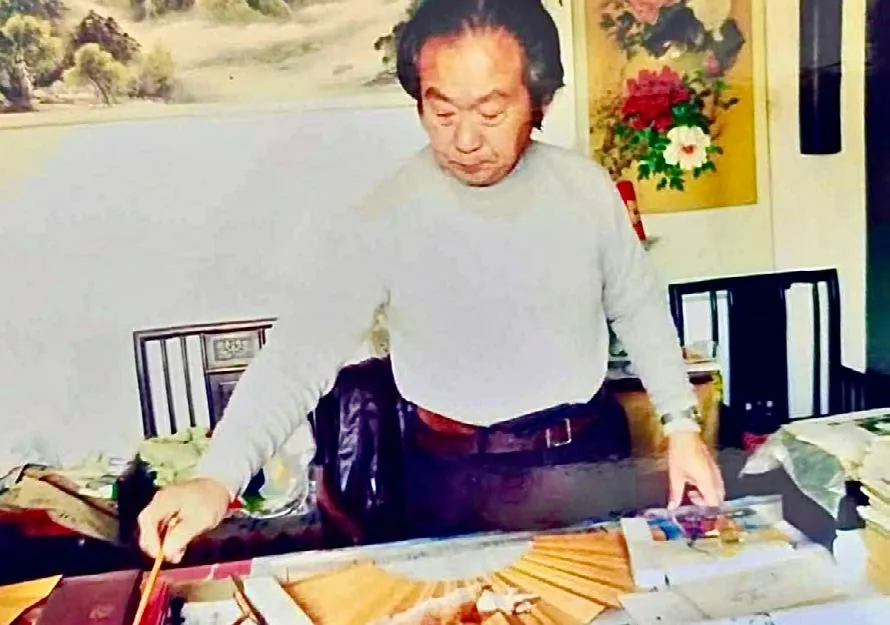
Laoshi Wang
“The eyes look so real!” I exclaimed.
“It was painted by my uncle,”my teacher answered. “He is an art teacher. Now he is old and doesn’t work anymore.”
“I like Western paintings so much, but I don’t understand anything in Chinese art. It seems to be monotonous,” I said.
My friend was offended. Some days later she warned me in a flat tone: “Sunday Laoshi (Teacher)Wang will come to your home.”
“Laoshi Wang? I thought you are my laoshi.”
“Your Chinese art teacher,”clarified the girl.
One aspect of traveling to a new country is finding more about the historical and cultural backgrounds. The other aspect introduces people, their faces,eyes, smiles, gestures, looks,and behaviors. This is a more complicated kind of traveling,because by purchasing a ticket you can get to the farthest point of a country. But to look into the soul—there is no ticket to help you get there, until the soul itself opens to meet you.
A small in stature, oldfashioned, but a rather lively Chinese man quickly entered my apartment, smiled and said his name: “It’s so easy to remember,in China every third person has the name Wang!”
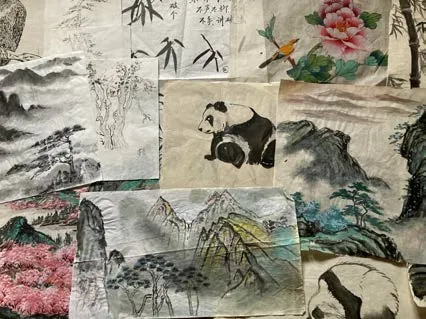
Victoria’s new world of Chinese painting
He immediately began to pull out all of his tools from his cotton bag. One by one he laid out supplies on the table: some drawing ink, brushes, an ink stone, scrolls of white paper,scrolls of paper with Chinese characters, scrolls of silk,scrolls of paintings. The table immediately came to life. The table transformed from a place to eat at to a place to create at.
Laoshi Wang took a sip of his green tea from his thermos and asked my daughter and I in a professorial tone of voice: “Do you know anything about the Four Treasures of the Chinese Study?
“No!” my daughter and I answered together.
“They are brushes, ink, paper,and an ink stone,” he said,pointing his finger at each of the objects.
He unfolded one scroll, and we stared with wide eyes at a long chain of calligraphy, written beautifully. He unfolded another scroll and a small yellow bird began singing her spring song for us from a plum branch in bloom.
“Let’s begin with simple things.From lines, which we use to draw characters…”
“Oh, well! We can easily draw one, two, three,” I joked. “We also know a couple of simple ones. For example, 山 (shān), the mountain,looks like a real mountain.”
I drew some characters quickly,but they turned out ugly. Laoshi Wang, dipped a brush in ink and began to weave black laces on white paper. How beautiful was his calligraphy! I was upset—I thought that I’d never write so well! He told me with an expressionless face: “Manman lai!”
“This is a Chinese saying meaning gradually. Study gradually and you will learn,” my daughter translated.
Our lesson continued. He gave us homework. We tried our best to do the simple exercises and couldn’t wait to switch from lines to real paintings! The next lesson, Laoshi Wang began: “Do you know what kind of paintings Chinese art are divided into? It can be roughly divided into 花鳥(huāniǎo, flowers and birds), 山水 (shānshuǐ, landscape), 人物(rénwù, people), 動物 (dòngwù,animals).”
He again took the brush,dipped it in ink, and suddenly on the white paper a little bird fluttered its wings. Wow! We also wanted to start drawing immediately, but our teacher didn’t yet believe in us, so he gave us a paper with outlines of already painted birds. We painted them.

Shapes of the character心 (heart)without dots and the phoenix tails can be seen from the bamboo painting
At the next lesson Laoshi Wang criticized their claws, telling us they looked like frozen chicks,and feathers, that appeared as if ruffled after being shot with a stun gun. We knew that we were not going to be artists, but now we truly wanted to get a deeper understanding of Chinese art.
From birds we gradually switched to flowers. The first flower that our teacher taught us to draw was a peony. He held two brushes together in his hand,one dipped in red paint, the other in water to slightly blur out the overly vivid colors.
“In the ancient times, the flower has another name—富貴花(fùguì huā)—flower of wealth and nobility. Only empresses could wear a robe embroidered with peonies.”
The lessons continued. We learned a lot of techniques, like how to draw bamboo and pandas,mountains and rivers.Back in Ukraine, I opened the glass gallery doors and found myself again in China.“Remarkable mountains, a small river with a tiny boat on it, a fluffy pine tree on the rock, every detail has its own meaning, every line tells or symbolizes something.”
I glanced at the paintings.Bamboo! It was amazing to learn how to draw it. Each part of the stem is separate, connecting these parts with the nodes that resemble the character 心 (xīn)—the heart, without dots.
I recalled how our teacher explained: “The leaves at the end of the branch should be painted like the tail of a phoenix. The right and left leaves have to be the same and should face each other!”
Coming back to the gallery from my memories, I suddenly glanced upon a painting called“Bamboo Under the Snow.” The work was done with ink and white paint. It seems so real and cold, the bamboo leaves weighed down with the heavy snow. The snowflakes, which circled and landed everywhere, formed lacewhite clouds.

Bamboo Under the Snow
“This is the painting of our Laoshi Wang. At least it’s quite similar.”
I didn’t understand how the painting of our old teacher Wang could be among students’ works.I read the information card near the painting. The student, whose name was not Wang, studies in Kyiv and was born in Beijing.
From the other room of the gallery, I heard voices and saw a group of young men from China and a reporter asking them questions. Carefully I approached them and listened. The reporter addressed one silent guy: “What do you like to draw most of all?”
He glanced at her awkwardly and answered so quietly that I barely heard: “I liked to draw bamboo under the snow. Here in Ukraine I see a lot of beautiful snow, but in Beijing snow is so rare! The combination of white snow and green bamboo is so symbolic to me. It means strength and courage, personally.”
“How did you start drawing?”the girl continued with questions.
“Me? I guess I started in school,thanks to my teacher...”
I couldn’t help but ask: “What was the name of your school teacher?”
“Laoshi Wang,” answered the guy.
My soul warmed up, although it is believed that in China every third person has the name Wang,I’d really like to think that this painter and I shared the same teacher.
We are living on a huge globe in vastly different parts of it. But someday, suddenly the breeze brings in some familiar smell,and perhaps the eyes see a picture of the plum flower. And sweet memories arrive. And already you are traveling in time and in space…
