
Study on the differences between moxibustion at different points in the effects on the anti-fatigue ability of rats undergoing one-time exhaustive swimming
2020-08-29 02:49:52LiuHailong劉海龍GaoLei高磊ZhangYahui張亞輝LiangYulei梁玉磊Tianyuan呂天元YangXin楊鑫ZhaoZhiguo趙志國
關鍵詞:科學研究
Liu Hai-long (劉海龍), Gao Lei (高磊), Zhang Ya-hui (張亞輝), Liang Yu-lei (梁玉磊), Lü Tian-yuan (呂天元), Yang Xin (楊鑫), Zhao Zhi-guo (趙志國)
1 The 926th Hospital of PLA Joint Logistic Support Force, Kaiyuan 661699, China
2 Hebei University of Chinese Medicine, Shijiazhuang 050200, China
Abstract
Keywords: Moxibustion Therapy; Moxa Stick Moxibustion; Point, Shenque (CV 8); Point, Shenshu (BL 23); Point, Zusanli (ST 36); Exhaustive Exercise; Fatigue; Rats
The original purpose of anti-exercise fatigue study was to improve the performance of athletes in competitive sports. With the development of research, the investigation scope gradually involved more fields such as clinical medicine and rehabilitation medicine. In rehabilitation clinics, some patients often autonomously receive overtime and over-intensity training due to the eagerness of recovery, leading to exercise fatigue. Therefore, their rehabilitation programs cannot be effectively implemented, affecting the effectiveness of rehabilitation training. Therefore, how to effectively eliminate exercise fatigue is of clinical relevance to rehabilitation. At present, most studies focus on repeated exercise fatigue, lacking of research on overtraining-caused one-time exercise fatigue. Based on the previous research[1-6], in our current work, Shenshu (BL 23), Zusanli (ST 36) and Shenque (CV 8) with better anti-exercise fatigue outcomes were investigated for their effects on fatigue caused by one-time exhaustive exercise and the functional difference in energy metabolism, so as to better serve the rehabilitation clinic and provide experimental basis.
1 Materials and Methods
1.1 Experimental animals and groups
Forty-eight male SPF rats, with a body mass of (200±10) g, were purchased from the Experimental Animal Center of Hebei Province (Qualification Number: 17112115), and were randomly divided into 6 groups using the random number table method: a blank group, a model group, a non-meridian and non-acupoint group, a Shenshu (BL 23) group, a Zusanli (ST 36) group and a Shenque (CV 8) group, with 8 rats in each group. The rats were housed in the Experimental Animal Center of Hebei University of Chinese Medicine, with 4 rats in each cage and free diet access. All experimental operations followed the relevant regulations on the management of laboratory animals of Hebei University of Chinese Medicine.
1.2 Main reagents and instruments
Blood lactate (BLA) kit (Batch No.: A019-2), lactate dehydrogenase (LDH) kit (Batch No.: A020-1) and creatine kinase (CK) kit (Batch No.: A032), (Nanjing Jiancheng Bioengineering Research Institute, China); blood urea nitrogen (BUN) kit (Batch No.: A012) and creatinine (CRE) kit (Batch No.: A015), (Changchun Huili Biotechnology Co., Ltd., China); testosterone (T) kit (Batch No.: S10940111) and cortisol (C) kit (Batch No.: S10940110), (Tianjin Jiuding Medical Bioengineering Co., Ltd., China).
Homemade constant temperature water tank (200 cm×80 cm); moxa stick (0.7 cm×11.7 cm, Nanyang Hanyi Airong Co., Ltd., China); TD10001 electronic balance (Tianjin Tianping Instrument Co., Ltd., China); self-made moxibustion rat box (National Utility Model Patent Number: ZL201120193244.8)[7]; TDL-5-A centrifuge (Shanghai Anting Scientific Instrument Factory, China); iChem-530 automatic biochemical analyzer (Shenzhen Icubio Biotechnology Co., Ltd., China).
1.3 Preparation of model
The adaptive swimming began on the third day of adaptive feeding for rats, once per day, 3 min/time. The one-time exhaustive swimming rat model was established with reference to the literature after 7-day adaptive feeding[8]. Except for the blank group, the rats in the other groups were placed in a labyrinth water tank with 50 cm deep and (30±2) ℃ water to perform the exhaustive swimming carrying 5% lead mass at the base of the tail (covered at 1-5 cm from the base tail). The exhaustive standard for the rats: the swimming movement was obviously unbalanced and would not be continued; the rat body sank until the water exceeded the nose tip for 5 s and was unable to return to the water surface.
1.4 Interventions according to the designated groups
All rats received corresponding interventions in a special moxibustion rat box for 15 min.
Blank group: Rats did not receive exhaustive swimming and moxibustion treatment.
Model group: No moxibustion after exhaustive swimming.
Non-meridian and non-acupoint group: After exhaustive swimming, rats received one time of mild moxibustion at bilateral subcostal non-meridian and non-acupoint points (25 mm above the bilateral lateral iliac crest below the costal region, and 20 mm away from the posterior midline) for 15 min[9].
Shenshu (BL 23) group: After exhaustive swimming, rats received one time of mild moxibustion at bilateral Shenshu (BL 23).
Zusanli (ST 36) group: After exhaustive swimming, rats received one time of mild moxibustion at bilateral Zusanli (ST 36).
Shenque (CV 8) group: After exhaustive swimming, rats received one time of mild moxibustion at Shenque (CV 8).
1.5 Detection indicators
All rats were anesthetized with chloral hydrate 4 h after exhaustive swimming. After collection of about 5 mL femoral artery blood, the supernatant was separated for test by centrifuging at 3 000 r/min and 4 ℃ for 10 min. Colorimetric method was used to detect serum BLA, LDH and CK; picric acid method was used to detect serum CRE; urease indigo method was used to detect serum BUN; and liquid phase equilibrium competitive radioimmunoassay was used to detect serum C and T levels. All tests were completed by the Research Center of Hebei University of Chinese Medicine.
1.6 Statistical processing
Data were analyzed with SPSS version 21.0 statistical software. Measurement data conforming to the normal distribution with homogeneity variance were expressed as mean ± standard deviation (±s), and one-way ANOVA was used for comparison between groups. The Tamhane’s T2 test was used when normal distribution was not satisfied or the variance was uneven.P<0.05 was considered statistically significant.
2 Results
2.1 Comparisons of the serum BLA, LDH, CK, BUN and CRE levels
Compared with the blank group, the serum BLA, LDH, CK and BUN levels in the model group and the non-meridian and non-acupoint group were increased (allP<0.01), and the CRE levels were decreased (bothP<0.01). Compared with the model group and the non-meridian and non-acupoint group, the serum levels of BLA, LDH, CK and BUN in the Shenshu (BL 23) group, Zusanli (ST 36) group and Shenque (CV 8) group were decreased (allP<0.01), and the CRE levels were increased (allP<0.01). Compared with the Shenshu (BL 23) group, the CK level was decreased in the Shenque (CV 8) group (P<0.01); compared with the Zusanli (ST 36) group, the CK and BUN levels in the Shenque (CV 8) group were decreased (P<0.01,P<0.05), (Table 1).
2.2 Comparisons of the serum C and T levels and T/C ratio
Compared with the blank group, the T levels and T/C ratios were decreased in the model group and the non-meridian and non-acupoint group (allP<0.01); the C level was increased in the model group (P<0.05). Compared with the model group and the non-meridian and non-acupoint group, the T levels and T/C ratios were increased, while the C levels were decreased in the Shenshu (BL 23) group, Zusanli (ST 36) group and Shenque (CV 8) group (allP<0.01); compared with the Shenshu (BL 23) group, the C and T levels in the Zusanli (ST 36) group and Shenque (CV 8) group were decreased (P<0.01 orP<0.05), and the T/C ratio in the Shenque (CV 8) group was increased (P<0.01); compared with the Zusanli (ST 36) group, the T/C ratio was increased in the Shenque (CV 8) group (P<0.05), (Table 2).
Table 1. Comparisons of rat’s serum levels of BLA, LDH, CK, BUN and CRE among groups (±s)
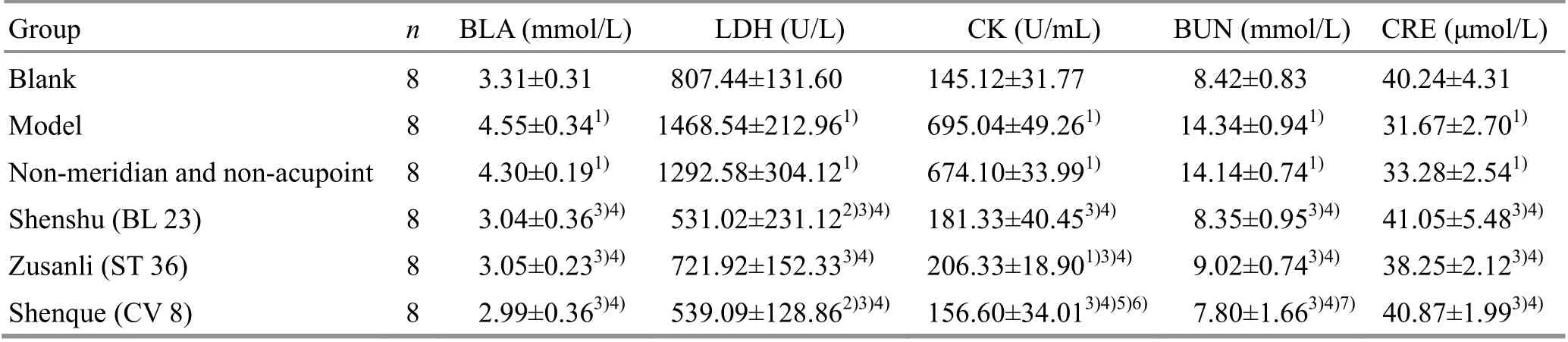
Table 1. Comparisons of rat’s serum levels of BLA, LDH, CK, BUN and CRE among groups (±s)
Note: Compared with the blank group, 1) P<0.01, 2) P<0.05; compared with the model group, 3) P<0.01; compared with the non-meridian and non-acupoint group, 4) P<0.01; compared with the Shenshu (BL 23) group, 5) P<0.01; compared with the Zusanli (ST 36) group, 6) P<0.01, 7) P<0.05
Group n BLA (mmol/L) LDH (U/L) CK (U/mL) BUN (mmol/L) CRE (μmol/L) Blank 8 3.31±0.31 807.44±131.60 145.12±31.77 8.42±0.83 40.24±4.31 Model 8 4.55±0.341) 1468.54±212.961) 695.04±49.261) 14.34±0.941) 31.67±2.701) Non-meridian and non-acupoint 8 4.30±0.191) 1292.58±304.121) 674.10±33.991) 14.14±0.741) 33.28±2.541) Shenshu (BL 23) 8 3.04±0.363)4) 531.02±231.122)3)4) 181.33±40.453)4) 8.35±0.953)4) 41.05±5.483)4) Zusanli (ST 36) 8 3.05±0.233)4) 721.92±152.333)4) 206.33±18.901)3)4) 9.02±0.743)4) 38.25±2.123)4) Shenque (CV 8) 8 2.99±0.363)4) 539.09±128.862)3)4) 156.60±34.013)4)5)6) 7.80±1.663)4)7) 40.87±1.993)4)
Table 2. Comparisons of the serum levels of C and T and T/C ratio among groups (±s)
Note: Compared with the blank group, 1) P<0.01, 2) P<0.05; compared with the model group, 3) P<0.01; compared with the non-meridian and non-acupoint group, 4) P<0.01; compared with the Shenshu (BL 23) group, 5) P<0.01, 6) P<0.05; compared with the Zusanli (ST 36) group, 7) P<0.05
Group n Cortisol (μg/L) Testosterone (ng/L) T/C Blank group 8 54.94±3.57 788.34±93.63 14.36±1.78 Model group 8 65.48±6.942) 546.05±35.011) 8.34±0.972) Non-meridian and non-acupoint 8 63.31±8.00 543.45±29.051) 8.58±1.022) Shenshu (BL 23) 8 47.53±6.913)4) 960.87±62.961)3)4) 16.75±0.723)4) Zusanli (ST 36) 8 39.02±8.471)3)4)6) 747.69±80.893)4)5) 19.17±1.343)4) Shenque (CV 8) 8 31.93±8.791)3)4)5) 777.75±82.903)4)5) 24.38±1.613)4)5)7)
3 Discussion
During exercise, muscles consume a lot of energy to produce strength. The body mainly consumes fat for energy during light exercises. The sugar oxidation function increases significantly during exercise when the energy requirement is greater than the maximum output power of free fatty acid oxidation, that is, when the exercise load exceeds 30%-50% of the maximum oxygen consumption (VO2max), the oxygen supply is sufficient and a large amount of adenosine triphosphate (ATP) is generated, and energy is released through the ATP/adenosine diphosphate (ADP) conversion, that is, the tricarboxylic acid cycle. CK catalyzes the transfer of a high-energy phosphate bond from creatine phosphate (CP) to ADP for the synthesis of ATP, which is important for ATP resynthesis, especially for energy supply during high-intensity exercises[10]. The energy demand during exercise is greater than the output power generated by fat energy supply and sugar oxidation energy supply when the exercise load reaches 55%-75% of the VO2max, then the energy supply through the glycolysis pathway increases rapidly to produce lactic acid by decomposition. BLA is often used to evaluate changes in energy metabolism of the body during exercise. LDH catalyzes the conversion of lactic acid and pyruvate to ensure muscles get ATP under hypoxic conditions[11]. During vigorous exercises, repeatedly stretched skeletal muscles damage the cell membranes, accumulating intracellular metabolites and cell hypoxia, leading to increased permeability of the cell membranes, and causing LDH and CK to be released into blood[12]. When the exercise load reaches 85%-95% of the VO2max, on one hand, the energy requirement during exercise is greater than the output power generated by glycolysis; on the other hand, continuously increasing H+in the muscle cells inhibits glycolysis due to the large amount of lactic acid production. Then the muscle activates the prophosphate acid supply system. Creatine is stored in skeletal muscle as the form of CP, which produces CRE and releases energy at a relatively stable rate. CRE is filtered by the glomeruli and excreted in urine. Creatine levels are related to the explosive power and speed ability of muscles[13]. Phosphagen is mainly used for energy supply during high-intensity exercises with accelerated protein decomposition. CRE can be used to measure muscle mass and non-invasively measure the CP metabolism in the body. BUN is a commonly used indicator for detecting protein catabolism. BUN maintains a balance between production and excretion under physiological conditions[14]. The urea level, and then the BUN level is increased due to the participation of proteins in metabolic breakdown, as a result of increased energy requirement by the muscles during strenuous exercises. Therefore, BUN is also an important indicator of body fatigue.
T is closely related to exercise capacity, muscle strength growth and fatigue recovery, which is released by the hypothalamic-pituitary-gonadal (HPG) axis to promote protein synthesis in the body, especially the muscle protein synthesis, and weaken amino acid catabolism. It can increase muscle glycogen synthesis capacity and glycogen reserve to recover the energy substances after intense exercises[15]. Studies have shown that 4-6 h after a short period of high-intensity exercise, T concentration reaches the lowest level[16]. C is released by the hypothalamic-pituitary-adrenal (HPA) axis. During exercise, C mainly maintains the normal glucose metabolism in the body, promotes the protein breakdown in extrahepatic tissues, maintains the stable blood glucose concentration, and provides energy for exercise[17]. Generally speaking, blood T concentration reflects the situation of anabolism in the body, and C concentration reflects the situation of catabolism in the body. The ratio of T to C (T/C ratio) is usually used as a standard of the stability of anabolic- catabolic metabolism, which reflects the body's exercise ability and fatigue degree[18].
Traditional Chinese medicine believes that the mechanism of exercise fatigue is the imbalance of qi, blood, yin, yang and Zang-fu organs, which is a complex physiological change and body response[19]. Moxibustion has a confirmed significant effect in alleviating exercise fatigue. Studies have shown that moxibustion at Shenshu (BL 23) improves the levels of hemoglobin, muscle glycogen and liver glycogen of the fatigued body and promotes the elimination of fatigue[20]; moxibustion at Zusanli (ST 36) effectively increases the mitochondrial antioxidant enzyme activity of skeletal muscles in exercise fatigue rats, increases blood perfusion in skeletal muscles, relieves exercise fatigue of the peripheral skeletal muscles, and improves exercise endurance[21]. Moxibustion at Shenque (CV 8) improves the serum CD3+level and promotes the recovery of CD4+/CD8+value, thereby improving chronic fatigue symptoms[22].
The results of this experiment showed that the serum levels of BLA, LDH, CK, BUN and C in the Shenshu (BL 23) group, Zusanli (ST 36) group and Shenque (CV 8) group were lower than those in the model group and the non-meridian and non-acupoint group, while the serum levels of CRE and T, also T/C ratios, were all increased compared with the model group, indicating that Shenshu (BL 23), Zusanli (ST 36) and Shenque (CV 8) all can relieve exercise fatigue by regulating energy metabolism and endocrine system. At the same time, it was found that the blood levels of C and T in the Shenshu (BL 23) group were higher than those in the Zusanli (ST 36) group and Shenque (CV 8) group; the serum BUN and CK levels in the Shenque (CV 8) group were lower than those in the Zusanli (ST 36) group. The T/C ratio in the Shenque (CV 8) group was higher than that in the Shenshu (BL 23) group and Zusanli (ST 36) group, indicating that moxibustion at Shenshu (BL 23), Zusanli (ST 36) and Shenque (CV 8) have different effects on exercise-induced fatigue[23]. Moxibustion at Shenshu (BL 23) works better in promoting energy synthesis, and moxibustion at Shenque (CV 8) is better in regulating the synthesis and decomposition of skeletal muscle proteins[24]. However, in-depth research is needed to explore other mechanisms.
Conflict of Interest
The authors declare that there is no potential conflict of interest in this article.
Acknowledgments
This work was supported by Scientific Research Project of Education Department of Hebei Province (河北省教育廳科學研究項目, No. ZD2019061); Undergraduate Innovation and Entrepreneurship Training Program of Hebei University of Chinese Medicine (河北中醫學院大學生創新創業訓練計劃項目, No. 2017044).
Statement of Human and Animal Rights
The treatment of animals conformed to the ethical criteria.
Received: 12 December 2019/Accepted: 17 January 2020
猜你喜歡
林業科學研究(2022年5期)2022-10-12 06:50:18
老齡科學研究(2022年9期)2022-10-12 01:48:30
環境科學研究(2022年2期)2022-02-28 02:37:54
環境科學研究(2021年12期)2021-12-21 04:14:36
環境科學研究(2021年11期)2021-11-22 12:28:00
紡織科學研究(2021年9期)2021-10-14 08:52:14
環境科學研究(2021年9期)2021-09-27 02:17:28
紡織科學研究(2021年7期)2021-08-14 01:42:38
環境科學研究(2021年3期)2021-03-25 08:07:58
紡織科學研究(2020年1期)2020-05-21 00:31:08
 Journal of Acupuncture and Tuina Science2020年4期
- Journal of Acupuncture and Tuina Science的其它文章
- Clinical observation of Zhen’ai needling method in Nei Jing (Classic of Internal Medicine) for children with allergic rhinitis accompanied by adenoid hypertrophy
- Clinical observation of tuina manipulations for tic disorders in kids
- Clinical observation on muscle regions of meridians needling method in improving upper limb function for children with cerebral palsy of spastic hemiplegia type
- Electronic moxibustion apparatus and traditional moxibustion in treating knee osteoarthritis: a randomized controlled trial
- Clinical observation on filiform fire-needling plus continuous passive motion therapy for frozen shoulder
- Clinical study on auricular point sticking plus Western medicine for moderate gastric cancer pain