中國十大傳世名畫
2020-08-28 11:33:20卜杭賓
英語世界 2020年8期
卜杭賓

Chinas long history has delivered us with many priceless masterpieces in traditional Chinese painting. While some of them were lost or destroyed during wars, many more survived thousands of years and are now conserved and protected within museums throughout China and around the world. Here are 10 of the most famous Chinese paintings of all time:
Nymph1 of the Luo River
Artist and writer Gu Kaizhi (ca. 344–406) painted Nymph of the Luo River on a long silk scroll during the Eastern Jin Dynasty (317–420). The narrative scroll, from which four copies dating to the Song Dynasty (960–1127) survived (now exhibited in Beijing, Liaoning and Washington2), illustrates the poem Ode to the Nymph of the Luo River, written by Cao Zhi (192–232).
It is a large scroll that should be “read” horizontally, depicting the love story between the poet and the nymph, from their meeting to their parting.
Emperor Taizong Receiving the Tibetan Envoy
Emperor Taizong Receiving the Tibetan Envoy depicts the meeting of Emperor Taizong of the Tang Dynasty (618–907) and Ludongzan, Gar Tongtsen Yulsung, an envoy sent by Songtsan Gampo (617–650), the ruler of Tibet, to accompany Princess Wencheng back to Tibet to be his queen. Yan Liben (601–673), the artist who created this painting, was one of the most revered3 Chinese figure painters in the early years of the Tang Dynasty. The ink and colour on silk handscroll4, 129.6 cm long and 38.5 cm wide, is now in the collection of the Palace Museum in Beijing.
Noble Ladies in Tang Dynasty
Noble Ladies in Tang Dynasty are a serial of paintings drawn by Zhang Xuan (713–755) and Zhou Fang (ca. 730–800), two of the most influential figure painters of the Tang Dynasty, when the paintings of noble ladies became very popular.
The paintings depict the leisurely, lonely and peaceful life of the ladies at court, who are shown to be beautiful, dignified and graceful. Four most-renowned paintings in the serial are Portrait of Lady of Guo Going Sightseeing in Spring (by Zhang Xuan), Court Ladies Preparing Silk (by Zhang Xuan), Court Ladies Adorning Their Hair with Flowers (by Zhou Fang), Court Ladies Swinging Fans (by Zhou Fang).
Zhang Xuan used fine brushwork5 to make paintings of people and was especially good at painting noble ladies, infants and pommel horses. Zhou Fang was influenced by the pure and detailed style of the Jin Dynasty artist Gu Kaizhi, and his portrayals of court ladies are characterized by round faces and plump figures.
The paintings are now kept in several museums around China.
Five Oxen
Five Oxen, a painting by renowned Tang Dynasty artist Han Huang (723–787), is housed in the Palace Museum in Beijing.
Han Huang was born in Changan during the reign of Emperor Xuanzong (685–762), and served as a chancellor during the reign of Emperor Dezong (742–805).
Han was renowned for painting people and animals with detailed facial expressions. He was especially distinguished at painting agricultural life and livestock, including oxen and goats.
Five Oxen is 139.8 centimeters long and 20.8 centimeters wide. The painting, as the name suggests, is of five oxen without any background. The oxen are positioned in a line, each with distinctive appearance, walking or standing, holding their heads high or low. The oxen have bright, piercing eyes and different temperaments: lively, docile6, romping7 and even eccentric.
The Night Revels of Han Xizai
The Night Revels of Han Xizai by Southern Tang (937–975) artist Gu Hong-zhong reproduces the historical scene of Southern Tang Minister Han Xizais evening banquet. It shows the host and guests, singing and dancing, laughter and joy, as well as the protagonists detachment and a sense of gloom. The surviving copy is a 28.7 cm × 335.5 cm, ink and color on silk handscroll made during the Song Dynasty, and is now housed in the Palace Museum in Beijing.
Han Xizai (902–970) was a scholar-official of the Southern Tang court. As he wanted to save himself from a delicate political situation, Han pretended to live a dissolute life, so as to dispel Emperor Li Yus (937–978) doubts and suspicion.
Gu Hongzhong (910–980) was a court-painter in the painting academy of the Southern Tang Dynasty during the Five Dynasty and Ten Kingdoms period (907–979). Emperor Li Yu sent Gu to spy on one of Hans sumptuous parties, leading Gu to produce this famous artwork.
This narrative painting is split into five distinct sections: Han Xizai listens to the pipa, watches dancers, takes a rest, plays string instruments, and then sees guests off. It shows precise portraits of more than 40 figures with fine and continuous brush lines and delicate colours.
The work was not only a painting about personal life, but also represented many features from that period.
A Thousand Li of Rivers and Mountains
Wang Ximeng, a teenage artist during the Song Dynasty of China, painted A Thousand Li of Rivers and Mountains in 1113. Wang studied landscape painting at the Imperial Painting Academy, and was taught personally by Emperor Huizong of Song. He was only 18 years old when he painted this artwork, and he passed away probably around the age of 20.
The background of the scene is largely colored gold—the color symbolizing wealth and royalty—further glorifying the country.
The hand scroll is 1,191.5 cm long and 51.5 cm wide. It depicts spectacular landscapes, excellent architecture, exotic animals, and humans living in harmony and peace. It is now part of the collection of the Palace Museum in Beijing.
Along the River During the Qingming Festival
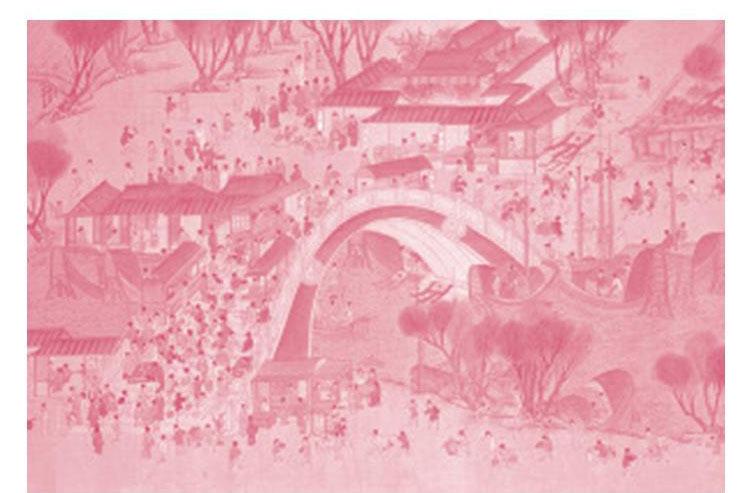
Along the River During the Qingming Festival was painted by Zhang Zeduan (1085–1145), a court artist of the North Song Dynasty (960–1127). The handscroll captures the rich scenery and natural landscapes along the shores of Bian River in the Northern Song capital Bianliang, which was located near modern-day Kaifeng in Henan Province.
Painted in light colors on silk and measuring 24.8cm × 528.7cm, the original work is now in the collection of the Palace Museum in Beijing.
Dwelling in the Fuchun Mountains
Dwelling in the Fuchun Mountains is one of the few surviving works by the painter Huang Gongwang (1269–1354). The painting is created based on the Fuchun rivers8 early autumn scenery. Huang made full use of the Chinese traditional techniques. The arrangement is a masterpiece of movement and stillness as well as density and expansiveness. The ink likewise ranges from extremely dry to moist, and the strokes also vary from centered brushwork to slanted.
Painted between 1348 and 1350, the Chinese landscape painting was burnt into two pieces in 1650. Today, one piece9 is kept in the Zhejiang Provincial Museum in Hangzhou, while the other piece10 is kept in the Taipei Palace Museum. The entire painting combined would measure 691.3 cm in length.
Spring Morning in the Han Palace
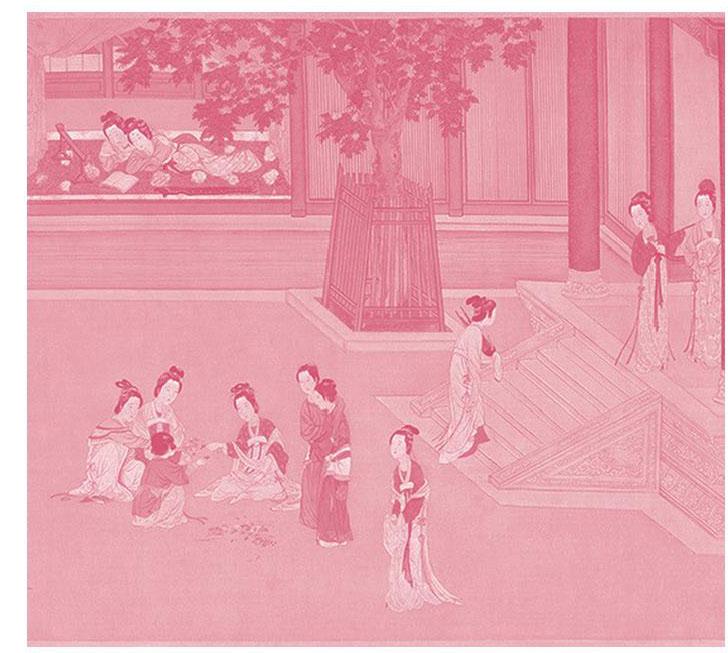
Created by the Ming Dynasty (1368–1644) painter Qiu Ying (ca. 1494–1552), Spring Morning in the Han Palace is a silk scroll painting noted for its bold use of colors. With a length of 574.1 centimeters and a width of 30.6 centimeters, it is considered very large relative to other similar decorative artwork. Qiu Ying is one representative painter in the Ming Dynasty, and is regarded as one of the Four Great Masters of the Ming Dynasty along with Shen Zhou (1427–1509), Wen Zhengming (1470–1559) and Tang Yin (1470–1523).
This long scroll is an imaginary representation of various activities in a Han Dynasty (206BC–220AD) palace on a spring morning. The intricate composition is rendered with crisp brushwork and beautiful colors. Trees and rocks decorate and punctuate the garden scenery of the lavish palace architecture, creating marvelous scenery similar to that of immortal realms. In addition to the groups of beauties, leisure activities of the literati, such as the zither, chess, calligraphy, and painting as well as appreciating antiquities and planting flowers are depicted, making it a masterpiece among Qiu Yings historical narrative paintings.
One Hundred Horses
One Hundred Horses was drawn by Lang Shining in the Qing Dynasty (1644–1911). Lang was a missionary from Italy with birth name Giuseppe Castiglione. Working as a court painter in China for over 50 years, his talent in painting was regarded highly by Chinese emperors Kangxi, Yongzheng and Qianlong. He helped to create a hybrid11 style that combined the Western realism with traditional Chinese composition12 and brushwork.
This paper painting, 813 cm long and 102 cm wide, captures 100 horses in various postures. They are kneeling, standing, frolicking, rolling, eating and running on the grassland—staying alone and among groups. The artwork is now preserved in the Taipei Palace Museum.
中國歷史悠久,國畫杰作眾多,價值連城。有些畫作在戰爭中損毀或遺失,但更多畫作傳世千年,現藏于國內外各大博物館。此處輯錄的是中國十大傳世名畫:
《洛神賦圖》
《洛神賦圖》為東晉(317—420)畫家和詩人顧愷之(約344—406)所作,絹本,長卷。這幅敘事畫卷乃據曹植(192—232)的《洛神賦》而作。有四件宋(960—1127)摹本傳世,分別藏于北京故宮博物院、遼寧省博物館和美國弗利爾美術館。
這幅古畫為長卷,需橫覽,繪曹植與洛神自邂逅定情到悵然分別的人神之戀。
《步輦圖》
《步輦圖》為唐代(618—907)頗受尊崇的人物畫家閻立本(601—673)所繪,以吐蕃王松贊干布(617—650)迎娶文成公主入藏為背景,描繪了吐蕃使臣祿東贊晉見唐太宗時的場景。此畫縱38.5厘米,橫129.6厘米,手卷,絹本設色,現藏北京故宮博物院。
《唐宮仕女圖》
《唐宮仕女圖》是張萱(713—755)、周昉(約730—800)所繪的一組畫。二人為唐代人物畫名家,當時仕女畫風行。
此畫繪宮廷仕女閑靜寥落的生活,人物優美、典雅、端莊。這組畫中最著名的四幅作品是張萱所作《虢國夫人游春圖》《搗練圖》以及周昉所作《簪花仕女圖》《揮扇仕女圖》。
張萱以工筆人物寫生見長,擅繪仕女、嬰兒和鞍馬。周昉繪畫遠師晉代的顧愷之,不求藻飾,注重細節,仕女造型以面容圓潤、體態豐腴為主要特征。
這組畫現藏于國內幾家博物館。
《五牛圖》
《五牛圖》為唐代著名畫家韓滉(723―787)所作,北京故宮博物院藏。
韓滉生于唐玄宗(685—762)開元年間,長安人,唐德宗(742—805)年間任宰相。
韓滉以人物、畜獸畫著稱,神態刻畫細致入微,對田家風俗和牛羊等家畜的描摹可謂曲盡其妙。
《五牛圖》縱20.8厘米,橫139.8厘米。顧名思義,畫的是五頭牛,畫面上沒有背景襯托。五頭牛一字排開,各具狀貌,姿態互異:或行,或立,或俯首,或昂頭。五牛瞳眸炯炯有神,性情各不相同:活潑、溫順、喧鬧甚或乖僻。
《韓熙載夜宴圖》
《韓熙載夜宴圖》為南唐(937—975)畫家顧閎中所作,再現了南唐大臣韓熙載夜宴賓客的歷史場景,描繪了宴會上主客揉雜、彈絲吹竹、清歌艷舞、調笑歡樂的場面,又刻畫了主人公超脫不羈、沉郁寡歡的復雜性格。現存宋摹本手卷,絹本設色,縱28.7厘米,橫335.5厘米,現藏于北京故宮博物院。
韓熙載(902—970),南唐文臣。他為了從復雜的政治局勢中脫身,消除后主李煜(937—978)對自己的猜忌,以聲色為韜晦之所,營造頹廢無為的假象。
顧閎中(910—980),五代十國(907—979)南唐畫家,任南唐畫院待詔。后主李煜派其潛入韓府偷看韓熙載夜宴的奢華場面。顧閎中目識心記,繪制出這幅名畫。
該敘事畫卷分為五段場景,即聽樂、觀舞、暫歇、清吹、散宴。作品描繪了40多個人物,造型準確精微,線條工細流暢,色彩絢麗清雅。
這幅畫不僅展現了韓熙載的個人生活,也反映了那個時代的多種風情。
《千里江山圖》
北宋政和三年(1113年),少年畫家王希孟繪制了《千里江山圖》。王希孟曾入畫學為生徒,工山水,得宋徽宗親授。他創作此畫時年僅18歲,20歲左右去世。
這幅畫的背景主要是金色,象征財富和皇權,彰顯了國家的榮耀。
畫卷縱51.5厘米,橫1191.5厘米,展現了秀美山川、非凡建筑、珍禽異獸、安居百姓。現藏于北京故宮博物院。
《清明上河圖》
《清明上河圖》,北宋(960—1127)宮廷畫師張擇端(1085—1145)所作。該手卷,反映了北宋都城東京汴梁(今河南開封附近)汴河兩岸的街市繁榮景象和自然風光。
原畫縱24.8厘米,橫528.7厘米,絹本淺色。現藏北京故宮博物院。
《富春山居圖》
《富春山居圖》為畫家黃公望(1269—1354)少數的存世作品之一。畫家充分利用水墨技法描繪了富春江一帶的初秋景色,山水布置動靜結合,疏密得當,墨色濃淡干濕并用,中鋒圓渾、側鋒峻峭,極富變化。
這幅山水畫作于元至正八年(1348年)到至正十年(1350年),清順治七年(1650年)曾遭火焚,斷為兩段。現分藏于浙江省博物館和臺北故宮博物院。兩段相加橫691.3厘米。
《漢宮春曉圖》
《漢宮春曉圖》是明代(1368—1644)畫家仇英(約1494—1552)的一幅絹本重彩仕女畫,縱30.6厘米,橫574.1厘米,就裝飾繪畫而言,堪稱巨制。仇英是明朝代表畫家,與沈周(1427—1509)、文征明(1470—1559)、唐寅(1470—1523)合稱“明四家”。
《漢宮春曉圖》以春日晨曦里的漢代(公元前206—公元220)宮廷為題,以長卷的形式描繪了宮闈的各種日常活動。構景繁復,用筆清勁,賦色妍雅,林木、奇石與華麗的宮闕穿插掩映,鋪陳出宛如仙境般的瑰麗景象。除卻美女群像之外,復融入琴棋書畫、鑒古、蒔花等文人式的休閑活動,實為仇英歷史故事畫中的精彩之作。
《百駿圖》
《百駿圖》,清(1644—1911)郎世寧所繪。郎世寧,意大利傳教士,原名朱塞佩·伽斯底里奧內。郎世寧任宮廷畫師五十多年,畫才深得康熙、雍正、乾隆贊許。他將西洋現實主義手法與中國傳統構圖和筆法相融合,開創了一種中西雜糅風格。
《百駿圖》,紙質稿本,縱102厘米,橫813厘米。此圖共繪有100匹駿馬,在草地上或跪或立,嬉鬧翻滾,覓食奔跑,聚散不一,姿勢各異。現藏臺北故宮博物院。
(譯者為“《英語世界》杯”翻譯大賽獲獎者)