
HIGH ON THE HOG
2020-08-14 10:05:37
漢語世界(The World of Chinese) 2020年4期


Chinas growing appetite for meat threatens public health and the environment
As a child, Mrs. Li and her siblings used to dream of meat, but would be lucky to have it once a week, or even once a month. “Sometimes, we had to rely on begging for steamed buns to survive…we were malnourished, so I was very skinny.”
Nowadays, the 45-year-old from Henan province, like many in her city, works in a meat processing plant; she sees the stuff every day, and eats it on most days too, without thinking twice about the cost.
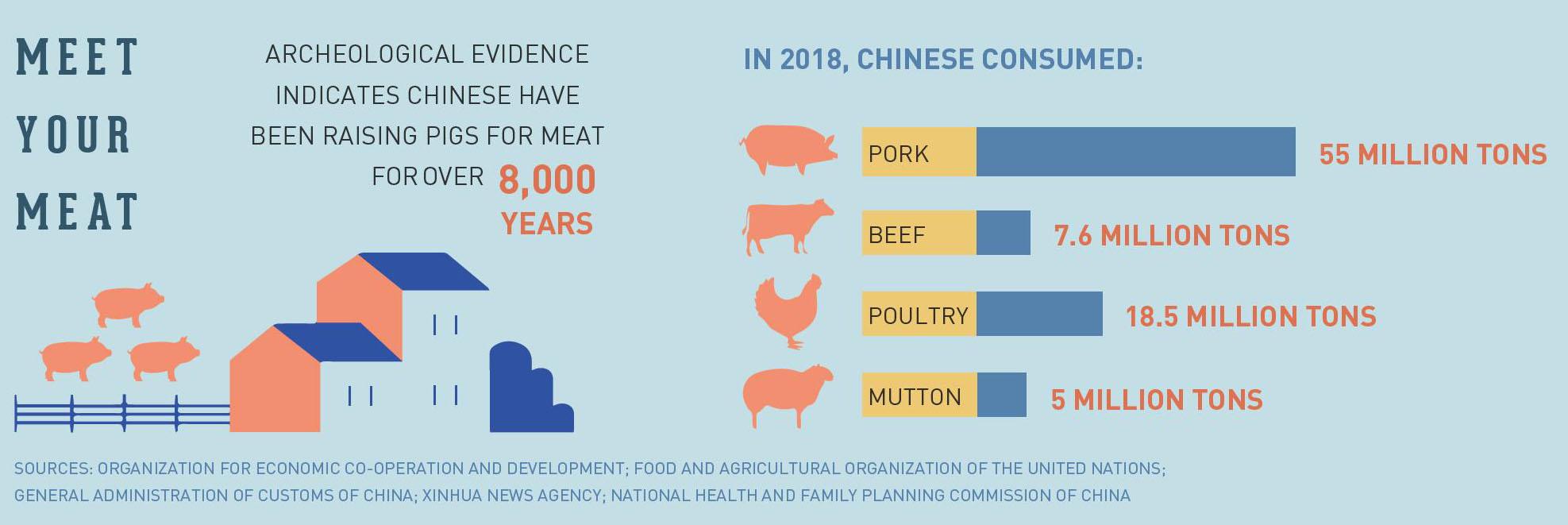
For much of Chinas history, meat has been off the menu, a luxury reserved for the elite and for special celebrations. But along with economic development, meat has become an everyday staple. In 1961, the average Chinese ate 4 kilograms of meat per year; by 2013, that figure was closer to 60 kilograms.
China has now become both the largest consumer and the largest producer of meat in the world. While this huge increase is a symptom of Chinas growing wealth, and a positive sign that hunger and deprivation no longer exist for the majority of the population, the explosion in supply and demand has created vast challenges for health care, the environment, and disease management.
For the older generations, it is the memory of past scarcity that drives current consumption habits, according to Peter Li (no relation to Mrs. Li), associate professor of East Asian politics at the University of Houston. They are “consuming meat as if it were their last meal to compensate themselves for the meat and food deprivation they went through,” he tells TWOC. “To these folks, aged 55 and older, a good life is a life with meat on the dinner table.”
That sentiment was evident in 2019 when WildAid, an American NGO, partnered with prominent Chinese celebrities in a campaign to encourage people to reduce their meat intake to protect the environment and improve their health. “Chinese people have only just begun to have enough to eat, and now were being told its not healthy and not good for the environment!” one Weibo user complained. Other users noted that Chinas per capita meat consumption still falls well behind that of the US (over 90 kilograms per year).
The ready availability of meat today is unprecedented in China, as in the rest of the world. Livestock breeding goes back at least 7,000 years, but “from a historical perspective, Chinese people made vegetables the main part of their diet,” says Dr. Xiao Changjiang, head of the cardiovascular department at the Hunan Academy of Traditional Chinese Medicine Affiliated Hospital. Dr. Xiao argues that ancient texts such as the Han dynasty (206 – 220) Yellow Emperors Classic of Internal Medicine ?encourage the consumption of grains, vegetables, and fruit. Other records from the period indicate that the consumption of meat was prohibited except at specific events, such as religious rituals.
Meat eating slowly became more common, and after the fall of the Mongol Yuan dynasty (1206 – 1368), pork outstripped mutton as the most common meat found on Chinese tables. Imperial records suggest that around 100,000 pigs were slaughtered in Beijing at Spring Festival each year during the Qing dynasty (1616 – 1911). By 1980, pork represented 95 percent of total meat consumption in China, and had come to occupy an important place in Chinese hearts and stomachs.
Now, the problem is how to get around 50 kilograms of meat every year to each of Chinas 1.4 billion people safely and cheaply. This is a matter of vital importance to the government, which since 2007 has kept a strategic reserve of frozen pork; no other nation has such a policy.
Food safety is a perennial concern for Chinas meat industry. One of the most notorious incidents in recent memory involved 16,000 dead pigs found floating down the Huangpu River into Shanghai in 2013. In 2014, expired meat products were supplied to fast food chains, including McDonalds.
Multiple incidents of farmers pumping live animals with water to inflate their weight have been documented; an undercover reporter for state broadcaster CCTV filmed the practice in Hunan in 2017. Mrs. Li claims that some imported meat at her factory appears to be rotten by the time it arrives, but “after it is processed, you cant tell…I dont let my children eat it,” she says.
“Food security is no longer an issue, but food safety problems are staggering,” says Professor Li. Disease is another major concern. An outbreak of avian flu in February this year saw thousands of birds culled in Hubei and Hunan provinces. Foot-and-mouth disease outbreaks have been reported since 2005, with one as recently as April 2019.
China is still battling an outbreak of African Swine Fever (ASF), which has resulted in the death of perhaps half of the countrys pig population (around 200 million hogs) through infection and culling. Reports of farmers sending diseased meat to market flooded the internet, while local authorities were accused of hiding outbreaks, and gangs of selling fake vaccines. More hogs have washed up in rivers—including 50 at a nature park in Guangxi, amid concerns that infected pigs are not being properly disposed of according to the law.
The sudden drop in supply led to skyrocketing prices, up to 110 percent higher in November 2019 than the same period in the previous year, according to the National Bureau of Statistics. QiuHuaji, who leads swine infectious diseases research at the Academy of Agricultural Sciences Harbin Research Institute, told an industry meeting in April 2019 that although ASF hadnt killed any humans, “the political, social, and economic effects are no less than a war.”
Trouble with supply is matched by growing government and societal concern about increased demand. Chinese rates of obesity and other chronic diseases linked to meat eating are on the rise, though still below numbers in most of the Western world. Chinese government statistics from 2015 show around 30 percent of Chinas population is overweight, and 12 percent is obese, compared with an obesity rate of around 40 percent in the US. The prevalence of heart disease in China increased by 15 percent between 1990 and 2016, with 9.4 million instances of the condition in 2016.
“Ive been doing constant surgery since 11 this morning, all of it heart surgery,” Dr. Xiao tells TWOC on a weekday evening. “Forty years ago, chronic diseases like heart disease, diabetes, cancer, were all very uncommon.” He believes the Chinese diet needs to return to its ancient roots. “Health isnt only a medical problem, its a cultural problem…I think we need to encourage people to study traditional eating culture, traditional nutrition.”
The government, too, has encouraged citizens to eat less red meat, recommending between 40 and 75 grams a day (about half of the average consumption at present) in dietary guidelines released in 2016. The central governments “Healthy China 2030” project seeks to reduce the rate of diabetes, obesity, and salt consumption, and raise life expectancy.
Meat consumption is also a growing problem for the environment. Waste from livestock farming results in the pollution of soil and rivers. In 2018, a government review of poultry and livestock facilities in Heilongjiang concluded that just 47 percent of the provinces farms had adequate waste treatment capabilities.
A shift in tastes from pork to beef is likely to see the carbon footprint of Chinese meat consumption rise. Though pigs remain Chinas favorite meat, beef eating has risen over seven times since 1990, and raising cattle produces five times more greenhouse gases and takes up far more land than raising pigs.
Chinas overall meat consumption may actually be plateauing. While animal welfare and environmental concerns around livestock farming remain fringe issues, Chinese are increasingly wary of health problems. A survey in 2017 of urban residents showed 39 percent reported reducing their meat intake in the previous year.
Mrs Li has not been turned vegetarian by working in her factorys slaughtering team for 18 years, but she would still like to reduce her intake, despite her memories of past starvation: “In the past, the few occasions when we ate meat were an improvement to our lives; now eating more meat is worse than eating less. Eating too much isnt healthy.”
– SAM DAVIES; ADDITIONAL REPORTING
byJiacheng li
 漢語世界(The World of Chinese)2020年4期
- 漢語世界(The World of Chinese)的其它文章
- HAPPY TROUBLE
- HYPER INFLATED
- 光影
- YOU’VE GOT QUESTIONS? SHE’S GOT ANSWERS
- 吃
- TECHNO BABBLE