基于屬性約簡—光滑支持向量機的中小企業信息化評價研究
2020-07-27 16:11:35戴強
軟件工程 2020年7期
戴強
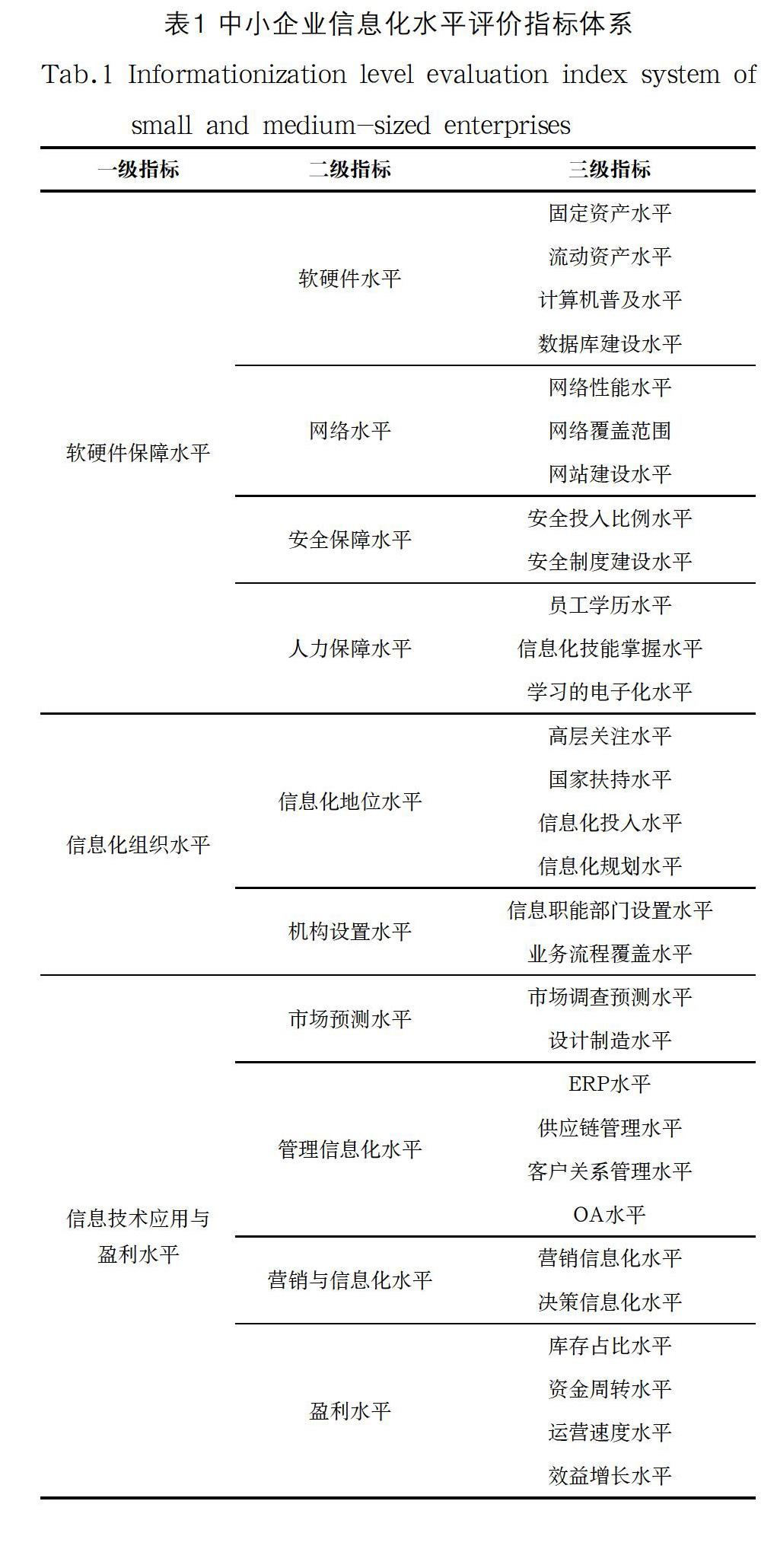
摘? 要:本文以企業信息化的軟硬件保障水平、信息化組織水平、信息技術應用與盈利水平、信息化能力水平四個角度建立中小企業信息化評價體系,應用粗集的屬性約簡理論對指標進行約簡,同時構建了一個二階分段光滑函數支持向量機模型,利用光滑支持向量機對企業的信息化水平進行了評價,最后,通過具體實例進行實證分析,以證明方法的有效性。
關鍵詞:企業信息化;光滑支持向量機;屬性約簡
中圖分類號:TP301? ? ?文獻標識碼:A
Abstract: In this research, the information evaluation system for SMEs is established from the four perspectives of enterprise informationization: software and hardware security level, information organization level, information technology application and profit level, and the informationization level. Through applying the attribute reduction theory of rough set to the index and meanwhile constructing the second-order piecewise smooth function support vector machine model, the informationization level of the enterprises is evaluated with the smooth support vector machine. Finally, the method is proved to be effective through the empirical analysis of the real cases.
Keywords: enterprise informationization; smooth support vector machine; attribute reduction
1? ?引言(Introduction)
隨著大數據、邊緣計算、物聯網、區塊鏈等技術的快速發展,企業的信息化數據呈幾何趨勢增長,根據互聯網數據中心預測,2020年全球企業信息化的數據量將達到35ZB[1]。2016年大數據產業峰會4月27日到28日舉行[2],在工業和信息化部的指導下,中國信息通信研究院和數據中心聯盟面向企業和政府部門征集大數據在政府及相關部門應用的優秀技術成果和案例,形成政府大數據應用領域的優秀案例匯編。總之,在大數據時代背景下,中小企業信息化水平影響著中小企業的健康發展,然而企業的信息化建設需要投入大量的前期成本,信息化投入的成本能否給中小企業帶來效益還是未知[3],因此對中小企業信息化水平進行有效地評估顯得尤為重要。
支持向量機(Support Vector Machine,SVM)是人工智能算法一個較新的研究成果[4-7],其應用的領域越來越廣泛,SVM的優點是在處理小樣本數據時克服了神經網絡的過擬合、易入局部極小的問題[8-10]。然而SVM在數據輸入訓練時,其分類和預測的光滑性略顯不足,同時其不能智能的確定輸入的訓練數據的冗余性,這樣就增加了計算運行的復雜度,而粗糙集的屬性約簡可以有效地降低輸入數據中的噪聲[11],降低輸入數據的冗余性。因此,構造一個二階分段光滑函數,增強支持向量機的非凸分類和預測性能,將光滑支持向量機智能算法與粗糙集屬性約簡聯合是互補的,將屬性約簡后的訓練指標數據輸入到光滑支持向量機中進行訓練學習,然后對測試樣本進行預測或評價,這樣在消除冗余信息減少光滑支持向量機的學習與預測復雜度的同時,提高了光滑支持向量機的精度。因此,本文應用屬性約簡—光滑支持向量機算法對中小企業信息化水平評價進行了研究。
2? 屬性約簡—光滑支持向量機模型構建 (Attribute reduction-construction of smooth support vector machine model)
2.1? ?模型構建描述
本文的屬性約簡—光滑支持向量機聯合評價模型主要是應用在中小企業信息化水平評價上,因此構建模型的基本思路是:第一步應用粗糙集的屬性約簡剔除光滑支持向量機輸入的指標數據進行有效地去噪處理,將約簡得到的核心屬性指標數據分為訓練樣本和預測樣本送進光滑支持向量機進行學習與預測,進而進行有效地評價。
4? ?結論 (Conclusion)
本文依據中小企業的信息化指標體系,設計了一種基于屬性約簡—光滑支持向量機的評價模型,通過實例分析,本文算法對中小企業的信息化評價是客觀有效地,與比BP神經網的評價效果相比,本文算法更加準確和簡便。因此在信息化飛速發展的背景下,本文的研究方法在理論和實際應用中都具有重要的意義。
參考文獻(References)
[1] 馬立川,裴慶祺,冷昊,等.大數據安全研究概述[J].無線電通信技術,2015,41(1):01-07.
[2] 數博會組委會.2016中國大數據產業峰會暨中國電子商務創新發展峰會[J].中國信息安全,2016(5):4.
[3] 李國杰,程學旗.大數據研究:未來科技及經濟社會發展的重大戰略領域—大數據的研究現狀與科學思考[J].中國科學院院刊,2012,27(6):647-657.
[4] Saunders C, Stitson M O, Weston J, et al. Support vector machine[J]. 2002, 1(4): 1-28.
[5] Lin K C, Chien H Y. CSO-based feature selection and parameter optimization for support vector machine[C]. Pervasive Computing. DOI:10.1109/JCPC.2009.5420080.
[6] Shalev Shwartz S, Singer Y, Srebro N, et al. Pegasos: primal estimated sub-gradient solver for SVM[J]. Mathematical Programming, 2011, 127(1): 3-30.
[7] Shom Prasad Das, Sudarsan Pa dhy. A novel hybrid model using teaching learning based optimization and a support vector machine for commodity futures index forecasting[J]. International Journal of Machine Learning & Cybernetics, 2018, 9(1): 97-111.
[8] Yang Z, Lin H Y. A protein-protein interaction extractor for biomedical literature using SVM and rich feature sets [J]. Journal of Biomedical Informatics, 2010, 43(1): 88-96.
[9] Biswajeet Pradhan. A comparative study on the predictive ability of the decision tree, support vector machine and neuro fuzzy models in landslide susceptibility mapping using GIS [J]. Computers & Geosciences, 2012, 51(2): 350-365.
[10] Qian H, Mao Y, Xiang W, et al. Recognition of human activities using SVM multiclass classifier[J]. Pattern Recognition Letters, 2010, 31(2): 100-111.
[11] 謝宏,程浩忠,牛東曉,等.基于信息熵的粗糙集連續屬性離散化算法[J]. 計算機學報,2005,28(9):1570-1574.
[12] Dun Liu, Tianrui Li, Junbo Zhang. A rough set based incremental approach for learning knowledge in dynamic incomplete information systems[J]. International Journal of Approximate Reasoning, 2014, 55(9): 1764-1786.
[13] Siyuan Jing. A hybrid genetic algorithm for feature subset selection in rough set theory[J]. Soft Computing, 2013, 18(7): 1373-1382.
[14] Richard Jensen, Andrew Tuson. Finding rough and fuzzy rough set reducts with SAT[J]. Information Sciences, 2014, 255: 100-120.
[15] Phophalia A, Rajwade A, Mitra S K. Rough set based image denoising for brain MR images[J]. signal processing, 2014, 103(10): 24-35.
[16] Burges C. A tutorial on support vector machines for pattern recognition[J]. Data Mining and Knowledge Discovery, 1998, 2(2): 121-167.
[17] Lee Y J, Hsieh W F, Huang C M. A smooth support vector machine for epsilon insensitive regression [J]. IEEE Transactions on Knowledge & Data Engineering, 2005, 17(5): 678-685.
[18] 袁玉波,嚴杰,徐成賢,等.多項式光滑的支撐向量機[J].計算機學報,2005,28(1):9-17.
[19] Wu Q. A new class of piecewise smooth support vector regressions[J]. Journal of Information Science Engineering,? 2015, 31(5): 1813-1828.
[20] Qing Wu, Bo Li, Wa Wang, et al. Face recognition method based on multi-class classification of smooth support vector machine[J]. Journal of Computer Applications, 2015, 19(5): 688-696.
[21] 肖素梅,殷國富,汪永超,等.企業信息化水平評價指標與評價方法研究[J]. 計算機集成制造系統,2005(08):106-114.
[22] 何永琴,王燕嘉,毛文靜,等.中小企業信息化水平調查研究[J].內蒙古財經大學學報,2015(2):60-67.
[23] 李鵬飛.制造企業信息化水平的評價研究[D].青島:中國海洋大學,2013.
[24] 李鋼,田麗娜,齊二石,等.基于BP神經網絡和遺傳算法的企業信息化評價研究[J].科技進步與對策,2018,25(5):129-132.
作者簡介:
戴? ?強(1972-),男,本科,工程師.研究領域:人工智能,信息化評估.