
Resumption of production in the industry is generally stable,and the foreign trade situation is becoming severe
2020-06-09 12:03:20
China Textile 2020年4期
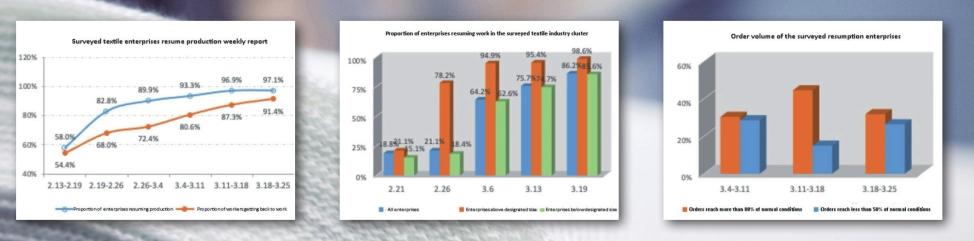
In order to better understand the direct impact of the COVID-19 pandemic on the production and operation of the textile industry, CNTAC launched a weekly survey on the production resumption of textile enterprises. The report on the production resumption of textile enterprises in the week of March 18 -25 is as follows for industry reference.
The situation of resumption and production of textile enterprises is generally stable, and the situation of resumption of small and micro enterprises has further improved.
According to the survey results of the weekly return to work report, from 12:00 on March 18 to 12:00 on March 25, a total of 245 enterprises submitted valid reinstatement data through an online questionnaire, and the proportion of work resumption enterprises reached 97.1%, a slight increase of 0.2 percentage points from the survey result of the previous week; the number of workers getting back to work in 238 enterprises that have resumed work reached 301,000, accounting for 91.4% of the total number of workers under normal circumstances, an increase of 4.1 percentage points from the survey result of the previous week. Enterprises in Hubei, Xinjiang and other regions that were previously affected by the pandemic situation and delayed resumption of work have begun to resume work and production.
The Cluster Office and the Park Office of CNTAC conducted a survey of 28 key textile industrial clusters in 13 provinces across the country. As of 15:00 on March 19, a total of 66,000 textile enterprises have resumed production in the above clusters, accounting for 86.2% of the total number of cluster enterprises, an increase of 11.2 percentage points from the survey data a week ago; the number of workers getting back to work reached 1.561 million, accounting for 71.5% of the total number of workers under normal circumstances, an increase of 12.5 percentage points from the survey data a week ago. Among the 3,942 enterprises above designated size in the cluster, the proportion of enterprises that have resumed work has reached 98.6%, and the proportion of workers who have resumed work has reached 81.6%, which are 3.2 and 10 percentage points higher than the survey data last week.
The resumption of production of small and micro enterprises continued to improve. Within the 28 key industry clusters, a total of 62,000 enterprises below designated size have resumed work, accounting for 85.6% of the total number of enterprises below designated size in the cluster, which is an in- crease of 10.9 percentage points from the survey data a week ago; the number of workers getting back to work reached 932,000, accounting for 66% of the number of workers under normal circumstances, an increase of 14.7 percentage points from the survey data a week ago.
The coordination efficiency of the industrial chain has been steadily improved, and the start-up load of enterprises has remained stable.
At this stage, the progress of the resumption of production in the textile industry chain is basically synchronized, and the overall efficiency of the coordinated operation of the entire industry chain is improving. According to the survey data of the weekly report, the percentage of resuming work in the cotton spinning and chemical fiber industry in the upstream of the textile industry chain, and in the midstream and downstream filament weaving, dyeing and printing, and knitting industries has reached more than 95%, and the rate of workers getting back to work has increased to more than 90%. According to the survey data of the CNTAC on key industry clusters, among the 40,000 enterprises in Dongguan, Nantong, Changshu, Haining and other clothing and home textile industry clusters with complete information, the proportion of enterprises that have resumed work has reached 84.4%, 9.5 percentage points higher than the previous weeks survey; among them, the proportion of enterprises above designated size that resumed work has reached 98.8%.
The operating load of enterprises remained stable. According to the survey data from the CNTAC weekly report, among the 242 resumed enterprises that effectively filled out the situation of their production capacity in the questionnaire, 60.3% of the enterprises have reached 80% of the capacity utilization rate, which is basically the same as the ratio of one week ago. The proportion of surveyed enterprises with a capacity utilization rate of less than 50% was 10.3%, a decrease of 3.7 percentage points from the survey a week ago.
Affected by the global spread of the pandemic, the level of corporate orders has fallen, and export enterprises have been required to postpone delivery or cancel orders.
A week ago, orders from textile enterprises showed signs of improvement, but this trend has changed this week. Affected by the global spread of the COVID-19 pandemic, the developed countries such as the U.S. and Europe have shut down businesses on a large scale, and many export enterprises encountered overseas customers chargebacks and rejections, and the textile industrys export situation became more severe.
According to the China Cotton Textile Associations survey of more than 120 key enterprises from March 16 to 20, 35% of the surveyed enterprises reported insufficient orders, an increase of 12.1 percentage points from the survey a week ago.
According to the survey data of the CNTACs weekly report, among the 242 resumed enterprises that effectively filled out the situation of their orders in the questionnaire this week, the proportion of enterprises that reached 80% of their normal orders was 31.8%, a 12.8 percentage point decrease from the survey a week ago; the proportion of the surveyed enterprises that were less than 50% increased to 26.4%, which was an increase of 11.4 percentage points from the survey a week ago. At 12:00 noon on March 22, the weekly report increased the investigation of cancellation of orders. As of 12:00 on March 25, 37% of the enterprises surveyed reported that they had encountered orders cancelled by customers.
Insufficient orders and poor sales are the outstanding difficulties facing enterprises today. Under the severe situation of global pandemic prevention and control, it is recommended that enterprises carefully arrange production and actively prevent and control the risks of the capital chain.
With the improvement of the domestic pandemic prevention and control situation, the most prominent problems in the early stage of the resumption of work, such as the difficulty of workers getting back to work and poor logistics, have been greatly eased. Insufficient orders has become the first difficulty faced by enterprises in production and operation. According to the weekly work resumption report and cluster survey results, 57% of enterprises and 75.9% of industrial clusters reported that there were insufficient orders. In addition, as the pandemic situation has not ended, business entities have not fully resumed normal operations, and the passenger flow is also significantly less than normal. Poor sales channels are an important issue for domestic enterprises at this stage. In addition to declining orders for export enterprises, there are also cases where goods are stranded or refused to be received overseas, increasing the cost burden.
CNTAC carefully compiled the policy requirements of the enterprises, and put forward to the relevant government departments policies and measures to strengthen financial support, effectively reduce the burden on enterprises, start domestic demand consumption as soon as possible, and support export enterprises to overcome difficulties.
At present, although the domestic pandemic prevention and control situation is steadily improving, the global pandemic prevention and control situation is extremely severe and is expected to continue for a long time. The international market has declined significantly, and there is a high degree of uncertainty on the impact on the domestic textile supply chain. Recently, due to the cancellation of orders, many textile enterprises have experienced a sudden increase in inventory and a tight capital chain. It is recommended that enterprises make predictions in accordance with the overall tight market situation in the first half of the year, reasonably plan production and operation strategies, carefully arrange production load, raw material inventory, and investment projects, vigorously prevent and control capital chain risks, and strive to maintain low-speed and stable operation.
- China Textile的其它文章
- aining China International Home Textiles Cloud Expo goes live this year,launching a new“cloud”model
- Strike hard to maintain the order of the melt blown nonwovens market
- A 500K Ton/Year PET Project Breaks Ground in Korla,Bayingol Mongolia of Xinjiang
- A Glimpse of Industrial Park in Xinjiang amid Virus Fighting
- From January to March,the profits of industrial enterprises above designated size decreased by 36.7%
- Manmade fiber industry hit hard with profits fallout by 75%