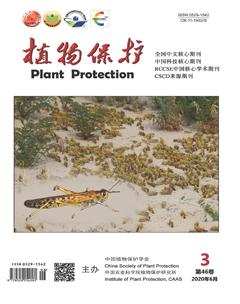
沙漠蝗生物學特性及防治技術研究進展
2020-06-08 10:55:23涂雄兵李霜杜桂林潘凡徐超民陳俊王卓然楊智張澤華
植物保護 2020年3期
涂雄兵 李霜 杜桂林 潘凡 徐超民 陳俊 王卓然 楊智 張澤華

摘要? 歷史記載中,沙漠蝗Schistocerca gregaria(Forsk.,1775)主要在北非發生,對當地農作物構成嚴重威脅。大規模發生時,可向西亞等地繼續擴散為害。2020年初沙漠蝗在巴基斯坦、印度大量發生,肆虐為害,對糧食安全和生態安全構成了嚴重威脅。因其具有遷飛性,周邊多個國家面臨重大入侵風險。因本次沙漠蝗發生規模與破壞程度堪比1985年非洲蝗災,2020年2月11日,聯合國糧農組織(FAO)向全球發布預警:“高度戒備正在肆虐的蝗災,防止被入侵國家出現糧食危機”。本文介紹了沙漠蝗分類地位、形態學特征,概述了沙漠蝗生物學特性、監測預警與防治技術研究進展,為科學防控沙漠蝗提供理論支撐。
關鍵詞? 沙漠蝗; 入侵風險; 綜合防治
中圖分類號: S 433.2
文獻標識碼: A
DOI: 10.16688/j.zwbh.2020204
Abstract
Schistocerca gregaria has been recorded to occur mainly in North Africa, posing a serious threat to local crops. When occurring on a large scale, it might spread to Western Asia and other places. At the beginning of 2020, S.gregaria ravaged Pakistan and India due to its migration, threatening food security and ecological security in many countries. The scale and destruction of S.gregaria this year was comparable to the African locust plague of 1985. On February 11, 2020, Food and Agriculture Organization (FAO) issued an alert:“high alert for an ongoing plague of desert locusts to prevent food crisis in the invaded countries”. Here, we summarized the classification status, morphological and biological characteristics, and the research progresses in monitoring and sustainable management methods of desert locust, helping to provide effective measures to defeat this notorious pest.
Key words
Schistocerca gregaria; potential invasion risk; sustainable management
根據歷史記載,蝗蟲造成了周期性的人類災難[1]。直到今天,蝗災仍是世界農牧業生產的重大威脅[23]。沙漠蝗Schistocerca gregaria(Forsk.,1775)是發生最為嚴重的蝗蟲之一,據報道,公元前2800年烏干達語中就有沙漠蝗的記載[4]。公元2世紀以來,沙漠蝗幾乎連年發生[4]。20世紀以來,沙漠蝗大規模暴發15次,波及非洲和亞洲3 000萬km2農田和草原,影響65個國家8.5億人口的生活 [57]。2020年初沙漠蝗在巴基斯坦、印度肆虐為害,威脅多個國家糧食安全和生態安全[8]。據報道,沙漠蝗直接跨越喜馬拉雅山脈進入我國的可能性較小,但是如果5-7月份西風急流和印度洋暖濕氣流強勁,沙漠蝗仍然存在入侵我國的可能,進而對我國的農牧業生產構成嚴重威脅[9]。因此,了解沙漠蝗分類地位、分布與為害,掌握其形態特征,摸清其生物學特性,是開展沙漠蝗監測與防治工作的前提和基礎。本文概述了沙漠蝗分布與為害、生物學特性,綜述了近年來沙漠蝗監測與防治工作進展,為科學防治提供理論支撐。
1 形態特征
1.1 分類地位
沙漠蝗Schistocerca gregaria(Forsk.,1775)為直翅目Orthoptera,蝗亞目Caelifera,蝗總科Acridoidea,斑腿蝗科Catantopidae,刺胸蝗亞科Cyrtacanthacridinae,沙漠蝗屬Schistocerca[1012]昆蟲。沙漠蝗1775年由德國分類學家Forskl定名為Gryllus gregarious,1804年Olivier定名的 Acridium peregrinum為其同物異名[10]。1838年Bureister將采自非洲南部的標本定名為Acridium flaviventre,1979年Jago將其定為沙漠蝗的亞種[13]。1873年Stl建立了沙漠蝗屬Schistocerca,并把沙漠蝗移到該屬。1910年Kirby完成了系統的蝗蟲分類工作,并建立了刺胸蝗亞科,將沙漠蝗屬分類到該亞科[12]。Krauss曾在其論文中詳細記載了Forskl和Olivier關于沙漠蝗的定名工作,但Kirby 忽略了前人的工作,誤認為Gryllus talarieus L.就是沙漠蝗。1923年俄國分類學家Uvarov發現了這個錯誤并將其訂正為Schistocerca gregaria (Forsk.,1775)[14],該學名一直沿用至今。1979年Jago將沙漠蝗分為兩個亞種 Schistocerca gregaria gregaria (Forskl 1775) 和Schistocerca gregaria flaviventris (Burmeister 1838) [13]。
1.2 沙漠蝗屬特征
沙漠蝗屬Schistocerca主要形態學特征為:雄蟲下生殖板雙葉狀,其裂片明顯突出。該屬體色多變是其分類困難的原因之一。其余特征還包括:頭部有明顯的顳凹;顏頂角略微隆起,溝前區寬度略等于溝后區寬度,形成一個圓角;背面有條紋,從頭部延伸到前胸端部;具復眼,單眼內側的額脊寬;前胸較發達,有的種可見3個橫溝;前胸腹板直,完全不向中胸腹板傾斜,分布有刺,中胸腹板的側裂片長小于或等于寬。前翅可延伸到腹部末端甚至更長,翅脈清晰可見,不密集,多數種前翅上布有斑紋;前翅翅基端部圓形或斜圓形,末端支脈部分垂直于主脈;有的種有較長的后翅。后足發達,股節基部短寬,端部窄長,脛節基部強烈側向收縮,不同種類后足脛節顏色不同,脛節內外側均密被剛毛[12,15]。
1.3 沙漠蝗形態特征
雄蟲體長45.8~55.3 mm,雌蟲體長50.7~61.0 mm。雌蟲形態近似雄蟲,體型粗大,頭頂短于前胸背板,略凹陷;復眼大,卵形;觸角到達或超過前胸背板的后緣;前胸腹板突圓錐狀,直或微后傾,背板溝前區在群居型甚縮狹,具小刻點,中隆線不明顯,后緣呈寬圓形,而散居型溝前區略縮狹,具粗刻點,中隆線明顯,后緣近90°,略圓;中胸腹板側葉狹長,后角明顯向內傾斜成銳角;側葉間的中隔呈梯形,中隔的長度明顯大于其最狹處;后胸腹板側葉略分開或毗連;前、后翅狹長,明顯超過后足股節的端部,長約為寬的5~5.5倍;后足股節細長,其長度為其寬度的5~5.6倍。后足脛節無外端刺,外緣具刺9~10個,內緣具刺10~11個[10,16]。
2 分布與為害
2.1 分布
沙漠蝗主要分布在沙漠灌叢地區,包括薩赫勒地區、阿拉伯半島、西亞部分地區及印度西部[1718]。沙漠蝗猖獗發生時,每天可隨氣流飛行150~200 km[6,1920]。通常情況下,入侵擴散可由非洲的西部、北部遷飛擴散到非洲中東部和亞洲西南部等地區,有時還可以從非洲遷飛到葡萄牙的馬德拉群島和西班牙的加那利群島[21],波及65個國家的全部或部分地區[15]。而當沙漠蝗蝗群處于衰退期,即平靜期時,沙漠蝗通常局限于非洲西北部、中東及西南亞的半干旱和干旱沙漠,尤其是年降雨量不超過200 mm的地區,該地區面積約1 600萬km2,近30個國家受害[15]。
2.2 食性與棲境
沙漠蝗為雜食性昆蟲,可取食300多種植物[6],包括一年生紫草科Boraginaceae天芥菜屬Heliotropium,禾本科Gramineae狼尾草屬Pennisetum、黍屬Panicum,大戟科Euphorbiaceae沙戟屬Chrozophora,蒺藜科 Zygophyllaceae蒺藜屬Tribulus等4個科5個屬植物[2223],以及多年生禾本科賴草屬Leymus、羊茅屬Festuca、狼尾草屬Pennisetum,大戟科大戟屬Euphorbia,豆科Leguminosae苜蓿屬Medicago,莧科 Amaranthaceae白花莧屬Aerva等4個科6個屬植物[16,2224]。決定沙漠蝗食性的主要因子是植物次生代謝物,如沙漠蝗對黃酮含量高的植物具有偏好性[25]。但會拒食一些苦味的植物,如常春藤Hedera nepalensis var. sinensis (Tobl.) Rehd等[26]。同時,開闊的草原植被中,裸露地面為沙漠蝗創造了理想的繁殖場所[2728]。在夏季,巴基斯坦、伊朗和印度等地的蝗蟲往往集中暴發于有成片裸露地面的沙丘頂部和斜坡上,而在冬季和春季,沙漠蝗喜歡在低覆蓋的開放草原植被周邊區域大量繁殖[27]。
2.3 為害
遷飛擴散為害是沙漠蝗造成重大損失的重要原因。1967年4-5月沙漠蝗在阿拉伯半島西南部大暴發,擴散為害至紅海沿岸國家,至1969年中結束,3年間成功繁衍了7代,大規模發生了5次,僅第5代沙漠蝗(1968年4月)為害面積就達10萬km2[29]。1986年-1989年沙漠蝗蝗災造成毛里塔尼亞近300萬hm2遭受為害,政府耗資約2億美元用于開展防治工作[30]。2003年-2005年大規模沙漠蝗災,使得西非、北非及非洲中東部多個國家受到影響,引起了FAO高度重視[20];這次蝗災導致整個薩赫勒地區800多萬人遭受糧食危機,除直接經濟損失外,蝗災還造成了嚴重的社會影響,據調查,2004年馬里受災地區出生兒童的身高較未受災地區出生兒童的身高明顯降低[31]。2019年5月開始的沙漠蝗災至今仍未停息,為害區域遍布非洲、亞洲,使得巴基斯坦、索馬里、埃塞俄比亞、肯尼亞等國家和地區宣布進入緊急狀態,聯合國糧農組織呼吁全球高度重視此次蝗災,并計劃籌集約7 600萬美元來阻止蝗災進一步擴散蔓延[32]。
3 生物學特性
3.1 生活史
沙漠蝗為不完全變態昆蟲,分為卵、蝗蝻和成蟲3個階段,蝗蝻有5個齡期,成蟲有兩種類型:一種為散居型,呈灰黃色或灰色,即在低密度條件下,蝗蟲多以散居型出現,相對不活躍;另一種為群居型,呈鮮黃色或黑色,更加活躍。當散居型沙漠蝗密度較高時,個體間的身體接觸會刺激其向群居型轉變[3335]。
散居型雌成蟲每頭可產卵200~300粒,群居型可產95~158粒。蝗卵通常產在10~15 cm深的濕潤沙土中,每頭雌成蟲平均可產卵2~3次,一般間隔6~11 d左右。產下的卵被一種分泌物結合在一起,形成一個卵莢,長約3~4 cm。蝗卵最高密度可達5 000~6 000塊/m2[6,16]。蝗卵一般在2周后開始孵化,蝗蝻分為5個齡期,最快在25 d后羽化,成蟲至少需要3周才能性成熟,并開始交配產卵。成蟲存活時間為2.5~5個月,主要取決于天氣和環境條件,且性成熟越早,壽命就越短[29,36]。一般而言,不同區域沙漠蝗每年可發生1~4代[18]。例如,1967年在沙特阿拉伯沙漠蝗一年可發生3代[29]。
3.2 發生規律
沙漠蝗無滯育現象[3739]。在非洲,每年3月、7月和10月上旬是沙漠蝗卵孵化盛期;每年5-6月、11月,受氣流影響,成蟲可遠距離遷飛擴散為害。若遭遇不利條件,如低溫,沙漠蝗發育較慢,羽化后成蟲到產卵可能需要長達6個月的發育時間[18]。
3.3 遷飛規律
沙漠蝗具備很強的遷飛能力,每年夏季從紅海經阿拉伯半島遷飛至印度河流域,冬天從印度河流域回遷至紅海附近,并進一步遷移至薩赫勒地區;紅海沿岸為沙漠蝗重要蟲源地,向南經過埃塞俄比亞到達肯尼亞,轉向烏干達進入南蘇丹為害;薩赫勒西段受西非季風控制,向北進入北非,轉而向東進入埃及,可到達兩河(底格里斯和幼發拉底河)流域,嚴重威脅農牧業生產 [5,31,39]。
4 環境因子對沙漠蝗種群的影響
4.1 溫度
沙漠蝗卵孵化溫度范圍為21~45℃,在42~43℃發育最快,9 d即可孵化,在21℃時孵化則需23 d,在15.5℃以下和45℃以上時,蝗卵不發育[6,19,40]。24℃時,蝻期約62~64 d;41℃條件下,蝻期僅21 d,且當溫度在20℃及以下時蝗蝻活動減弱[6]。沙漠蝗蝗蝻和成蟲活動的最適溫度約40℃[19,41]。高于40℃時,活動開始減弱[36]。溫度還決定了沙漠蝗的遷飛,通常將20℃作為蝗蟲飛行的閾值溫度。群居型沙漠蝗遷飛的環境溫度范圍為22~24℃[42],散居型持續飛行溫度范圍為19.5~33℃[43]。
4.2 光照
沙漠蝗產卵與光照無關,但光周期是決定卵孵化的重要因子,并相應地控制了孵化時間[4446]。群居型沙漠蝗日夜均能遷飛,而散居型沙漠蝗通常只能在晚上發生短距離遷移擴散[29]。另一個有趣的發現是,適當延長光照時間可使沙漠蝗體內乙酰膽堿酯酶的活性上升,且在光照期間,溫度升高到30℃時,可導致沙漠蝗所有神經節的酶活性顯著升高,反之下降[47]。
4.3 濕度
沙漠蝗在半干旱環境中發育快,喜在濕潤的新沙土中產卵,降雨有利于其生存和繁殖,大發生多出現在年降雨量超過200 mm的地區[19],如2003年7月至2004年4月,薩赫勒地區和非洲西北部地區的降雨量超過平均水平,為沙漠蝗聚集創造了理想的條件,形成了蝗災[20]。蝗蝻和兩型成蟲正常發育和迅速成熟的相對濕度為60%~75%,當缺乏足夠的濕度時蝗蝻壽命可延長幾個月[19,41]。濕度還可控制沙漠蝗體壁顏色的多型現象,在潮濕的條件下沙漠蝗以綠色種為主,而在干燥條件下棕色種居多[4850]。
5 沙漠蝗監測與防控技術研究進展
5.1 監測技術
沙漠蝗監測工作最早始于1912年,Uvarov在摩洛哥采用捕蟲網開展野外調查[11],到20世紀90年代中期,聯合國糧農組織及其他防蝗組織利用遙感圖像、氣候變化預測模型和氣象數據,提出了早期預警和快速反應的預防策略。同時,結合蝗蟲種群現狀(實地調查)、生態條件(植被和土壤水分)和歷史資料(過去的類似情況)等數據進行綜合研判[5153],借助蝗蟲信息服務系統(DLIS)、物種分布模型(SDMS)和數字工具,評估、預警蝗蟲暴發的潛在可能性[5455]。在上述技術基礎上, Gómez等基于人工智能算法和衛星遙感數據,開發了一種用于識別沙漠蝗的預警系統,能快速、有效提高沙漠蝗早期預警效率,減少地理偏差。該系統能結合物種分布模型(SDMs)、歸一化植被指數(NDVI)、葉面積指數(LAI)等模型,大大提高了監測效率和準確率[56]。
5.2 防治策略
1921年,Uvarov提出沙漠蝗“預防控制”策略[57],主要是在群居型沙漠蝗活躍早期開始使用。但這種策略在很大程度上依賴于有機氯農藥的使用,由于其對環境的破壞性,這種防治策略在20世紀80年代后期限制使用,僅在災情大面積暴發時使用[58]。隨后,Haskell于1993年提出了“標準控制系統”的理念,Lecoq等在此基礎上制定了沙漠蝗綜合防治戰略,即預防、應急防治和保守控制,其主要內容包括開展沙漠蝗種群動態研究(地理分布、密度和發育進度等),利用氣象、衛星數據,開發專門監測沙漠蝗動態的地理信息系統(GIS),在此基礎上制定一級和二級緊急防治計劃[54,58],根據不同受災程度采取對應的防治措施。
5.3 防治藥劑
沙漠蝗防治工作最早始于1860年,主要采用挖掘溝渠、誘捕后將其焚燒的方法以減少種群數量[59]。至1945年,英國海外害蟲研究中心開始采用化學殺蟲劑如狄氏劑防治沙漠蝗,化學防治在當時發揮了重要作用[60]。隨后研發的殺硝脲等有機氯農藥也在60年代用于防治沙漠蝗[61]。70年代初,非洲多個國家發現有機氯農藥包括狄氏劑具有廣譜性,不僅造成非靶標生物死亡,還嚴重污染環境[6263]。人們開始選用有機磷農藥(如殺螟松和馬拉硫磷)、氨基甲酸酯(如苯二甲酸乙酯)和擬除蟲菊酯(如溴氰菊酯)等觸殺型、持效期短的殺蟲劑來替代狄氏劑等有機氯農藥[64]。但因有機磷農藥(馬拉硫磷)、氨基甲酸酯類殺蟲劑(惡蟲威)等對環境毒性大,加之使用量大幅增加造成嚴重的“3R”問題,因此在90年代開始使用昆蟲生長調節劑(如除蟲脲、殺鈴脲和氟樂美隆)和新型苯基吡唑(氟蟲腈)等產品[54,65]。90年代中期至今,綠僵菌[66]和白僵菌[67]、印楝油[68]、微孢子蟲[69]等生物源農藥開始用于沙漠蝗的防治。同時,一些生態治理手段也逐漸用于沙漠蝗防治中,如改變作物種植結構[70]、利用天敵等[7172]。
劑型和施藥方式也在逐漸改變。20世紀70年代以前,防治沙漠蝗主要使用餌劑,少量使用粉劑和水劑[29]。至70年代,開始少量使用粉劑、餌劑,大量使用水劑、乳油[30],目前這幾種劑型一直沿用至今[62]。20世紀50代年開始使用噴霧方式施藥,主要采用人工和小型機械。1989年11月7日,聯合國糧農組織開始利用超輕型飛行器施藥[70]。現階段,在上述施藥方式基礎上,對施藥機械進行了進一步改進,包括背負式小型機械、地面大型器械和飛機等,推廣使用超低容量(ULV)噴霧[63]。特別是21世紀以來,結合全球定位系統逐步實現了精準用藥,減少了化學農藥的浪費和環境污染[54,63]。
6 展望
我國關于沙漠蝗僅有4次報道,1956年蔡邦華先生記錄云南有分布[73],1974年中科院動物所在西藏聶拉木縣的樟木地區采集到沙漠蝗,1982年陳永林先生報告西藏有沙漠蝗分布[74],2002年,陳永林先生撰文《警惕沙漠蝗的猖獗發生》,指出西藏、云南等邊境地區應加強監測工作[6]。這些報道表明沙漠蝗曾借助風場遷飛到上述地區,由于青藏高原地理阻隔,沒有形成種群,尚未造成災害。我國近30年也并未發現沙漠蝗種群。但是,目前沙漠蝗災在印巴邊境和非洲之角等地大規模暴發[75],除西藏外,我國云南、新疆也與印度、緬甸接壤,仍然存在一定的入侵風險。因此,現階段應加強邊境地區沙漠蝗監測預警工作。印巴邊境塔爾沙漠地區是沙漠蝗的重要蟲源地,擴散區可達緬甸,因此應重點關注印巴邊境地區沙漠蝗種群動態,以及夏季西風和印度洋暖濕氣流的變化,開展沙漠蝗遷飛路線、落點區域等研究工作。近年來,沙漠蝗持續為害,氣候變化被認為是沙漠蝗成災的主要原因。因此,應加強氣候變化對沙漠蝗種群動態演變規律研究,從生態系統角度出發,分析環境因子、氣象因子對沙漠蝗種群的影響。同時,應加快構建新型、高效沙漠蝗防控技術體系,針對不同區域沙漠蝗為害,篩選適合不同區域防控藥劑和施藥方式;加快研制一批真菌、細菌、病毒等高效、新型防蝗產品,建立分區分級防控策略,實現沙漠蝗持續控制。沙漠蝗災情影響多個國家和地區,應加快建立國際合作溝通機制,共同應對蝗蟲災害。
參考文獻
[1] 康樂, 陳永林. 關于蝗蟲災害減災對策的探討[J]. 中國減災, 1992, 2(1): 5052.
[2] 聯合國糧食及農業組織. 沙漠蝗[EB/OL]. (20200131)[20200402]. http:∥www.fao.org/locusts/zh/.
[3] HUNTER D M. Advances in the control of locusts (Orthoptera: Acrididae) in eastern Australia: from crop protection to preventive control [J]. Australian Journal of Entomology, 2004, 43(3): 293303.
[4] NEVO D. The desert locust, Schistocerca gregaria, and its control in the land of Israel and the near east in antiquity, with some reflections on its appearance in Israel in modern times [J]. Phytoparasitica, 1996, 24(1): 732.
[5] Food and Agriculture Organization of the United Nations. Desert Locust situation update [EB/OL]. (20200317) [20200402]. http:∥www.fao.org/ag/locusts/en/info/info/index.html.
[6] 陳永林. 警惕沙漠蝗的猖獗發生[J]. 昆蟲知識, 2002,39(5): 335339.
[7] TUCKER C J, HIELKEMA J U, ROFFEY J. The potential of satellite remote sensing of ecological conditions for survey and forecasting desert-locust activity [J]. International Journal of Remote Sensing, 1985, 6(1): 127138.
[8] FAO of the United Nations. Desert locust bulletin, general situation during February 2020. Forecast until mid-April 2020 [R]. FAO of the United Nations, 20200414(497).
[9] 張澤華, 張鑫, 石旺鵬. 蝗蟲壓境, 會否影響我國糧食安全[N]. 中國科學報, 20200218(1).
[10]中國動物主題數據庫[DB/OL]. (20200330) http:∥www.zoology.csdb.cn/page/showTreeMap.vpage?uri=cnfauna.tableTaxa&id=.
[11]WALOFF N, POPOV G B. Sir Boris Uvarov (18891970): The father of acridology [J]. Annual Review of Entomology, 1990, 35(1): 126.
[12]UVAROV B P. XI.—A revision of the old world Cyrtacanthacrini (Orthoptera, Acridid).—I. Introduction and key to genera [J]. Annals & Magazine of Natural History, 1923, 11(61): 130144.
[13]JAGO N D, ANTONIOU A, SCOTT P. Laboratory evidence showing the separate species status of Schistocerca gregaria, americana and cancellata (Acrididae, Crytacanthacridinae) [J]. Systematic Entomology, 1979, 4(2): 133142.
[14]UVAROV B P. XLVII—A revision of the old world Cyrtacanthacrini (Orthoptera, Acrididae)—II. Genera Phyxacra to Willemsea [J]. Annals and Magazine of Natural History, 1923, 11(64): 473490.
[15]Food and Agriculture. Organization of the United Nations. Locust watch—desert locust [DB/OL] (20200211) [20200402]. http:∥www.fao.org/ag/locusts/en/info/info/faq/index.html.
[16]中國生物志庫·動物[DB/OL]. (20200330)[20200402]. http:∥species.sciencereading.cn/biology/v/speciesDetails/122/DW/3456324.html.2020.
[17]YIN Xiangchu, SHI Jianping, YIN Zhan. A synonymic catalogue of grasshoppers and their allies of the world: Orthoptera: Caelifera [M]. Beijing: China Forestry Publishing House, 1996: 626631.
[18]SHOWLER A. Desert locust, Schistocerca gregaria Forskl (Orthoptera: Acrididae) plagues [M]. Dordrecht:Springer, 2005: 682685.
[19]SIR B U. Grasshopper and locusts—a handbook of general acridology [EB/OL]. Centre for Overseas Pest Research, 1977: 128.
[20]CECCATO P, CRESSMAN K, GIANNINI A, et al. The desert locust upsurge in West Africa (20032005): Information on the desert locust early warning system and the prospects for seasonal climate forecasting [J]. International Journal of Pest Management, 2007, 53(1): 713.
[21]WALOF Z. Proceedings of the international study conference on the current and future problems of acridology, London 1970 [M]. Centre for Overseas Pest Research, 1972: 343349.
[22]AKWAI L K E. Field study of host plant preference of solitary desert locust Schistocerca gregaria (Forskl) (Orthoptera: Acrididae) [D]. Sudan: Faculty of Agriculture University of Khartoum Shambat, 2003.
[23]PEKEL J F, CECCATO P, VANCUTSEM C, et al. Development and application of multi-temporal colorimetric transformation to monitor vegetation in the desert locust habitat [J]. IEEE Journal of Selected Topics in Applied Earth Observations and Remote Sensing, 2011, 4(2): 318326.
[24]TOYE S A. Effects of food on the development of the desert locust, Schistocerca gregaria (Forsk.) [J]. Physiological Entomology, 2009, 48(1): 95102.
[25]LOUVEAUX A, JAY M, HADI O T M E, et al. Variability in flavonoid compounds of four Tribulus species: Does it play a role in their identification by desert locust Schistocerca gregaria? [J]. Journal of Chemical Ecology, 1998, 24(9): 14651481.
[26]WILLIAMS L H. The feeding habits and food preferences of Acrididae and the factor that determine them [J]. Ecological Entomology, 2009, 105(18): 423454.
[27]STEEDMAN A. Locust handbook [M]. London: Natural Resources Institute Chatham UK, 1990: 204.
[28]UVAROV B P S. Grasshoppers and locusts. Behavior, ecology, biogeography population dynamics [M]. London: Centre of Overseas Pest Reasearch, 1977: 1613.
[29]BENNETT L V. The development and termination of the 1968 plague of the desert locust [J]. Bulletin of Entomological Research, 1976, 66(3): 511552.
[30]SKAF R, POPOV G B, ROFFEY J. The desert locust: an international challenge [J]. Philosophical Transactions of the Royal Society of London. B, Biological Sciences, 1990, 328(1251): 525538.
[31]CONTE B, PIEMONTESE L, TAPSOBA A. Ancient plagues in modern times: The impact of desert locust invasions on child health [R/OL].Toulouse School of Economics, 2020. http:∥publications.ut-capitole.fr/33912/1/wp_tse_1069.pdf.
[32]DEVI S. Locust swarms in east Africa could be “a catastrophe” [J]. The Lancet, 2020, 395(10224): 547.
[33]SIMPSON S J, McCAFFERY A R, HGELE B F, et al. A behavioural analysis of phase change in the desert locust [J]. Biological Reviews, 1999, 74(4): 461480.
[34]DESPLAND E, SIMPSON S J. Food choices of solitarious and gregarious locusts reflect cryptic and aposematic antipredator strategies [J]. Animal Behaviour, 2005, 69(2): 471479.
[35]ENSERINK M. Entomology: An insects extreme makeover [J]. Science, 2004,306(5703): 1881.
[36]NEVO D. Pests and diseases of agricultural crops and their control in Erez Israel during the Biblical and Mishna Periods [D]. Ramat Gan, Israel: Bar-Ilan University, 1992.
[37]HUSAIN M A, AHMAD T. Studies on Schistocerca gregaria Forsk, II: the biology of the desert locust with special reference to temperature [J]. Indian Journal of Pharmacology, 1936, 6:188263.
[38]SCHMIDT G H, ALBUTZ R. Laboratory studies on pheromones and reproduction in the desert locust Schistocerca gregaria (Forsk.) [J]. Journal of Applied Entomology, 1994, 118(15): 378391.
[39]BRADER L, DJIBO H, FAYE F G, et al. Towards a more effective response to desert locusts and their impacts on food security, livelihoods and poverty [R]. Multilateral evaluation of the 200305 desert locust campaign. Food and Agriculture Organization of the United Nations,Rome, 2006: 185.
[40]HUQUE H, JALEEL M A. Temperature-induced quiescence in the eggs of the desert locust [J]. Journal of Economic Entomology, 1970, 63(5): 13981400.
[41]HEMMING C F. The locust menace [EB/OL]. Centre for Overseas Pest Research, 1974: 348.
[42]WEIS-FOGH T. Biology and physics of locust flight. II. Flight performance of the desert locust (Schistocerca gregaria) [J]. Philosophical Transactions of the Royal Society Biological Sciences, 1956, 239(667): 459510.
[43]ROFFEY J. Observations on gliding in the desert locust [J]. Animal Behaviour, 1963,11: 359366.
[44]STOWER W J, POPV G B, GREATHEAD D J. Oviposition behaviour and egg mortality of the desert locust (Schistocerca gregaria Forskl) on the coast of Eritrea [J]. Anti-Locust Bulletin, 1958, 30:133.
[45]ELLIS P E, ASHALL C. Field studies on diurnal behaviour, movement and aggregation in the desert locust (Schistocerca gregaria Forskl) [J]. Anti-Locust Bulletin, 1957, 25: 194.
[46]NISHIDE Y, TANAKA S, SEAKIA S. Egg hatching of two locusts, Schistocerca gregaria and Locusta migratoria, in response to light and temperature cycles [J]. Journal of Insect Physiology, 2015, 76: 2429.
[47]BAUER H C. Effects of photoperiod and temperature on the cholinesterase activity in the ganglia of Schistocerca gregaria [J]. Journal of Insect Physiology, 1976, 22(5): 683688.
[48]MAENO K, TANAKA S. Artificial miniaturization causes eggs laid by crowd-reared (gregarious) desert locusts to produce green (solitarious) offspring in the desert locust, Schistocerca gregaria [J]. Journal of Insect Physiology, 2009, 55(9): 849854.
[49]TANAKA S, HARANO K, NISHIDE Y. Re-examination of the roles of environmental factors in the control of body color polyphenism in solitarious nymphs of the desert locust Schistocerca gregaria with special reference to substrate color and humidity [J]. Journal of Insect Physiology, 2012, 58(1): 89101.
[50]HUNTRER J P. Coloration of the desert locust (Schistocerca gregaria Forskl) reared in isolation [J]. Entomologists Monthly Magazine, 1962, 98: 8992.
[51]CRESSMAN K, HODSON D. Surveillance, information sharing and early warning systems for transboundary plant pests diseases: the FAO experience [J]. Arab Journal of Plant Protection, 2009,27: 226232.
[52]ELLIOTT C C H. FAOs perspective on migratory pests [C]. Workshop on Research Priorities for Migrant Pests of Agriculture in Southern Africa. 2000, 3(37): 17.
[53]FRANOIS W, MOHAMED A B E, KEITH C, et al. Operational monitoring of the desert locust habitat with earth observation: an assessment [J]. ISPRS International Journal of Geo-Information, 2015, 4(4): 23792400.
[54]LECOQ M. Recent progress in desert and migratory locust management in Africa: are preventative actions possible? [J]. Journal of Orthoptera Research 2001,10: 277291.
[55]ROBINSON T P, WINT G W, CONCHEDDA G, et al. Mapping the global distribution of livestock [J]. PLoS ONE, 2014, 9(5): e96084.
[56]GMEZ D, SALVADOR P, SANZ J, et al. Desert locust detection using earth observation satellite data in Mauritania [J]. Journal of Arid Environments, 2019, 164: 2937.
[57]UVAROV B P. A revision of the genus Locusta L. (=Pachytylus Fieb.), with a new theory as to the periodicity and migrations of locusts [J]. Bulletin of Entomological Research, 1921, 12: 135163.
[58]LECOQ M, DURANTON J F, RACHADI T. Towards an integrated strategy for the control of the desert locust [M]∥KRALL S, PEVELING R, DIALLO D B. New strategies in locust control. Birkhuser Basel, 1997: 467473.
[59]VAN HUIS A. Desert locust plagues [J]. Endeavour, 1995, 19(3): 118124.
[60]MATTHEWS G A. Pesticide application methods [M]. Harlow, UK: Longmans, 1992: 405.
[61]SKAF R. A story of a disaster: why locust plagues are still possible [J]. Disasters, 1988, 12(2): 122127.
[62]GUNN D L, RAINEY R C. Systems and management: Strategies, systems, value judgements and dieldrin in control of locust hoppers [J]. Philosophical Transactions of the Royal Society of London. B, Biological Sciences, 1979, 287(1022): 429445.
[63]SHARMA A. Locust control management: moving from traditional to new technologies—an empirical analysis [J/OL]. Entomology, Ornithology, and Herpetology: Current Research, 2014, 4:1. DOI:10.4172/21610983.1000141.
[64]Locust Pesticide Referee Group of FAO. Evaluation of field trial data on the efficacy and selectivity of insecticides on locusts and grasshoppers [C]. Referee Group Meeting, 7th, Rome, Food and Agriculture Organization Rome, Italy,1998: 24.
[65]Locust Pesticide Referee Group of FAO. Evaluation of field trials data on the efficacy and selectivity of insecticides on locusts and grasshoppers [C]. The pesticide referee group meeting, 8th, Rome, Food and Agriculture Orgnization of the United Nations, Rome, 1999: 1114.
[66]DRIVER F, MILNER R J, TRUEMAN W H. A taxonomic revision of Metarhizium based on a phylogenetic analysis of ribosomal DNA sequence data [J]. Mycological Research, 2000, 104: 135151.
[67]SHAH P A, EVANS H C. Sorosporella: a cryptic pathogen of grasshoppers and locusts in Africa [J]. Mycologist, 1997, 11: 106110.
[68]BASHIR E M, ELSHAFIE H A F. Toxicity, antifeedant, and growth regulating potential of three plant extracts against the desert locust, Schistocerca gregaria Forskl (Orthoptera: Acrididae) [J]. American Journal of Experimental Agriculture, 2014, 4(8): 959970.
[69]JOHNSON D L. Nosematidae and other Protozoa as agents for control of grasshoppers and locusts: current status and prospects [J]. Memoirs of the Entomological Society of Canada, 1997, 129(S171): 375389.
[70]SHOWLER A T, POTTER C S. Synopsis of the desert locust, Schistocerca gregaria (Forskl), plague 19861989 and the concept of strategic control [J]. American Entomologist, 1991, 37: 106110.
[71]RITCHIE J M, DOBSON H. Desert locust control operations and their environmental impacts [M]. UK: Hobbs the Printers Ltd,1995: 142.
[72]BAKER G L, DYSART R J, PIGOTT R G. Parasitism of grasshopper and locust eggs (Orthoptera: Acrididae) by Scelio species (Hymenoptera: Scelionidae) in southern Australia [J]. Australian Journal of Zoology,1996, 44(4): 427433.
[73]蔡邦華. 昆蟲分類學上冊[M]. 北京:財政經濟出版社, 1956: 212.
[74]陳永林. 我國西藏初次發現沙漠蝗[J]. 昆蟲學報, 1982, 25(1): 69.
[75]聯合國糧食及農業組織. 沙漠蝗[EB/OL]. (20200414) [20200415]. http:∥www.fao.org/ag/locusts.
(責任編輯:張文蔚)
2020,46(3):23-29Plant Protection
收稿日期: 20200417?? 修訂日期: 20200419
基金項目:
中國農業科學院應急任務(Y2020YJ02);
中央級公益性科研院所基本科研業務費專項(Y2018YJ16)
通信作者E-mail:zhangzehua@caas.cn
#為并列第一作者