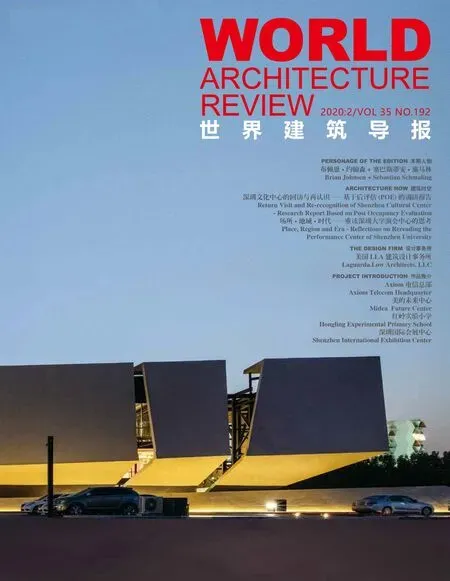
紅嶺實驗小學
2020-05-21 02:33:00吳一飛,張婉怡,王玥等
世界建筑導報 2020年2期
項目地址:中國,深圳福田區
建設單位:深圳市福田區建筑工務署
建筑總面積:33 721 平方米
高度:24 米
設計單位: 源計劃建筑師事務所
主持建筑師:何健翔,蔣瀅
項目建筑師:董京宇,陳曉霖
設計團隊:吳一飛,張婉怡,王玥,黃城強,曾維,何文康,蔡樂歡,彭偉森,何振中
現場工程管理:深圳市萬科房地產有限公司(代建)-趙偲翼,王川,黃鑫
結構顧問:廣州容柏生建筑結構設計事務所
結構機電設計:申都設計集團有限公司深圳分公司
其他顧問單位:廣州諾科建筑幕墻技術有限公司(幕墻設計),廣州尚點園林景觀設計有限公司(景觀植物),廣州哲外藝術設計(TheWhy art x design)有限公司(標識設計),深圳市光藝規劃設計有限公司(照明設計),深圳千典建筑與工程設計顧問有限公司(結構超限顧問)
建成時間:2019 年
攝影:張超,吳嗣銘
Project location: Futian District, Shenzhen, China
Client: Bureau Public Works of Shenzhen Municipality
Gross Built Area: 33 721 m2
Height: 24 meters
Design: O-office Architects
Chief Architects: He Jianxiang& Jiang Ying
Project Architects: Dong Jingyu, Chen Xiaolin
Design Team: Wu Yifei, Zhang Wanyi, Wang Yue, Huang Chengqiang, Zeng Wei, CaiLehuan,Peng Weisen, He Zhenzhong
Construction Project Management: Shenzhen Vanke Real Estate Co., Ltd.– Zhao Siyi,Huang Xin, Wang Chuan (SiteProject Management)
Structural Consultant: RBS Architectural Engineering Design Associates
Structural & M.E.Design: CMAD Design Group
Other Consultant: Neuco Building Facades Technology Co., Ltd.(Building Facades Design),TOP DESIGN (Landscape Design), TheWhy art x design (VI Design),Shenzhen Guangyi Lighting Planning and Design Co., Ltd.(Lighting Design),Shenzhen QianDian construction and Engineering Design Consulting Co., Ltd.(Structural Overrun Consultant)
Completion Date: 2019
Photography: Zhang Chao, Wu Siming
高密度的南中國小學
1,高密度
高速度和高密度已成了地處亞熱地帶的南中國城市深圳的代名詞。這座沿著珠江口出海口東側濱海帶狀規劃的超級城市中的人口和建筑密度依然與日俱增,超高層建筑中的居住和工作已成為這座城市的日常。城市里的休閑、甚至教育都被帶進高空之中。
紅嶺實驗小學及其周邊城市的所在地原本是福田區西北部的一座名為安托山的小山。這座小山在城市中廣為人知是因為它供給了大量用于城市填海擴張的花崗巖土石方,以至于山體被基本削平,僅剩在小學西側的一座孤獨的小山包。其余場地在采石行動逐步退出后被平整為城市開發用地。紅嶺實驗小學的建設用地約100米見方,原規劃24班小學,后因學位缺口巨大而增容至36班。現建筑面積約為原規劃的兩倍,建筑容積率超過3.0。加上用地東南角基礎對地鐵線路的避讓、道路退縮以及規范上對日照間距(雖然這在亞熱帶氣候的南方常被質疑,但到目前為止仍是強制性的要求)的規定,使得建筑設計面臨諸多空間上的挑戰。,
2,垂直機制
因此,校園垂直向度的策略變得至關重要。超過24米的高層校舍在深圳小學建筑中已經被廣泛采用,但相應的副作用是垂直方向的交通過多以及樓梯間需要被封閉和增加前室而阻隔了小學生們的交往。建筑師在紅嶺實驗小學的設計中努力把建筑總高控制在24米以下,以創造水平交往和在建筑/景觀空間上回應對兒童的身體和心理特點。
A High-density Primary School in the Tropical South China
1.High-density
High speed and high density have become synonymous with Shenzhen, the southern Chinese city in the sub-tropical coast area.The population and urban density of this hyper-city along the eastern side of the Pearl River Estuary is still booming,even after 40 years of rapid development.Living and working in super high-rises has become the daily life of the city.Leisure and even education have also been brought into the sky.
The building site of Hongling Experimental Primary School (HEPS) and its surrounding cities was originally a hill named Antuoshan in the north-west part of Futian District.This hill is widely known in the city because it had provided a huge quantity of granite earthwork for urban reclamation.As a result, the hillalmostdisappears, excepta small lonely part standingto the west of the school site.The rest of the terrain was levelled into urban development land after the gradual withdraw of the quarrying operation.The site of HEPS, originally planned for a 24-class school, is about 100by 100 meters.Its current capacity has increased to 36 classes due to the huge pressure from the lack of school places, with a totalfloor areadoubled of theoriginal planning.The building ratio is over 3.Besides, giving way to the subway line at the southeast corner, the retreat from the road on all sides, and the building code of the sunshine spacing (although often questioned in the south of the country, but it is still a mandatory requirement), the architectural design has to confront many challenges form the space.
2.Organism of the vertical
Therefore, design strategy on the vertical orientation becomes crucial.School buildings over 24 meters (the division number between low-rise and high-rise buildings) have been widely applied in Shenzhen’s primary schools, but the side-effectis the obstruction of the students’ interaction caused byovermany vertical traffic and thecompulsory closed fire staircases.In the scheme of the HEPS, the architect make effort to control the building height of within 24 meters, to encourage horizontal interactions and tries to respond to the physical and psychological characteristics of children in the architectural/landscape spatial design.


教學建筑幾乎滿鋪可以建設的用地,建筑分為東西高度不同的兩個半區,平面上以兩個鏡像的E字形連接。西半區利用學習單元之間所必須的間距創造出兩個曲線形邊界的“山谷”庭院。庭院下沉至地下一層,結合由道路退縮距離中取得的邊坡綠化,為地下一層的文體設施和餐廳空間爭取充足的采光和自然通風。下沉庭院通過緩坡和露天階梯劇場與架空且自然起伏的首層地面連接成為一個整體的地景兒童樂園。200米環形跑道和運動場被置于建筑東半區三層屋面,與西側主教學建筑的三層平面相連,便于在二、三、四樓上課的小學生們課間到運動區域活動。運動場下方中部是可容納300人的小禮堂,懸掛于鑲嵌在地景樂園中的半戶外泳池。主教學建筑的四、五層分別為課外教室和教師辦公室,而天面屋頂是學校的園藝農場。
3,單元組織
學習單元——傳統上稱為課室,是小學生們學習和交往基本空間細胞單元。建筑師針對深圳所在的亞熱帶氣候在水平的E字形板式樓層平面上構想了成對組合的鼓形平面的教學單元,避免課室過長的連排阻隔自然通風。每層12間課室分3列共6對布置。每個單元對組合可以通過開閉連接部的靈活隔斷以滿足合班和分班等不同空間需要。鼓形平面展現出比傳統矩形學習單元更大的靈活性與自由度,更有利于單元課室里面的多樣化的教學模式。課室經過連接后產生的富有韻律的折曲線與各層樓板在內庭院一側的自由曲線間形成的線性活動場地,為小朋友們課間提供了一個富有活力的半戶外活動場地。建筑師利用了場地北高南低的條件讓每層的三排課室從南往北各有一米的高差,在E形平板上產生了爬升的地景式行進體驗。最終,兩個“山谷”庭院中各有兩道連接庭院兩側不同樓層的階梯式花園廊橋,在“山谷”的上空懸置了一份獨特的觀賞和游戲體驗。
The school building, divided into two halves with different heights on the east and west, almost fully covers the land that can be constructed in the site.The general plan is an inter-linking mirrored E-shapes.The West Half uses the obligatory spacing between classroom rows to create a “valley” courtyard with two curved boundaries.The courtyards sink to the underground level, combining with the greenery slope garden obtained from the retreating distance site boundary, strivesfor the underground cultural/sport facilities and canteen space fully illuminated and naturally ventilated.The sinking courtyard is connected to the overhead and naturally undulating ground floorthrough a gentle slope in the south courtyard and an open-air steppingtheaterin the north courtyard, all together becoming a children’s landform park.The 200-meter circular runway and sports ground are placed on the 3rd floor of the Eastern Half, linked to the 2nd level of the main teaching building on the west side, which offers convenience for students on the 2nd,3rd and 4th floors to run to the sports area.Underneathof the stadium is a 300-seat auditorium, hanging abovethe semi-outdoor swimming pool in the landform park.The fourth and fifth floors of the West Half are the extracurricular classrooms and the teacher's office, while the roof is the school's horticultural farm.
3.Cellular Fabric
The learning unit, traditionally the classroom, is the basic spatial cell for primary school students to learn and communicate.The architect conceived separated pairs of drum-shaped learning units on the horizontal E-shaped floor plan, for the subtropical climate in which Shenzhen is located, to avoid blocking fluent ventilation on the facade.Every 12 classrooms are divided into 3 rows and arranged in 6 pairs.Each unit-pair combination can be flexible in opening to join the two units,and closingto separate the two, by the moveable division wall in-between two units.The drum-shaped plan shows greater flexibility and freedom when compared to the traditional rectangular classrooms.It is also more conducive to a variety of learning and teaching patterns.The rhythmic folding curve outline of the learning units and the curve edge of the courtyard form the linear activity space to shapea dynamic semi-outdoor venue for the children.The architectmaintains and uses the height different between the north and south of the site,to make 1-meter slopes to connectbetween the three rows of learning unitson each floor and createalso the landform experience on the E-shaped floor plate.In the end, two steel stepped garden bridges hung in the middle of the two “Valley” courtyards, connecting the different floors of the courtyard, are adding unique viewing and gaming experiences over the “Valley”.


攝影:張超

“山谷”庭院、上下錯動的水平層板、疏松的細胞組織以及有機的綠化植入系統均是項目中回應高密度和亞熱帶的南方氣候的建造策略。而更為重要的是,建筑師希望通過紅嶺實驗小學的建造過程和結果進一步探索高速發展之后的高密度城市里公共性設施的全新空間范式。
“Valley” courtyards, dynamic horizontal slabs, loose cellular fabric, and the implanted organic greening systemsare the design strategies to response to high-density urban condition and the subtropical southern climates.Furthermore, through the process and results of the HEPS, the architect aims ata new spatialproductive paradigm for designingof public facilities in high-density Shenzhen.

猜你喜歡
北方建筑(2021年6期)2021-12-31 03:03:54
文苑(2020年10期)2020-11-07 03:15:36
現代裝飾(2020年7期)2020-07-27 01:27:42
現代裝飾(2020年6期)2020-06-22 08:43:12
現代裝飾(2020年4期)2020-05-20 08:55:08
流行色(2020年1期)2020-04-28 11:16:38
藝術啟蒙(2018年7期)2018-08-23 09:14:18
海峽姐妹(2017年7期)2017-07-31 19:08:17
Coco薇(2017年5期)2017-06-05 08:53:16
福建農業科技(2016年10期)2016-03-07 09:46:49