
基于NALP3炎性體的痛風(fēng)寧對(duì)急性痛風(fēng)性關(guān)節(jié)炎大鼠抗炎作用量效和時(shí)效研究
2020-04-29 12:26:46王建輝李保林蔡唐彥郭潔梅朱亞菊滕方舟張藝強(qiáng)肖艷毛驍蘇友新
中國(guó)中醫(yī)藥信息雜志
2020年1期
王建輝 李保林 蔡唐彥 郭潔梅 朱亞菊 滕方舟 張藝強(qiáng) 肖艷 毛驍 蘇友新
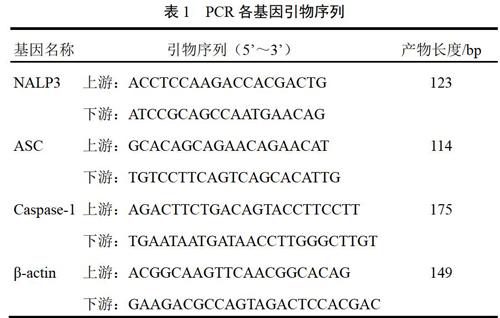
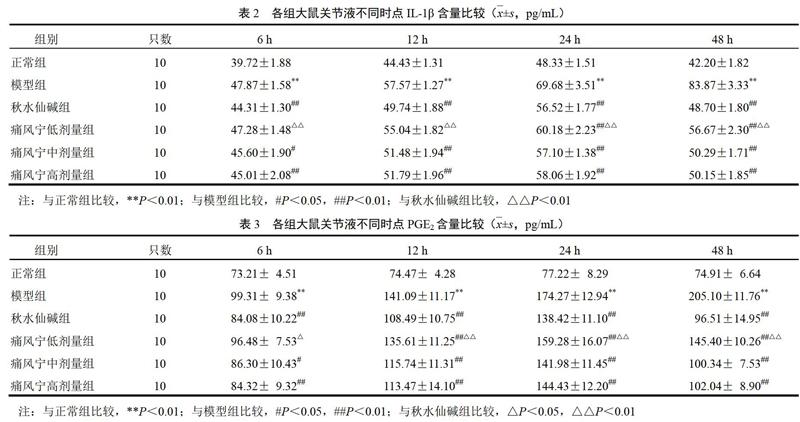

摘要:目的? 觀察痛風(fēng)寧對(duì)急性痛風(fēng)性關(guān)節(jié)炎(AGA)大鼠NALP3炎性體及相關(guān)炎癥因子的影響,探討其抗炎作用的量效與時(shí)效關(guān)系。方法? 將240只SD大鼠隨機(jī)分為造模組200只和正常組40只。右后踝關(guān)節(jié)腔內(nèi)注射尿酸鹽混懸液制作大鼠AGA模型,成模大鼠隨機(jī)分為模型組、秋水仙堿組及痛風(fēng)寧低、中、高劑量組,每組40只。正常組和模型組大鼠給予等量生理鹽水灌胃,其余組大鼠給予相應(yīng)藥物灌胃干預(yù)。首次干預(yù)后6、12、24、48 h各組隨機(jī)取10只大鼠處死,收集右后踝關(guān)節(jié)液與滑膜組織,采用ELISA、Western blot和RT-qPCR分別檢測(cè)白細(xì)胞介素-1β(IL-1β)、前列腺素E2(PGE2)含量及NALP3、ASC、Caspase-1蛋白和mRNA表達(dá)。結(jié)果? 與正常組比較,模型組大鼠各時(shí)間點(diǎn)IL-1β、PGE2含量及NALP3、ASC、Caspase-1蛋白和mRNA表達(dá)明顯升高(P<0.01);與模型組比較,痛風(fēng)寧中、高劑量組及秋水仙堿組大鼠各時(shí)間點(diǎn)IL-1β、PGE2含量及NALP3、ASC、Caspase-1蛋白和mRNA表達(dá)均明顯降低(P<0.01,P<0.05);與秋水仙堿組比較,痛風(fēng)寧中、高劑量組大鼠各時(shí)間點(diǎn)IL-1β、PGE2含量及NALP3、ASC、Caspase-1蛋白和mRNA表達(dá)無(wú)明顯差異(P>0.05),痛風(fēng)寧低劑量組大鼠明顯升高(P<0.01,P<0.05)。結(jié)論? 中劑量痛風(fēng)寧在下調(diào)模型大鼠NALP3、ASC、Caspase-1蛋白和mRNA表達(dá)及降低IL-1β、PGE2含量方面作用相對(duì)較佳,且首次干預(yù)后48 h抗炎作用相對(duì)明顯。
關(guān)鍵詞:痛風(fēng)寧;NALP3炎性體;急性痛風(fēng)性關(guān)節(jié)炎;量效;時(shí)效;大鼠
中圖分類號(hào):R285.5 ???文獻(xiàn)標(biāo)識(shí)碼:A??? 文章編號(hào):1005-5304(2020)01-0051-06
DOI:10.3969/j.issn.1005-5304.201906101
Study on Tongfengning on Dosage Effect and Time Effect of Anti-inflammatory in Model Rats with Acute Gouty Arthritis Based on NALP3 Inflammasome
WANG Jianhui1, LI Baolin1, CAI Tangyan2, GUO Jiemei1,2, ZHU Yaju1, TENG Fangzhou1,ZHANG Yiqiang1, XIAO Yan1, MAO Xiao1, SU Youxin1,2
1. Fujian University of Traditional Chinese Medicine, Fuzhou 350122, China;
2. Fuijiang Health College, Fuzhou 350101, China
Abstract: Objective To observe the effects of Tongfengning on NALP3 inflammasome and related inflammatory factors in acute gouty arthritis (AGA) rats; To explore the dosage effect and time effect of its anti-inflammatory effect. Methods Totally 240 SD rats were randomly divided into model rats (n=200) and normal rats (the normal group, n=40). The AGA model was made by intraperitoneal injection of urate suspension into the right posterior ankle joint of the rats. Model rats were randomly divided into model group, colchicine group and Tongfengning low-, medium- and high-dosage groups, with 40 rats in each group. Normal group and model group were given the same amount of normal saline for gavage, and other groups were given the corresponding medicine for gavage intervention. At 6 h, 12 h, 24 h, and 48 h after the first intervention, 10 rats in each group were sacrificed at each time point, and the right posterior ankle joint fluid and synovial tissue were collected. ELISA, Western blot, and RT-qPCR were used to detect the contents of interleukin-1β (IL-1β) and prostaglandin E2 (PGE2), and expressions of NALP3, ASC, Caspase-1 protein and mRNA. Results Compared with the normal group, the contents of IL-1β and PGE2, and the expressions of NALP3, ASC, Caspase-1 protein and mRNA increased in the model group at each time point (P<0.01); Compared
with the model group, the contents of IL-1β and PGE2, and the expressions of NALP3, ASC, Caspase-1 protein and mRNA significantly decreased in Tongfengning medium- and high-dosage groups at each time point (P<0.01, P<0.01); Compared with the colchicine group, the contents of IL-1β and PGE2, and the expressions of NALP3, ASC, Caspase-1 protein and mRNA were not significantly different in the Tongfengning medium- and high-dosage groups at each time point (P>0.05), while they increased significantly in Tongfengning? low-dosage group (P<0.01, P<0.05). Conclusion The medium dosage of Tongfengning is relatively better in down-regulating the expressions of NALP3, ASC, Caspase-1 protein and mRNA and decreasing the contents of IL-1β and PGE2, and its anti-inflammatory effects were relatively obvious 48 h after the first intervention.
Key words: Tongfengning; NALP3 inflammasome; acute gouty arthritis; dosage effect; time effect; rats
痛風(fēng)是由于尿酸生成增多和/或尿酸排泄減少導(dǎo)致尿酸鹽(MSU)沉積所致的晶體相關(guān)性關(guān)節(jié)病[1]。臨床所見痛風(fēng)多為急性痛風(fēng)性關(guān)節(jié)炎(acute gouty arthritis,AGA)的狀態(tài),發(fā)病急驟,多于深夜發(fā)作,受累關(guān)節(jié)及周圍組織紅、腫、熱、痛和功能受限均明顯,尤其是疼痛呈撕裂樣、刀割樣或咬噬樣,且進(jìn)行性加劇[2],嚴(yán)重影響患者身心健康。痛風(fēng)寧是本課題組在痛風(fēng)“內(nèi)濕致痹”發(fā)病觀[3]指導(dǎo)下組方并經(jīng)臨床使用多年的效驗(yàn)方,該方能明顯降低關(guān)節(jié)液中炎癥因子含量,減輕AGA動(dòng)物模型關(guān)節(jié)炎癥反應(yīng)[4-7]。前……
登錄APP查看全文
