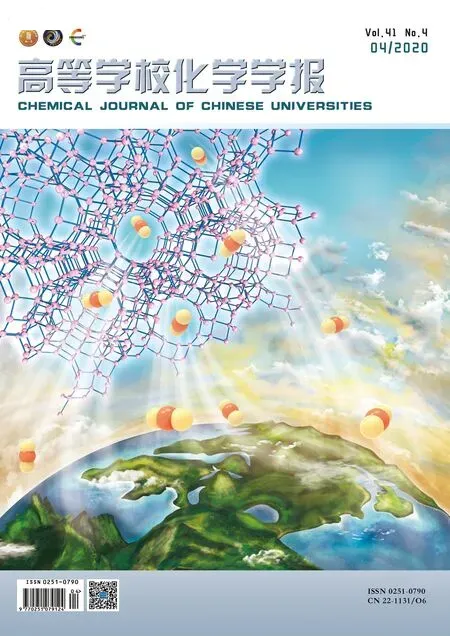
Auto-redox Strategy for the Synthesis of Co3O4/CeO2 Nanocomposites and Their Structural Optimization Towards Catalytic CO Oxidation
2020-04-13 10:04:08JINXinFENGXilanLIUDapengSUYutongZHANGZhengZHANGYu
高等學(xué)校化學(xué)學(xué)報
2020年4期
JIN Xin,FENG Xilan,LIU Dapeng*,SU Yutong,ZHANG Zheng,ZHANG Yu,2,3*
(1.Key Laboratory of Bio-inspired Smart Interfacial Science and Technology of Ministry of Education,School of Chemistry, 2. International Research Institute for Multidisciplinary Science, 3. Beijing Advanced Innovation Center for Biomedical Engineering,Beihang University,Beijing 100191,China)
Abstract A simple auto-redox strategy was successfully used to synthesize Co3O4/CeO2 nanocomposites.These samples were then characterized by means of TEM,XRD,XPS,and so on,to study the influence of reaction parameters on their catalyst activity.The results indicate that the catalytic performance of Co3O4/CeO2 nanocomposites could be optimized by changing the molar ratio of Co/Ce,pH values,reaction and calcination temperatures.The optimal Co3O4/CeO2 nanocomposite could reach a 100% CO conversion at 140 ℃ compared to the others.Moreover its catalytic activity kept stable after cycling,indicating its good stability.
Keywords Co3O4; CeO2; Auto-redox; CO oxidation
It is of great significance to design highly active catalystsviasimple aqueous strategies for applications[1—5].Recently,an auto-redox process for the preparation of nanostructures that happens in water phase has aroused wide interests of scientists[6—8].Compared with the oil phase routs or impregnation methods,the auto-redox one has some outstanding advantages: (1) the synthesis is green with simple post-treatment and less byproducts; (2) it brings more clean surface as active sites; (3) more importantly,it favors strong synergistic effects between components[9].For heterogeneous catalysis,the more active sites locating at the surface or the interface of catalysts will greatly enhance their catalytic activities[10—12].Many precious metal catalysts have been successfully synthesized using the auto-redox strategy,such as Pt@CeO2[1],Pd@CeO2[9]and AgxAu1-x@CeO2[13]nanospheres.Although precious metal catalysts often exhibit good catalytic performance,their high prices,complex separation and poor recovery have limited their practical application[14—17].Scientists have begun to focus on non-precious metal catalysts such as transition metal oxides and rare earth metal catalysts,and in this consideration Cu2O@CeO2[18—22]nanocubes have been successfully preparedviathe auto-redox strategy.As known Co3O4as a kind of non-precious metal material has also become a hot spot of research in recent years for CO oxidation[23—27].However,due to its relatively high potential of Co3+/Co2+in aqueous solution that can easily oxidize H2O,it is difficult to find a suitable Co3+compound as precursor for the aqueous auto-redox strategy.
In this paper,we have demonstrated a green auto-redox synthetic strategy to prepare Co3O4/CeO2nanocomposites by using [Co(NH3)6]Cl3and Ce3+.The synergistic effect of Co3O4/CeO2nanocomposites was improved by optimizing the molar ratio of Co/Ce,pH value,reaction temperature and calcination temperature,and explained in detail through various characterizations.It is believed that this work will inspire us much to expand the synthetic system for many other transition metals.The synthetic process is described in Scheme 1.The Ce(NO3)3·6H2O and [Co(NH3)6]Cl3was mixed evenly in the flask,and the auto-redox was induced after adding NaOH,resulting in the sheet-like structure of Co3O4/CeO2nanocomposites.

Scheme 1 Synthetic process of Co3O4/CeO2 nanocomposites
1 Experimental
1.1 Synthesis of Pure Co3O4 and CeO2
Ce(NO3)3·6H2O(1.308 g,2.5 mmol) was ultrasonically dispersed in deionized water(100 mL) and stirred for 10 min.After that the NaOH solution(9 mL,1 mmol/L) was added.This solution was heated at 40 ℃ for 1 h and then allowed to cool down to room temperature.The precipitation was collected from solution by centrifugation at 8000 r/min for 5 min and washed with deionized water for three times.Finally,the products were dried under vacuum at 60 ℃ overnight and calcined at a heating rate of 10 ℃/min in air at 500 ℃ for 2 h.The preparation of Co3O4is the same as above,but due to the high potential of Co3+([Co(NH3)6]Cl30.804 g,3 mmol),the NaOH dosage was increased to 27 mL and the reaction temperature was raised to 60 ℃.
1.2 Synthesis of Co3O4/CeO2 Nanocomposites
A series of Co3O4/CeO2nanocomposites was synthesized in aqueous solution.Firstly,[Co(NH3)6]Cl3(0.134 g,0.5 mmol) and Ce(NO3)3·6H2O(1.09 g,2.5 mmol) were ultrasonically dispersed in 100 mL deionized water and stirred for 10 min.Then the NaOH solution(9 mL,1 mmol/L) was added.This orange solution was heated at 40 ℃ for 1 h and cooled down to room temperature.The products were collected from the mother solution by centrifugation at 8000 r/min for 5 min and washed with deionized water for three times.Finally,the products were dried under a vacuum oven at 60 ℃ overnight and calcined in air at a heating rate of 10 ℃/min at 500 ℃ for 2 h.All the samples were obtained by the same procedure except for changing the molar ratio of Co/Ce[n(Co)/n(Ce)].The products were named as Cox/Ceyaccording ton(Co)/n(Ce)=1∶,5 for Co1/Ce5,n(Co)/n(Ce)=5∶,1 for Co5/Ce1,n(Co)/n(Ce)=9∶,1 for Co9/Ce1,n(Co)/n(Ce)=15∶,1 for Co15/Ce1.
To tune the pH value of the solution,the above mentioned process was modified using different amounts of NaOH.Here take the preparation of Co9/Ce1as an example.[Co(NH3)6]Cl3(0.722 g,2.7 mmol) and Ce(NO3)3·6H2O(0.13 g,0.3 mmol) were dissolved in H2O(100 mL),and varied amounts of NaOH(1 mmol/L) were added into the solution.The final products were named as Co9/Ce1-1NaOH[V(NaOH)=9 mL],Co9/Ce1-3NaOH[V(NaOH)=27 mL],Co9/Ce1-5NaOH[V(NaOH)=45 mL].
Besides varying the pH value of the solution,the reaction temperature(tR) was also increased from the above-mentioned 40 ℃ to 60,80 and 100 ℃ while preparing Co9/Ce1-3NaOH.The final products were named as Co9/Ce1-tR-40,Co9/Ce1-tR-60,Co9/Ce1-tR-80,Co9/Ce1-tR-100,respectively.Similarly,the samples of Co9/Ce1-tC-500,Co9/Ce1-tC-400 and Co9/Ce1-tC-300 were derived from Co9/Ce1-tR-60 and thus named by their calcination temperature(tC) of 500,400 and 300 ℃,respectively.
X-Ray diffraction(XRD) measurement was performed using a Shimadzu XRD-6000 spectrometer with CuKαradiation(λ=0.15418 nm),the operating voltage and the current are 40 kV and 30 mA,respectively.TEM images were obtained with a JEM-2100F field emission gun transmission electron microscope operating at 200 kV.The elemental composition and valence states(XPS) were performed on an ESCALab 250Xi photo-electron spectrometer with AlKαradiation as the X-ray source for excitation.N2sorption characterization was carried out on a NOVA 2200e gas sorption analyzer,and the samples were first degassed in vacuum at 300 ℃ for 4 h prior to N2adsorption at the liquid nitrogen temperature.H2-temperature programmed reduction(H2-TPR) analyses were carried out in a quartz tube reactor.After the samples(25 mg) were balanced at theow of H2/Ar(volume fraction 5% of H2,20 mL/min) for a while,the reactor was heated at a rate of 20 ℃/min to 800 ℃.Meanwhile a thermal conductivity detector was used to record the consumption of H2signals.
For catalytic CO oxidation,25 mg catalysts mixed with 25 mg Al2O3were filled in a quartz reaction tube.Then the experiment was carried out under aow of reactant gas mixture of 1% CO and 99% air by elevating the temperature from 25 to 400 ℃ at a rate of 30 mL/min.The composition of the tail gas was monitored online by GC 1100-gas chromatograph.
2 Results and Discussion
Notice that the auto-redox reactions occur between Co3+and Ce3+under alkaline conditions,so the products should be most possibly composed by Co(OH)2and CeO2.The TEM images in Fig.1(A)—(D) identify that by changing the molar ratio of Co/Ce,no difference in morphology could be clearly observed,and the particle size is around 5—10 nm.However,the particle size increases obviously to 20 nm after calcination [Fig.1(E)—(H)] as the ratio of Co/Ce increased from 1∶,5 to 15∶,1.The XRD patterns in Fig.1(I) show that before calcination these nanoparticles were indeed composed by CeO2(JCPDS No.43-1002) and Co(OH)2(JCPDS No.45-0031) for all the as-obtained samples.The distinguished peaks located at 2θ=28.5°,33.1°,47.5°,56.3° and 59.1° were assigned to the facets of (111),(200),(220),(311) and (222) for CeO2,respectively.And the peaks at 37.9°,51.4°,57.9° and 61.5° were consistent with the reflection of Co(OH)2for the facets (101),(102),(110) and(111),respectively.The total amount of Co3+and Ce3+is known to remain constant,but that of Ce3+gradually decreased in the feeding ratio.So the peak intensity of CeO2in Fig.1(I) became weaker and weaker.However,the peak intensity of Co(OH)2did not simultaneously enhance with the increasing ratio of Co3+.The main reason is that there were not enough Ce3+ions to react with Co3+,and just a small amount of Co(OH)2was obtained.Therefore,when the Co/Ce molar ratio increases to some extent,the peak intensity of Co(OH)2began to decrease.As seen in Fig.1(J),the peaks of Co(OH)2disappeared completely after calcination,while some new peaks appeared that should be ascribed to the spinel Co3O4(JCPDS No.43-1003).The peaks at 2θ=31.3°,36.8°,59.4° and 65.2° match well with the plane facets (220),(311),(511) and (440) of Co3O4,respectively.In addition the diffraction peaks of CeO2became sharper,indicating its better crystallinity after calcination.

Fig.1 TEM images(A—H) and XRD patterns(I,J) of Co3O4/CeO2 samples before(A—D,I) and after calcination(E—H,J)(A,E) Co1/Ce5; (B,F) Co5/Ce1; (C,G) Co9/Ce1; (D,H) Co15/Ce1; (I,J) a.CeO2; b.Co1/Ce5; c. Co5/Ce1; d. Co9/Ce1; e. Co15/Ce1.
The catalytic performance of all samples was then evaluated in a model reaction of catalytic CO oxidation,and the results are shown in Fig.2.As seen,pure CeO2performs the worst that even when the test temperature was increased to 400 ℃,only about 90% of CO was oxidized into CO2.As the molar ratio of Co/Ce increases,the performance of the catalyst improved significantly and it follows such a sequence oft100(100% conversion temperature): Co9/Ce1>Co5/Ce1>Co15/Ce1>Co1/Ce5>CeO2.Obviously Co9/Ce1shows a much higher catalytic activity and itst100is 280 ℃.However,as the molar ratio of Co/Ce increases to 15∶,1,thet100was increased to 340 ℃.Thus the following adjustment was conducted on the basis ofn(Co)/n(Ce)=9∶,1 in order to realize sample optimization.

Fig.2 CO conversions of Co3O4/CeO2 samples with different molar ratios of Co/Ce

Fig.3 CO conversions of Co3O4/CeO2 samples with different amounts of NaOH(aq)
In thermodynamics,the pH value will greatly influence the electrode potential of elements and thus the redox performance of the reaction.Therefore,different amounts of NaOH was employed to adjust the pH value of the solution.As shown in the TEM images(Fig.S1,see the Electronic Supplementary Material of this paper),the particle size decreased gradually as the pH increases,and the morphology of the catalyst maintains a flake-like structure.When the concentration of NaOH was tripled,the size distribution of the sample was the most uniform.XRD patterns(Fig.S2,see the Electronic Supplementary Material of this paper) indicate that the full width at half maximum(FWHM) for the characteristic peaks of either CeO2or Co3O4increased with the pH value,which further proves the decreased particle size.As shown in Fig.3,the pH value has a great influence on their catalytic activity that follows a sequence that Co9/Ce1-1NaOH Fig.4 CO conversions of Co3O4/CeO2 samples prepared at different temperatures Fig.5 CO conversions of Co9/Co1-tC-300,Co9/Co1-tC-400 and Co9/Co1-tC-500 In kinetics,the reaction temperature during synthesis should be well considered to investigate the influence on particle growth.As shown in the TEM images(Fig.S3,see the Electronic Supplementary Material of this paper),changing the reaction temperature can significantly change the size of catalysts,and the layered flake-like structure is more obvious.When the temperature was increased to 60 ℃,the layered structure appeared significantly.However to 100 ℃,the layered structure gradually decreased.XRD patterns show(Fig.S4,see the Electronic Supplementary Material of this paper) that with the increase of reaction temperature from 40 ℃ to 100 ℃,the diffraction peaks of Co3O4and CeO2only appeared after calcination.When the reaction temperature increases to 60 ℃,the peaks of Co3O4/CeO2nanocomposites become sharper due to the higher crystallinity,and meanwhile the FWHM of Co3O4/CeO2prepared at 60 ℃ is the smallest.The catalytic curves in Fig.4 demonstrate that thet100of Co9/Ce1-tR-40,Co9/Ce1-tR-60,Co9/Ce1-tR-80,and Co9/Ce1-tR-100 are 250,180,180 and 220 ℃,respectively.Since the Co9/Ce1-tR-60 performed the best,the reaction temperature was set at 60 ℃ for the following tests. Finally,the influence of the calcination temperature on the catalytic performance was studied to investigate the thermal stability.It can be seen from the TEM images(Fig.S5,see the Electronic Supplementary Material of this paper) that with the increase of calcination temperature,the samples showed obvious increase in particle size.The FWHM of XRD peaks(Fig.S6,see the Electronic Supplementary Material of this paper) becomes narrower along with the increasing of calcination temperature,indicating the increased particle size.To evaluate the catalytic activities of the three samples of Co9/Co1-tC-300,Co9/Co1-tC-400 and Co9/Co1-tC-500,catalytic CO oxidation was also employed and displayed in Fig.5.It follows such a sequence oft100: Co9/Ce1-tC-400 Fig.6 TEM(A),HRTEM(B) images and mapping analysis(C—F) of Co9/Ce1-tC-400 In order to make sense of the reason for its optimal catalytic performance,a series of characterization was conducted.The TEM images of Co9/Ce1-tC-400 are shown in Fig.6,which presents us more details on its structure.The high-resolution TEM images[Fig.6(B)] prove the unambiguous existence of Co3O4and CeO2and their uniform distribution.The lattice fringe of 0.31 nm corresponds well to the (111) planes of CeO2.While the lattice fringes of 0.23 and 0.29 nm match well with the (222) and (220) planes of Co3O4,respectively.This result is consistent with the XRD results(Fig.S6,see the Electronic Supplementary Material of this paper).As seen from the mapping analysis[Fig.6(C)—(F)],Ce and Co are evenly distributed in Co9/Ce1-tC-400,and the content of Co is significantly higher than that of Ce.The molar ratio of Co/Ce is about 4.25∶,1 judged by ICP.X-ray photoelectron spectroscopy(XPS) was then employed to determine the valence states of elements in the surface atomic layers of catalysts.Fig.7(A) presents the Ce3dbinding energy of Co9/Ce1-tC-400.The bands labeled withu(901.1 eV),u2(907.5 eV),u3(916.9 eV) andv(882.6 eV),v3(888.8 eV),v3(885.1 eV) indicate the 3d104f0electronic state of Ce4+,the peaks labeled byu1(903.7 eV) andv1(885.2 eV) represent the 3d104f1electronic state of Ce3+.The spectrum of Co2p[Fig.7(B)] shows two major peaks at 779.8 and 794.8 eV,which are corresponding to Co2p3/2and Co2p1/2of Co3O4.Then the two peaks could be further divided into six peaks,which will be assigned to Co3+and Co2+[28,29].The Ce3dand Co2psignals of Co9/Ce1-tC-400 have been compared with those of CeO2and Co3O4as shown in Fig.S7(see the Electronic Supplementary Material of this paper),in which the peak position of Co9/Ce1-tC-400 significantly shifted,indicating the synergistic effect between CeO2and Co3O4in Co9/Ce1-tC-400. Fig.7 XPS spectra of Ce3d(A),Co2p(B),O1s(C) of Co9/Ce1-tC-400 In addition,the XPS spectra of Co9/Ce1calcined at different temperatures are shown in Fig.S8(see the Electronic Supplementary Material of this paper).It can be seen that despite the peak position did not change,theu1peak area of Co9/Ce1-tC-400 was significantly larger than that of Co9/Ce1calcined at other temperatures,indicating its higher Ce3+content compared to the others. Fig.S9(see the Electronic Supplementary Material of this paper) presents the N2adsorption-desorption isotherms and pore size distributions of pure Co3O4,pure CeO2and Co3O4/CeO2samples after calcined at different temperatures.The specific surface area,pore volume and pore size are listed in Table 1.This result shows that doping with a small amount of Ce3+would significantly increase the specific surface area and pore volume of the catalysts,which are beneficial to improve the catalytic performance.Meanwhile,the specific surface area of the Co3O4/CeO2samples will be further changed by adjusting the calcination temperature.According to the results,Co9/Ce1-tC-400 shows the best catalytic performance even though its specific surface area is not the largest among the samples,but the pore size and volume are the largest.It can be seen that the specific surface area,pore volume and pore size have impact on the performance of the catalyst. Table 1 BET surface area,pore volumes and pore sizes of pure Co3O4,CeO2 and Co9/Ce1samples calcinated at 300,400 and 500 ℃ H2-TPR(Fig.8) further explains the synergistic interaction of Co3O4and CeO2in Co3O4/CeO2nanocomposite.The reduction of pure Co3O4in H2-TPR mainly undergoes two steps that the peak at high temperature(503 ℃) is assigned to the reduction of Co2+to Co0,and the peak at low temperature(396 ℃) could be attributed to the reduction of Co3+to Co2+.The pure CeO2only has one reduction peak at around 553 ℃ which is attributed to the reduction of surface oxygen.However,for Co3O4/CeO2after optimization by pH value,reaction temperature and calcination temperature,all the reduction peaks gradually move toward the lower temperature.This phenomenon shows that CeO2has a great influence on the reduction of Co3O4,and the interaction between CeO2and Co3O4will be beneficial to the reduction of Co3+and Co2+.It indicates that the Co3O4/CeO2has a higher synergistic effect and oxidation property.The catalytic performance of the Co3O4/CeO2nanocomposites confirms that adding a small amount of CeO2can make the catalyst have a perfect CO oxidation activity[30,31].So it is identified that there is a synergistic effect between Co3O4and CeO2,it is crucial importance to improve the catalytic properties.During the reaction,when little oxygen is adsorbed on the surface of the catalyst,CeO2could provide with the oxygen required for the reaction.Meanwhile,the relatively lower reduction temperature indicates a better activity of oxygen in Co3O4/CeO2,which is conductive to the improved catalytic properties.Finally,a subsequent cycling test was conducted to study the stability of Co3O4/CeO2.In Fig.9,it is seen that after six successful cycles,Co3O4/CeO2still maintained a high catalytic activity without degradation.Moreover,Table 2 shows that Co3O4/CeO2has rather high catalytic activity towards CO oxidation compared to the previously reported works. Fig.8 H2-TPR profiles of Co9/Ce1(a),Co9/Ce1-3NaOH(b),Co9/Ce1-tR-60(c),Co9/Ce1-tC-400(d),Co3O4(e) and CeO2(f) Fig.9 Cycling test curves of Co3O4/CeO2nanocomposites Table 2 Catalytic activity for CO oxidation of Co3O4/CeO2 composites reported in the literatures In summary,we used auto-redox strategy to prepare the layered structure Co3O4/CeO2nanocomposites.The factors that affected the catalytic activity of the samples were studied systematically.The results show that the molar ratio of Co/Ce,pH value,reaction temperature and calcination temperature all affect the catalytic activity.Co3O4/CeO2nanocomposites show higher catalytic activity than pure Co3O4or CeO2due to the interaction between Co3O4and CeO2.For the Co3O4/CeO2nanocomposites prepared under the optimal conditions,t100was achieved at 140 ℃.It has a perfect catalytic stability during CO oxidation.We believe that Co3O4/CeO2nanocomposites might be a candidate catalyst for CO oxidation.Therefore,the auto-redox strategy provides an effective way to produce Co3O4/CeO2,and this method can be extended to other systems. Supporting Information: http://www.cjcu.jlu.edu.cn/CN/10.7503/cjcu20190649. This paper is supported by the National Natural Science Foundation of China(Nos.51972008,51925202).


3 Conclusions
登錄APP查看全文