
上海華漕社區托幼機構保教人員健康素養影響因素與健康教育效果研究
2020-04-09 04:51:04王敬之張曉英楊郗
上海醫藥 2020年6期
關鍵詞:健康教育
王敬之 張曉英 楊郗
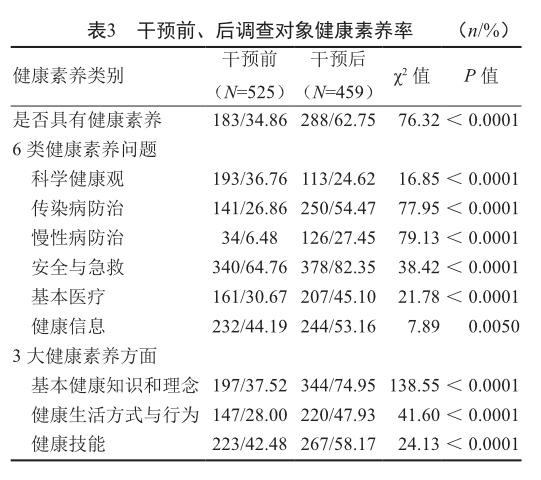
摘 要 目的:對上海市華漕社區公辦及民辦托幼機構保教人員的健康素養水平進行調查,為制定保教人員的健康教育方案提供依據。方法:于2017年10月—2018年5月選取上海市閔行區華漕社區14家托幼機構的626名保教人員為調查對象,在進行健康教育干預前和干預后分別對其健康素養水平進行問卷調查。結果:不同年齡、學校性質、文化程度和崗位的保教人員,其健康素養的得分差異有統計學意義,學校性質和文化程度為健康素養水平的影響因素。干預前僅有34.86%的保教人員具有健康素養,干預后具有健康素養的保教人員比例增加至62.75%;干預后保教人員在科學健康觀維度的健康素養率有所下降,其他維度具有健康素養的保教人員比例均有所增加。結論:影響健康素養的一個重要因素是文化程度。科學健康觀、慢性病防治及健康生活方式與行為這幾個方面是托幼機構保教人員健康教育知識的薄弱環節,今后應加強相關方面的知識宣教。
關鍵詞 托幼機構 保教人員 健康素養 健康教育
中圖分類號:R179 文獻標志碼:A 文章編號:1006-1533(2020)06-0021-04
Study of the influential factors of health literacy and the effect of health education on the caregivers and teachers in childcare institutions in Huajing Community of Shanghai
WANG Jingzhi1, ZHANG Xiaoying2, YANG Xi3
(1. Department of Prevention and Health Care of Jiuting Community Health Service Center of Songjiang District, Shanghai 201615, China; 2. Department of Prevention and Health Care of Huacao Community Health Service Center of Minhang District, Shanghai 201106, China; 3. Dongming Community Health Service Center of Pudong New District, Shanghai 200123, China)
ABSTRACT Objective: To investigate the health literacy level of caregivers and teachers in public and private childcare institutions in Huaying Community of Shanghai in order to provide a basis for formulating health education programs for caregivers and teachers. Methods: From October 2017 to May 2018, 626 caregivers and teachers from 14 childcare institutions in Huaying Community of Minhang District, Shanghai were selected as the survey objects, and before and after health education intervention, the level of their health literacy was investigated by the questionnaire. Results: There are statistically significant differences in the scores of health literacy among caregivers and teachers of the different ages, school nature, education level and position, and the nature of school and education level were the factors that influence the level of health literacy. Before the intervention, only 34.86% of the caregivers and teachers had health literacy, and after the intervention, the proportion of health educators with health literacy increased to 62.75%; after the intervention, the health literacy rate of the caregivers and teachers in the dimension of scientific health concept decreased, and the proportion of caregivers and teachers in other dimensions increased. Conclusion: An important factor affecting health literacy is education. The scientific health concept, the prevention and treatment of chronic diseases, and healthy lifestyles and behaviors are the weak links in the health education knowledge of caregivers and teachers in childcare institutions, and in the future, relevant aspects of knowledge education should be strengthened.
KEY WORDS childcare institution; caregiver and teacher; health literacy; health education
健康素養是健康素質的重要組成部分,也是近年來備受關注的研究領域[1]。WHO認為健康素養是指個體所具有的獲取、理解和處理基本健康信息和服務,并運用這些信息和服務做出正確判斷及維持和促進健康的能力[2]。托幼機構是幼兒學習和生活的主要場所,幼兒缺乏自我保護能力,其對危險的識別能力、身體活動能力和自我照護能力都較差,容易導致意外傷害、傳染病和突發事件等的發生。托幼機構保教人員的健康素養水平不僅關系到自身的健康水平,也與幼兒的健康水平密切相關[3-7]。本研究以上海市閔行區華漕社區為例,對轄區內公辦及民辦托幼機構保教人員的健康素養水平進行調查,為針對性制定保教人員的健康教育方案提供依據。
1 對象與方法
1.1 研究對象
于2017年10月—2018年5月選取上海市閔行區華漕社區14家托幼機構(公辦托幼機構5家,民辦托幼機構9家)的626名保教人員為調查對象,在進行健康教育干預前和干預后分別對其健康素養水平進行問卷調查。干預前發放調查問卷626份,回收問卷594份,其中有效問卷525份,問卷有效回收率83.87%;干預后發放調查問卷626份,回收問卷490份,其中有效問卷459份,問卷有效回收率73.32%
納入標準:(1)在轄區托幼機構工作的保教人員,包括行政管理人員、教師、保育員、保健老師、后勤保障人員和營養師;(2)參加工作滿1年及以上者,不限性別、年齡;(3)自愿參與本次研究。
干預前的調查對象中,男性52名,女性473名,男女性別比例約為1∶9;平均年齡(36.44±10.10)歲;來自公辦與民辦托幼機構的人數基本各占一半;大專/本科及以上學歷人數最多,為250名(47.62%);職業為教師的人數最多,為223名(由于干預前后的調查對象來自同一樣本,因此干預后調查對象的基本信息不再列出)。
1.2 研究方法
1.2.1 樣本量確認
參考胡亞飛等[8]關于2012年上海市15~69歲居民的健康素養調查數據,上海市居民具備健康素養的比例為19.59%,由此預估上海市托幼機構保教人員具有健康素養的比例約為20%。
根據公式n=Z2P(1-P)/e2,Z取值1.96(置信度為95%),P取值0.20,比例誤差e取值介于正負0.05之間,計算出至少需要的樣本量人數為246名。本次調查對象共626名,大于樣本量所需人數。
1.2.2 調查問卷設計
本次問卷主要參照中華人民共和國國家衛生健康委員會制定的《2018年全國居民健康素養監測調查問卷》[9]進行設計。
問卷內容包括被調查者的基本信息及健康素養相關問題,共56題。以公共衛生為導向可將問卷內容分為健康科學觀素養、傳染病防治素養、慢性病防治素養、安全與急救素養、基本醫療素養及健康信息素養6類健康素養問題;基于“知識-行為-技能”理論模式可將問卷內容分為基本健康知識和理念素養、健康生活方式與行為素養及基本技能素養3個方面。
計分標準為單選及判斷題回答正確得1分,錯誤得0分;多選題回答正確得2分,多選題正確回答率≥60%且無錯誤選項得1分,出現錯誤選項得0分。
1.2.3 健康素養判斷標準
以得分的80%為分界點,將調查對象分為健康素養較高和較低組別,為了表述及計算方便,后文稱有健康素養和無健康素養。實際得分占總分80%及以上認為調查對象有健康素養;各維度得分占該維度總分80%及以上認為調查對象在該維度上有健康素養。
1.2.4 干預方法
干預時間為2個月,干預方法包括發放干預資料、開展健康講座及在微信群內發布健康知識等。干預資料為上海市健康教育所編寫的《<健康66條>逐條看》及參考《<健康66條>逐條看》主要內容及調查問卷相關內容編寫的宣傳折頁《健康逐條看》;每兩周一次召集各托幼機構的保健老師,以PPT形式對其進行健康宣教,宣教后再以分組討論的形式對健康宣教內容進行逐條解讀,隨后由保健老師對所在托幼機構的其他保教人員進行宣教;建立健康宣教微信群,定期將電子版宣傳資料及相關醫學知識發送到群內,并針對提問進行健康知識講解。
1.3 統計學分析
使用SAS 9.4軟件進行統計學分析。計數資料用百分率(%)表示,行χ2檢驗;采用單因素及多因素logistic回歸分析方法進行健康素養影響因素分析,使用Mantel-Haenszel法進行檢驗。單因素分析中,P<0.2表示差異有統計學意義;多因素分析中,P<0.05表示差異有統計學意義。
2 結果
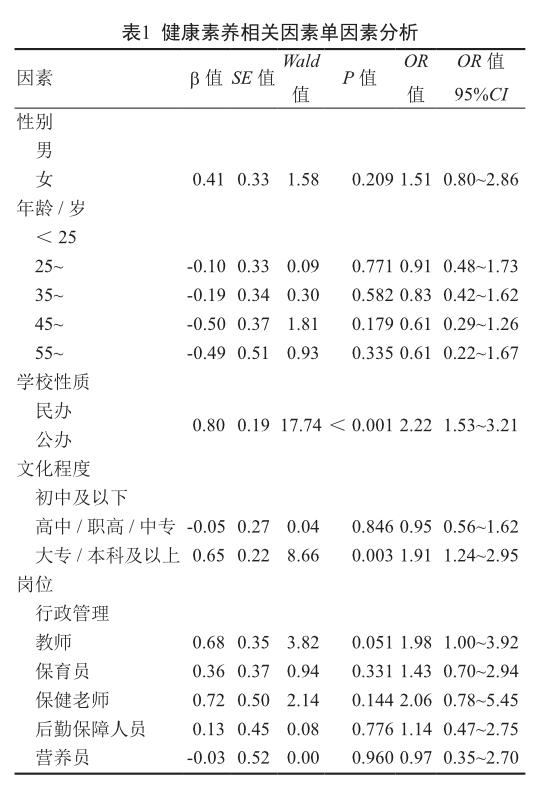
2.1 健康素養相關因素單因素分析
以是否具有健康素養為因變量,以年齡、性別、學校性質、文化程度和崗位為自變量進行單因素logistic回歸分析。結果顯示,不同年齡、學校性質、文化程度和崗位的保教人員,其健康素養的得分差異有統計學意義(P<0.2,表1)。
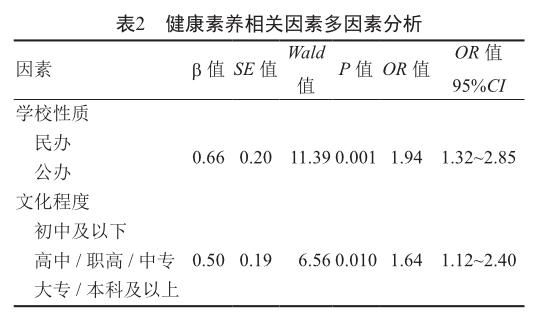
2.2 健康素養相關因素多因素分析
以是否具有健康素養為因變量,以年齡、學校性質、文化程度和崗位為自變量進行多因素logistic回歸分析。結果顯示,學校性質和文化程度為健康素養水平的影響因素(P<0.05,表2)。
相對于民辦托幼機構的保教人員,公辦托幼機構的保教人員具有健康素養的可能性更大(OR=1.94);具有大專/本科及以上學歷的保教人員相對于初中及以下文化學歷者,具有健康素養的可能性更大(OR=1.64)。
猜你喜歡
今日健康(2016年12期)2016-11-17 14:38:15
今日健康(2016年12期)2016-11-17 14:36:46
今日健康(2016年12期)2016-11-17 14:06:45
今日健康(2016年12期)2016-11-17 14:06:22
今日健康(2016年12期)2016-11-17 13:41:00
今日健康(2016年12期)2016-11-17 13:38:17
體育時空·上半月(2016年11期)2016-11-11 12:35:53
現代經濟信息(2016年19期)2016-10-20 20:36:04
中國實用醫藥(2016年24期)2016-10-17 06:19:34
中國實用醫藥(2016年24期)2016-10-17 06:11:01
