
NO TIME TO WASTE
2020-02-14 15:11:54TEXTANDPHOTOGRAPHYBYTINAXU徐盈盈
漢語世界 2020年1期
TEXT AND PHOTOGRAPHY BY TINA XU (徐盈盈)
As landfills overflow, China’s villages struggle with the impact of the country’s trash problem
農村垃圾處理進入新時代
T he wake-up call came with the tragedy of a newborn boy. In 2008, fourmonth-old Xie Yongkang was living 190 meters away from the Hai’an Waste Incineration Plant in Jiangsu province when his eyes began to no longer follow movement; doctors diagnosed baby Xie with cerebral palsy and epilepsy.
With no genetic cause, experts blamed the incineration plant. But the hazards of mismanaged trash had been signaled long before:Six villagers had died of cancer in neighboring Xiehe Village the previous year; five more cases were diagnosed in 2009. Soon, farmers began dragging dead livestock to the incinerator’s gates,demanding compensation.
A lawsuit by Xie’s father, brought with the aid of the Center for Legal Assistance to Pollution Victims, documented high levels of airborne dioxins in the area from years of the plant’s operations. It emerged that the plant had been built within the regulatory 300-meter safety exclusion zone from residents, and even lacked the proper environmental licensing. Yet the courts acquitted the incineration company,claiming inconclusive evidence.
Chen Liwen, a 37-year-old environmentalist and founder of the NGO Zero Waste Village,who assisted with fundraising for the Xie family’s legal expenses, calls it “a tragedy I will never forget.” Yongkang is now 12 and still bedridden.“He inspired many, including me, to begin studying incinerators and their effects,” Chen tells TWOC. “Industrialization, while raising our standard of living, is supposed to make us more healthy, not less.”
The mission to tackle China’s chronic wastemanagement issues is partly personal for Chen,who recalls summers spent swimming in rivers near her childhood home in Hebei province.
But after pursuing a master’s degree in the United States, Chen was shaken by what she saw on her return in 2017: Piles of plastic trash and rotting food had glutted the streams of her youth, and children no longer dared to touch the water. As middle-class consumption levels increasingly become the standard in China,decades of “economy first” policies have left its countryside besieged by waste and wracked by environmental and publichealth concerns.
The clock is ticking on finding a solution. In the 1980s, China generated on average 30 million tons of garbage annually, a figure that has since mushroomed to a level nearly on par with the United States (215 million tons in 2017, compared to 268 million tons in the US).
In 2018, the government banned the decades-long import of 24 kinds of plastic waste, primarily from the US and Europe, and has turned its attention sharply inward toward its own mountains of waste.Unfortunately, many of the nation’s mega-landfills, the cheapest disposal option per unit of trash, are now reaching capacity.
The Jiangcungou landfill in Shaanxi,which serves the provincial capital of Xi’an, is currently150-meters high and covers an area the size of 100 football fields. Intended to last until 2044,Jiangcungou made headlines last year when officials declared it was already full—25 years ahead of schedule.
The concern is not just over the lack of space: in 2015, a Guangdong landfill that was illegally piled 65 meters higher than its maximum capacity collapsed onto a neighboring district, killing 73 people.
In need of a quick alternative, the central government set a target to burn 50 percent of China’s garbage by 2020, up from 25.6 percent in 2015. At the same time, most rural areas lack even dumpsters or garbage collection—a 2017 survey of 100 villages across five provinces found that only 22 percent of villages had any form of waste-disposal service.Another survey of 22 villages in southwestern China found that 45 percent of trash was illegally dumped or burned on riverbanks and open areas.
To tackle this, thousands of smaller incinerators were installed across the country. However, with little funding for their maintenance, and with rural trash requiring careful sorting and drying, many of these village incinerators have been largely neglected by residents more used to simply fly-tipping at random sites and burning the excess, plastic and all.
Meanwhile, 286 “waste-to-energy”incinerator plants had been built by 2017, offering more expensive and efficient solutions—as well as potentially more dangerous ones. While the plants generate some electricity through burning for local power grids, health risks associated with rural industry have often come at the expense of the poor communities that surround them, and incinerators are no exception, as the families near the Ha’ian plant discovered.
While such incinerators are operated to relatively clean standards in countries like Japan and Germany,lax regulatory enforcement and an emphasis on profit have led to a much smoggier history of operation in China.
ONLY 22 PERCENT OF VILLAGES HAD ANY FORM OF WASTE-DISPOSAL SERVICE IN 2015
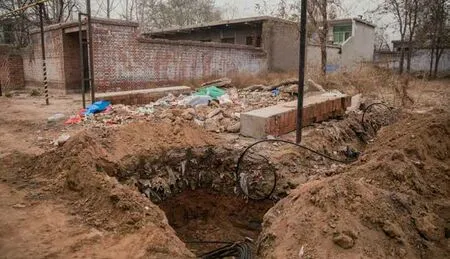
Villagers dumped or burned trash in roadside pits and riverbanks before there were waste management systems
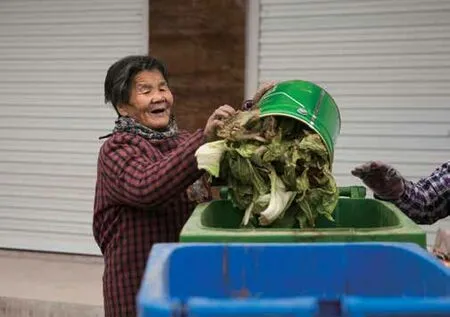
Around half of rural household waste is compostable if processed correctly
Local governments contract private companies to build incineration plants,often choosing the cheapest option.Operators are expected to make a profit, part of which returns to the local government through taxes. Lowemission incinerators are costly to build, and must be correctly operated to actually reduce hazardous output,leading some environmentalists to believe that a lack of supervision means many plants cut corners to increase revenue.
The Wuhu Ecological Centre(WEC), an NGO in Anhui province,is among those pressuring operators to disclose emissions data. The WEC found that of the 77 incinerators out of 230 that disclosed data in 2016,a quarter failed to meet China’s emission standards, which allow for 10 times the dioxins by US standards.
Thanks to stories like Baby Xie’s, protests over plans to build incineration plants have erupted across the country over the last decade in provinces like Zhejiang,Jiangsu, Hubei, and Guangdong. A demonstration in Hangzhou in 2014 left 10 participants and 29 policemen injured.
Last year, a reported 10,000 marched in Wuhan to oppose a waste-toenergy plant atop a filled landfill, with banners reading “Pollution will kill our next generation,” and “We only want a breath of fresh air.”
While the average Chinese still produces a fraction of the average American’s garbage, the World Bank predicts the country’s annual waste will reach 500 million tons in the next five years, making China by far the world’s largest producer of trash in 2025.
In 2014, Premier Li Keqiang told the National People’s Congress that the government would “resolutely declare war against pollution as we declared war against poverty.” But there are no easy solutions.
W hen I was a kid, the sky was blue. What color is the sky now?” Chen, the environmentalist,asks in an elementary school classroom in Hou’anzhuang village on the outskirts of Xingtai, Hebei province.
“White!” the children chorus on a smoggy winter day.
Seven of the ten most polluted Chinese cities are in Hebei’s industrial zone; it’s here that Chen Liwen is trying to give villagers an environmental education, including schoolchildren.
Xingtai used to be known as China’s most air-polluted city. In 2013,there were only 38 days when its air quality met national standards.For children growing up in the early 2000s, an omnipresent haze had become a hazardous norm, consisting of chemical, metallurgical, coal combustion, construction, soil, and road dust.
“Who here lives near the landfill?”Chen asks. “Does it stink?” Another affirmative chorus. Chen relates the tragic tale of Baby Xie: “This boy who was born next to a landfill is your age.Instead of going to school, he can only lie in bed every day.”
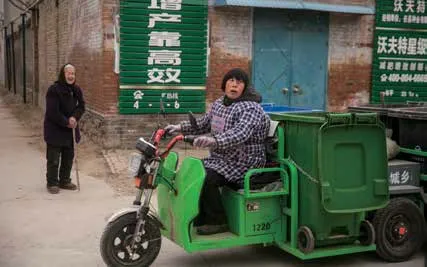
The cost of transportation,labor, and facilities are barriers to rural waste disposal services
The room falls quiet. “Why can’t he get up from bed? Because he was born near this garbage plant that polluted the air around it. Why was the garbage plant built? Because there was too much garbage.”
Chen picks up two bins—one yellow, one green. “We each have the responsibility to sort our trash.”
The students murmur in recognition:A week ago, following a town meeting about the village’s new wasteseparation plan, each household had received one of each bin. Chen is now teaching the children how to identify what goes into the compost bucket and what is non-compostable.
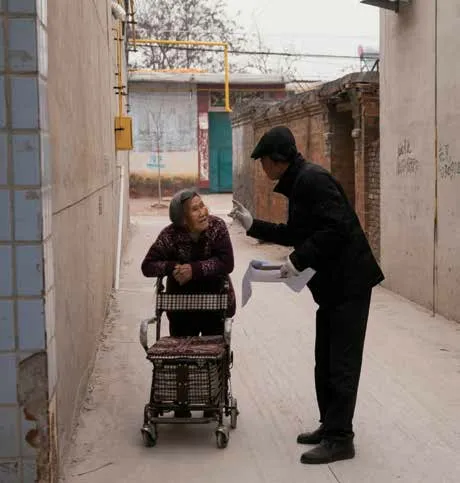
A village leader corrects improper sorting and tracks each household's waste separation record
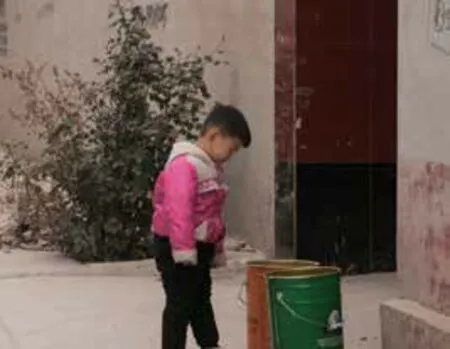
Most families will sort correctly by the third or fourth collection,advocates say
“For a long time, villagers would take their trash somewhere nearby and just dump it,” explains Wu Gailu, the former village committee secretary. “You can see the effect.”Along Hou’anzhuang’s dirt roads are pits peppered with plastic. Frozen dumpling packets, popsicle wrappers,water bottles, and empty jugs of cleaning agents jut out of the soil.
Formal garbage collection began in Hou’anzhuang just four years ago, as part of the government’s official policy called “village collection, township transfer, and county treatment,”in which waste is amassed and transferred to county landfills or incinerators.
With rising rates of trash disposal,even the Xingtai Ren County landfill, where Hou’anzhuang’s waste is bound, is growing faster than anticipated. Plant manager Wu Lifei explains that the site, opened in 2012,was designed to last until 2027, “but who knows when it will be filled to capacity.” Nearly 1.3 million tons have already been dumped there, with just 400,000 tons of capacity left.
Meanwhile, Chen has found a way to reduce the flow of rural trash by more than half—by separating waste for local compost, leaving a considerably slighter volume to be buried or burned. With eager buy-in from the local government,Hou’anzhuang village has launched a waste-separation initiative under Chen’s guidance.
As a first step, to make each household accountable for their own trash, the village removed all public trash bins. Instead, a garbage vehicle now circulates the village to collect household bins every other morning,during which each family’s progress toward proper sorting can be individually tracked. Chen personally accompanies the trash collection for the first few weeks, until she finds that most villagers can consistently and correctly sort their garbage.
Hou’anzhuang is one of 24 villages so far where Chen has gone door-todoor to establish a waste separation and local compost system, alongside communities in Hebei, Zhejiang,and Guangdong provinces. In each,Chen troubleshoots problems along the route, trains waste management employees on correct composting practices, and advises local governments on how to coordinate an efficient system of bins, waste types, and collection.
Chen and former village secretary Wu meet in front of the school at 8:30 a.m. The vehicle’s loudspeaker blares a recording of Wu’s voice on loop: “Hey, trash collection, hey! Bring out your buckets! You’ve got two,dump them correctly, don’t mix them up!”
While major cities like Shanghai and Shenzhen have begun piloting their own waste-separation and recycling system, places like Hou’anzhuang are about as far from the urban heart of China’s middle-class environmentalist movement as possible.
“Village life is a life of acquaintances,” explains Chen.“People know each other, so we can organize the community to make a tangible change. However, we can’t just come in as outsiders. We need the support of the village government.”
Ex-secretary Wu has accompanied each collection so far, greeting each family at their door in the local accent,and checking off their work on his clipboard: “X” for correctly sorted,“O” for those who have put eggshells in the dry waste bin, or styrofoam with the compost. “By the third or fourth time, most people get it,” says Wu.“It’s not too complicated.”
In the afternoon, the collection makes its way to Dadun Household Waste Transportation Center,operated by Runyi, the sanitation firm contracted to run the route. The kitchen waste is kept for household compost that any resident can collect for personal use.
So far, there are few takers. “People don’t have a concept of compost yet,” admits Wu. Some farmers in Hou’anzhuang argue that it simply doesn’t generate enough soil for serious agricultural use, although employees at Runyi have used it to cultivate their own vegetables in a small on-site garden.
“IF WE KEEP DIGGING LANDFILLS, WE’LL ALL LIVE SURROUNDED BY LANDFILL ONE DAY”
The program, though, is slowly winning converts. “I used to really think that if it’s out of sight, it’s out of mind,” a 40-year-old Runyi employee, surnamed Zheng, tells TWOC, but, “The more knowledge you have, the more confidence you have. I’m afraid that if we keep digging landfills, we’ll all live surrounded by landfill one day.”
“People always say waste sorting‘won’t work’ because people won’t follow the rules,” says Chen.“But they don’t consider that humans are capable of addressing problems.”
However, Chen notes that continued momentum is the largest challenge to her work. She had originally overseen a 70-percent reduction of landfill-bound waste in her home village of Xicai, Hebei,but the success didn’t last. Within a year, the local government’s interest in trash separation waned, and residents had gone back to their old ways. A 2012 World Bank report on waste emphasized that a successful waste treatment system “requires a strong social contract between the municipality and the community.”
Maintaining supervision is the key to the success of Dongyang, a “model county” in Zhejiang province where local officials keep strict records of villagers’ waste-sorting assessments,says Chen. The top three villages are awarded bonuses of between 4,000 -8,000 RMB—as Dongyang’s county secretary told Southern Weekend last year, “No one wants to fall behind.”
In the end, the same rampant materialism which helped create China’s trash problem may also play a part in reining it back in, at least until the burgeoning of a broader environmental consciousness. “We’ve told the people many times to recycle and teach them the importance of recycling, but no one listens to us.No one cares,” the China Plastics Processing Industry Association’s Frank Chen told the Washington Post last year. “Chinese people understand only one thing: money.”
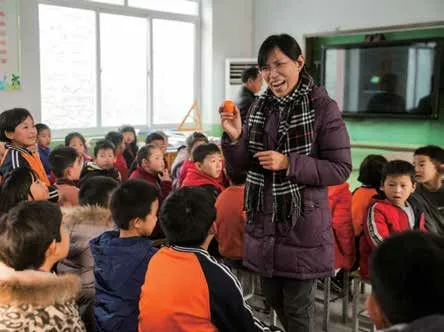
Chen Liwen quizzes elementary school students on what items are compostable
猜你喜歡
今日農業(2022年1期)2022-11-16 21:20:05
今日農業(2021年21期)2022-01-12 06:32:04
陽光(2020年6期)2020-06-01 07:48:36
陽光(2020年5期)2020-05-06 13:29:18
活力(2019年21期)2019-04-01 12:17:48
中國公路(2017年16期)2017-10-14 01:04:28
足球周刊(2016年14期)2016-11-02 10:56:23
足球周刊(2016年15期)2016-11-02 10:55:36
足球周刊(2016年10期)2016-10-08 10:54:55
中國記者(2014年2期)2014-03-01 01:38:08
