
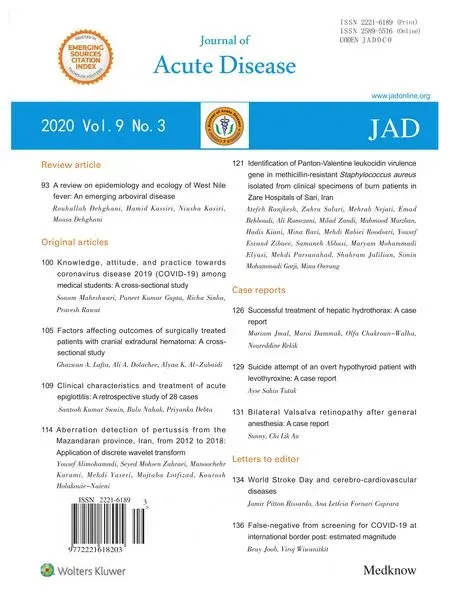
A review on epidemiology and ecology of West Nile fever: An emerging arboviral disease
2020-02-13 09:51:22RouhullahDehghaniHamidKassiriNiushaKasiriMousaDehghaniSocialDeterminantsofHealthSDHResearchCenterandDepartmentofEnvironmentHealthKashanUniversityofMedicalSciencesKashanIran
Journal of Acute Disease 2020年3期
Rouhullah Dehghani, Hamid Kassiri, Niusha Kasiri, Mousa DehghaniSocial Determinants of Health (SDH) Research Center, and Department of Environment Health, Kashan University of Medical Sciences, Kashan, Iran
2Department of Medical Entomology, School of Health, Ahvaz Jundishapur University of Medical Sciences, Ahvaz, Iran
3School of Medicine, Ahvaz Jundishapur University of Medical Sciences, Ahvaz, Iran
4Department of Environmental Science, Faculty of Natural Resources, Isfahan University of Technology, Isfahan, Iran
ABSTRACT
KEYWORDS: Epidemiology; West Nile Fever; Arbovirus; Iran
1. Introduction
West Nile virus (WNV) is an arbovirus transmitted through mosquitoes of the family Culicidae, which has been isolated from birds, horses, mosquitoes, and humans. Humans and Equidae (horses, donkeys, and mules) are susceptible to the virus.
In nature, WNV cycles between mosquitoes (especially the Culex genus) and birds. Wild birds, especially wetlands species, are the main vertebrate hosts of the virus. Some bird species can have a high concentration of the virus in their bloodstream, and mosquitoes are infected by biting and sucking blood from these birds.
As the main vectors, Culex mosquitoes are responsible for the natural WNV transmission between birds and humans cycle. Besides Culex mosquitoes, WNV transmission to humans has been reported by other species of anthropophilic mosquitoes such as Aedes[1].
The virus was first identified in birds such as crows and pigeons. The family Corvidae has a high susceptibility to the virus. Migratory birds make a major contribution to spread the disease around the world. In Europe, Africa and Asia, the mortality of WNV-infected birds is extremely low. In contrast, the virus is highly pathogenic for birds in the Americas. Horses, as well as humans, are “dead-end” hosts meaning that while they become infected, they do not transmit the virus to other objectives. The infected horses usually present with no symptoms or with benign symptoms. But in some cases, WNV can cause neurological complications, including deadly encephalomyelitis. The virus can also be transmitted via contact with infected blood or tissues. Rare transmission of the virus happened through organ transplantation, blood transfusion, and breast milk, but mother-to-child transmission and transmission to laboratory staff have been reported[2-9].
WNV is the most widely distributed Flavivirus worldwide. The virus has been found in Africa, America, Australia, southern Europe, western Asia, and the Middle East, and it has been found in the neighboring countries of Iran. WNV is a member of the family Flaviviridae, specifically from the genus Flavivirus. The family Flaviviridae includes 58 viruses which are the main health threats to humans. The genus Flavivirus includes 53 virus species, and 39 of them are transmitted by mosquitoes or ticks (soft and hard). The WNV genome contains 11 kb single-stranded RNA that encodes three structural and seven non-structural proteins. WNV is a member of the Japanese encephalitis serocomplex, which includes Japanese encephalitis, Saint Louis encephalitis, Rico and Murray Valley viruses. WNV strains have eight lineages[10-13]. The serological studies in the 1970s showed the presence of WNV antibodies in humans in several provinces of Iran. WNV is found in horses, humans, and birds in Iran. The serological studies also showed WNV infection rates of 10%-26.6% in Iran[14,15].
A serological and molecular study of 26 wild aquatic bird species in Iran from 2004 to 2007 showed a seropositive rate of 15%. In a study on the wetlands of West Azerbaijan in 2012, WNV was detected by PCR in Ochlerotatus (Aedes) caspius, indicating local transmission of the virus in the region[6]. In a study in five provinces of Iran (Golestan, East Azarbaijan, Lorestan, Mazandaran, and Guilan) in 2015 and 2016, a total of 32 317 mosquitoes belonging to 25 species were collected. Molecular study of the mosquitoes by RT-PCR revealed the presence of the virus in mosquito Culex pipiens pipiens from Sepid Rood site in Guilan province[16,17]. In a study in northern Iran, adult mosquitoes were collected including eight species with the most abundant species of Aedes vexans (33.2%), Culex tritaeniorhynchus (22%), Culex pipiens (20.7%), and Anopheles maculipennis s.l. (15.6%). The results of the molecular study on the mosquitoes showed that they were not infected with the virus[10].
In a cross-sectional study on blood donors in Tehran in 2005, all samples were negative for IgG antibody and WNV. However, the seropositive IgM antibody rate was 5% for WNV[18]. The results of a study in Isfahan province (central Iran) from 2008 to 2009 showed that 1.2% of the patients with symptoms of fever and decreased consciousness were positive for WNV tested by RT-PCR[13]. In a study from the year 2010 to 2011 in the northern and central provinces of Iran, positive antibody levels were reported in 1.3% of the human population and 2.8% of horses[19]. In a study in 2011 and 2012, the WNV antibody was confirmed in 67.4% of the serum samples collected from horses in Alborz and Tehran. From 2008 to 2009, a large-scale survey of horses in different regions of Iran showed that 23.7% of the horses were positive for WNV antibodies. The highest rate of seroprevalence was seen in the southern and western provinces of Iran (over 30%). The highest rate of infection in horses was observed in Khuzestan, Chaharmahal-Bakhtiari and Kermanshah provinces (prevalence of over 60%)[20]. In addition, in southwestern Iran, WNV antibody was reported in 70% of the horses between 2011 and 2012[21]. In Guilan province, WNV has been found in humans (1.4%-10%), horses (2.2%-25%), and birds (62.7%)[16]. WNV is probably the most important and widespread mosquito-borne arbovirus in Iran. It was identified in at least 26 of the 31 provinces in Iran using ELISA[13,20,21]. In a study in Mashhad, northeast of Iran, the overall IgG seroprevalence of the positive WNV was 11%. However, IgM antibody was not found in the participants[22]. In another study in Neka of Mazandaran province in northern Iran and Shiraz of Fars province in southern Iran, the results showed that there was a significant difference in the WNV infection rate between men (39.19%) and women (13.04%)[23].
It is significant to note that risk evaluation is a persistent proceeding. The WNV situation changes each year in the world, and it should regularly re-evaluate in the future years. Similarly, for this purpose, there is a need to update the novel evidence on the ecology and epidemiology of WNV in the globe. In recent years, various studies in Iran have confirmed the presence of WNV antibody in humans, wild birds, and animals. Considering that most of the Iranian provinces reported the confirmed cases of WNV infection, a more active surveillance and care system must be set in place to control the disease. Therefore, it is necessary to study different aspects and status of the disease in Iran.
2. Data collection
In this study, some keywords such as epidemiology, West Nile fever, West Nile encephalitis, West Nile meningitis, clinical manifestations, arbovirus, vectors, reservoirs, control, and Iran were used to search the Internet and authentic medical journals in scientific databases including Web of Science, Ovid, PubMed, Systematic Review, Scopus, Iran Medex, Scirus, Google Scholar, and Medline to reach the Persian and English papers published from 1940 to 2019. A total of 113 papers were found and 76 papers were chosen with regard to the study objectives. Accordingly, we used a random effect pattern to incorporate the early findings in this review paper.
3. History
Some pathogens, which are proven to be transmitted by Culicidae mosquitoes, are found in Iran such as dengue viruses (Flaviviridae: Flavivirus), Rift Valley Fever virus (Phenuiviridae: Phlebovirus), Dirofilaria repens and D. immitis, Sindbis virus (Togaviridae: Alphavirus), Plasmodium spp., and WNV. Meantime, there is the possibility of several other mosquito-borne viral outbreaks like the Japanese encephalitis virus (Flaviviridae: Flavivirus) in the World Health Organization Eastern Mediterranean Region[10].
WNV was first isolated in 1937 from a woman from the West Nile region in Uganda[24]. It was detected in birds (crows and pigeons) in the Nile delta region in 1953. Before the year 1997, the pathogenic properties of WNV had not been diagnosed, but then, a very virulent strain in Israel killed many birds who showed the symptoms of encephalitis and paralysis. A WNV strain from Israel and Tunisia entered in New York in 1999, causing an extensive and large outbreak across the USA. The WNV outbreak in the USA (1999-2010) highlighted the importation and establishment of vector-borne pathogens outside their current and main habitat representing a serious danger to the world. Meanwhile, few human cases of WNF have been reported in Central and South America, but the virus has been found in field specimens by performing surveillance operations. Therefore, there is a potential and risk of disease outbreak in humans in these regions. The biggest outbreaks happened in Israel, Russia, the USA, Greece, and Romania. The foci of the outbreak are on the birds’ major migratory routes. The WNV virus inset to the USA in 1999 and is now widespread from Canada to Venezuela. The largest outbreak of WNV infection in Europe to date was in Romania during 1996 and 1997 with over 500 clinical cases and 10% of deaths. Human infections attributable to WNV have been reported in many countries for over the last 50 years[3-9,25,26].
4. Prevalence
Between 1999 and 2010, over 2.5 million people infected with this virus were confirmed worldwide. Of them, 12 000 people developed encephalitis and 1 300 people died. According to the data released by the European Center for Disease Prevention and Control in 2018, a total of 401 cases of WNF infections were reported, including 22 deaths in humans. Various studies have been conducted on WNV infection in Djibouti, Iran, Jordan, Morocco, Pakistan, Palestine, Qatar, Saudi Arabia, Tunisia, and the UAE, etc. The most infected countries were Serbia, Italy, Greece, Hungary, and Romania with 126, 123, 75, 39, and 31 patients, respectively in 2018. According to the report of the Centers for Disease Control and Prevention in 2018, a total of 2 544 WNF cases were reported in the USA, of which 1 594 cases (63%) suffered from neurological disease (encephalitis and meningitis) and 950 cases (37%) of non-neurotic. A WNV study in the Middle East in 2018 reported specific WNV antibodies in Iran (0%-30%), Iraq (11.6%-15.1%), Egypt (1%-61%), Djibouti (0.3%-60.0%), Jordan (8%), Lebanon (0.5%-1.0%), Libya (2.3%), Morocco (0%-18.8%), Pakistan (0.6%-65.0%), Sudan (2.2%-47.0%), and Tunisia (5.3%-15.9%). The RNA of WNV was also found in Iran (1.2%), Pakistan (33.3%), and Tunisia (5.3%-15.9%). Specific WNV antibodies were reported in various animals in the Eastern Mediterranean region. The highest seropositivity was observed in horses (100% in Morocco) and dogs (96% in Morocco). In addition, the highest seropositive WNV infection was found in birds in Tunisia (23%)[3-9,27-28].
The highest prevalence of WNV among domestic animals (including dogs) has been reported in Morocco, Pakistan, Israel, and Iran. The high levels of positive antibody and the geographical spread of infected animals indicate the favorable conditions for WNV circulation in these countries. Therefore, stronger precautionary measures should be taken in these areas to reduce the risk of transmission among humans and horses. The high prevalence of the virus in dogs and horses suggests that these animals should be given special attention in the WNV surveillance and control program. The infection of these animals with the virus changes the serum so that it is possible to predict conditions of the disease spread in human society. Studies have shown that serum changes in dogs occur six weeks before the emergence of human WNV cases. This means that the disease has already become epizootic and greatly increases the risk of spread in the human community[29-32].
5. Symptoms
The incubation period of WNV is 3-14 d. Nearly 80% of people with WNV infection were asymptomatic. In about 20% of cases, WNF was manifested with symptoms such as fever, headache, fatigue, body aches, nausea, vomiting, swollen lymph nodes, and sometimes rash on the body. In most cases, the symptoms disappear 7-10 d later. One in five people with the disease showed fever and other symptoms. Approximately 1 in 150 people infected with the virus (less than 1% of infected people) developed a severe and acute form of WNF, also called neuroinvasive disease, which includes West Nile encephalitis, West Nile meningitis, and West Nile poliomyelitis. Severe symptoms of the disease include headache, high fever, neck cramps, dizziness, confusion, tremor, convulsion, muscle weakness, and paralysis. The severe and acute forms of the disease occur at all ages, but those older than 50 years with weak immune systems (including organ transplant patients) are more prone to develop a severe form of the disease. In rare cases, WNV infection can lead to death. The mortality rate in patients with the neural form of the disease is 4%-14%[3-9,27-28].
6. Diagnosis and treatment
Diagnosis of WNV is based on virus detection through PCR, virus isolation through cell culture, detection of elevated IgG titers in serum using ELISA, and IgM detection in serum or cerebrospinal fluid using ELISA. IgM can be detected when clinical symptoms are present. This immunoglobulin may remain for more than 12 months. The vaccine has been developed for horses but there is no human vaccine yet. The treatment of WNV patients includes hospitalization, intravenous fluid injection, respiratory support, and prevention of secondary infection. The recovery span of WNV infection is often accompanied by muscle pain and long-term weakness, but no further symptoms will show after recovery. Children recover faster than adults in most the cases[3-5,9,27].
7. Reservoirs and life cycle
WNV infection has also been reported in rats and wild ruminants[33,34]. Incomplete information on the prevalence of WNV infection in wild animals is one of the challenges for disease control in human society. Adequate knowledge and information on the reservoir infection and circulation of the virus among wild animals play an important role in predicting WNV outbreaks and epidemics in human society. Studies on wildlife are necessary to better clarify the status of infection in these hosts[35]. Among them, birds play a significant role in the maintenance and expansion of WNV. Therefore, conducting bird studies is of crucial importance. Some bird species may have high levels of the virus in their bloodstream, and mosquitoes are infected by biting and sucking blood from these birds. One week after receiving infected blood, mosquitoes can transmit the virus to other objectives. So, monitoring and surveillance of WNV infection among birds (especially in areas with favorable ecological conditions for birds and mosquitoes) is of particular importance. In this case, a better understanding of birds’ migration pathways could be helpful in selecting the most likely locations for virus tracking and subsequently judging areas that may be new focal points for the emergence and spread of WNV[36,37]. Mosquitoes and birds are currently considered to have a key role in the life cycle of the virus[11,38-40]. Anyway, more than 30 of other vertebrates are possible reservoirs for WNV. These animals, such as lemurs, frogs, hamsters, squirrels, rabbits, and chipmunks have high levels of the virus in their blood and can infect vector insects. Therefore, more attention should be paid to the role of these animals in natural rotation and outbreaks of WNV in future research[3]. The important point is that elimination of blood-sucking sources in the wildlife can lead to an increased incidence of human disease, because by eliminating food sources (through killing dogs and possible species in wildlife reservoirs), mosquitoes would meet their blood need from humans. This is very likely to happen near towns and villages[41-45].
8. Vectors
In many countries, the main WNV vectors are Culex pipiens and Culex tritaeniorhynchus. In the eastern Mediterranean region, the main vector of the disease was reported to be Culex pipiens pipiens s.l. which is proven in Djibouti, Egypt, Iran, and Tunisia[11]. Among mosquitoes, the virus is transmitted through saliva. The virus is transmitted to the next generation of Culex mosquitoes through their eggs. So far, more than 60 species of the family Culicidae have been reported to be infected with WNV. But finding the virus in a species should not mean that it is an important and capable vector for the transmission. WNV has been found not only in Culex but also in Aedes and Mansonia. Additional studies are necessary to further clarify the potential role these species play in the maintenance and transmission of WNV. Interestingly, WNV infection was observed in ticks-Argas reflexus hermannii that are important pests of birds. Meanwhile, studies from other regions of the world detected the RNA of WNV in ticks-Rhipicephalus turanicus and mites-Dermanyssus gallinae and Ornithonyssus sylvarum. In addition, a WNV strain was isolated from ticks-Dermacentor marginatus in the Caucasus. However, the role and ability of ticks and mites as WNV vectors have been less studied[46].
9. Prevention
In the absence of a good vaccine to prevent WNF in humans, the only way to reduce infection in individuals is to raise awareness about risk factors and educate people about what they can do to reduce exposure to the virus. Carrying out prevention programs for this disease requires the presentation and implementation of detailed and extensive monitoring programs, as well as the implementation of vector control operations in the countries involved. Studies should be conducted to identify local species of mosquitoes that transmit the virus between animal reservoirs, as well as species that may transmit the virus from birds to humans[4,9]. Wearing gloves and other protective clothing can reduce the risk of the transmission when slaughtering the infected poultries. Reducing transmission risk through blood transfusion and organ transplantation is also significant. After evaluating the local/regional epidemiological situation, blood and tissue donation restrictions and laboratory testing should be established at the time of the outbreak in the affected areas. Health care staff should take standard infection control precautions when treating patients with suspected or confirmed WNV infection or sampling them. Samples of individuals and animals with suspected WNV infection should be examined by trained personnel working in well-equipped laboratories[47,48]. The use of live or dead virus vaccine has been tested. The most important advantages of the vaccines made from attenuated viruses are that they produce a balanced immune response and that the resulting immunity is longer lasting than killed vaccines[49-52]. The major concern in using WNV live vaccine is its safety. Among major concerns over the live vaccine is that the vaccine may contain unknown factors or that the live virus in the vaccine may cause disease in some of its recipients[49].
10. Ecology
Given the presence of WNV in mosquitoes, wetlands, and populations of migratory birds and horses in Iran, accurate monitoring of the disease cycle by health staff is essential to control the disease and to reduce the mosquito population to the lowest level possible. On the other hand, migratory birds, horses, dogs, and other animals must be closely monitored. Hunting and killing of migratory birds, dogs, and other animals that live in urban and rural areas increase the risk of deviating zoophilic mosquitoes toward humans, thereby increasing the risk of transmitting diseases, especially WNV to humans.
In this case, vectorial capacity is increased in mosquito vectors that may have a potential role of the reservoir in viral diseases. Dogs, on the other hand, are carnivorous animals that can feed the carcasses of migratory dead birds or possibly reservoir birds and play a useful role in environmental cleanup. It is necessary to provide an active animal health surveillance system to detect new cases of infection in animals (especially in horses and birds) in order to give an early warning. People should be trained to report dead bird cases to local authorities. In addition, given the increasing trend in reports of human WNF cases and the likelihood of more disease outbreaks in the coming years due to climate change and global warming, physicians, laboratory scientists, and health surveillance staff need to pay more attention to clinical symptoms of the disease in humans, especially in the foci of the disease.
11. Situation in Iran
Reducing virus transmission is one of the main strategies to control arboviral diseases. Therefore, additional efforts to identify primary and secondary vectors, and the extent of the relation between vectors and infected reservoirs are among the strategies for disease control[53].
The mosquitoes of the subfamily Culicinae are one of the most common household pests in Iran. They are scattered throughout Iran, causing more damage to people, and contributing to the transmission of diseases including WNV compared to other household pests[17,18,54]. Sixty-nine species of mosquitoes from the family Culicidea have been reported in Iran. Of these, 39 are from the Culicinae subfamily, and others including Culex pipiens, Culex quinquefasciatus, and Culex tritaeniorhynchus are also important vectors of the WNV[55-62]. Ticks are blood-sucking arthropods that live on mammals, birds, reptiles, and amphibians as ectoparasites, and nearly all of them are capable of sucking blood from humans. Ticks are composed of hard ticks (Ixodidae) and soft ticks (Argasidae)[63]. Hard ticks transmit more diseases for having multiple hosts[64-66]. Due to the abundance of ticks in Iran, numerous cases of bites and diseases transmitted by them have been reported from different areas. Over 30 species of ticks have been identified in Iran from families Ixodidae and Argasidae[67-69]. Therefore, these arthropods may play a role in transmitting the West Nile infection, but so far, no WNV transmission by these arthropods has been reported in Iran. However, researchers have elucidated the role of different species of hard and soft ticks in West Nile transmission around the world[70,71]. Mites are among the arthropods that may contribute to the transmission of the WNV, which belong to the order Acarina, and some of which continue to live by sucking blood from wild animals. Rodents, mammals, and birds are a source of blood for mites, so they can play a role in WNV transmission. Dozens of mite species have been identified in Iran[7,72-76].
Conflict of interest statement
The authors report no conflict of interest.
Acknowledgments
The authors would like to thank Research Health vice-chancellery of Ahvaz Jundishapur University of Medical Sciences and Kashan University of Medical Sciences for their cooperation.
Authors’ contribution
All authors participated in the research design and contributed to different parts of the research.
 Journal of Acute Disease2020年3期
- Journal of Acute Disease的其它文章
- Bilateral Valsalva retinopathy after general anesthesia: A case report
- Suicide attempt of an overt hypothyroid patient with levothyroxine: A case report
- Successful treatment of hepatic hydrothorax: A case report
- Identification of Panton-Valentine leukocidin virulence gene in methicillinresistant Staphylococcus aureus isolated from clinical specimens of burn patients in Zare Hospitals of Sari, Iran
- Aberration detection of pertussis from the Mazandaran province, Iran, from 2012 to 2018: Application of discrete wavelet transform
- Clinical characteristics and treatment of acute epiglottitis: A retrospective study of 28 cases