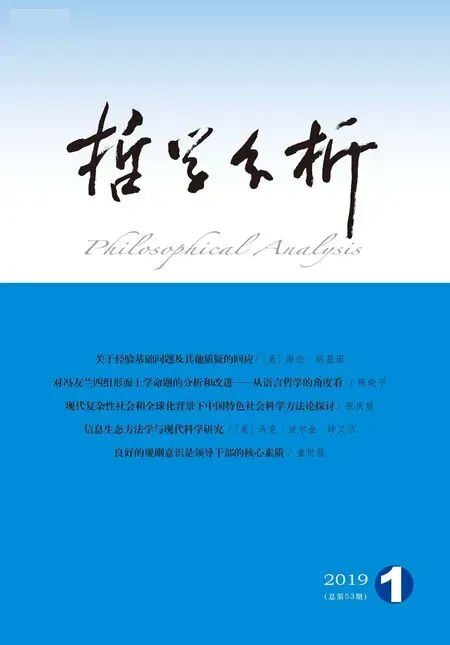
Abstracts and Key Words
2019-12-14 01:14:51
哲學分析 2019年1期
● An Enactivist Defense of Longino’s Critical Contextual Empiricism
HUANG Xiang
Abstract:Helen Longino’s critical contextual empiricism (CCE) can be understood in two versions. The weak version claims that in scientific practices social factors are necessarily involved in the epistemology of science. The strong one contends that some social factors are consitituents of the epistemological processes of science. The weak version has been accepted by most scholars whereas the strong one is more controversial. The paper deals with the gap between the two versions. Firstly, it shows that a similar gap exists in the area of embodiment approach in cognitive sciences; and secondly, it argues that the strategy of the enactivist theory to fill the gap may help to fill the CCE gap. The similarity of the two gap-filling strategies is not accidental but implies that the enactivist resources may provide a better way to defend CCE.
Key words:critical contextual empiricism; Helen Logino; enactivist approach; embodied cognition
● Critical Contextual Empiricism as a Version of Realism
Peeter Müürsepp
Abstract:Critical contextual empiricism has enabled to bring the social and normative aspects into the treatment of the understanding of science. Practical realism also gives the cultural and normative aspects an influential role in making sense of science. A comparative analysis of the two shows that the former can actually been taken as a version of realism. As a result of combining the two, a new version of realism that can be developed on their basis could be called “pluralist social realism”. After discussing map analogy and aimoriented empiricism which analyse the problem of under-determination, and with the help of the recent research by Helen Longino, the final conclusion of the analysis is that pluralist social realism is possible but even this development does not look promising in providing a conclusive solution of the problem of under-determination because the god’s eye view is missing.
Key words:aim-oriented empiricism; critical contextual empiricism; realism; under-determination
● Between Facts and Norms: Some Notes on CCE
MENG Qiang
Abstract:Critical contextual empiricism (CCE) proposed by Helen Longino is the third way between social studies of science (SSS) and philosophical studies of science. In part one I will point out that the rational-social dichotomy is not an objective way to describe the relationship between philosophy of science and SSS. Part two will trace the origin of epistemic normativity to Kant’s problem of rights. Part three will argue that the object of philosophy of science is science as ideal, while the object of SSS is science as practice. Part four will focus on the first two keywords of CCE: empiricism and context. Part five will analyze the third keyword: critical. Finally, I will question the necessity of normativity in understanding scientific knowledge.
Key words:critical contextual empiricism; Helen Longino; social studies of science; normativity
● A Response to the Problem of Experience Grounds and Other Questions
Helen E. Longino
Abstract:Critical contextual empiricism emphasizes the ground of evidential relevance of empirical content. It appeals to some certain dynamic and reliable background assumption between data and hypotheses. And it also gives four social norms through considering the critical interactions between/in communities. Longino points out that the dichotomy of “rational-social” is caused by misunderstanding of the concept of knowledge, and that the four social norms come from the image of science itself. Compared with the enactivism approach in cognitive science, critical contextual empiricism mainly focuses on the process of scientific inquiry, which is related to science about public knowledge. As realism, both critical contextual empiricism and practical realism reject the possibility of the eye of god, but there are still differences on metaphysics and normative issues.
Key words:critical contextual empiricism; norms; interaction
● Analyses and Improvements of Feng Youlan’s Four Groups of Metaphysical Propositions: From the Point of View of Language Philosophy
CHEN Xiaoping
Abstract:Feng Youlan approved the rejection of traditional metaphysics by logical empiricism, but not the rejection of all metaphysics. Therefore, he proposed a kind of metaphysics that is logically analytical and irrelevant to the reality, which mainly includes four groups of propositions and four relevant concepts: Li (Principle), Qi (Matter), Dao Body and Big Whole. The linguistically analytic metaphysics created by Feng Youlan has its important theoretical significance, but there are some defects in its arguments and some problems unsolved. This paper will make some supplements and improvements for the four groups of propositions and their arguments one by one. The key measure is to distinguish the language world from the empirical world , thereby let the four concepts of Li, Qi, Dao Body and Big Whole exist in the language world. In this way, the metaphysics related only to the language world is insulated from the empirical world, and hence the “linguistic turn” is realized in the metaphysics.
Key words:Feng Youlan; metaphysics; logical empiricism; linguistic turn; ontological commitment
● The Metaphysical Dimension of Kant’s Concept of Personhood
JIANG Lu
Abstract:This papers points out the necessity of a clear distinction between “person” and “personhood” in Kant’s philosophy. Based on Kant’s texts, it gives a definition and explanation of both concepts. The purpose is to show from the perspective of the discussion about the reality of personhood how this concept offers a metaphysical foundation for core ethical concepts like obligation, morality and accountability.
Key words:Kant; personhood; practical philosophy; meta-ethics
● On the Constitutive-Regulative Division in Kant
LU Xinyu
Abstract:The constitutive-regulative division concerns fundamental problems of Kant. The transcendental dialectics proclaims the bankruptcy of traditional metaphysics, but it also indicates that the metaphysical tendency rooted in reason is legitimate as the ideal of reason. If an ideal (say, the unity of presentation) is mistaken as a constitutive principle, it shall generate a metaphysical entity (correspondingly, the idea of soul), which is the transcendental illusion of reason. However, if it is taken as a regulative principle, then it shall guide the application of understanding and moral practices. The basic structure in preserving the rationality in metaphysics is to turn a Platonic idea into an ideal. According to Kant, the thing in itself is the solely true ideal for human reason.
Kant is known for limiting knowledge in order to make room for belief. Noticeably, the knowledge is specifically metaphysics, and the Kantian belief is ideal, which is the direction by an idea for understanding and actions of the subject, even though the idea itself is inexplicable. Both theoretical belief (doctrinalen Glauben) in scientific research and moral belief (moralischer Glaube) are the regulative application of reason. In sciences, the concept of nature in its totality and teleology is regulative idea, which enlightens researchers to concretely discover comprehensive and coherent explanations for various phenomena by hypotheses and experiments. In moral practices, ideas motivate human to follow the law of reason, as if the ideas exist.
In sum, in the division, for an idea X, “X exists” is not a necessary condition for “X is meaningful”. The meaning of X is to enlighten and motivate praxis, rather than to describe facts. The confusion between constitutive and regulative principles leads to various transcendental illusions in metaphysics. After the failure of constitutive principles of reason in transcendental realm, regulative principles function as the ground for appearance (as thing in itself) and the guidance of morality (as ideals). There remains a hope of modernity in the Kantian constitutive-regulative division, namely: reason is not mortal.
Key words:Kant; constitutive-regulative; transcendental dialectics; idea; thing in itself
● Discussion on Methodology of Social Science with Chinese Characteristics in the Context of Modern Complex Society and Globalization
ZHA NG Qingxiong
Abstract:The methodology of social science with Chinese characteristics has developed under the background of modern complex society and globalization. The discussion that practice is the test of truth was significant at the beginning of reform and opening-up 40 years ago. It started the voyage for the development of the methods of social science with Chinese characteristics in the new era. From the perspective of methodology concerning social sciences, this is the result of the combination of realistic attitude and revolutionary idealism. Social practice includes two aspects: ideal and reality. The ideal must be combined with the reality, and the theory must be combined with practice. Therefore, we must follow the objective logic of social development and constantly reflect on the problems in social practice. This is the key point of the methodology of social science with Chinese characteristics. There are also very complex situations and difficulties on our way forward. Keeping this in mind, in order to achieve more great achievements of the construction of the socialism with Chinese characteristics, we must make a systematic analysis of the complexity of modern society, and further study the relation between the idea of community of shared destiny by mankind and the objective logic of globalization.
Key words:practice tests; rational reflection; modern complex society;globalization; methodology
● The Idea of a Global History of Philosophy
Gunnar Skirbekk
Abstract:As which is delimited to those who raise some epistemic claims, some validity claims, to the extent that they operate with some degree of a “give and take” of arguments, of reasons of some kind, our restrictive definition of philosophy, emphasizing the importance of epistemic claims, leads toward a broadened conception of the history of philosophy. In short, in addition to seeing each thinker alone, according to his or her own approach and presuppositions, it is also worthwhile looking at references and argumentations between various thinkers. Moreover, philosophers also relate to epistemic claims raised by the various sciences and humanities, some epistemic claims inherent in political ideologies or in religious and cultural convictions, and respond to, various challenges and events in human history. That is, a history of philosophy should at the same time be conceived as argumentative and situated. In our contemporary world, This kind of philosophy is a broad history of philosophy, a global history of philosophy, that rightly can be seen as a history of global modernization,with its focus on the development of various forms for reason and rationality and their historical and institutional “situatedness” -both as common modernity and as multiple modernities.
Key words:philosophy; epistemic claims; a global history of philosophy; the socio-historical situatedness; common modernity; multiple modernities
● Methodology of Information Ecology for Academic Studies
Mark Burgin, ZHONG Yixin
Abstract:The information about anything is referred to the states and the pattern of the state changing, all presented by the thing. The academic study about any discipline is the processes to acquire and manipulate the information and refine the knowledge from the information about the discipline. Therefore, the process of academic studies is indeed a kind of information process. On the other hand, the academic studies in contemporary time are normally the studies of inter-disciplinary studies, rather than a single disciplinary study. As result, the ecological rules should be observed. It is believed that the methodology of information ecology will provide the researchers with efficient methods to better understand the information contained in all disciplines and to better utilize the information for refining the knowledge and to raise the academic quality and level. Then, what is the methodology of information ecology? How to raise the academic level and quality through the utilization of the methodology? The basic concepts and principles will be explicated in the paper.
Key words:information ecology; inter-disciplinary studies; utilization of the methodology
● The Evolution of Knowledge Production Mode in the Internet Age and the Pros and Cons Discussion
LI Jingrui, XIAO Feng
Abstract:The Internet age is driving the evolution of knowledge production mode from traditional knowledge production to internet knowledge production. Compared with traditional knowledge production, internet knowledge production has led to the new transformation of knowledge production: the tools and media have been transformed from traditional artificial solid into computers and virtual internet. The subject of knowledge production has moved from the traditional knowledge elite to the Internet citizens. The knowledge production mechanism has been relatively closed to open. The subject of knowledge production has been “physical presence” to “virtual presence”. These changes have brought great convenience to human knowledge production and creation, and inevitably accompanied by corresponding deficiencies. It has a lot of theoretical and practical significance for the knowledge production of human being to discuss and differentiate the evolution and its advantages and disadvantages.
Key words:electrical network; knowledge production mode; internet knowledge production; evolution; pros and cons