Techniques of Defamiliarization in Atonement
2019-09-10 05:00:40李珺婷
校園英語·月末 2019年8期
【Abstract】Regarded as the most sweeping and expansive novel of the Booker Prize winner Ian McEwan, Atonement tells a story about love, crime and war with an impressive feature of construction and deconstruction. This paper seeks to analyze the novel’s narrative structure and its language strategy from the perspective of the defamiliarization theory. The former shifts from one character to another while the latter manifests itself in fragmentization and retardation of information.
【Key words】Atonement; Defamiliarization; Narrative Structure; Retardation
【作者簡介】李珺婷(1999.01.28-),女,漢族,江蘇徐州人,上海外國語大學國際教育學院,本科在讀,研究方向:語言文學。
I. Introduction
The major events of the novel occur one day in the summer of 1935. Briony Tallis, a hyperimaginative 13-year-old girl who sees her older sister Cecilia mysteriously involved with their neighbor Robbie Turner, a fellow Cambridge student subsidized by the Tallis family, mistakenly identifies him as the one who assaults her cousin Lola on the ground that night; on her testimony alone, Robbie is jailed. Five years later, she begins to come to terms with what she has done and offers to make amends to him and Cecilia, now together as lovers. However, the novel discloses itself in the epilogue that all above is just a literary confession which has taken Briony a lifetime to write. Contrary to the work, Robbie died of septicemia in the Retreat of Dunkirk in 1941 while Cecilia was also killed in the blast at Balham Underground station.
In the work, McEwan masterfully employs the technique of defamiliarization, in which case, he challenges the readers’ expectations and jars their sensibilities as they explore. Readers are forced to see the story from a different perspective and thus achieve a prolonged aesthetic experience.
II. Application of Defamiliarization in Atonement
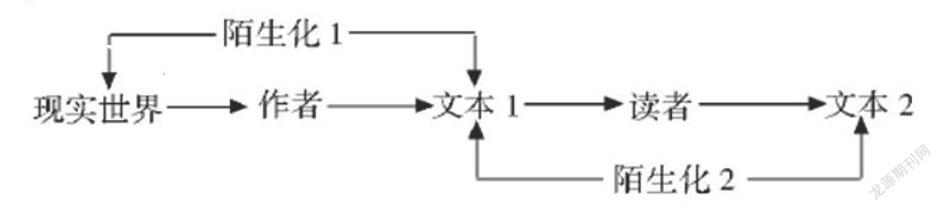
The concept of defamiliarization is first introduced by Viktor Shklovsky in his seminal essay “Art as Device” (often translated as “Art as Technique”) in 1917. It refers to the artistic technique of presenting common things to audiences in an unfamiliar or strange way in a bid to enhance perception of the familiar (Lawrence, “Victor Shklovskij”209-219). Both the author and the reader are involved in this process (see fig. 1).
Fig. 1. Effect of Defamiliarization; Mei, Ziman. “the Aesthetic Effect of Defamiliarization” Journal of Zhejiang Business Technology Institute 3(2004): 48.
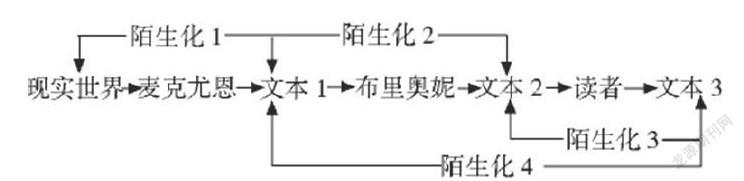
In Atonement, the process is more complicated and ingenious. Due to the fact that the first three parts of the novel (Text 2 in Picture 2-1) are created by the protagonist, set as a writer as well, readers have to interpret Briony’s work before McEwan’s. They are forced to reexamine and correct their judgements of characters and events (Defamiliarization 3 and Defamiliarization 4 in fig.2) when they detect inconsistent information in different versions. Such kind of constructing and deconstructing dramatically increase the length and difficulty of their comprehension and great possible effect can be attained by this impediment and slowness of perception.
Fig. 2 . Effect of Defamiliarization in Atonement; Du, Weiping. “Ian McEwan’s Free Realm——On Defamiliarization of the Narrative Structure of Atonement.” Journal of Shanxi University (Philosophy&Social Science) 32(2009) :61.
The completeness of the artistic effect of Defamiliarization relies on the distinct narrative structure and the language strategy applied in the story.
A. Multithreading Narrative Structure
McEwan creatively employs a spindle structure which greatly enriches the depth of readers’ aesthetic experience. To be specific, Atonement is comprised of four parts from different perspectives. They are respectively a series of events of Tallis family from Young Briony’s view, cruelty of WWII from Robbie’s view, writing and nursing experience of Adult Briony and confession and reflection from the 77-year-old writer Briony. It is noticeable that these three lines develop respectively but they drive the narrative as a whole at the same time. Scenes, narrative angles and focalizations shift from one to another and the original cohesion and logic of the narrative will be broken. As a result, great flexibility and instability brought by the structure offer readers a sense of uncertainty and encourage them to create the vision from the deautomatized perception rather than automatism. Also, using this method can bring them a more comprehensive and objective angle to review the whole story through self-renovation and self-correction.
B. “Cognitive Violence in Narration”
What’s more, shifting from different narrative perspectives breeds the fragmentization of the information. Such retardation and impediment of information flow also contribute to the effect of defamiliarization.
The first three parts are written from a third-person voice and a seemingly omniscient point of view, however, the truth is that, the narrator Briony who once wanted judgement, inevitably integrates some personal feelings and subjective elements in presenting the story. For example, she shows us the crime in the first part while deliberately omitting describing the pain of being framed and separation of lovers out of guilt. Likewise, in the second part, the author sheds much light on the bloodiness of war in the hope that war can take her place to be responsible for tragedies of the separated couple. That can also explain for the emphasis on her ambition and effort to atone by writing in the third part.
Despite the fact that above parts serve as perfect complement to each other and offer readers novel pleasure during interpreting and exploring, on the flipside, the author suggests the harm of “the Cognitive Violence in Narrative” in literature, namely imposing one’s own cognitive schema upon others usually with the method of falsification, confabulation, revisionism and so on(Strawson 443).
III. Aesthetic and Provoking Implications
A. Artistic Effect with Lingering Aftertastes
By applying the theory of defamiliarization both in the structure and narrative, McEwan brilliantly renders the old topic of love and redemption fresh and reveals the world anew. Readers tend to first assume Briony’s work as the truth but with the disclosure of plots, a sense of uncertainty creeps up on their mind. When the so-called reality blurs, they had to reexamine and correct their previous cognition about the context. Until the 4th part, they finally realize that the reunion of the couple is fictional and her enduring efforts for atonement are completely futile. Thus, their surprise and pity reach a peak and the utmost emotional experience can be achieved by then. The unconventional way of writing really challenges readers’ expectations and breaks their mental set so that they can chew the endless aftertaste triggered by defamiliarization.
B. Thought-provoking Connotation of Human Nature
Apart from providing mental pleasure, McEwan also devotes himself to reflecting human nature through writing. Just as he said in the interview, “I look on novels as exploratory, forms of investigation, into the human condition.” What he seeks to reveal in Atonement is more than Briony’s crime itself but“how it is perceived through her love of literature and her burning ambition to be a writer (from his interview with Sutherland). ” Hence, he explores humanity by contrasting the protagonist’s confession and selfish desire, trying to illustrate how human live paradoxically in the moral dilemmas and with stressed minds in action without losing a keen sense of the body’s terrible fragility. His perceptiveness gives life to the literary work and that will have readers applauding.
IV. Conclusion
In sum, Atonement is a masterpiece of astonishing depth and humanity. It exquisitely depicts a big picture about love and war, crime and absolution, forgiveness and confession and even more, the danger of writing. Ian McEwan brilliantly employs a narrative structure of defamiliarization to challenge reader`s expectations and enhance their aesthetic experience. Need of constructing and deconstructing also motivates their initiative to explore the theme and reflect the vulnerability of human heart mirrored in the story.
References:
[1]McEwan, Ian. Atonement[J]. New York: Anchor Books,2003.
[2]Lawrence, Crawford. Victor Shklovskij: Différance in Defamiliarization[J]. Comparative Literature,1984,36:209-219.
[3]Finney, Brian. Briony’s Stand against Oblivion: The Making of Fiction in Ian McEwan’s Atonement[J]. Journal of Modern Literature,2004,27:68-82.
[4]Cryer, Dan. A Novelist on the Edge. Newsday, 24 Apr 2002.20 May 2019[OL]. https:// www. bath literature review. com /articles/exploring-narrative-time.
[5]Sutherland, John. Life was clearly too Interesting in the War. Guardian, 3Jan2002,20. May 2019[OL]. https://www. The guardian. com/ books/ 2002/ jan/ 03/ fiction. ianmcewan.
[6]Strawson, Galen. Against Narrativity[J]. Ratio,2004,17:428-452.
[7]Phelan, James,Trans. Shen Dan. Narrative Judgments and the Rhetorical Theory of Narrative: Ian McEwan’s Atonement[J]. Jiangxi Social Sciences,2007,1:25-35.
[8]Mei, Ziman. “the Aesthetic Effect of Defamiliarization.” Journal of Zhejiang Business Technology Institute,2004,3:46-50.
[9]Du, Weiping. Ian McEwan’s Free Realm——On Defamiliarization of the Narrative Structure of Atonement[D]. Journal of Shanxi University (Philosophy&Social Science),2009,32:60-63.
[10]Huang, Yichang. Inquiry into the Complexity of Humanity: On the Effect of Deconstructive Narration in Atonement[J]. Journal of Foreign Languages,2010,33:89-94.
[11]Jiang, Nan. Play in the Play: the Instability of the Text in McEwan’s Atonement[J]. Journal of Guangxi University(Philosophy and Social Science,2008,30:148-149.
[12]Zhang, Helong. Epic of Human heart: the Instability of McEwan’s Atonement[J]. Foreign Literature Dynamics,2008,2:20- 22.
[13]Chen, Rong. Historical Novel and its Metafictional Ending: Reading Ian McEwan’s Atonement[J]. Foreign Literature,2008, 1:91-98.
[14]Zou, Tao. Violence and Atonement in Ian McEwan’s Atonement [J]. Contemportary National Literature,2011,4:67-73.
猜你喜歡
華人時刊(2022年13期)2022-10-27 08:55:52
中學生天地(A版)(2022年6期)2022-07-14 12:39:26
當代陜西(2022年4期)2022-04-19 12:08:52
軟件導刊(2022年3期)2022-03-25 04:44:48
當代陜西(2021年15期)2021-10-14 08:24:24
大學(2021年2期)2021-06-11 01:13:48
大學(2021年2期)2021-06-11 01:13:12
海峽姐妹(2020年12期)2021-01-18 05:53:08
民主與法制(2020年16期)2020-08-24 06:54:50
福建基礎教育研究(2019年9期)2019-05-28 01:34:27