Gender Differences in Expressing Gratitude
2019-09-10 07:22:44汪菁
校園英語·月末 2019年8期
【Abstract】The gender-linked language effect has aroused researchers’ attention for more than 30 years. This study tried to investigate gender differences in the codes Chinese EFL learners employ for expressing gratitude. 30 participants (15 male and 15 female) were selected from the freshmen at one university in Beijing. They were asked to complete a writing task about expressing gratitude based on the general process model for the gender-linked language effect proposed by Anthony Mulac (2012). The findings suggested that female Chinese EFL participants use gratitude codes more than the males.
【Key words】gender; gratitude; Chinese; EFL; sociolinguistics
【作者簡介】汪菁,北京師范大學外文學院。
1. Introduction
Language has the communicative function. In order to reach successful communication, people should acquire pragmatic competence, which refers to “the ability to perform language functions in a context” (Taguchi, 2008, p.34). One of the most commonly used speech acts in everyday communication is the expression of gratitude. People express gratitude through words of thanks, praise or appreciation (Zarei, 2011). It’s quite important to understand the expression of gratitude for EFL learners.
Expression of gratitude varies with culture. Hymes (1992) said that “thank you” is used more commonly in American English as an expression of gratitude, while in British English it is more a formal marker. Except cultural differences, gender differences should be taken into account as well. Mills (2003) stated that gender play an important role in deciding which strategies should be used in different situations. Kashdan, Mishra, Breen and Froh (2009) found out that men’s expression of gratitude is less familiar and more discomforting compared with women’s. Besides, men’s expression seems to be more challenging and anxiety provoking. Fauziyah (2010) compared and contrasted gratitude expressions and responses between male and female characters in the movie Rachel Getting Married. The results indicated that women tended to be more polite in expressing gratitude in all kinds of conditions and situations. Cui (2012) has once investigated the expressing gratitude among speakers from various language and cultural backgrounds. The data from non-native speakers suggested that generally women are not only more likely to express thanks than men, but also using more lengthy expressions in the expression.
2. Research design
As shown in the above research background, there are few literatures related to gender and gratitude for Chinese EFL learners. Therefore, this study sought to investigate the gratitude expressions used by Chinese male and female EFL learners, and examine if there are any gender differences. The following research questions are raised:
(1) What are the common gratitude expressions used by Chinese male and female EFL learners?
(2) How do Chinese male and female EFL learners differ in the expression of gratitude?
2.1 Participants
The participants consisted of 30 native speakers of Chinese (female=15, male=15). They were all freshmen studying non-English majors and taking the same English course at one university.
2.2 Instrument and materials
Based on the general process model for the gender-linked language effect Anthony Mulac et al. (2012) used, this study chose the gratitude expression as its context. Subjects were asked to write a letter to express their thanks to one of their friends who helped them most when they were in difficulty. They needed to write at least 120 words but no more than 180 words within 30 minutes.
2.3 Data analysis
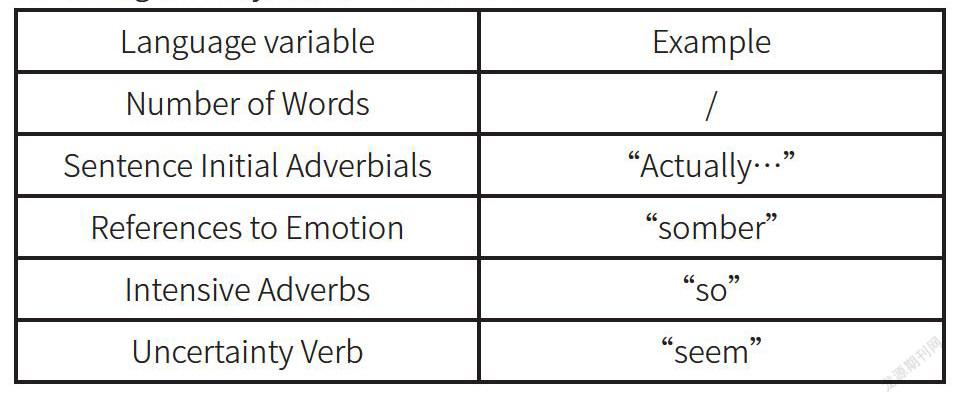
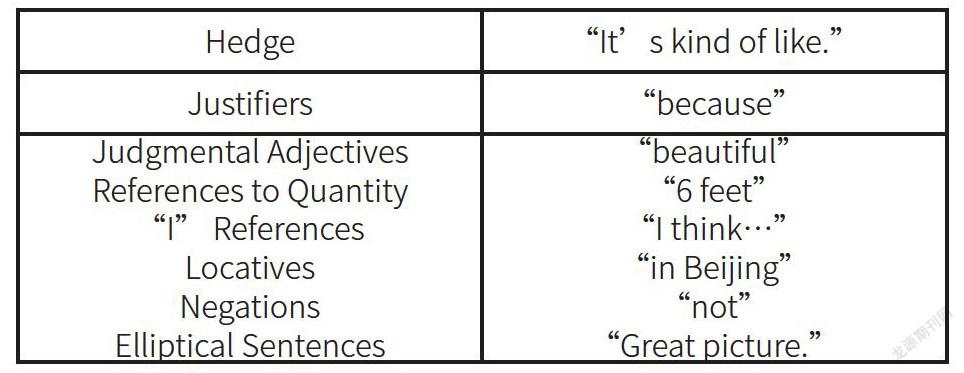
The subjects’ writings were coded in accordance with a coding scheme proposed by Anthony Mulac et al. (2012). It is based on the following 13 elements, in which these italicized bolded language feature generally favored female use while the rest generally favored male use.
3. Results and discussion
3.1 Chinese male EFL learners
According to the results, “I” references (2%) is the most frequently used code while the second most frequent code is references to emotions (1.31%). The code ranking the third place is locatives (1.21%). The judgmental adjectives (1.04%) and justifiers (0.78%) are the fourth and fifth most frequent code among males. References to quantity, intensive adverbs, sentence initial adverbials, hedges, uncertainty verbs, negations and elliptical sentences accounted for 0.74%, 0.69%, 0.69%, 0.56%, 0.39%, 0.34% and 0.22% respectively.
3.2 Chinese female EFL learners
The results illustrated that the female Chinese EFL learners used “I” references (4.6%) as the first most frequently used code. The second common code is references to emotion (2.90%) and justifier (2.3%) ranked third. The fourth and fifth codes are intensive adverbs (1.74%) and uncertainty verbs (1.5%) respectively.
3.3 Comparison between Chinese male and female EFL learners
The results show that in general female participants write more than males do, which is in accordance to what previous studied had revealed. In this study, female wrote 2582 words in total while male participants wrote 2300 words. The difference implies that female participants tend to express more in order to show gratitude.
3.3.1 “I” references
Both male and female participants use “I” references most frequently, which is quiet understandable in expressing gratitude. Participants need to express emotions and state facts from the point of view of themselves. However, it can be easily noticed that females use “I” references more frequently. This may be partly due to the fact that females usually express more.
3.3.2 References to emotions
In expressing gratitude, the use of references to emotion ranks the second place for both males and females. Participants need to show their thanks and appreciation to the receivers. Nevertheless, females use more words referring to emotions as well. In this study, females use emotional words for 75 times while male participants just use references to emotion for 30 times. It can reveal that females are more likely to express their emotions.
3.3.3 Other codes
Both male and female participants use “I” references and emotion references most, but they vary in using other codes. The third frequently used code for the males is locatives (“campus”, “university”), while for females it is justifiers (“because”, “in that”). Through analysis, it can be found male participants tend to use more references to quantity and elliptical sentences. However, for other codes including intensive adverbs, uncertainty verbs, judgmental adjectives, negations, sentence initial adverbials and hedges, female participants have a higher using tendency.
4. Conclusions
The results revealed that female participants expressed more than male participants. It was demonstrated that most females enjoyed using language to establish personal relationships and thus generally are more likely to express thanks than men. There was a significant difference among the use of references to emotion, intensive verbs, uncertainty verbs, justifiers and “I” references. Frequencies of using these codes were significantly greater in females than in males. Besides, males use references to quantity and locatives more frequently than females. These results are consistent with Lakoff’s finding that women’s language tend to be hesitant, emotional, and uncertain while men’s was deemed to be more dominant, direct, and controlling.
All in all, this study showed that male and female Chinese EFL learners do express gratitude differently. Generally speaking, female Chinese EFL learners are more likely to express gratitude and use longer utterances as well.
References:
[1]Cui, X.. A cross-linguistic study on expressions of gratitude by native and non-native english speakers[J]. Journal of Language Teaching & Research,2012,3(4).
[2]Fauziyah, N. U.. Gratitude expressions and gratitude responses of male and female characters in Rachel getting married movie[D]. Doctoral dissertation, Maulana Malik Ibrahim State Islamic University of Malang,2010.
[3]Froh, J. J., Yurkewicz, C., & Kashdan, T. B.. Gratitude and subjective well-being in early adolescence: examining gender differences[J]. Journal of Adolescence,2009,32(3):633.
[4]Kashdan, T. B., Mishra, A., Breen, W. E., & Froh, J. J.. Gender differences in gratitude: examining appraisals, narratives, the willingness to express emotions, and changes in psychological needs[J]. Journal of Personality,2009,77(3):691-730.
[5]Lakoff, R.. Language and women’s place[J]. Language in Society,1973,2(1):45-79.
[6]Mills, S.. Gender and politeness[M]. Cambridge: Cambridge University Press,2003.
[7]Taguchi, N.. Cognition, language contact, and the development of pragmatic comprehension in a study-abroad context[J]. Language Learning,2008,58(1):33-71.