
The Rebirth of an Ancient Craft
2019-09-10 21:33:24BystaffreporterJIAOFENG
CHINA TODAY 2019年8期
By staff reporter JIAO FENG

THE art of printing has always helped steer the direction of the development of civilizations through creating conditions for the vast dissemination of knowledge and exchange between civilizations. China was the first country to invent printing, which has played a very important role in the rise and development of the Chinese culture, making great and unique contributions to the development of civilizations around the world.
Block printing was invented in ancient China around the sixth century and became the precursor of modern printing technology. Even though industrial printing is quite advanced today, the traditional craft of manual block printing still retains an irreplaceable role in certain fields, and with the advancement of technology it has reached even new heights. The greatest example of this is the Rongbaozhai watercolor woodblock printing technology. In 2006, watercolor woodblock printing was added to the National Intangible Culture Heritage List and Beijing Intangible Culture Heritage List.
A Living Fossil of the Printing Industry
Watercolor woodblock printing, just as the name implies, is a printing technique which prints material using pigments and wooden blocks. This technique can be traced back as far as the Sui Dynasty(581-619) and Tang Dynasty (618-907) in China. The earliest piece of complete and dated printed material was a copy of the Diamond Sutra printed in 868. The document was discovered in a cave for preserving Buddhist scripts in Dunhuang, and is now kept in the British Library.
During the early period of woodblock printing, only ink was used to print, all the text and graphic content were printed in monochrome, and the content of printing was mainly religious writings and literary works. Later in the 14th century, chromolithography, or color printing, appeared. In the beginning of color printing, colors were applied to blocks, and the print was then printed onto paper by placing the paper over the blocks. As time went on, artisans developed the technique of carving separate blocks for different colors, then printing them separately onto the paper. This printing technique later became known as offset printing. From that time on, the art of woodblock printing in China entered a prosperous age in which various styles and methods of fine printing were formed.
After the beginning of the 17th century, the artisans of chormatography printing continued to refine the craftsmanship, developing an even more detailed kind of printing. During the printing process, artisans carved a separate woodblock for each of the colored areas in the original painting. After that, they printed the content on the blocks in succession according to the dimensions of the art piece, thus completely reproducing the various shading and dimensions of the original piece.
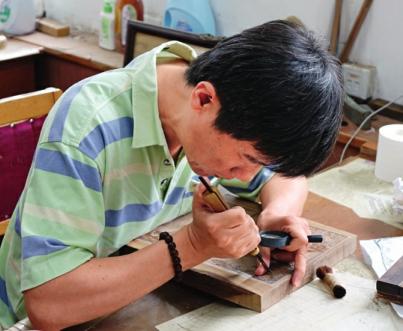
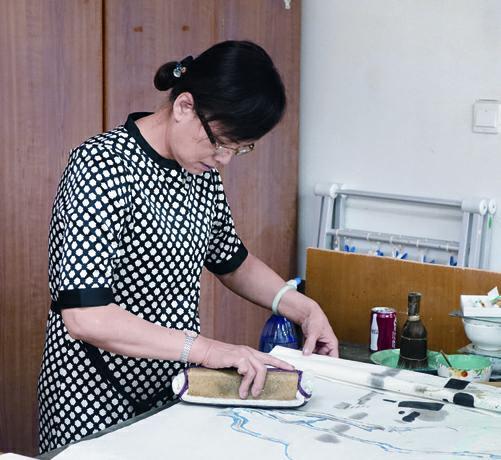
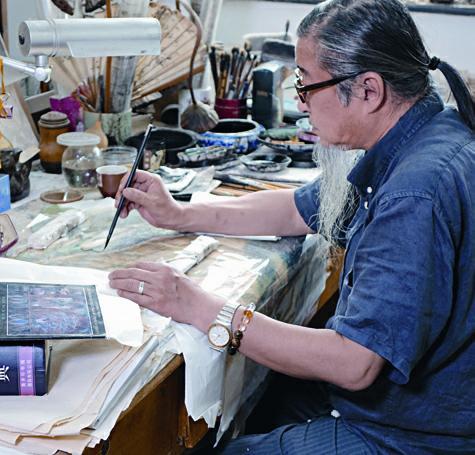
This kind of chromatography printing was the predecessor of the watercolor woodblock printing of the Rongbaizhai workshop. In 1896, the Tietaozuo of Rongbaozhai (printing workshop) officially opened, and began to do its own carving and printing, laying the groundwork for what would later become watercolor woodblock printing. The craft of watercolor woodblock printing has now been passed down several generations for more than 100 years. After the establishment of the Peoples Republic of China in 1949, the traditional craftsmanship of woodblock printing with a history of over 1,000 years was developed by Rongbaozhai to a whole new level. Today, the woodblock printing craftsmanship of Rongbaozhai has already been passed down to the sixth generation successor.
Watercolor Woodblock Printing
Towards the end of the 19th century, the introduction of modern mechanical printing equipment and technology from the West into China greatly improved the proficiency of printing. As a result, the printing of art masterpieces was all done by mechanical printing, slowly replacing the traditional manual craftsmanship of woodblock printing, with the exception of a few stationary shops who kept the old craft alive for printing special paper for writing traditional Chinese poetry. In its early years, the main business of the Rongbaozhai workshop was carving, printing, and selling elegant poetry stationary.
In the 1940s, the famous Chinese artist Zhang Daqian took students to make facsimiles of cave murals in the Mogao Caves in Dunhuang. In total he made paintings of 276 murals in the Mogao Caves. After this became known, he received a pile of requests from people wanting his paintings, taking much of his time and energy. In order to resolve this conundrum, he attempted to reduplicate his series of paintings using watercolor woodblock printing. In 1945, Rongbaozhai conducted a trial printing of the Providers of Dunhuang. The portraits in the copies were so detailed and exquisite, that Zhang Daqian was very satisfied after comparing them with his original paintings. The success of the duplication of the paintings was a turning point in the development of Rongbaozhai. Its ability in using watercolor woodblock printing to not only print special stationary for poetry but duplicate Chinese masterpieces stunned the intelligentsia and connoisseurs of culture.
After this, Rongbaozhai used watercolor woodblock printing to duplicate many traditional masterpieces of famous artists, including Galloping Horse by Xu Beihong, and Shrimps by Qi Baishi. It was even able to duplicate the effect of the dripping ink on the original works. The ability of the artisans of Rongbaozhai to make a realistic reproduction of an original masterpiece having the same color, varied and rich brush strokes, content, and even print it on exactly the same kind of paper all received high praise by the original artists.
Rongbaozhai continued to advance the techniques of the industry. Not satisfied with the achievements of reprinting the art work of renowned modern artists, Rongbaozhai set its horizons on du-plicating ancient paintings. In 1954, it successfully reproduced the silk landscape painting Pavilion under the Moonlight from the Qing Dynasty, filling a gap of no printing being done on silk scrolls for the last 1,400 years. After that, Rongbaozhai copied famous ancient paintings from small and large, single frame to whole sets of albums. Steadily it expanded its horizons and techniques. Up till now, the watercolor woodblock technology has enabled the copying of more than 5,000 different kinds of calligraphy and paintings.
Lifelike Replicas
When discussing the watercolor woodblock printing of Rongbaozhai workshop, we must mention the reproduction of a famous piece of art work that was completed on a silk scroll in the 1970s, called Han Xizais Evening Banquet. The original masterpiece, created during the 10th century, is now with the Palace Museum. The original version was 335.5 centimeters long and 28.7 centimeters wide. In total, the painting depicted 46 people. The subjects in the painting, from beds, long tables, partition screens, to stringed musical instruments, eating utensils and so on, were depicted in such fine details, especially the portrayal of the beards, ornate cloths, and ornaments.
Han Xizais Evening Banquet was painted on thin silk. This made its reproduction quite a challenge. With the tight structure of silk material, it does not absorb color as well as rice paper, and to make things more challenging, no one had heretofore duplicate a painting on silk. The project was by far the most difficult task Rongbaozhai had taken on up to this point.
During an interview with artisans at the Rongbaozhai, China Today learned the following stunning figures about the completion of this project: the total time to complete the reduplication of the painting was 20 years, eight of which were spent making the painting; during the project, 1,667 sets of woodblocks were carved, and more than 8,000 instances of chromatography were conducted for a single copy. In the end Rongbaozhai only printed 35 copies of the painting.
In order to complete the printing of the painting, Rongbaozhai specially manufactured high-quality silk, and used the same mineral pigments and metallic colors as the original painting, including quartz, stone green, cinnabar, and solid gold. With the high level of complexity of the printed content, this undertaking set a record in the history of Chinas woodblock printing. For example, three wooden blocks were used to replicate the ornate details of the whiskers of the beard on the figures in the painting. Even the faded and damaged parts of the original work were reproduced perfectly. The artistic level displayed by Rongbaozhai in the reproductions was so unparalleled that the replicas were almost indistinguishable from the original. The National Palace Museum has called them “lifelike replicas.” It can be said that the successful reproduction of Han Xizais Evening Banquet took Chinas watercolor woodblock printing technology to a new peak.
Cooperation and Dividing Responsibility
Machine-printed replicas, although identical to the original in appearance, lack the charm of the original, and can be recognized at first glance by viewers as “replicas.” The technique of the watercolor woodblock printing, on the other hand, makes a draft based on the thickness, shapes, dryness and rigidity of strokes and shades of colors of the original painting, and then engraves on several sections of woodblocks. The dimensions of the original works are then compared, and printed over. The end product is thus able to duplicate and reflect the visage and charm of the original work.
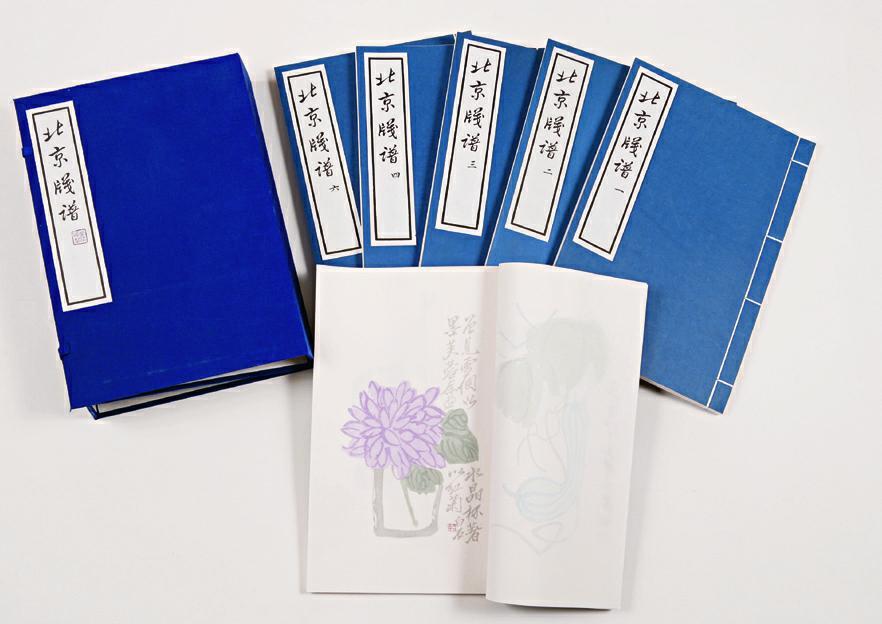
To accomplish this, it requires cooperation in a three-step process consisting of tracing, carving, and printing. Since the success or failure of each link in the process affects the quality and result of the entire painting, the artists in each of the three links must have a full understanding of the final product, and work together to achieve a perfect reproduction of the painting if the successful duplication of a painting is to be achieved.
Tracing is the foundational step for watercolor woodblock printing. First, after analyzing the original painting, the artist divides the painting into color block sections, that is, they congregate all the places in the painting that have the same color or hue and make one block for each color. Regardless of how many shades there are on the painting, there will be one block made for that color. The artist who conducts the tracing then covers the original painting with a kind of waterproof transparent cellophane tape, and traces the lines, texture, and color blocks on the painting, and then retraces them onto goose paper as needed for the engraving. The final product of the tracing becomes the draft for the next step of carving the woodblocks. During this process, no matter how rough or free the lines are on the original work, it is necessary to display the subtleties and reflect the brush strokes of the work faithfully. To accomplish this, the painter is required to have very good painting skills.
The second step in the printing process is carving the woodblocks. The sketched sample is pasted onto the pear wood board, and carving knives are used like paintbrushes in the hands of an artist to carve out the various lines onto the wooden blocks. The difficulty lies in the fact that the carver has to carefully study the techniques exhibited in the original painting, and completely copy the subtle and varied brush strokes on the board. If even one stroke cannot faithfully reflect the style of the original painting, regardless of how skilled the next artist is in printing, it cannot print an identical duplicate of the original painting.

The last step in the process is printing, which is the most crucial step. In addition to mastering the art of printing with woodblocks, the printers also need to have skills in painting and be familiar with the styles and techniques of the paintings they print. Although the convenience of printing is considered as much as possible in both the tracing and carving of the woodblocks, the ultimate expression of the painting style is largely dependent on the skill and experience of the printer in finalizing the details during the final step. The difficulty of printing is that each painting requires the use of different paper and printing skills. Traditional Chinese paintings use rice paper, mulberry paper, and silk scrolls. Consequently, different methods of printing should be used to completely restore the original works.
Watercolor woodblock printing is actually a kind of artistic re-creation, and because of this fact, it requires that artisans have very high skills. Every year Rongbaozhai recruits a number of apprentices to learn from its artisans how to do watercolor woodblock printing. At the same time, arrangements are also made for its staff to visit exhibitions, take part in painting and calligraphy trainings, lectures, and other forms of activities. The objective of the activities is to improve each artisans artistic capabilities, as well as encourage individual and professional learning, thus helping them continue to improve and refine the techniques of the traditional craftsmanship.
Innovation is also the source of the continuous development of Rongbaozhai watercolor woodblock printing. In addition to reproducing traditional Chinese calligraphy and paintings, artisans at Rongbaozhai are always expanding their ability at duplicating oil paintings, gouache paintings, and other fields of art with the technique of watercolor woodblock printing. They even create new prints, giving new life to the ancient art of traditional Chinese manual printing.
