
Study on the development of forest tourism under a collective forest right system
2019-09-10 05:22:48WangXianyeZhuKexi
現(xiàn)代鹽化工 2019年2期
Wang Xianye Zhu Kexi
Abstract:This paper discusses the potential for developing forest tourism under a collective forest right system by analyzing the status of China’s forest tourism and collective forest right reform. In addition to the above, it also compares the differences between forest tourism under a collective forest right system and the existing forest tourism industry in China, which is mainly centered on existing national forests. By now, a fundamental forest tourism system has come into shape, with national forest parks, wetland parks, and natural reserves as main destinations, and supplemented by featured ecological parks such as desert parks. Forest tourism, as a leading tertiary industry under forestry, shows great potential for developing a new mode of tourism under the collective forest right system.
Key words:collective forest right; Forest Tourism; forest park
Forest tourism is a rising star of featured tourism and green tourism. It is also the theme of the globally prevailing ecological tourism that integrates entertainment, environmental education, and natural conservation. Up to now, the main destinations for forest tourism in China are national forest parks, wetland parks, natural reserves, desert parks, scenic areas, botanic gardens, and state-owned forest farms, but as the collective forest right reform carries on, it is possible to make foresters cooperate to develop the forest tourism. The forest tourism economy under the collective forest right system should head towards a new type of forestry economy that develops forest tourism and lifts foresters out of poverty.
1? ? Collective forest right reform
1.1? General situation
Forest right determines the efficiency and revenue distribution with regards to the cultivation, protection, and utilization of forest resources. The forest right system can be mainly divided into two: the ownership system and the usage system of forest lands and trees, with the former taking care of ownership and the latter utilization. Forest right reform is intending to legitimately transform collectively-owned forest lands into means of production for foresters, making forest resources their assets, and forestry an essential platform for starting a business. This way, the potential of collectively owned forest lands can be fully employed and foresters’ income increased. According to the time of transitions for the forest right system and its influence on forestry and forest tourism, the collective forest right reform in China can be divided into three stages, namely, the primary stage(1949—beginning of 1990s), the development stage(beginning of 1990s—2003)and the deepening stage(2003—present).(1)In the primary stage, as the forest system constantly undergone changes and its policies had not been consolidated, deforestation was rampant, forest coverage plummeted, and farmers were not keen on developing the forestry economy.(2)In the development stage, the forestry businesses were operated in diverse forms. The main organizational forms included household operation, partnership, collective management, share-exchange management, and joint management by entities of forestry, industry, and commerce. (3)Since the reform entered the deepening stage, China has carried out far-reaching reform measures. A reform plan guided by “clarifying title, enlivening management, ascertaining disposition rights, and guaranteeing usufruct” is in place.
1.2? Influence of forest right reform on forester’s forestry income
After the collective forest right reform, foresters holding a Certificate of Forest and Woodland Rights acquire legally the right to use and forest ownership of contracting and managing the forest and woodland. This means that foresters have the rights and benefits as follows. Firstly, they can improve low-yield forests, cultivate woods, and plant trees, thus increasing job opportunities, effectively addressing the local unemployment problem, and increasing their income. Secondly, they can independently decide on forest management and operation. For example, breeding and cultivating animals and plants in the woods under their management in order to increase income through multiple means. Thirdly, they can reap revenue from logging in the commercial forests and benefit from the ecological compensation when done in the non-commercial forests. Fourthly, they can obtain mortgages from banks with their Certificate of Forest and Woodland Rights as a collateral and invest in forest operation or other related industries. Fifthly, by planting trees on the forest lands contracted by them, they can get state grants, thus reducing the financial pressure imposed on their families due to the investment in forestry. Sixthly, they are entitled to transfer the forest lands where they have user rights in exchange of a decent amount of transfer fee which can be invested in other businesses as well as used to increase their income. Seventhly, they can exchange the forest lands for which they own the rights for shares, and partner with others to establish forest farms and realize scale management. In this way, they can benefit from both service income and shared profits.
2? ? Status-Quo and development potential of forest tourism
2.1? Resources distribution of forest tourism
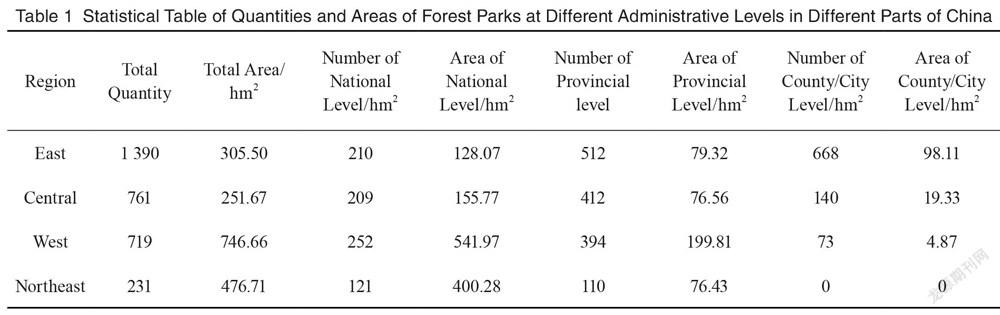
Forest parks make up a large part of forest tourism. The quantities and areas of forest parks at different levels in East, Central, West and Northeast China are as shown in the table below. The development statuses of the forest parks are imbalanced, with the East region showing better development than the West. Forest parks in the East region are abundant but small in area, while those in the West are fewer but larger. Across China, there are 9 forest tourist zones, 11 national scenic tourist belts, and 61 competitive forest tourist routes at the provincial level (including autonomous regions and municipalities directly under the central government).
2.1.1? Forest tourism resources management
Organizational Management of Forest Tourism.In 2012, the State Forestry Administration initiated the national leading group mechanism for forest tourism. Under the guidance of Comments on Accelerating the Development of Forest Tourism by the State Forestry Administration and the National Tourism Administration, forestry administrations and tourism administrations at the provincial level(including autonomous regions and municipalities directly under the central government) have successively signed the Cooperation Framework Agreement on Promoting Forest Tourism as an effort to strengthen the organization, supervision, and guidance of forest tourism related works. In 2014, the SFA issued the Outline of National Program on Development of Tourism Relying on Forest and Other Natural Resources (2013-2020), the first programmatic document in guiding the development of tourism relying on forests and other natural resources. The SFA has organized the compilation of annual nation-wide reports on the development of tourism relying on forest and other natural resources, which presents an overall situation of forest tourism of the year and informs the whole society on the status-quo of forests and other natural resources in the country, serving as a reference for local authorities to promote and regulate forest tourism.
2.1.2? Forest tourism demonstrative projects
Work on building demonstration counties, villages (towns), and scenic zones of forest tourism has been carried out, and some of the said projects have been established on schedule. As of 2014, the establishment works of 10 pilot national demonstration zones of forest tourism, 9 national demonstration zones of ecological tourism, and 32 pilot national desert parks have seen steady progress.
2.2? Potential for development
Forest tourism in China started in 2000 and henceforth embarked on the path of rapid development, with a forest tourism system in place and an accelerated growth in the number of national forest parks in recent years. According to the data from 2014, the number of tourists opting for forest travel was 709.8 million visits, and has increased to 1.05 billion visits the following year. In 2016, the number climbed to 3.11 billion visits. The total value of the tourism industry grew from RMB 70.977 billion in 2014 to RMB 259.854 billion in 2016. According to statistics released by the SFA, ecological tourism was expanding at a high rate of 30% within a decade, and 30-40% of tourists opt for forest travels. It was predicted based on the given statistics that, by 2020, the total value of forest tourism in China will reach RMB 300 billion, creating 2 million job opportunities. The momentum of forest tourism is unstoppable. From the perspective of employment, the number of employees in the social tourism industry of forest park across the country is estimated at 792,600 people. The construction of national forest parks and the advancement of tourism that depends on this have driven the development of the forest regions and its neighboring areas. At the same time, related industries such as transportation, culture, and services that take place in the neighboring cities and towns have seen similar developments as well. From the above statistics, it can be seen just how national forest parks play an indispensable role in boosting the local economic growth.
3? ? Comparison of Forest Tourism Under Collective Forest Right System and That in National Forest Parks
3.1? Different development shareholders
The majority of development shareholders in forest parks are state-owned forest farms which are partitioned and built into national forest parks that serve as recreational venues for tourists. In contrast to the above, most development stakeholders in forest tourism under the collective forest right system are foresters who acquire management rights of forest lands after the collective forest right reform. They are organized to operate forest tourism businesses, which is quite different from the prevailing situation in the national forest parks.
3.2? Different financing channels
The funding of forest parks mainly comes from the central government and other levels of the administration that allocate financial support for construction, management, and maintenance. It would be ideal if forest tourism under the collective forest right system can obtain similar government support; but with the absence of government funding, the task of financing falls onto local enterprises or joint organizations of foresters. The latter means of financing is weaker compared with the solid financial resources of forest parks. This causes the infrastructure construction in forest tourism destinations under the collective forest right system to encounter more difficulties than that in forest parks.
3.3? Different ways of operation
The operation of forest parks is mainly run by special staff appointed by local governments like forestry bureau or tourist administration, whose responsibilities cover the management and maintenance of the forest parks. Whereas for forest tourism destinations under the collective forest right system, due to the different financing channels and operators, these responsibilities are mainly assumed by foresters, staff members deployed by the leading enterprises, or managerial personnel from joint organizations.
3.4? Different beneficiaries
Revenues of forest parks mainly go into the pockets of the central or local-level governments, which are then invested into the maintenance and infrastructure as well as the promotion of forest tourism economy. Revenues of forest tourism under the collective forest right system are mainly controlled by joint organizations or foresters, and this condition contributes a lot to improving the foresters’ income and living standards.
4? ? Priorities the key issues of forest tourism under the collective forest right system
4.1? Expanding financing channels
After the collective forest right reform, forest lands have been divided into small partitions and corresponding rights have fallen into different hands, so most foresters do not possess adequate land and money to develop forest tourism on a large scale. They are in lack of funding and infrastructure. Therefore, financing channels must be expanded. In addition to actively applying for financial support from the government, they also need to enhance their efforts in attracting investment, and seek investments by inviting various economic entities to finance the construction of the scenic areas, attractions, as well as services and facilities, through business-oriented means such as contracting, leasing, joint investment, and cooperation.
4.2? Perfection of trading organization markets
In the scenario of developing forest tourism in collectively owned forests through enterprises, foresters have to transfer their rights pertaining to the forest lands. In this case, sometimes the rights are transferred by bypassing forestry administrations, therefore giving rise to irregular operations. Given these, and with the absence of trading markets and intermediaries, as well as the existence of gaps in trading information, fairness is difficult to guarantee in the transactions.
4.3? Training professionals
The development of forest tourism under the collective forest right system requires specialized forestry resources and professionals, the same way the deployment of professionals is necessary for the operation of national forest parks. Professionals are indispensable for resources opening, management, planning, and promotion of scenic areas. Hence, while developing tourism in collectively owned forests, training professionals has become a fundamental work in order to facilitate the promotion of the new type of tourism.
5? ? Conclusions
The development of national forest parks in China has revealed many problems, such as flawed management system, monotonic forest tourism products, inappropriate exploitation of scenic areas, immature infrastructure, the absence of tourist culture, and the lack of research on forest tourism. Forest tourism under the collective forest right system and that in forest parks are developing in completely different paths. The development of the former, as a new type of tourism, is conducive to not only raising the living standards of foresters, but also improving the system and management of forest park tourism in China. Lastly, it plays an important role in enriching the theoretical research on national forest tourism and promoting the development of national forest tourism.
[References]
[1]SHIMING T,JUNBIAO Z.Literature review on collective forest right reform[J].Hubei Social Sciences,2008,19(6):23-27.
[2]HONGWU X.Study on collective forest right reform in hunan province[D].Changsha:Hunan Agricultural University,2007.
[3]XIUYING X.Study on forest right for sustainable management in collectively owned forests in South China[M].Beijing:China Forestry Press,2005.
[4]DEZHONG Y.Empowerment and planning:collective forest right reform[D].Beijing:Beijing Forestry University,2007.
[5]SHENGWEN Z.Analysis on influence of forest right reform on sustainable management of collectively owned forests[D].Fuzhou:Fujian Agriculture and Forestry University,2007.
