
New Threats to the Environment with the Increasing Delivery Food Boxes Garbage
2019-07-21 14:26:24黃戈
山東青年 2019年3期
黃戈

Abstract :The delivery food business has rapidly developed in China in the past 5 years , but the delivery food hoxes coming with this hoom-ing business have brought significant environmental pollution. Most of the containers are made of non - degradable plastics, so their incorrectdisposal causes white pollution, which is a leading source of pollution. In order to explore the current situation of delivery food garbage, a sur-vey accompanied by questionnaires (n=73) was conducted in March 2018 among young adults, the main consumers of delivery food and ulti-mately one of the causes of this iSSUe. The study reveals that while most respondents are concerned with the white pollution caused by deliVeryfood boxes (72.6l%) , only 23.29% of them have actively tried to help solve this problem. Their inaction must be blamed. While the food de-livery husiness is unavoidable, it is imperative we react at this stage rather than in the future where the situation will he harder to change.
Key words : delivery food hoxes; non-degradable plastics; food boxes garbage disposal; white pollution
Introduction
Food deliVery industry is one of the booming industries in Chinanow. This kind of convenient service is popular especially young a-dults. However. it seems many are unaware that enjoying such serv-ice comes with a heavy cost for the environment. According to datareleased by the thref main Chinese delivery food Apps platforms,Meituan . Baidu and Elemo . ahout 20 million orders are placed everyday. It is not hard to estimate how many food boxes are being con-sumed in a day. Plastic food boxes garbage is one component of mu-nicipal solid waste (MSW). MSW management is a major challengein urban areas worldwide (Huang et al , 2007 ). In addition. cur-rent main disposal ways towards plastic products are by landfill andincineration. Both of them have bad effects on soil and air quality.Obviously , a big storm of plastic pollution is coming if actions are nottaken to deal with these new threats to the cnvironment.
Materials and Methods
Participants
A survey was conducted in March. 2018. All the respondentswere aged 18-25, as they are the major users of food delivery appli-cations. Participants were asked structured and open - ended ques-tions ahout their awareness, actions, and attitudes towards deliveryfood hoxes garhage pollution.
Procedure
Questionnaires designed for anonymous response comprised of 10questions. These questions can he divided into six parts with regardto their purpose :
Q1 to Q3 are designed to gather respondents' personal informa-tion.
Q4 to Q5 attempted to investigate the popularity of food deliveryService now . from their experiences of ordering food deliVery and thefrequency of it.
Q6 inquired about people's disposal of used deliverv food bo-xes.
Q7 investigated people's concern about the environmental pollu-tion caUSed by delivery food boxes. and their future actions or the ac-tions they have taken to help solve this problem.
Q8 was designed to evaluate people's willingness to help changethe situation by using environmentally friendly biodegradable deliveryfood boxes to estimate the feasibility of every husiness using biode-gradable delivery food boxes in the future.
The last two questions examined people's opinions of the rea-sons for the increasingly serious white pollution caused by plastic de-liverv food boxes and their suggestions for solutions.
Results
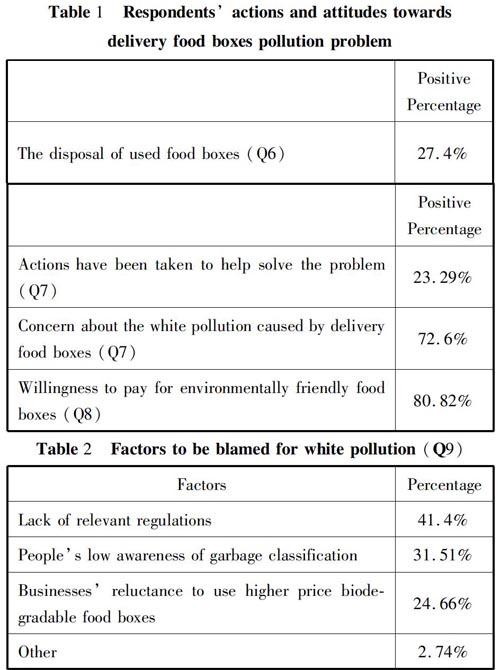
Table I shows the gap between the respondents' thought andtheir actual actions towards delivery food boxes pollution. Althoughmost people showed their concern , only a small number of them haveactively done something about it. Indeed, the majority formed a badhabit of disposing of used deliVery food boxes, Which directly has ledto the challenge of recycling. Fortunately, the proportion of respond-ents who were willing to pay for biodegradable food boxes was high.Table 2 reveals that most respondents helieve that the lack of relevantregulations was to blame for the main cause of pollution. Figure Idemonstrates the results for each solution were very narrow. Howev-er . the most voted solution was that the government should issue man-datory policies to force businesses to use degradahle delivered foodboxes.
Discussion
The purpose of this study is to investigate the current situation ofdelivery food boxes garhage, and try to find out what are the relevantfactors. Then, some targetable suggestions can be made to help con-trol the situation. The results show that, although people expressedtheir concern ahout delivery food boxes pollution. concrete actionshave not followed. In addition, the results reveal that there isn ' t asound system for the disposal and recycling of plastic food boxes gar-hage currently.
There are several explanations for this failure. To start with. thefood delivery industry is a booming industry in China and relevantregulations about the disposal of used plastic food boxes have notbeen established or improved. Secondly, people have not formed aconsciousness of garbage classification yet. How they deal with gar-bage is the first and major step for garbage recycling. If the plasticgarbage isn't Separated from unrecyclable ones, it will increase thedifficulty of garbage recycling and reusing.
From the survey and analysis , some suggestions are made to helpsolve the prohlem. Firstly, the survey reveals that the majority arewilling to pay for hiodegradable food boxes(80.82% ). Therefore.the comprehensive popularization of biodegradable food boxes is feasi-ble. Secondly, people's consciousness of garhage classificationshould be raised and the hahit of it should be cultivated better froman early age. Japan attaches much importance to information and ed-ucation. Children are educated by parents and schools about properMSW disposal since childhood (Liu, Liu, & Huang, 2016). Theway to improve people's garbage classification consciousness couldbe implemented through some penalties. Thirdly, relevant regulationsshould be implemented. Germanv leads by example in waste manage-ment. There are about 800 laws relating to management of Waste inGermany , and the administrative regulations are up t0 5000 (Wiem-er, 2004 ). Compared with Germany, relevant regulations aboutWaste management in China are less. So. it is strongly encouragedthat relevant regulations should be issued, especially those ahoutplastic garbage disposal. Finally, Waste classification and separationheing the critical link in the recycling system, the European Union,Australia, and some developing countries have implemented a strictwaste classification system to ensure that most recyclable resourcesare separated from household waste, which greatly simplifies wastedisposal (Wen et aL , 2014 ). Hence, specific garhage recycling sta-tions for delivery food plastic could be set. meanwhile facilities todispose and recycle them must be put in place. A chain from collec-tion to recycle raises the efficiency and recycling rate.
The growing pollution caused by delivery food boxes needs to heurgently addressed importance. From the analysis of the survey, peo-ple's inactivity, low classification awareness, lack of regulations,and the absence of a sound recycling system are all responsible for thecurrent situation. In order to achieVe our goal of sustainable develop-ment, a series of actions must to be taken. The above suggestions areavailahle for reference.
[References]
[1] Huang, J, Li , G, Wang, H, Ma, S, Chen, L ( 2007 ) As-Sessment and investigation methodology for solid waste recycling sys-tems. Environment Pollution Control 29:74 - 79.
[2] Liu, W. , Liu, S, & Huang, G. (2016). Research onthe sorting reclaim system of municipal solid waste based on the con-cept of " cradle to cradle " . Procedia Environmental Sciences .31 . 482- 490.
[3] Wen, X, Luo, Q, Hu, H. (2014) Comparison researchon waste classification between China and the EU, Japan, and theUSA. Journal of Material Cycles and Waste Management 16 : 321 -334.
[4] Wiemer K. (2004). Development of domestic waste treat-ment technology in China. Environmental Sanitation Engineering , 12 :200-201+205.
