
Machine Learning for Network Slicing Resource Management:A Comprehensive Survey
2019-06-16 04:01:58HANBinandHansSCHOTTEN
ZTE Communications 2019年4期
HAN Bin and Hans D.SCHOTTEN,2
(1.University of Kaiserslautern,67663 Kaiserslautern,Germany;2.German Research Center for Artificial Intelligence,67663 Kaiserslautern,Germany)
Abstract:The emerging technology of multi-tenancy network slicing is considered as an es?sential feature of 5G cellular networks.It provides network slices as a new type of public cloud services and therewith increases the service flexibility and enhances the network re?source efficiency.Meanwhile,it raises new challenges of network resource management.A number of various methods have been proposed over the recent past years,in which machine learning and artificial intelligence techniques are widely deployed.In this article,we provide a survey to existing approaches of network slicing resource management,with a highlight on the roles played by machine learning in them.
Keywords:5G;machine learning;multi-tenancy;network slicing;resource management
1 Introduction
As an emerging technology,network slicing is believed to be a key enabler and essential feature of the fifth generation (5G) cellular networks.Proposed by the Next Generation Mobile Networks (NGMN) Alliance as an end-to-end (E2E) concept,network slicing is involved across the radio access network (RAN) and the core network(CN).It refers to operating and maintaining multiple logically independent virtual telecommunication networks on the top of a shared physical infrastructure,in order to provide enhanced heterogeneity,flexibility,scalability,profitability and security of future network services.This requires both the network re?sources and network functions to be highly countable,divisible and isolatable,which can be realized by the modern network function virtualization technologies.
Since its first proposal,network slicing has triggered exten?sive research interest in various topics in the broad scope of wireless networking.This includes network architecture de?sign,E2E slice orchestration and management,slice blueprint design,slice lifecycle management,RAN virtualization,net?work resource management,slice isolation,mobility manage?ment,and cyber-security in network slicing.
In this article,we focus on the problems of resource manage?ment in network slicing,attempting to address the most signifi?cant challenges in this area and provide a timely and compre?hensive survey to the state of the art.Especially,we will show how machine learning and artificial intelligence are applied to assist the resource management in sliced wireless networks.
2 Network Slicing and Multi-Tenancy Networks
2.1 Sliced 5G Network:Heterogeneous Services and Het?erogeneous Requirements
The concept of network slicing refers to creating and main?taining multiple independent logical networks,i.e.“network slices”,on the top of a shared physical network infrastructure.Every instance of the network slice,according to the definition of NGMN [1],is defined by a set of network functions and the resources to run them.These network functions and resources form a complete instantiated logical network,to meet certain network characteristics required by the service instance(s),which is realized within or by the network slice.Different net?work slice instances can be,fully or partially,physically or log?ically,isolated from each other in the perspectives of control,traffic,resources,etc.Furthermore,each slice instance can be individually tailored to fulfill the requirements by its service instance(s).
The feature of individual slice specification in network slic?ing plays a critical role in future 5G networks,due to the high heterogeneity of different 5G service types,i.e.enhanced mo?bile broadband (eMBB),massive machine type communica?tions (mMTC),and ultra-reliable and low-latency communica?tions (URLLC) [2].These services generally have different re?quirements for technical performance,each being extreme in a different aspect,e.g.,throughput,access capacity,and laten?cy,as shown in Fig.1.This implies highly heterogeneous specifications of resources and network functions for different types of slices.Indeed,even for a certain type of 5G service,the resource requirement can also vary from one service in?stance to another.Aiming at fulfilling the requirements of het?erogeneous service instances simultaneously,the classical onesize-fits-all architecture that has been deployed in legacy Long Term Evolution/Long Term Evolution-Advanced (LTE/LTE-A)networks exposes significant lacks of flexibility and scalability,which can lead to low resource efficiency and therewith an un?affordable resource cost.Network slicing,in this context,has become an essential enabler of 5G networks.
2.2 Slice-as-a-Service:a New Public Cloud Environment
In addition to the enhancement of resource efficiency,net?work slicing also makes it possible to decouple the provisions of wireless network infrastructure and network services.In?stead of running and maintaining the network services by them?selves,mobile network operators (MNOs) can lease network slices to multiple network slice tenants upon their requests.The tenants are therewith able to create network services and deliver them to the end customers without possessing their own network infrastructure,as illustrated in Fig.2.The quality of service (QoS) of a leased slice is guaranteed by a service level agreement (SLA) between the MNO and the tenant,which de?fines the cost rate,the required minimal performances,and the penalty in case of SLA violation.This multi-tenancy network architecture introduces a new business mode that the network slices are provided as an emerging public cloud service,which is known as“slice-as-a-service”(SlaaS)[3].
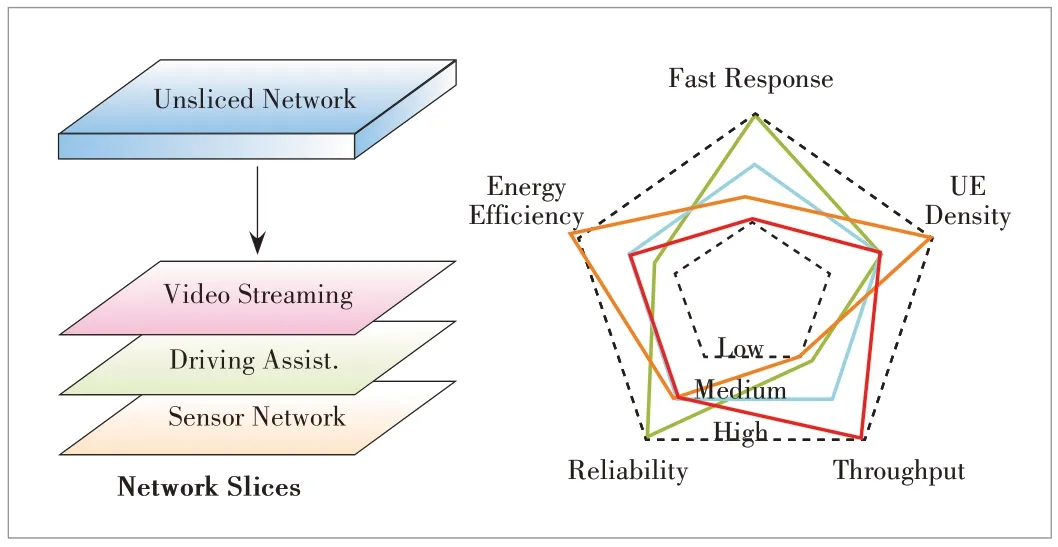
▲Figure 1.Network slicing enables heterogeneous and highly special?ized services on top of a shared network infrastructure.
Despite of the similarity in many aspects to classical public cloud environments such as software-as-a-service(SaaS),platformas-a-service (PaaS) and infrastructure-as-a-service (IaaS),SlaaS is distinguished from them in the complexity of resource manage?ment due to the heterogeneity of network slices,while the service instances in classical cloud environments are generally homoge?neous.This challenges the efficient deployment of SlaaS and has triggered dense interest of research in recent years.
3 Resource Management in Network Slicing
3.1 Classification of Approaches
In an architectural perspective,efforts that have been made towards efficient resource management in sliced networks can be generally classified into two categories:the slice admission control and the cross-slice resource allocation(Table 1).
The former one consists of methods focusing on the issue that the limited resource pool of a MNO may be overloaded by an overwhelming amount of tenant requests for slices,whereby the MNO has to select some requests for acceptance while de?clining the others.It has been demonstrated that the policy of such selection,a.k.a.the slice admission strategy,has a dom?inant impact on the overall resource efficiency and utilization rate of sliced networks.Advanced methods are therefore pro?posed to find the best strategy,in order to optimize the longterm overall network performance statistically.
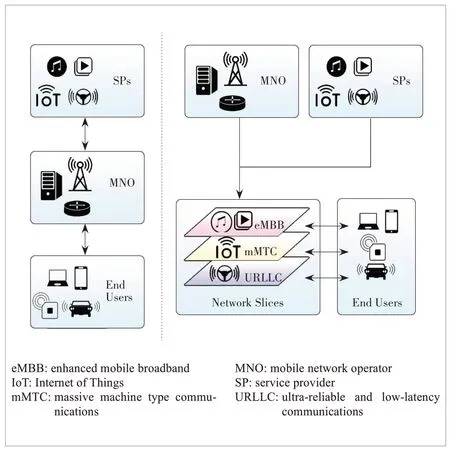
▲Figure 2.Traditional unsliced networks (left) and multi-tenancy sliced networks(right).
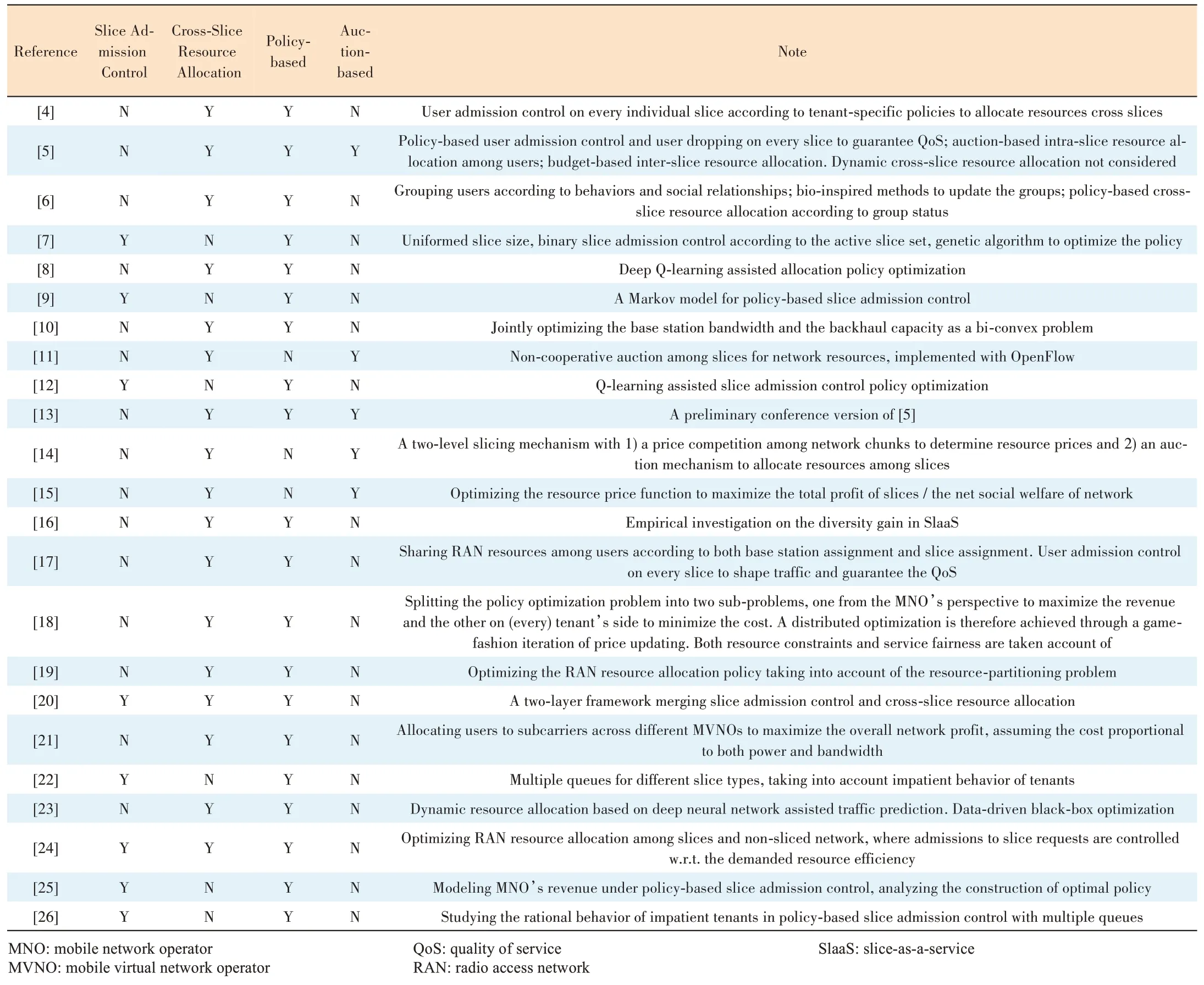
▼Table 1.A summary of existing works on resource management in network slicing
Approaches in the latter class,in contrast,concentrate on the active slices that have already been created and leased to tenants.The real-time traffic load of every individual slice is universally time varying,exhibiting stochastic dynamics.This phenomenon,known as the slice elasticity,enables the MNO to overbook slices to tenants for a diversity gain that im?proves the resource efficiency and overall revenue.To realize slice overbooking and jointly maximize the short-term perfor?mance of all active slices,it calls for methods that efficiently share network resources among slices in a real-time and dy?namic fashion.
On the other hand,in perspective of the decision making mechanism,for both the admission control and cross-slice re?source allocation,there are two types of approaches available:1)policy-based decision and 2)auction-based decision(Table 1).
In policy-based approaches,the MNO provides a standard list of prices for slices (in case of admission control) or re?sources (in case of cross-slice resource allocation),which is consistent for all tenants,and the decision of admission/allo?cation is made according to the MNO’s resource management policy under the current system state.In case of admission control,the system state information usually consists of the amount of idle resources,the set of current active slices,and the queuing status of awaiting requests.In case of cross-slice resource admission,on the other hand,such information usu?ally refers to the resource pool size,and the set of current ac?tive slices along with their instantaneous resource demands and utility rates.
In auction-based approaches,the MNO does not provide uni?versal prices,but only a list of available slices/resources.In?stead,the tenants shall propose their own bids for their request?ed slices/resources.These bids are periodically collected and evaluated by the MNO,and the winner(s) of the auction will be granted the requested slice/resources.To guarantee a minimal revenue of operating the network infrastructure,lowest bids are universally required by the auction-based approaches.
3.2 Key Challenges
A main and generic challenge for policy-based methods for network slicing resource management is the high computation?al complexity.On one hand,for both admission control and cross-slice resource allocation,the utility function is generally non-convex with regard to the MNO’s policy,eliminating any analytical solution of the global optimum.On the other hand,numerical solvers are also challenged by the complexity of the problem.Policy-based admission control problems,no matter with or without queuing mechanism,are binary programming problems where the MNO’s decision is always either“0”for decline or“1”for admission.The policy-based cross-slice re?source allocation problems,in comparison,are integer program?ming problems,where the amount of resource allocated to an arbitrary slice is always integer times of some atomic resource block.Both the problems are known to be NP-hard,leading to an unaffordable computational effort to optimize the policy through exhaustive search.
In comparison to policy-based methods,auction-based ap?proaches are proven effective to reduce the computational com?plexity significantly.However,it generally requires a careful design of the auction mechanism and strict regulations,in or?der to mitigate drawbacks and risks that intrinsically root in the procedure of auction itself,such as multi-round auction overhead,biased bidding,and cheating[27],[28].
Additionally,although slice overbooking and cross-slice re?source allocation allow the MNO to benefit from the load-driv?en elasticity of network slices,they also lead to risk of over?loading the shared resource pool when traffic peaks simultane?ous occur across multiple slices.In this case,the MNO be?comes incapable to deliver guaranteed QoS to all active slices and therefore have to violate some SLAs,which implies paying penalty to the involved tenants.Such a risk must be taken into account as part of the opportunity cost of maintaining slices.In an extreme case,the opportunity cost of accepting a request for new network slice instance may overwhelm the revenue gen?erated by the corresponding slice,and therefore the greedy strategy fails in admission control.
On the other hand,being too conservative in admission con?trol also leads to the MNO’s loss,due to a two-fold reason.First,it naturally implies a low resource utilization rate and low revenue.Second,since the tenants’need for slices does not simply vanish,the declined requests will usually be either reissued later,or buffered in a queue for delayed admission.No matter which design is used,under a low admission rate,declined requests will stack to cause serious congestions,and therefore significantly raise the average delay between the issu?ing and the admission of a request.As we have indicated in[22],after being awaiting for too long time,tenants will eventu?ally lose their patience and interest in the MNO’s service.In a competitive SlaaS market,such situation can probably lead to permanent loss of tenants.
Aiming at an optimal balance between the resource feasibili?ty and the admission rate,the MNO must have a deep under?standing in tenant behavior.This includes the characteristics of both active slices (e.g.,load dynamics,lifetime distribu?tion,etc.) and tenant requests (e.g.,arriving rate,impatience,etc.).This not only calls for accurate models,but also further raises the computational complexity.
4 Machine Learning and Artificial Intelli?gence Methods
4.1 Reinforcement Learning
Since policy-based network slicing resource management procedures are typically Markov decision processes (MDPs)where a policy maps every specific system“state”to a corre?sponding“action”and therewith generates a“reward”.In net?work slicing resource management problems,the reward func?tion is generally non-convex over a huge policy space,as prov?en in [9].Therefore,in this field people commonly choose to rely on Reinforcement Learning (RL),which is known for its high efficiency and convenient implementation in solving Mar?kov decision problems.
A pioneering attempt of deploying RL to optimize the net?work slicing policy was given by [12],where the authors have demonstrated that their Q-Learning solver can efficiently ap?proximate the optimal slice admission policy that maximizes the MNO’s revenue and significantly outperform the bench?mark of random policies.In comparison to the value iteration method that guarantees to achieve the optimum,the Q-Learn?ing method is capable to be executed in an online learning fashion with a much more reasonable computation cost,with only a tradeoff of slight reduction in the revenue.Furthermore,RL algorithms can be designed model-free by appropriately se?lecting the reward functions,which makes them much more ro?bust against imperfect estimations of the slicing statistics,as al?so demonstrated in[12].
The authors of [20] attempted to apply RL for cross-slice re?source allocation,which they called cross-slice congestion con?trol.Aiming at this,they have proposed a framework where the real-time slice elasticity is realized upon requests of every ex?isting slice for the grant of more resource and the MNO makes policy-based decisions with regard to both the current resource availability and the slice priorities.In this way,the cross-slice resource allocation task is accomplished by an admission-con?trol-like mechanism,where a Q-Learning method is proven to bring a significant gain in slice elasticity.
Cross-slice resource allocation was achieved in a more straightforward manner in [8],where the authors defined an“action”of the system as a specific allocation of radio resource to all existing slices instead of a binary decision like in slice admission.This design simplifies the system design,but leads to a significantly huger policy space and a high non-linearity of the reward function about the action.To cope with this issue,the authors adopted deep neural networks,as we will introduce later in Section 4.2.
4.2 Artificial Neural Networks
As the most important part of modern artificial intelligence technologies,artificial neural networks (ANN) are known to be efficient in modeling non-linear systems.This can be used to enhance RL methods into deep reinforcement learn?ing (DRL) methods,such the deep Q-Learning method report?ed in[8].
Another common application of ANN is the model estima?tion and prediction of complex non-linear processes.The au?thors of [23] have given a typical example of ANN-based pre?diction in the field of network slicing resource management.In this work,they stacked three layers of three-dimensional convolutional neural networks (3D-CNN) to compose an en?coder,which is cascaded with a decoder implemented by multi-layer perceptrons (MLPs).This encoder-decoder struc?tured cognitive network is proven capable to predict service capacity requirement in a data-driven fashion with high accu?racy,which helps the slice orchestrator to make decisions in slice admission control and cross-slice resource allocation.In contrast,legacy methods are only able to predict the mean traffic.
4.3 Evolutionary Algorithms
There are various methods,which rely on statistical evolu?tions based on learning from the system feedbacks to random strategies.They are commonly referred to as evolutionary algo?rithms,which is an important category of machine learning techniques.
One example of evolutionary algorithms’application in cross-slice resource allocation is given by [6],where the social relationship between different users attached to multiple net?work slices are updated in a dynamic and evolutionary man?ner.Based on these social relationships,users are clustered in?to groups in such a way that all users in the same group have similar characteristics in service requirement.This process helps in degrading and simplifying the complex model of re?source requirement in a large-size sliced network,and there?fore supports to optimize the resource allocation strategy.
In context of slice admission control,on the other hand,we have shown in our previous work [7] the effectiveness of genet?ic algorithms (GAs).By encoding every slice admission policy into a chromosome,i.e.a binary sequence,and applying a classical GA on a population of randomly generated chromo?somes,it will recursively generate new generations of chromo?somes (policies) that statistically converge towards an opti?mum.Furthermore,by manually introducing (an arbitrary)benchmark policies into the first generation,this GA-based mechanism is guaranteed to outperform the benchmark.It also shows good robustness against dynamic environments.
4.4 Distributed Learning
While all the aforementioned cases generally invoke a cen?tralized learning process,some efforts have been made to dis?tribute the learning process over different participators in the network slicing process,i.e.the mobile network operator and different tenants/slices,in order to reduce the computational complexity.
A typical example is[11],where a RL process is executed si?multaneously at every bidder (slice) to recursively update its bid for network resources.This so-called Exponential Rein?forcement Learning (XL) algorithm is proven to converge to the unique Nash equilibrium of the auction game.
Similarly,the authors of [18] decomposed the cross-slice re?source allocation problem into a revenue-maximizing problem of the MNO and a cost-minimizing problem of every slice.This sets up a game where a distributed evolutionary algorithm converges to the equilibrium.
Another instance is provided by [21],which invokes the fa?mous Binary Particle Swarm Optimization (BIPSO) algorithm,which allows to jointly update the resource assignments to dif?ferent users in a distributed cross-learning manner,i.e.in each iteration,the resource assignment to every specific user will be updated according to the resource assignments to other users in the last iteration.Such iterative update continues un?til the utility requirement is satisfied.The authors have shown that the BIPSO is computationally efficient in solving the poli?cy-based cross-slice radio resource allocation optimization problem.
5 Future Challenges
Beyond the successes that have already been made,there are still many open issues and potentials for further successes of machine learning in the field of network slicing resource management,as we will name some of them below.
5.1 AI-Enhanced Optimization in More Complex Admis?sion Control Scenario
As it has been pointed out,complex features of slices/ten?ants,such as elasticity [20] and impatience [22],will lead to challenges in modeling their behavior,even under ideal as?sumptions such as Poisson arrivals of traffic/service requests.In realistic scenarios,the request arrivals and slice/resource re?lease are usually non-Markovian.This calls for a deeper un?derstanding in the system behavior and better policy optimiz?ers,which shall be provided by a better integration of artificial neural networks with RL methods,like the authors of[23]have done.
5.2 Cooperative Game with Distributed Learning
While existing applications of distributed learning in this field generally consider non-cooperative games where the Nash equilibriums are achieved,there is a great potential to adopt the concept of cooperative game,where tenants/slices can learn to make decisions in an organized and cooperative way,in order to maximize the global social welfare instead of their own interests.In this way,a Pareto optimum can be expected instead of the Nash equilibrium.
6 Conclusions
In this survey,we have discussed the resource management problem in multi-tenancy network slicing,introduced different types of approaches in this field,and extensively reviewed the existing works.Especially,we have shown how the modern techniques of machine learning and artificial intelligence could be applied in this field,and have named some open is?sues for potential future work.
- ZTE Communications的其它文章
- Editorial:Special Topic on Computational Radio Intelligence:One Key for 6G Wireless
- Fiber-Wireless Integrated Reliable Access Network for Mobile Fronthaul Using Synclastic UniformCircular Array with Dual-Mode OAM Multiplexing
- An Improved Non-Geometrical Stochastic Model for Non-WSSUS Vehicle-to-Vehicle Channels
- A Survey on Network Operation andMaintenance Quality Evaluation Models
- A Survey on Machine Learning Based Proactive Caching
- Machine Learning Based Unmanned Aerial Vehicle Enabled Fog-Radio Access Network and Edge Computing