
Crystallographic andmagnetic propertiesof van derWaals layered FePS3 crystal*
2019-05-11 07:36:24QiYunXie解其云inWu吳敏LiinChen陳麗敏GangBai白剛
Chinese Physics B 2019年5期
Qi-Yun Xie(解其云),M inWu(吳敏),Li-M in Chen(陳麗敏),Gang Bai(白剛),
Wen-Qin Zou(鄒文琴)3,WeiWang(王偉)2,3,?,and Liang He(何亮)3,?
1Key Laboratory ofRadio Frequency and M icro-Nano Electronicsof Jiangsu Province,
Nanjing University ofPosts&Telecommunications,Nanjing 210023,China
2Key Laboratory ofFlexible Electronics(KLOFE)&Institute ofAdvanced Materials(IAM),
Jiangsu National Synergetic Innovation CenterforAdvanced Materials(SICAM),Nanjing Tech University,Nanjing 211816,China
3Jiangsu ProvincialKey Laboratory ofAdvanced Photonic and Electronic Materials,Collaborative Innovation CenterofAdvanced M icrostructures,
SchoolofElectronic Science and Engineering,Nanjing University,Nanjing 210093,China
4National Laboratory ofSolid StateM icrostructures,Nanjing University,Nanjing 210093,China
(Received 23November2018;revisedmanuscript received 26 February 2019;published online20March 2019)
Keywords:FePS3,van derWaals crystals,single crystal,antiferromagnetism
1.Introduction
The discovery of graphene in 2004[1]has opened up intense research of various two-dimensional(2D)materials, such as transition-metal dichalcogenides,[2]black phosphorus,[3]hexagonal boron nitride,[4]InSe,[5]etc. The studies on these materials as well as stacked heterostructures[6,7]based on them have revealed interesting properties and potential applications.Despite the vast family of 2D crystals,only a few exhibit intrinsic magnetic orders.Thediscovery of suitable2Dmagneticmaterialsholds prom ise for futurenanoelectronicsand spintronicapplications.Therefore,recently some investigations on ferromagnetic CrI3,[8]Cr2Ge2Te6,[9]and antiferromagnetic transition-metal trichalcogenides with the chemical formula of M P X3[10,11]have been reported.
Among all the predicted and experimentally observed antiferromagnetic transition-metal trichalcogenides,a very promisingmaterialof particular interest is FePS3.Therehave beenmany studiesof FePS3since itsdiscovery,[12–16]notonly in the f ield of spintronics,[17,18]butalso in the areas of catalystchem istry[19]and electronic devices.Forexample,Raman spectroscopymeasurementsshow the Ising-typeantiferromagnetic order can even survive down to themonolayer limit.[20]FePS3quantum sheetsdemonstratea substantially accelerated photocatalytic H2generation rate,which is up to three times higher than the bulk counterpart.[21]Both negative and positive photoconductivity exist in FePS3-based photodetectors and can be controllably sw itched with bias voltage.[22]Existing studies make FePS3an ideal candidate for 2D magnetic aswell as optoelectronic systems.However,the corresponding research is still in its infancy,which motivates us to deeply investigate the crystallographic andmagnetic properties of FePS3using various experimental characterization methods.
In thiswork,the chem ical vapor transport(CVT)route,which has been considered as a promising way to synthesize layeredmaterials,is utilized to grow FePS3with high quality ina largescale.Theas-grown crystalsshow highly anisotropic magnetic properties.The frequency-independent behavior of alternating current(ac)magnetic susceptibility rules out the spin freezing.Instead,they represent the clear antiferromagnetic phase transition and themagnetic ordering is of Isingtype.
2.Experiment
High quality single crystals of FePS3were grown by a typical CVTmethod.The stoichiometric amounthigh purity elements(99.99%Fe,99.999%P,and 99.999%S from A lfa Aesar)and iodineas the transportagentwereplaced inaquartz ampoule and sealed under vacuum.The ampoulewas further placed in ahorizontal2-zone furnace.The temperatureswere setat750°C(hotzone)and 650°C(cold zone)and keptatthat condition for 21 days.The quality of crystalswas characterized by a Rigaku Dmax-rB diffractometerwith Cu Kαradiation.A scanningelectronmicroscope(SEM)equippedwithan energy dispersive spectroscopy(EDS)was used to check the surfacemorphology and composition ratio of the synthesized crystals.The m icrostructure of crystals was also observed by transmission electronm icroscopy(TEM)and selected area electron diffraction(SAED)using JEM-200CX m icroscope.For the study of Raman spectra,a He–Ne laser(λ=488 nm)was used as the excitation beam.The x-ray photoelectron spectroscopy(XPS)spectra were obtained using PHI 5000 VersaProbe instrument.Thedirectcurrent(dc)magnetizations from 300 K to 10 K weremeasured with a superconducting quantum interference device(SQUID)magnetometer(Quantum Design)under amagnetic f ield of 500 Oe,and the low temperatureacmagnetic susceptibilitywasmeasured by physicalpropertymeasurementsystem(PPMS,Quantum Design).
3.Resultsand discussions
In FePS3crystal,themagnetic Fe atoms form a honeycomb arrangement and each of them is octahedrally coordinated by six S atomswith a small trigonal distortion.The P atom iscoordinatedwith three Satomsand one Patom to form a[P2S6]4-unit.The Satom ic layersare arranged along the c direction inan ABCABC stacking sequence,forming in amonoclinic structurewith the space group of C2/m.The layered nature isapparent from the crystalstructure in Fig.1(b),where the topography of van derWaalsgap separating layers is visible.Hence,it is possible tomake FePS3easily exfoliated by scotch tape.
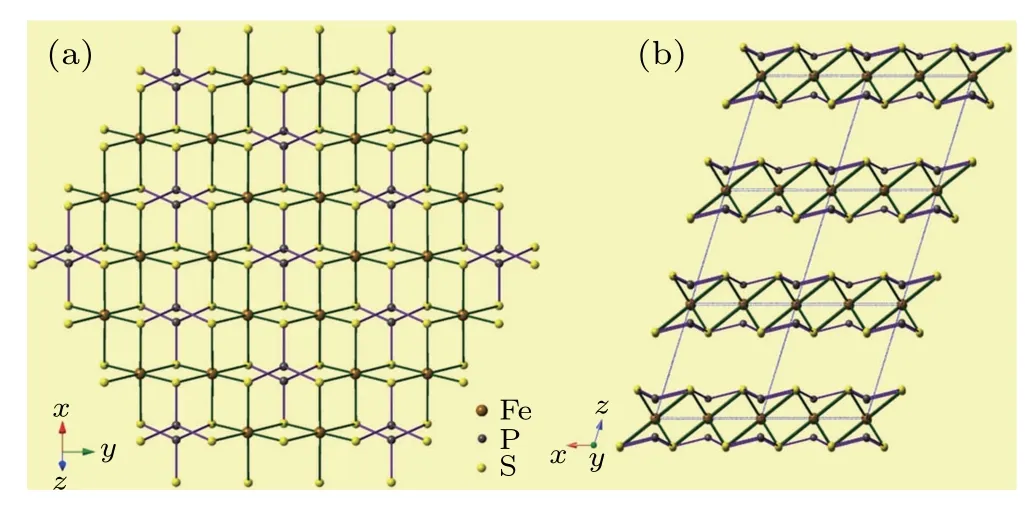
Fig.1.(a)In-planeand(b)out-of-plane crystalstructuresof FePS3.
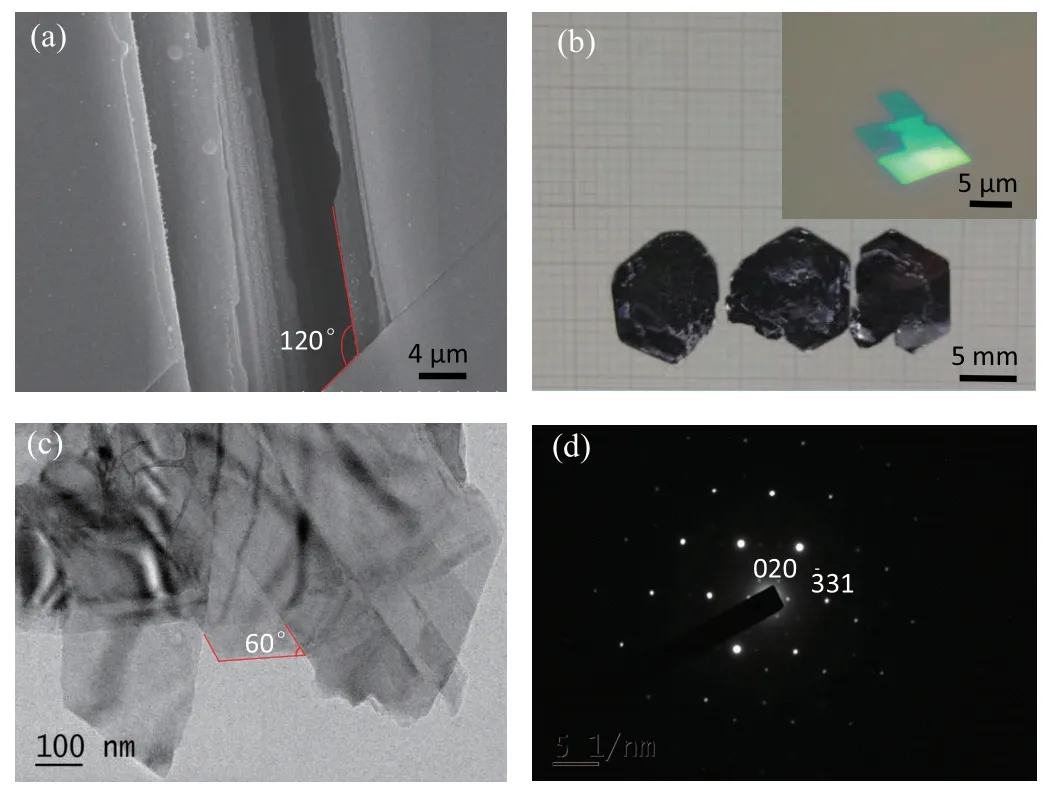
Fig.2.(a)SEM image,(b)photo of bulk FePS3 crystals,and the typicalexfoliated FePS3(the inset in(b)).Thebright-f ield TEM imageand electron diffraction pattern are shown in(c)and(d),respectively.
In ourstudy,the CVTmethod hasbeen shown to successfully yield high quality FePS3crystals.A typical SEM image of as-grown crystal is shown in Fig.2(a),exhibiting the expected layered structure.Asmentioned above,FePS3has a hexagonal in-planestructure.So,the straightedgeswith characteristic inneranglesof~120°can beeasily identif ied in the morphology.Mostof theobtained FePS3f lakeshave an average size of about10mm,as shown in Fig.2(b).The parameters of cleavage energy and cleavage strength are normally utilized to estimate the possibility ofmechanical exfoliation from thebulk 2D van derWaals.Previously,ithasbeen shown that the cleavageenergy of FePS3iscomparable to theexperimentally estimated valueofgraphiteand the cleavagestrength is even lower than that of graphite,[23]which indicates that the exfoliation of bulk FePS3by scotch tapmethods is feasible.Here,we havemechanically exfoliated the as-grown bulk FePS3crystal onto freshly cleaned Si substrates with a 300-nm-thick SiO2top-layer(see the inset of Fig.2(b)).The resulting FePS3sheetsshow differentoptical contrastdue to the interference.Different colors represent different thicknesses.The preferential crack-propagation along the high-symmetry crystal axis during exfoliation results in typical 120°or 60°anglesbetween sheetedges.[24]Thesuccessfulachievementof ultrathin FePS3favors forexploring theinteresting low dimensionalmagnetism,aswell as for further incorporation FePS3into van derWaals heterostructures.The chemical compositions of FePS3have been measured by EDS,which reveals that the ratio of Fe:S:Pisvery close to theexpected 1:1:3,suggesting the formation of FePS3phase.The TEM morphology image isshown in Fig.2(c),demonstrating the2D nanosheetlikegeometry of FePS3.Itseems that therearew rinkles in the sample.The SAED pattern is takenwith the incidentelectron beam normal to the ab-plane.Well-def ined diffraction spots are clearly shown,conf irm ing the presence of characteristic planes.Our SAED pattern agreeswellwith that reported by Murayama etal.,[25]suggesting that the prepared crystals are likely to have rotational tw insand are pseudo-3-fold symmetrical.
The x-ray diffraction(XRD)data are further collected at room temperature to determ ine theorientation of theas-grown crystals.As shown in Fig.3(a),only(00l)-oriented peaks for monoclinic structure(PDF#30-0663)of FePS3appearwithout any other impurities peaks,exhibiting high crystalline phase purity aswell as the desired layer structure.Structural characterization hasalso been performed by Raman spectroscopy.The Raman spectra at room temperature are collected using a 488 nm laser.On the basis of the present experiments and of previous analysis,the Raman peaks can be assigned as follows.The peak around 100 cm-1originates from the Fe atom vibrations.This peak is a spin-disorder-induced mode and could be replaced by other spin-order-induced modes below the N′eel temperature of FePS3.[26]The peak around 155 cm-1is the strongly infrared(IR)active Eutypemode of the P2S6molecule,which can be observed in all the M PS3compound.[27]Theother peaks come from[P2S6]4-anion vibrationalmodes.TheRaman peaksat247 cm-1and 380 cm-1correspond to the A1gmode,which is the out-of-plane vibration of P2S6entities.The other three peaks observed at 227 cm-1,279 cm-1,and 579 cm-1are related to the Egmode.Overall,the Ramanmodesobserved in ourexperiment agreewellwith previous studies.[15,26,27]The careful studies on thickness dependence and temperature dependence of Raman spectra for FePS3are underway.
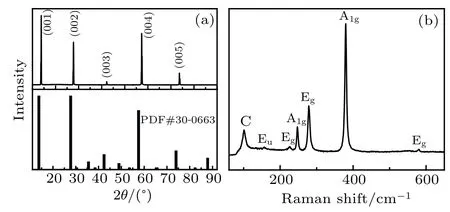
Fig.3.(a)X-ray diffraction pattern and(b)Raman spectrum of the as-grown FePS3 measured at room temperature.
The surface sensitive XPS has been performed to detect the surface composition and chem ical state of FePS3.The atom ic ratio of Fe:S:P is detected to be also about1:1:3.The corresponding Fe 2p,P 2p,and S 2p XPS spectra are shown in Fig.4.The Fe2p spectraappearaswell-resolved doublets.The Fe2+state can be ascertained from the peaksof Fe 2p1/2and Fe 2p3/2at the binding energies of 722 eV and 709 eV.The two resolved S 2p peaks at 162.4 eV and 163.5 eV are assigned to 2p1/2and 2p3/2,respectively,implying Fe–S and P–Sentities.The P 2p peaks located at131.9 eV and 132.5 eV correspond to P 2p1/2and P 2p3/2,respectively.All thevalues are comparablewith previous reported values.[19,28]
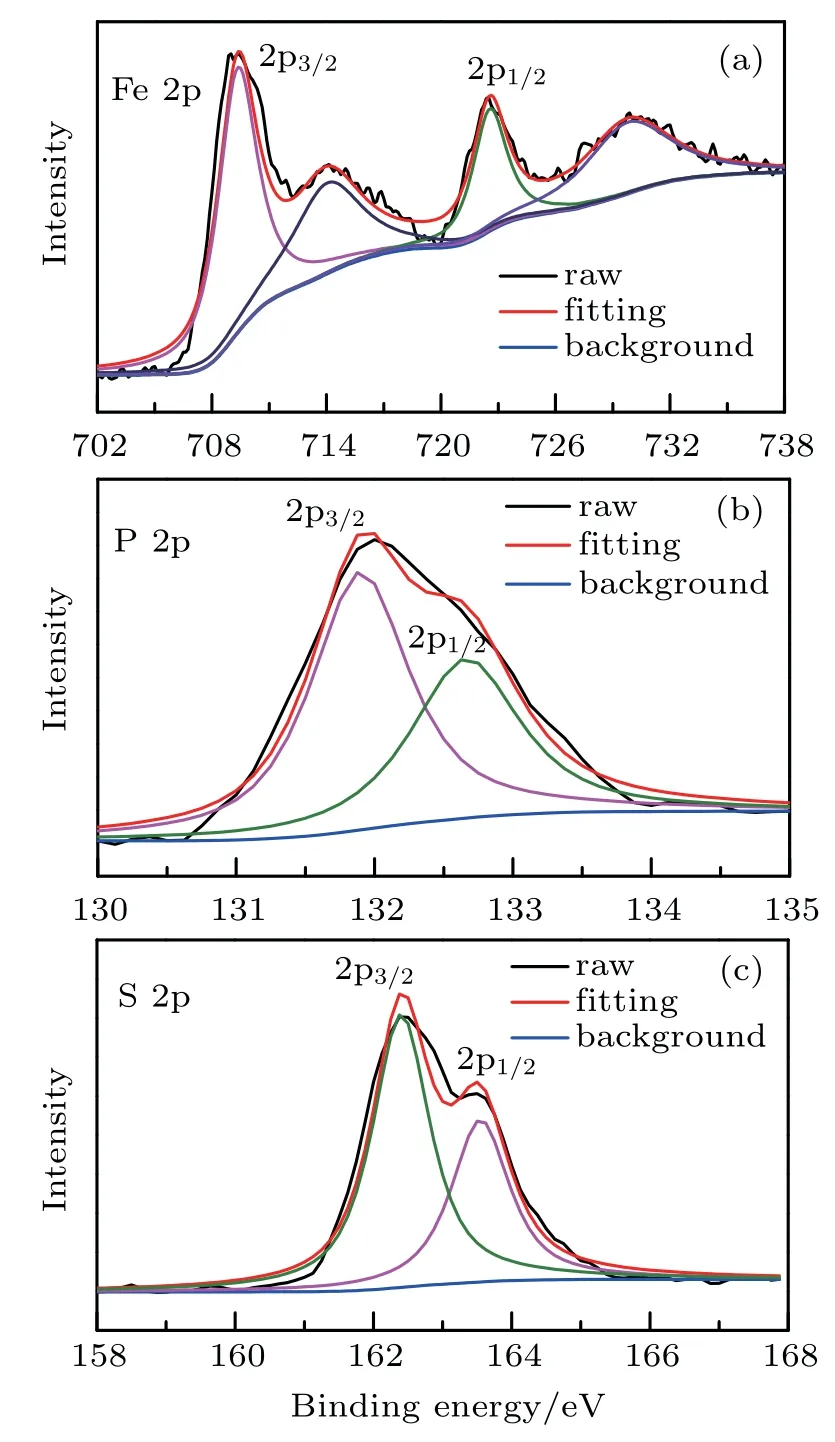
Fig.4.XPSspectra of(a)Fe2p,(b)P 2p,and(c)S 2p for FePS3.
In addition to structural characterization,the magnetic properties of FePS3crystals have been further probed.The dcmagnetic susceptibilitiesχ,measuredwith the500Oe f ield along the layer stacking direction(χ⊥,out-of-plane)and with the f ield in the plane of the FePS3layers(χ‖,in-plane),are shown in Fig.5(a).The curves show clearmagnetic phase transition from the antiferromagnetic to paramagnetic phase around N′eel temperature.The f irst derivative of susceptibility curves indicates a transition temperature of~115 K,which is in agreementwith previous studies.[20,26]Moreover,considerable anisotropy ofχis apparent.The change ofχ out of plane ismuch larger than that in plane,implying that the spin is aligned along the out-of-plane direction. The anisotropy in FePS3is so strong that it w ill create an energy gap of~16 meV in the spin-wave spectrum.[29]The high-temperature paramagnetic susceptibility in both directionsobeys the Curie–Weiss lawχ=C/(T-TC),where C is the Curie constant from which theeffectivemagneticmoment μeffof Fe2+could be deduced,and TCis the Curie temperature.Fitting thedataathigh temperaturegivesan effectivemomentofμeff=6.02μB,TC=62K forχ⊥,andμeff=5.23μB,TC=-85 K forχ‖,respectively.The different sign of TCis probably associatedwith thecrystal-f ield effectsarising due to the trigonal elongation of the FeS6octahedra.[30]If we consider the spin of Fe ion only,the theoreticalμeffwould be 4.9μB.The values after f itting are larger than the spin-only effectivemoment,which has also been reported in the previousstudies.[30,31]Thismight indicate that theorbitalmomentum in FePS3isnotcompletely quenched.[30]However,more studies are still needed in the future to give directevidences.The temperature dependence of the out-of-plane ac susceptibilityχacunderdifferent frequenciesisalsoshown in Fig.5(b).Over the entire rangeofmeasured frequencies from 100Hz to 2000Hz,no frequency dispersion isobserved,which rulesout a spin freezing transition.
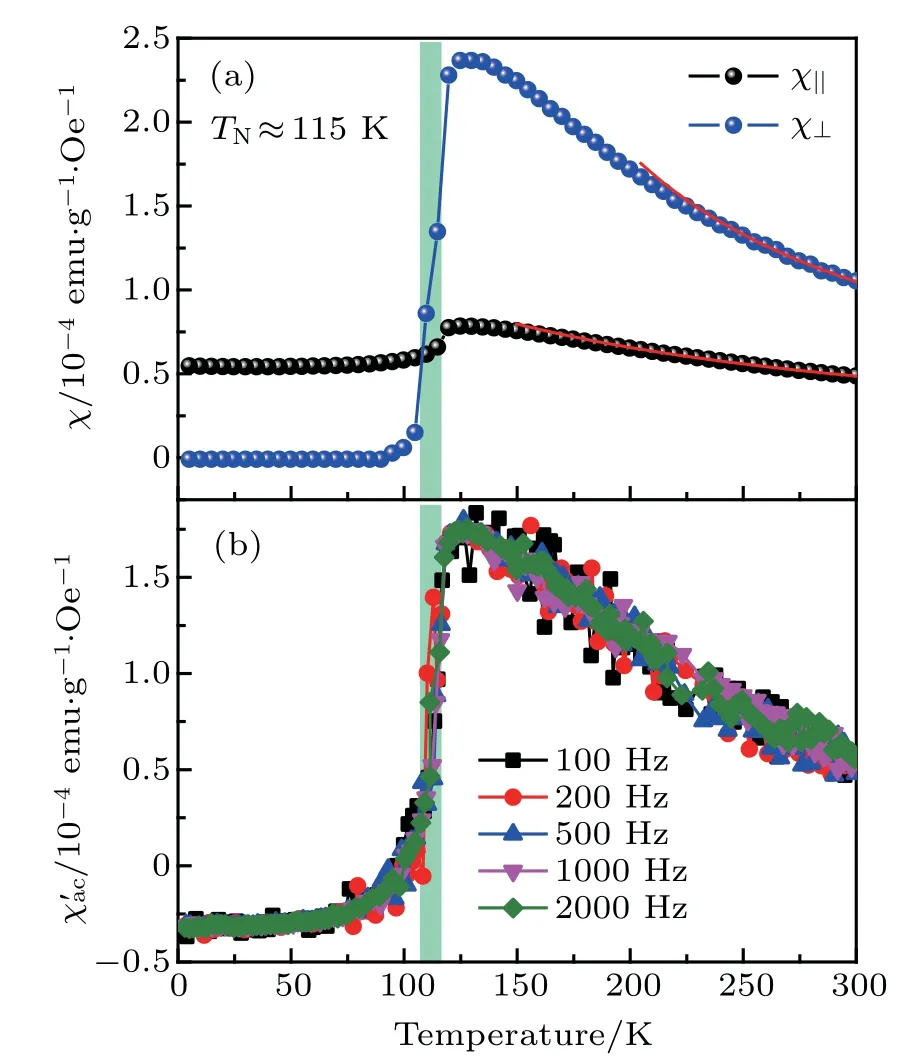
Fig.5.(a)Temperature dependence of dc parallel(χ‖)and perpendicular(χ⊥)magnetic susceptibility of FePS3.The f itting curve using the Curie–Weiss law is also shown.(b)Temperature dependence of real acmagnetic susceptibility of FePS3 measured at different frequencies from 100Hz to 2000Hz.
4.Conclusions
A comprehensive study of crystallographic andmagnetic properties of high quality van der Waals layered FePS3single crystals hasbeen performed using SEM,TEM,XRD,Raman,XPS,χdc(T),andχac(T).The synthesized FePS3show single-crystallinity with theaverage sizeof about10mm.The crystals can be exfoliated down to few layers.The preferred cleavageanglesare120 degreesor60 degrees.FePS3exhibits typicalmagnetic transition from the paramagnetic to antiferromagnetic phase.The derived effectivemoments are larger than thespin-only effectivemoment,suggesting thatan orbital contribution to the totalangularmomentum of the Fe2+could be present.The ac susceptibility lacks frequency dependence,whichmeans that the spin freezing effectisexcluded.
- Chinese Physics B的其它文章
- Computational study of inverse ferrite spinels
- Effectsof chem icalpressure on dilutedmagnetic sem iconductor(Ba,K)(Zn,M n)2As2*
- Particle–hole f luctuationsand possible superconductivity in dopedα-RuCl3*
- Surface stabilized cubic phaseof CsPb I3 and CsPbBr3 atroom tem perature*
- Raman scattering study ofmagnetic layered M PS3 crystals(M=M n,Fe,Ni)*
- Low tem perature Pmmm and C2/m phases in Sr2CuO3+δ high temperature superconductor*