
Tensile-strain induced phonon sp litting in diamond*
2019-05-11 07:35:10MeifangPu蒲梅芳FengZhang張峰ShanLiu劉珊TetsuoIrifune入舩徹男andLiLei雷力
Chinese Physics B 2019年5期
Meifang Pu(蒲梅芳),Feng Zhang(張峰),Shan Liu(劉珊),Tetsuo Irifune(入舩徹男),and Li Lei(雷力),?
1Institute ofAtomic and MolecularPhysics,Sichuan University,Chengdu 610065,China
2Geodynam icsResearch Center,Ehime University,Matsuyama790-8577,Japan
(Received 21 January 2019;revisedmanuscript received 22March 2019;published online8April2019)
Keywords:diamond,tensile-strain,phonon splitting,Brillouin zone
1.Introduction
Raman scattering can provide important information on lattice vibrational properties of the chosenmaterials of interest.For intrinsic crystals,only phononmodes in the proximity of the Brillouin zone(BZ)center are observed ow ing to the phonon wave vector q≈0 selection rule.However,for the conservation ofmomentum,relaxation of the q≈0 selection rulewould be expected in smallgrain size,defect,impurity,vacancies,and local structural disorder.[1]Diamond has unique properties,such asw ide bandgap,high bulkmodulus,and ultra-high hardness.[2–4]These interesting propertieshave opened pathways to numerousapplicationsof thismaterial in the areas ofmicroelectronic devices,coatings,optics,superhard materials,etc.[5]The Raman spectroscopy of diamond hasbeenextensively studied from a theoreticaland experimentalperspective.[6–9]
The f irst-order phonons of diamond can be classif ied in the space group Fd-3m.[10,11]There are two carbon atoms in the primitive unit cell and thus a single triply degenerate f irst-order phonon with symmetry F2g.[12]At theΓpoint,the three opticalbranches are triply degenerate and the corresponding phonons belong to the irreducible representation as shown in Fig.1(a).[13]In theabsenceof stress,the single crystal diamond exhibits a f irst-order f ingerprint Raman peak at 1332 cm-1which corresponds to the q≈0 triply degenerate optical phonons F2g(Fig.1(b)).[10]The in situ high-pressure Raman spectroscopy by using diamond anvil cell(DAC)has shown great potential for investigating the properties of diamond under stress,and the high-frequency edgeof the Raman band appears to be an excellentpressure-calibration standard as an alternative to the ruby pressure scale.[14–16]In the case of thehighly disordered diamond,thereexistsa pairof Raman bandsat~1350 cm-1and~1580 cm-1,whicharedesignated as the D band and G band,respectively.[10,17]The Raman line w idthand D/G intensity ratioare related to thedegreeofstructure order.[17–19]
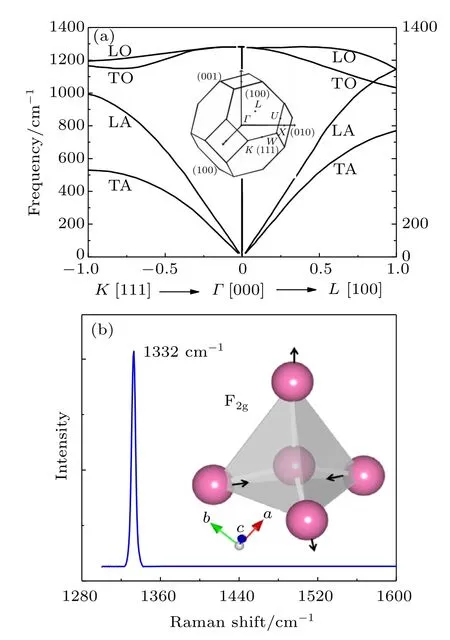
Fig.1.(a)Dispersion curves for diamond in the(100)and(111)directionsand Brillouin zoneof cubic diamond.(b)A f irst-order f ingerprint Raman peak at 1332 cm-1 and the Raman vibrationalmotions F2g of diamond.
Stress-induced lattice strain and distortion violates the translational invariance and breaks down the phonon wavevector selection rule so that the phonon’smode off the center of the BZ can be active in Raman scattering.The question of whether or not the disorder-activated phonon behavior could retain some in situ high-pressurecharacteristicsafter theshock treatmenthas,therefore,to beaddressed in order to betterunderstand the dynamic of theaforementioned lattice distortion.
In this paper,we study the corresponding diamond phonon behavior under the shock treatment of hightemperature and high-pressure.We reveal themechanism of disorder-activated Raman(DAR)phonon originated from the presence of tensile strain in the diamond lattice.
2.Experimental
The ultrahigh-pressure Raman scattering experimentand double-sided laser-heated diamond anvilcell(LHDAC)experimentof thisworkwereperformed in Sichuan University.The pressure-generation experimental runsusing a DACwere performed with a gasketed high-pressure technique.[20]We used the high-frequency edge of the diamond phonon as the pressure scale.[18]In this study,low-lum inescence type IA diamonds with a culet diameter of 80–200μm were used for the anvils,and Re metal with the thickness of 20μm was used as the gasket.The diamond anvils were pressurized to the lim it until catastrophic failure at the highest pressure(160–200 GPa)soon after laser heating(above 2000 K)with 1064 nm f iber laser(Fig.2).The sample chamber,typically smaller than 9×9μm2,was close to the spotsize of focused laser beams.Some laser absorbingmaterials,such as highpressureamorphousnitrogen,were f illed in the sample chamber for laser heating.No pressuremedium was used in allof our LHDAC experiments.Laser heating temperatures were either measured by the spectroradiometric method or estimated.The recovered broadened diamond anvilswere investigatedby scanningelectronm icroscopy(SEM,HitachiFESEM S4800,Japan),micro-focused x-ray diffraction(XRD,Rigaku,RAPIDII-V/DW,Cu Kα),andm icro-Raman spectroscopy.[21]Raman scattering experimentswere carried outon a custombuilt confocal Raman spectrometry system in the backscattering geometry based on triple gratingmonochromator(Andor Sham rock SR-303i-B,EU)with an attached electronmultiplying charge-coupled device(EMCCD,ANDOR New ton DU970P-UVB,EU);excitationwasachieved by using asolidstate laser at532 nm(RGB laser system,NovaPro,Germany)with a laser power of 50 mW for Raman measurement and collection by a 20×,0.28 numerical aperture(N.A.)objective(M itutoyo,Japan).The spectral resolution was within±1 cm-1,and the spatial resolutionwaswithin±1μm.
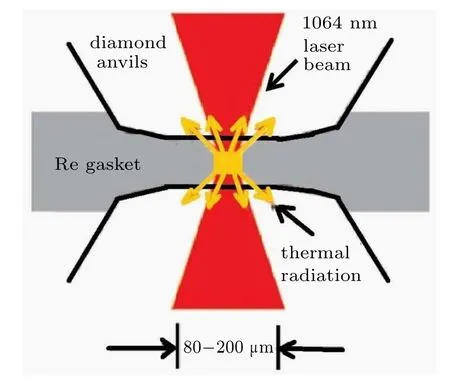
Fig.2. Scheme of the double-side LHDAC experiments. There is a small sample chamber for laser heating,typically smaller than 9×9μm2,and close to the spot sizeof focused laser beams.No pressuremedium wasused in allofour LHDAC experiments.
3.Resultsand discussions
W ith applied pressure,the Raman shift of the culet center of loaded diamond anvils is found to exhibit asymmetric broadening and blue-shift(due to the normal compressive stress).In marked contrast to the intrinsic Raman line at1332 cm-1,the Raman band of the diamond anvils loaded at 157 GPa exhibits signif icant broadening and blue-shift(Fig.3).The high-frequency edge comes from the singlet modewith a larger frequency shift to 1617 cm-1at157GPa.In our experiments,some of the diamond anvils experienced catastrophic breakdown upon heating by laser at ultra-high pressures.High temperature could relieve the stress,which is produced by cold compressing at room temperature.Typically,the pressure dropsby 2–5GPa after the laserheating at above 100 GPa.In this experimental run,the diamond anvils are pressurized up to~200GPauntilcatastrophic breakdown.The SEM images of recovered diamond anvils(Fig.4)show that the top of the recovered diamond anvils are completely damaged after the uncontrollable burst.
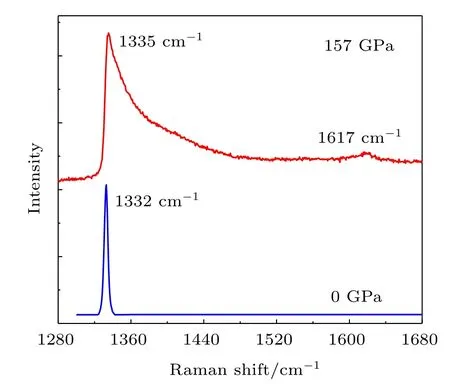
Fig.3.Typical Raman spectra from the center of the diamond anvil culetat0GPa and 157GPa.
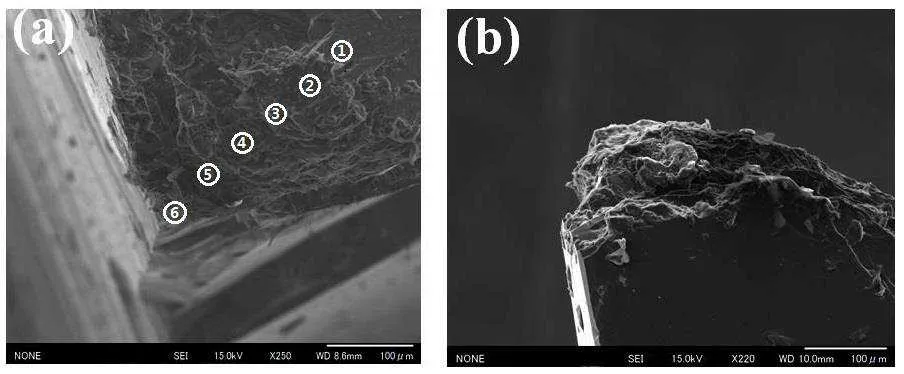
Fig.4.The SEM images of recovered diamond anvils.Thewhite number calibrates the testpointsof thesample,which corresponds to theRamanand micro-XRDmeasurements.
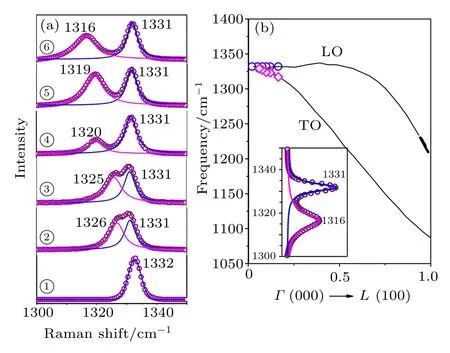
Fig.5.(a)Raman spectraof the recovered diamond anvil for differentsample regionsand f irst-orderRamanband splitting intoadoubletband of1316–1331 cm-1.It is a consistent one-to-onematch between the positions in SEM image(Fig.4(a))formeasurementand the Raman data.(b)The splitting of LO and TO in the f irstBrillouin zone.The insetcorresponds to the Raman peak of the rightmost LO and TO.
Figure 5(a)shows Raman spectra of a recovered diamond anvil for different sample regions.The sharp Raman line at 1332 cm-1is the characteristic signature of the intrinsic diamond.The triply generate f irst-order Raman band of the diamond is split into a doublet band of 1316–1331 cm-1. The red shift of the Raman phonon modes originates from the stress-induced lattice tensile strain,and this tensile stain is attributed to the carbon bond-stretching among themassof theatomsafter thehigh-pressureand hightemperatureburst.
Considering thatRaman excitation lighthasa very large wavelength(532 nm)when compared to the distancebetween neighboring atoms in adiamond crystal(~0.154 nm),themomentum conservation selection rulebasically implies thatonly phonons at BZ center(q≈0)are Raman active.[22,23]There are twomain aspects thatcould change theRaman signatureof acrystallinematerial.The f irstis thebreakdown ofmomentum conservation,in conditions of translational symmetry breaking.This symmetry selection rule relaxation can give rise to DARmodes,which could result in new peaks in the Raman spectrum of the diamond.The second aspect is the increase in the Raman peak linew idthsdue to the phonon conf inement.In a perfectly ordered system,the frequency uncertainty is governed by the phonon lifetime in the crystal lattice(Heisenberg uncertainty principle).Defects induced by tensile strain could generate boundaries thatcan conf ine the phononswithin a region of length,thus generating an uncertainty in the phonon momentum value.The atom ic vacancies,distortion,dislocations,and line-extension can introduce an sp2bond disorder into the sp3-bond dominated diamond system.[24,25]Thus,the diamond bands can be broadened by the disorder or dim inished phonon lifetimes resulting from lattice strain.[26,27]
The phonon modes(lattice vibrations)are usually presented by the irreducible representation based on the symmetry group of the crystals,which are essential to the interpretation ofRaman spectra.TheRaman shiftisgiven by thephonon vibrational frequency,which is governed by themass of the atoms and the strength of the chem ical bonds.In our experiments,the f irst-order Raman peak splitting induced by tensile strain is consistentwith the splitting of transverse optical(TO)and longitudinaloptical(LO)in the f irstBrillouin zone,as shown in Fig.5(b).The structural distortion induces relaxation of the q≈0 selection rule at the center of the BZ and allows detection of the phonons away from BZ center.[28,29]In the case of diamond,this results in separation of TOmode and LOmode.Therefore,the phonon splitting in the low frequency corresponds to the LO–TO phonon splitting near the centerof BZ.
Further evidence on tensile strain in the diamond lattice is provided by micro-focused XRD measurements.Figure 6 shows that(111)and(220)crystal faces of diamond shift to lower values of 2θdegrees in different sample regions.According to the equation 2d sinθ=kλ,the carbon–carbon bonding isstretched and C–C stretchingmodeexistsunder the condition of high degree of disorder.This phenomenon also supports the phenomenon of Raman redshiftand the TO–LO splitting of phonon.
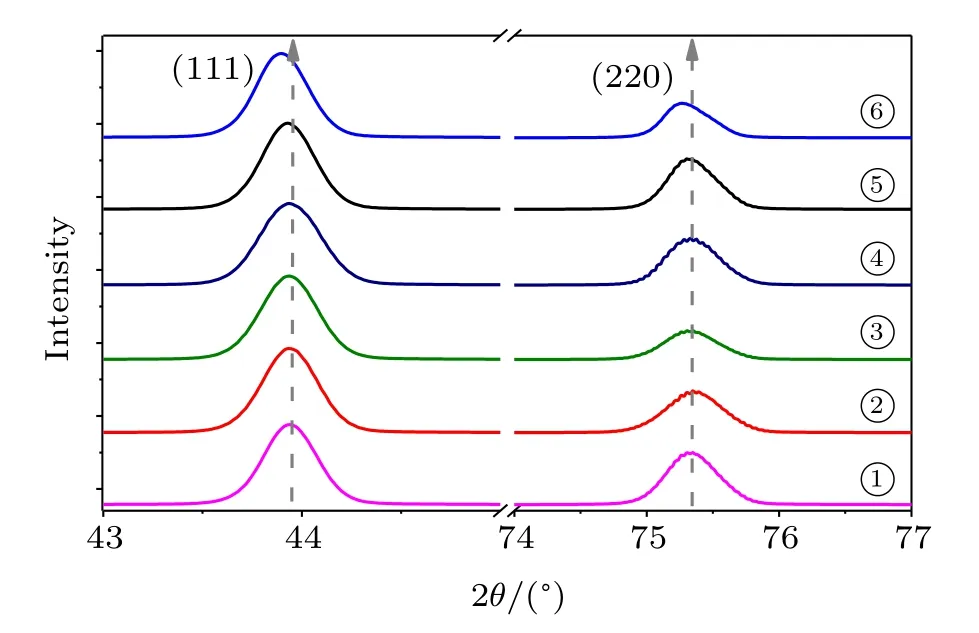
Fig.6.M icro-focused XRD of the recovered diamond anvil for differentsample regions.It isa consistentone-to-onematch between the positions in SEM image(Fig.4(a))formeasurement and the m icro-XRD data.
4.Conclusions
The phonon splitting behaviors of diamond after a burst of high-pressure and high-temperature have been investigated bymicro-Raman spectroscopy,micro-focused XRD,and SEM analysis.The double-splitting peak of diamond is due to the presence of tensile strain in the diamond lattice.
Acknow ledgments
We thank Prof.Filippo Boi for helpful discussions and the Joint Usage/Research Center PRIUS(Ehime University,Japan).

- Chinese Physics B的其它文章
- Computational study of inverse ferrite spinels
- Effectsof chem icalpressure on dilutedmagnetic sem iconductor(Ba,K)(Zn,M n)2As2*
- Particle–hole f luctuationsand possible superconductivity in dopedα-RuCl3*
- Surface stabilized cubic phaseof CsPb I3 and CsPbBr3 atroom tem perature*
- Raman scattering study ofmagnetic layered M PS3 crystals(M=M n,Fe,Ni)*
- Low tem perature Pmmm and C2/m phases in Sr2CuO3+δ high temperature superconductor*