SPE-GC/MS測定蘋果梨中19種有機氯農藥殘留
2019-04-16 12:18:54姚蘊恒白龍律武倫鵬吳信子秦振寧任秀麗
食品與機械 2019年12期
姚蘊恒 白龍律 武倫鵬 吳信子 衣 濤 秦振寧 任秀麗
(1.延邊朝鮮族自治州檢驗檢測中心,吉林 延吉 133000;2.吉林煙草工業有限責任公司,吉林 延吉 133000; 3.延邊大學工學院,吉林 延吉 133002)
“Food safety” is a social issue and affects social stability, especially with the endless stream of incidents related to pesticide residue in food or crops which have caused consumer panic(Alamgir, Fakhruddin, Nazrul, Mohammed, Siew, Khorshed, 2013).Therefore, different countries and international agencies have set maximum residue limits(MRLs)for pesticides in various food.However, there is no MRLs established for apple-pear so far.Apple-pear is one of the most famous fruit in the north cold temperate zone of China.It is originally from the Yanbian Korean Autonomous Prefecture of Jilin province.Because of the ugly appearance, it is also called “Chinese ugly pear”.The fruits of apple-pears not only taste good mouthfeel, but also contain large amount of vitamins, calcium, phosphorus, iron and other essential nutrients.They could be used to protect liver and stomach, disperse phlegm and suppress cough, soften blood vessels, which was praised by the nutrition experts as “health food” and “functional food”(Ana, Maria, Agustin, Yolanda, 2016).
Like other fruit and vegetables, organochlorine pesticides have to be used to fight against the weeds, pests and moulds during the growth, harvesting, and storage of the product(Dipakshi, Avinash, Yogesh, Jatinder, 2010), but the use of agrochemical can result in pesticide residues problem.The pesticides may cause severe damage to human health if present above levels due to their high toxicity(Kuang, Qiu, Kong, Luo, Cheng, Yang, 2013; Hou, Lei, Guo, Qiu, 2016).There has been an increasing public concern related to the presence and control of pesticide residues.Therefore, it is necessary to establish sensitive, simple, and accurate analytical methodologies for organochlorine pesticide analysis in apple-pear.
The analysis of organochlorine pesticide residues in apple-pear, which contains protein, sugars, pigments, carbohydrate, and other substances, is a challenging issue, due to the high complexity and low concentrations of target analytes.Many complex chemical substances are seized and co-extracted during the pretreatment process.This leads to interference problems and affects the detection limit.Any interference in the sample pretreatment may bring uncertainty for the determination of organochlorine pesticide residues.The extraction and clean-up procedures are therefore critical steps in the process of a comprehensive analysis, which directly affects the accuracy and repeatability of the detection and analysis.Generally, the analysis for pesticide residues is carried out in a sequence of three steps, including extraction, purification, and detection(Yang, Zhang, Liu, Wang, Zhang, Dong, Zhao, Sun, Cui, 2011).Lot kinds of solvents have been used for pesticide residues extractions such as acetonitrile, petroleum ether, acetone, etc.The extraction solvent with a proper polarity to match the target was beneficial to minimize interferences and improve process efficiency from the samples(Xie, Han, Qian, Ding, Chen, Xi, 2011).For the sample clean-up procedure, QuEChERS(quick, easy, cheap, effective, rugged and safe)method(Han, Song, Zou, Chen, Qin, Pan, 2016; Guan, Tang, Chen, Xu, Li, 2016), liquid-liquid extraction(LLE)(Chen, Chen, Guo, Li, Yang, Xu, Fu, 2014; Gevany, Antonio, Maria, Flaviano, 2010), dispersive solid phase extraction(dSPE)(Zhang, Chen, Zhu, Wang, Ma, Liu, 2016; Guan, Li, Zhang, Hong, Natalie, Ye, Ma, 2013), matrix solid-phase extraction(MSPD)(Ignacio, Natalia, Mariela, Horacio, Maria, 2017; Cao, Tang, Chen, Li, 2015)and solid-phase extraction(SPE)(Radu, Guillaume, Emilie, Brice, 2014; Mohd, Syairah, Wan, Ahmedy, Dadan, Mazidatulak-mam, Iqbal, Hassan, 2013)were successfully applied.Among the different purification methods, SPE technology not only offers the potential of simplifying the purification of the initial extract, but also minimizes the amount of solvent consumed, therefore, ideally suited to routine analysis.For the detection techniques, gas chromatography-mass spectrometry(GC/MS)has been widely used in food analysis, especially for pesticide residue analysis nowadays.It can be able to analysis multi residues with high selectivity and sensitivity(Hernandez, Cervera, Portoles, Beltran, Pitarch, 2013).
Even though lots of studies have been reported pesticide levels in fruit and vegetables(Irina, Andrey, Daria, Daria, Andrey, 2017; Lukman, Guan, 2015), there is very little information available on apple-pear.Therefore, in this study, an analytical method for the determination of organochlorine pesticides using ultrasound-assisted solvent extraction, solid-phase extraction(SPE)and gas chromatography-mass spectrometry(GC/MS)is presented.Moreover, the proposed method has been successfully applied to detect these pesticides in real samples.To the best of our knowledge, this is the first report on the determination of organochlorine pesticide residues in apple-pear.
1 Experimental
1.1 Reagent and Materials
The pesticide standards(Table 1)were purchased from Agro-Environment Protection Institute(Tianjin, China).The purities of these standards were more than 99%.Standard pesticide stock solution(10 μg/mL)of pesticides were prepared toluene and stored at 4 ℃ in the dark.HPLC-grade acetonitrile, petroleum ether, acetone, dichloromethane, methanol, andn-hexane were purcha-sed from Fisher Scientific(Belgium, UK).Analytical-grade sodium chloride(NaCl)was purchased from Kermel(Tianjin, China).For SPE, PestiCarb(500 mg/6 mL)cartridge, NH2(1 000 mg/6 mL)cartridge and Florisil(1 000 mg/6 mL)cartridge were obtained from Agela Technologies(Tianjin, China).Apple-pear samples were collected from the local market in Yanji.

表1 19種農藥的化學式、相對分子質量、保留時間、定量離子和定性離子?
? Target ions are printed in bold.
1.2 Sample extraction and clean-up
1.2.1 Sample extraction 100 g of the edible part of apple-pear sample was chopped and homogenized.5 g homogenized sample was accurately weighed into a 150 mL centrifuge bottle and 50 mL acetonitrile was added.Then 5 g sodium chloride was added.The mixture was shaken vigorously by hand for 10 s and followed by ultrasonic extraction for 20 min.Finally, the mixture was centrifuged for 5 min at 3 000 r/min, and then transferred 10 mL of upper organic phase solution into a 100 mL pear-shaped flask.Then concentrated at 40 ℃ until near dryness for clean-up.
1.2.2 Sample clean-up The SPE cartridges were preconditioned with 5 mL dichloromethane.After the conditioning step, the extract in section 2.2.1 was re-dissolved with 2 mL methanol-dichloromethane(1∶19,V/V), and then percolated through the cartridges and left to flow through under the action of gravity.The retained analytes were eluted with 3×5 mL of methanol-dichloromethane(1∶19,V/V)at 2 mL/min and the eluate was collected in a pear-shaped flask.The obtained eluate was concentrated to dryness under a gentle stream of nitrogen in a water bath at 40 ℃.Finally, the residue was re-dissolved with 2 mLn-hexane and filtered through a PTFE filter(0.22 μm)for GC/MS analysis.
1.3 GC/MS analysis
Thermo Scientific TRACE 1300 gas chromatograph combined with TSQ 8000Evo Triple Quadrupole Mass Spectrometer was employed.The analytical column TG-5MS(30 m×0.25 mm×0.25 μm)from Thermo Scientific was used, with helium(≥99.999%)as carrier gas at a constant flow of 1 mL/min.The injected volume was 2.0 μL in splitless mode at 290 ℃.The temperature program was the following: Initial temperature of 40 ℃, held for 1 min, and ramped to 130 ℃ by 30 ℃/min, then ramped to 250 ℃ by 5 ℃/min.Finally, increased to 300 ℃ by 10 ℃/min and held for 5 min.The total analysis time was 38 min.The mass spectrometry condition includes electron impact ionization(EI, 70 eV), ion source temperature 280 ℃.Argon(≥99.999%)was used as the collision gas.The optimization was carried out in full scan mode from 50 to 500m/zat 2.00 s per scan; Sovent was delayed for 8.0 min.Quantitation was done in selected ion monitoring(SIM)mode.The software Xcalibur was used for instrumental control, data acquisition, and treatment.
1.4 Method performance
The mixed standards in toluene were used to determine retention times, mass spectra and ion abundances for GC/MS.The method was validated through the following parameters: Accuracy and precision, the limit of detection(LODs), the limit of quantification(LOQs), and linearity.Recovery assays were carried out to study the accuracy and precision of the method with three replicates spiked at three different levels(20, 40, 200 μg/kg).The LODs were considered to be the concentration that produced a signal-to-noise(S/N)ratio 3.The LOQs were defined as anS/Nratio of 10.Linearity was studied by applying matrix-matched calibration with seven points.The correlation coefficients(R2)should be >0.99.For matrix effect evaluation, ME was calculated with the formula(1).
ME=(x2/x1-1)×100%,
(1)
In the formula:
ME——Matrix effect,%;
x2——Slops of matrix-matched calibrations;
x1——Slops of calibration curves in solvent.
2 Results and discussion
2.1 Optimization of sample pretreatment
2.1.1 Sample extraction A total chromatogram of a mixed standard solution is shown in Figure 1.The selection of the extraction solvents during the pretreatment process with a proper polarity to obtain higher extraction efficiency is extremely important.In the solvent selection experiments, acetone, petroleum ether, acetonitrile, different ratios of acetone and petroleum ether(acetone∶petroleum ether=1∶1, 1∶2, 1∶4,V/V)were studied.The experiment results(Figure 2)showed that petroleum ether and the mixture of acetone and petroleum ether(V/V=1∶1, 1∶2, 1∶4)could not extract the chlorothalonil effectively(recoveries<10%),owing to their poor solubility.However, both of the acetonitrile and acetone could extract all pesticides with good recoveries(80%~120%)effectively.By considering that acetonitrile was less volatile in comparison with acetone, acetonitrile was adopted as the extraction solvent in this study.

圖1 19種農藥混合標準溶液總離子流色譜圖
Figure 1 Total ion current chromatogram of a mixed standard solution of the 19 kinds of pesticides(50 μg/kg)
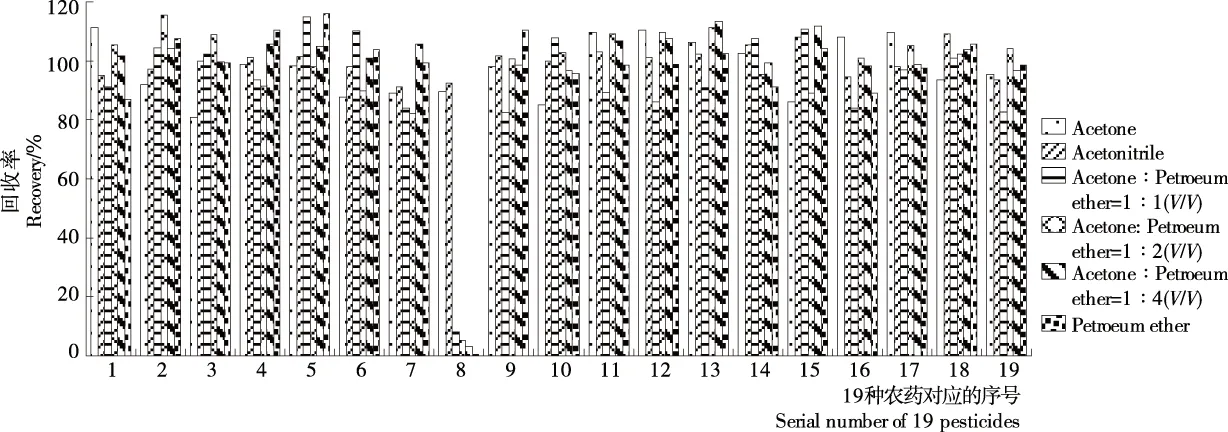
圖2 萃取劑對蘋果梨中19種農藥回收率的影響
There are three parameters that influence the analytes between the sample matrix and extracting solvents.The most common method used in the optimization of extraction parameters was the thermodynamic and theoretical models.A design of experiment using the software Design-Expert 11 was addressed.
The used statistical models designed to understand the relationship between the factors and response with a minimal number of experiments carried out in an orderly and efficient manner.A three-factor, three level Box-Behnken design(BBD)with sample weight, extraction solution volume, and extraction time as the independent variables was employed for the study.The actual design experiment was shown in Table 2 and 3.
For predicting the optimal point, a second-order model was fitted to mathematical relationship of the response and these variables.All the results obtained in the experiments were used for the computer simulation programming applying the quadratic polynomial equation.For the three factors, the equation is:
d=0.91-0.073 8A+0.104 6B-0.002 9C-0.005AB+0.07AC-0.058 2BC-0.332 1A2-0.242 9B2-0.270 4C2.
(2)
The summary of the analysis of variance(ANOVA)is shown in Table 4.The ANOVA of regression model demonstrates that the model is highly significant.It can be seen that theR2=0.925 8, it indicates a good correlation between the experimental and predicted values ofd.The P value and lack of fit value of model is 0.010 1(significant)and 0.151 5(no significant), respectively.These two values confirm that the model fitness is good and the quadratic model is statistically significant for the response.Values of desirability function(d)ranged from 0 to 1, for a completely undesirable responsed≤0 and for a fully desired responsed≥1(Norma, Silvia, Roberto, Jose, Angela, Ismael, 2017).As shown in Figure 3(a), for sample weight the highest desirability value(d=0.85)was adopted using 5 g.Probably low level(1 g sample)might decrease the extraction efficiency, whereas, high level(10 g sample)might increase the background disturbance and harm the recovery.For extraction solution volume, 50 mL of extraction solution was obtained the height desirability value[Figure 3(a)].Therefore, the ratio of extraction solution volume to the sample weight was 10 mL/g.For extraction time, 20 min as the optimum extraction time[Figure 3(b)and 3(c)].Longer ultrasonic extraction time(30 min)was not selected because it might cause heating of the extraction solution and sample.Therefore, the optimal control conditions were 5 g of sample, 50 mL of extraction solution and extraction for 20 min.

表2 響應面因素水平表

表3 響應面試驗設計及結果
2.1.2 Comparison of different SPE cartridges Apple-pear represents a very complex matrix, which contain a great deal of pigments, protein, carbohydrate, et al.Considering the clean-up capabilities, the used sorbents for apple-pear including PestiCarb, NH2, Florisil were compared.As shown in Figure 4, the recoveries of hexach lorobenzene and chlorothalonil were very low(<10%)by using PestiCarb cartridge.The result might due to the PestiCarb sorbent with stronger affinities to hexachlorobenzene and chlorothalonil, and the difficulties of eluting the two kinds of pesticides.Both NH2and Florisil cartridge exhibited better clean-up capabilities comparing to PestiCarb cartridge.The recoveries of most pesticides ranged from 80% to 110% for the NH2cartridge.Whereas, the recoveries ranged from 80% to 140% when Florisil cartridge was used.By considering the recovery distribution, the NH2cartridge was finally adopted for clean-up in this study.

表4 多元回歸模型及顯著性檢驗?
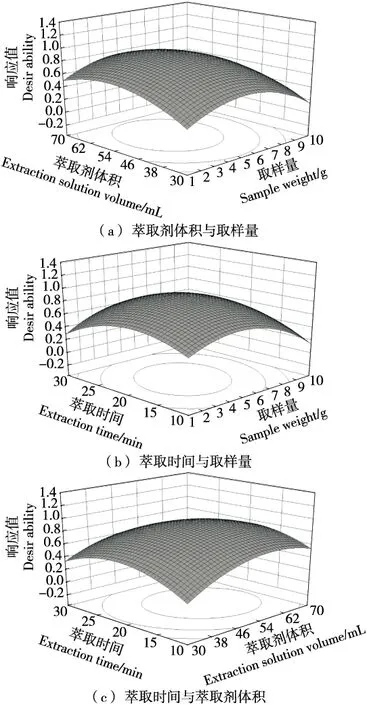
圖3 各因素交互作用的響應曲面圖
2.1.3 Selection of elution system The mixture of methanol and dichloromethane was used as the eluent.The proportion of methanol in the elution solvent is a key factor affecting the extraction efficiency since it could modify the polarity of the elution solvent and influence the interaction between the adsorbent and target analytes.Different ratios of methanol and dichloromethane(methanol∶dichloromethane = 1∶9, 1∶14, 1∶19, 1∶24,V/V)as eluent.As shown in Figure 5, the recoveries of all target pesticides did not show a significant difference by using the four kinds of eluent with different polarity.Therefore, the best recoveries were obtained when methanol-dichloromethane(1∶19,V/V)was used as eluent in this study.
2.2 Matrix effects
The matrix effect(ME)(enhancement or suppression of the signal is due to the competition for the charges during Coulomb explosion between the target analytes and the co-extractives)have been widely studied in quantitative analysis of the sample.When the ME values were 0%, represents no matrix effect.ME values(suppression/enhancement 0%~20%)were considered to be a soft matrix effect, and the values(suppression/enhancement 20%~50%)were considered to be a medium matrix effect.ME values(suppression/enhancement >50%)represents a strong matrix effect.As shown in Figure 6, the matrix effect of the present method for 13 kinds of pesticides was soft, and 5 kinds of pesticides were medium while only one pesticide(op’-DDT)was presented strong matrix effect.Therefore, the matrix-matched calibrations curves were required for quantification purposes.

圖4 固相萃取柱對蘋果梨中19種農藥回收率的影響

圖5 洗脫劑對蘋果梨中19種農藥回收率的影響
2.3 Method validation
Matrix matched calibration curves were prepared using matrix-matched calibration solutions in seven points.The results were listed in Table 5.Favorable linearity of pesticides in the studied range was obtained with correlation coefficients higher than 0.996 7.The obtained LODs and LOQs were also listed in Table 5.The results indicated that the method has excellent sensitivity.To confirm that the method was suitable for application, the recovery experiments were carried out at low, medium, and high spiked levels, 20, 40, 200 μg/kg, in blank sam-ple made from apple-pear(Table 5).The spiked recoveries ranged from 86.1% to 108.9% with RSD values lower than 10% for each pesticide.The values were in agreement with the values suggested by SANCO/12571/2013.All the results indicated that the optimized method was reliable.

圖6 19種農藥在蘋果梨中的基質效應

表5 19種農藥的加標回收率、相對標準偏差、檢出限、定量限、線性方程、線性范圍及相關系數
2.4 Real samples
The verified method was applied to simultaneous determination of nineteen organochlorine pesticide residues in six commercial samples of apple-pear purchased from local market in Yanji.No residue of studied pesticides found in all sample.
3 Conclusion
In this study, a simple and reliable method for the analysis of multiple organochlorine pesticides in apple-pear samples was developed.Factors affecting the SPE procedure,including types of extraction solvent, sample weight, the volume of extraction solvent, extraction time, SPE clean-up and eluent were optimized using a fractional factorial experimental design.A validation procedure was performed, obtaining good results in terms of linearity, sensitivity, precision, and accuracy.During the application of the method to apple-pear samples, no residue of studied pesticides detected.Besides, future work may validate the SPE extraction method followed by GC/MS simultaneous determination for organ phospho-rous and nitrogen pesticides.